Brushless DC Motor Market Size, Share & Industry Analysis, By Type (Inner-Rotor and Outer-Rotor), By Speed (Below 5,000 RPM, 5,000–10,000 RPM, and Above 10,000 RPM), By End-Use (Automotive, Consumer Electronics, Manufacturing, and Others), and Regional Forecast, 2026-2034
 Download Free Sample
KEY MARKET INSIGHTS
 Listen to Audio Version
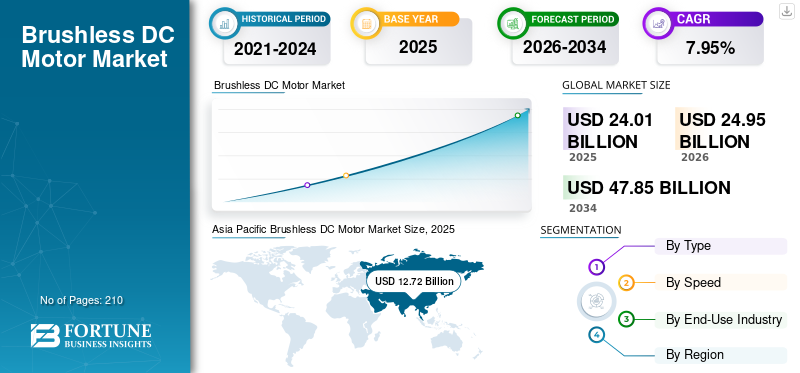
The global brushless DC motor market size was valued at USD 24.01 billion in 2025 and is expected to reach USD 24.95 billion in 2026. Furthermore, the market is projected to reach USD 47.85 billion by 2034, exhibiting a CAGR of 7.95% during the forecast period of 2026-2034. Asia Pacific dominated the global brushless DC motor market with a share of 52.97% in 2025. Moreover, the Asia Pacific region holds the largest market share in terms of revenue, driven by massive industrialization, rapid EV adoption (especially in China & India), and rising demand for energy-efficient consumer electronics.
- According to the Government of India, Global automobile production hit around 94 million units in 2023. The worldwide automotive components sector reached a value of USD 2 trillion, with exports totaling roughly USD 700 billion. India rose to become the fourth-largest vehicle producer globally, behind China, the U.S., and Japan, achieving nearly 6 million units annually. Such developments are expected to boost market growth.
A brushless DC (BLDC) motor is an electric motor that utilizes a permanent magnet rotor and a stationary winding stator, relying on an external electronic controller for commutation rather than mechanical brushes. This design eliminates friction and wear, offering superior efficiency, longer life, and precise control. The demand for BLDC motors is driven by their performance advantages over brushed DC and AC induction motors, as well as broader technological and environmental trends.
Nidec Corporation is considered as the market leader in the development and production of brushless DC (BLDC) motors. The company holds the top position in the global market and is known for its technical capabilities, high efficiency motors, and vast product portfolio. Other key leaders include Johnson Electric Holdings, Maxon Motor AG, AMETEK, Inc. and others.
Download Free sample to learn more about this report.
Brushless DC Motor Market KEY TAKEAWAYS
 Market Size & Forecast
- 2025 Market Size: USD 24.01 billion
- 2026 Market Size: USD 24.95 billion
- 2034 Forecast Market Size: USD 47.85 billion
- CAGR: 7.95% from 2026–2034
 Market Share
- Asia Pacific dominated the brushless DC motor market with a 52.97% share in 2025.
- The inner-rotor segment held the largest market share of 68.60% in 2025.
- The manufacturing segment accounted for a 34.74% share of the market in 2025.
 Key Regional Highlights
Asia Pacific
Asia Pacific emerged as the largest regional market, valued at USD 12.72 billion in 2025, supported by strong industrial automation and electronics manufacturing activities.
North America
North America was valued at USD 4.36 billion in 2025 and continues to benefit from increasing adoption of energy-efficient motor technologies across industries.
Europe
Europe accounted for the third-largest market share, reaching a valuation of USD 5.82 billion in 2025, driven by advancements in industrial and automotive applications.
U.S.
U.S. The market was valued at USD 3.49 billion in 2025, supported by rising demand for high-performance motors in manufacturing, HVAC systems, and electric vehicles.
Japan
Japan The market was estimated at USD 1.90 billion in 2025, driven by the country’s strong robotics, automation, and consumer electronics industries.
Read More

BRUSHLESS DC MOTOR MARKET TRENDS
Shift Toward Inner-Rotor and Higher-Speed Designs Shaping Market Trends
Manufacturers are increasingly adopting inner-rotor configurations and higher-speed designs in BLDC motors to boost power density and efficiency. These architectures deliver compact footprints with superior torque delivery, making them ideal for electric vehicles, drones, and industrial robots that demand rapid acceleration. Advanced rotor dynamics minimize inertia for quicker response times, while optimized laminations and magnets enhance speed capabilities without sacrificing reliability.
- In September 2024, ElectroCraft launched the EZ Drive speed controller for brushless DC motors, offering simplified trapezoidal commutation across 12-48VDC and 6-24A continuous ratings. Compatible with hall sensors or encoders, it enables precise speed control for diverse applications through plug-and-play setup, reducing complexity in medical, industrial, and automation systems.
Integration with high-frequency inverters enables precise control in aerospace propulsion and high-performance pumps. This evolution supports lighter weight solutions in eVTOLs and appliances, driving material innovations such as grain-oriented silicon steel. Customization surges as OEMs tailor motors for specific RPM envelopes, accelerating adoption in premium automation and mobility segments.
MARKET DYNAMICS
MARKET DRIVERS
Rising Electrification Across Automotive and Industrial Systems to Drive Market Growth
The surge in electrification transforms automotive powertrains, appliances, and industrial machinery, propelling demand for BLDC motors. These efficient, high-torque motors excel in electric vehicles, HVAC systems, drones, and robotics, delivering superior performance over traditional brushed alternatives. Their compact design, low maintenance, and precise speed control align perfectly with hybrid and fully electric architectures.
- In October 2025, OMRON inaugurated its Bengaluru Automation Center on October 8, 2025, to advance India's manufacturing through Industry 4.0 solutions. Part of a global network of 10 centers, it supports MSMEs with PoC development, training, and automation demos for packaging, automotive, and more.
As manufacturers prioritize energy efficiency and reduced emissions, BLDC motors enable seamless integration into smart grids and renewable-powered applications. This shift accelerates adoption across consumer electronics, aerospace, and automation, driving innovation in compact and reliable propulsion solutions. This fuels brushless DC motor market growth.
Growth in Industrial Automation and Robotics to Boost Market Expansion
The rapid rise of industrial automation and robotics reshapes manufacturing landscapes, fueling demand for the product. These motors deliver exceptional precision, high torque, and reliability, which are essential for robotic arms, conveyor systems, and automated guided vehicles. Their maintenance-free operation, compact size, and superior efficiency outperform brushed motors in high-speed, continuous-duty applications.
As factories embrace Industry 4.0 with smart sensors and AI-driven controls, brushless DC motors enable seamless integration into cobots, CNC machines, and warehouse automation. This evolution supports leaner production, faster throughput, and enhanced safety, accelerating adoption across automotive assembly, electronics fabrication, and logistics sectors.
MARKET RESTRAINTS
Dependence on Rare-Earth Magnets to Hinder Market Growth
A heavy reliance on rare-earth magnets, such as neodymium and dysprosium, poses significant challenges for BLDC motor production. These critical materials, essential for high-performance permanent magnet designs, face supply chain vulnerabilities from geopolitical tensions, export restrictions, and concentrated mining in select regions. Price volatility disrupts manufacturing costs, while environmental concerns over extraction and processing intensify regulatory scrutiny.
Alternative magnet technologies struggle to match the efficiency, power density, and compactness that drive the adoption of brushless motors in electric vehicles, drones, and automation. This dependency hampers scalability, delays innovation in cost-sensitive applications, and exposes the market to raw material shortages and trade barriers.
MARKET OPPORTUNITIES
High-Speed and High-Efficiency Motor Applications Creating Market Opportunities
Advancements in high-speed and high-efficiency applications unlock vast opportunities for brushless DC motors across emerging sectors. Their superior power density, minimal heat generation, and precise control excel in electric propulsion for drones, eVTOL aircraft, and high-performance EVs, enabling faster acceleration and extended range.
In renewable energy, they optimize wind turbine yaw systems and solar trackers for maximum output. Industrial fans, pumps, and compressors benefit from reduced energy loss and quieter operation, supporting green manufacturing. Medical devices, such as ventilators and surgical robots, demand their reliability and compactness. As sustainability drives demand for premium efficiency, brushless motors capture premium segments in aerospace, defense, and next-gen appliances.
MARKET CHALLENGES
Shift Toward Inner-Rotor and Higher-Speed Designs to Creates Challenges for Market Growth
The shift toward inner rotor and higher speed designs creates notable challenges for the market. These architectures demand advanced magnetic materials, precision bearings, and sophisticated cooling systems to manage higher rotational stresses and thermal loads. Manufacturers must invest in upgraded design tools, testing infrastructure, and tighter production tolerances, which can increase development and unit costs.
Vibration, acoustic noise, and reliability risks intensify at elevated speeds, complicating integration into compact systems. End users require advanced drives and control algorithms to fully leverage performance, thereby increasing system complexity. Smaller suppliers struggle to keep pace with the rapid design cycles, which limits competition and slows standardization across demanding applications.
Download Free sample to learn more about this report.
IMPACT OF TARIFFS
Tariffs significantly impact the brushless DC motor market by raising costs for key components (magnets, steel, copper), forcing supply chain shifts toward nearshoring/diversification, influencing R&D toward alternative materials, increasing final product prices for consumers, and spurring investment in localized manufacturing to build tariff-resilient operations, especially impacting Asian-sourced parts and creating strategic realignments.
Higher duties on raw materials (rare earths, steel, aluminum) and sub-assemblies (stators, rotors) directly increase production costs, leading to higher motor prices for manufacturers and end-users. Companies are reducing reliance on single-source regions (China) by nearshoring production, diversifying suppliers, and investing in domestic processing of magnets and materials.
SEGMENTATION ANALYSIS
By Type
Demand for High-Speed, Compact, and Fast-Accelerating Motor Designs Drives Inner-Rotor Segment Growth
By type, the market is segmented into inner-rotor and outer-rotor.
Inner-Rotor dominated the market in 2025, with a market share of 68.60%. Inner-rotor designs surge in demand for applications requiring high rotational speeds, rapid acceleration, and compact axial lengths, such as electric vehicle drivetrains, drones, and precision industrial robots.
Meanwhile, outer-rotor architectures experience significant expansion in direct-drive systems, such as e-bikes, HVAC fans, and conveyor drives, motors offering higher torque density, simplified gearboxes, and quieter operation through larger diameters. This dual evolution caters to diverse electrification needs across automotive, automation, and consumer appliances.
By Speed
Below 5,000 RPM Segment Dominated due to Demand for Quiet, Energy-Efficient, Reliable Motors Across Applications
By speed, the market is segmented into below 5,000 RPM, 5,000–10,000 RPM, and above 10,000 RPM.
Below 5,000 RPM segment dominated the market in 2025 with a market share of 41.01%, as manufacturers prioritize quiet, demand for energy efficient operation in appliances, HVAC systems, medical devices, and general industrial machinery. These low to medium speed motors offer smooth torque, precise control, and long service life, aligning with energy efficiency standards and reliability needs.
At the same time, motors operating above 10,000 RPM are experiencing significant growth with CAGR of 9.21% during the forecast period, due to high speed applications, including compressors, spindles, turbo blowers, drones, and automotive subsystems. Their high power density and compact size enable lightweight, space saving designs. Together, these segments reflect a widening performance spectrum as OEMs tailor motor speeds to specialized application profiles.
By End-Use Industry
To know how our report can help streamline your business, Speak to Analyst
Manufacturing Segment Dominates Due to Extensive Use in Automation, CNC Systems, and Robotics
By end-use industry, the market is segmented into automotive, consumer electronics, manufacturing, and others.
The manufacturing segment accounted for the largest brushless DC motor market share of 34.74% in 2025. The market witnesses robust demand growth from manufacturing applications, where motors power automated assembly lines, CNC machines, conveyor systems, and robotic arms requiring precise speed control and durability. Their efficient reliable and low maintenance reduces downtime and supports Industry 4.0 integration with smart sensors and IoT connectivity.
- In November 2024, Toshiba began sampling its TB9084FTG automotive MOSFET gate driver IC for three phase BLDC motors. The device integrates a six channel gate driver, reverse polarity protection output, current sense amplifier, SPI, and emergency stop with multiple protections in a compact AEC Q100 Grade zero qualified 6mm QFN package, supporting safer, miniaturized BLDC motor control in vehicles.
The automotive sector experiences significant expansion with a CAGR of 9.02% over the forecast period, driven by electric vehicles, hybrid powertrains, pumps, fans, and active suspension systems. High-efficiency designs enable extended range, quieter cabins, and advanced driver assistance features. This dual momentum underscores brushless motors' versatility across high-volume production and electrified mobility demands.
BRUSHLESS DC MOTOR MARKET REGIONAL OUTLOOK
By geography, the market is categorized into North America, Europe, Asia Pacific, Latin America, and the Middle East & Africa.
Asia Pacific
Asia Pacific Brushless DC Motor Market Size, 2025 (USD Billion) To get more information on the regional analysis of this market, Download Free sample
The Asia Pacific brushless DC motor market emerged as the largest market with a valuation of USD 12.72 billion in 2025. Asia Pacific is witnessing strong growth in the market, through rapid industrialization, EV adoption, and automation surges in China, Japan, and India. Manufacturing hubs drive demand in the automotive, consumer electronics, and HVAC sectors, fueled by energy efficiency mandates and the growth of robotics. For instance, in August 2021, Johnson Electric launched the ECI-040 brushless DC motor platform. The Hong Kong-based supplier's new BLDC motors deliver superior reliability, higher efficiency, and lower noise levels, targeting automotive and diverse motion control applications through advanced electronic commutation technology. Hence, local production advantages and government incentives for electrification accelerate expansion across inner-rotor and high-speed designs.
China Brushless DC Market
The China brushless DC motor market was valued at USD 5.972 billion, representing roughly 24.88% of the global market, driven by its booming consumer electronics, rapid industrialization, and government push for energy efficiency, with low labor costs enhancing its manufacturing advantage, making it a key production hub for applications from electric vehicles to robotics and smart home appliances.
Japan Brushless DC Motor Market
The Japan brushless DC motor market in 2025 was estimated to be around USD 1.90 billion, representing roughly 7.92% of the global market, driven by Japan's strong manufacturing infrastructure boosts BLDC use in automated machinery.
India Brushless DC Motor Market
The India brushless DC motor market revenue was valued at USD 1.65 billion in 2025, representing roughly 6.88% of the global market, driven by high demand from e-rickshaws, e-bikes, and compact EVs, boosted by government push
North America
The North America brushless DC motor industry was valued at USD 4.36 billion in 2025 and is estimated to reach USD 13.74 billion in 2026, driven by strong EV adoption, aerospace innovation, and industrial automation in the U.S. and Canada. Premium efficiency demands fuel growth in drones, robotics, and HVAC systems.
U.S. brushless DC Motor Market
The U.S. market was valued at USD 3.49 billion in 2025 with global market share of 14.55%. The market is driven by demand for energy efficiency in EVs, automation, and consumer goods, with significant growth fueled by government regulations and tech advancements, making North America a leading region with strong automotive/industrial presence and aerospace/defense demands.
Europe
The Europe brushless DC motor market was expected to account for the third-largest share with a valuation of USD 5.82 billion in 2025. Europe advances the market via stringent efficiency regulations, EV mandates, and renewable integration across Germany, France, and the U.K. Aerospace, automation, and green appliances drive premium adoption.
Germany Brushless DC Motor Market
The Germany brushless DC motor market in 2025 is estimated to be around USD 1.32 billion, representing roughly 5.52% of the global market, driven by its leading automotive sector (EVs) and strong industrial automation.
Latin America
The Latin America market was valued at USD 0.87 billion in 2025. The region grows the market through rising EV adoption, industrial modernization, and renewable projects in Brazil and Mexico. Cost-sensitive automation and HVAC upgrades fuel steady expansion.
Brazil Brushless DC Motor Market
Brazil's brushless DC motor market was projected to be around USD 0.41 billion in 2025, representing roughly 1.72% of the global Brushless DC Motor market.
Middle East & Africa
The Middle East & Africa market was valued at USD 0.77 billion in 2025. The region expands the market via oil-to-renewables diversification, smart city projects, and industrial upgrades in UAE, Saudi Arabia, and South Africa. HVAC, pumps, and automation drive emerging adoption.
GCC Brushless DC Motor Market
GCC brushless DC motor market is projected to be around USD 0.17 Billion in 2025, representing roughly 0.73%of the global Brushless DC Motor market.
COMPETITIVE LANDSCAPE
KEY INDUSTRY PLAYERS
Key Players Focused on Product Launches to Increase Market Share in the Future
The competitive landscape is fragmented, with key players including Nidec Corporation, Johnson Electric Holdings, Maxon Motor AG, AMETEK, Inc., and others. In June 2025, Qorvo launched the ACT72350, a highly integrated 160V 3-phase BLDC motor driver. Replacing up to 40 discrete components, it features a configurable analog front end, internal DC-DC buck converter, and LDOs, reducing solution size, design time, and BOM costs for automotive, industrial, EV, and battery-powered tools. Such developments are expected to foster market growth over the forecast period.
List of Key Brushless DC Motor Companies Profiled
- Nidec Corporation (Japan)
- Johnson Electric Holdings (Hong Kong)
- Maxon Motor AG (Switzerland)
- AMETEK, Inc. (U.S.)
- Oriental Motor Co., Ltd. (Japan)
- Allied Motion Technologies (U.S.)
- Kollmorgen (U.S.)
- Portescap (U.S.)
- SONTIAN Motor (China)
- Toshiba Corporation (Japan)
- Siemens AG (Germany)
- ABB Group (Switzerland)
- Bosch Group (Germany)
- Faulhaber Group (Germany)
- Mabuchi Motor (Japan)
KEY INDUSTRY DEVELOPMENTS
- In December 2025, MikroE introduced the compact BLDC FOC 2 Click board for precise three phase brushless DC motor control in robotics and industrial automation. It uses Allegro’s A89307 controller with field oriented control, supports multiple operating modes, low noise, rich protection features, and mikroBUS compatibility for easy integration and rapid prototyping.
- In September 2025, Dunkermotoren integrated functional safety directly into its BG series brushless DC motors, adding functions, such as safe torque off and safe speed monitoring. This enables compliance with key safety standards, simplifies machine design, and reduces external safety hardware, targeting robotics, intralogistics, and other safety-critical automation applications.
- In December 2024, Oriental Motor launched the BLS Series brushless DC motors with a 24 VDC universal driver. This lineup offers superior efficiency, compact size, extended life, and precise feedback control over traditional AC motors with inverters. Ideal for system upgrades, it features a comprehensive motor range from 30W to 400W, parallel shaft gearing, and simple speed regulation via potentiometer or external signals.
- In October 2024, Toshiba launched engineering samples of TB9084FTG gate driver IC on October 31, 2024, for three-phase brushless DC motors in automotive applications, such as body systems, electric pumps, and motor generators.
- In April 2021, Johnson Electric launched the ECI-048 BLDC motor platform, featuring high power density, compact Ø48mm size, and sensorless control for superior reliability. Designed with advanced topologies, it targets applications including blowers, hedge trimmers, and power tools, delivering long life, stable torque, and customizable performance through rigorous testing.
REPORT COVERAGE
The brushless DC motor market report delivers a detailed insight into the market. It focuses on key aspects, such as leading companies in the market. Additionally, the report provides regional insights and global market trends, as well as pressure ranges, and highlights key industry developments. In addition to the factors mentioned above, the report encompasses several other factors and challenges that contributed to the market's growth in recent years.
Request for Customization to gain extensive market insights.
Report Scope & Segmentation
|
ATTRIBUTE |
DETAILS |
|
Study Period |
2021-2034 |
|
Base Year |
2025 |
|
Estimated Year |
2026 |
|
Forecast Period |
2026-2034 |
|
Historical Period |
2021-2024 |
|
Growth Rate |
CAGR of 7.95% from 2026 to 2034 |
|
Unit |
Value (USD Billion) |
|
Segmentation |
By Type · Inner-Rotor · Outer-Rotor |
|
By Speed · Below 5,000 RPM · 5,000–10,000 RPM · Above 10,000 RPM |
|
|
By End-Use Industry · Automotive · Consumer Electronics · Manufacturing · Others |
|
|
By Region
|
Frequently Asked Questions
According to Fortune Business Insights, the global market value stood at USD 24.01 billion in 2025 and is projected to reach USD 47.85 billion by 2034.
In 2025, the market value stood at USD 12.72 billion.
The market is expected to exhibit a CAGR of 7.95% during the forecast period of 2026-2034.
By end-use industry, the manufacturing segment led the market in 2025.
Rising electrification across automotive and industrial systems are the key factors driving the market.
Some of the top players in the market include Nidec Corporation, Johnson Electric Holdings, Maxon Motor AG, AMETEK, Inc., Oriental Motor Co., Ltd., Allied Motion Technologies, and other are the major players in the global market.
Asia Pacific dominated the market in 2025 with the largest share.


- 2021-2034
- 2025
- 2021-2024
- 210
Get 30-60 hrs Free Customization
Expand Regional and Country Coverage, Segments Analysis, Company Profiles, Competitive Benchmarking, and End-user Insights.


















Related Reports
-
US +1 833 909 2966 ( Toll Free )
-
Get In Touch With Us