Financial Crime Compliance Market Size, Share & Industry Analysis, By Solution Type (Transaction Monitoring, CDD/KYC Systems, Anti-Money Laundering, Fraud Detection & Prevention, and Others), By End Use Industry (BFSI, Government, Real Estate, Healthcare, and Others), and Regional Forecast, 2026-2034
 Download Free Sample
KEY MARKET INSIGHTS
 Listen to Audio Version
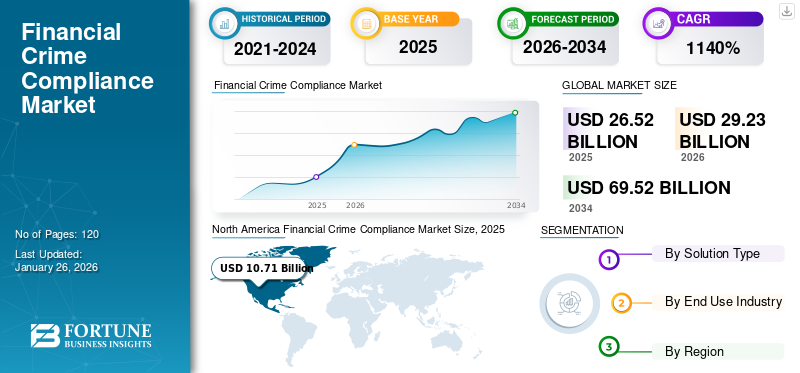
The global financial crime compliance market size was valued at USD 26.52 billion in 2025. The market is projected to grow from USD 29.23 billion in 2026 to USD 69.52 billion by 2034, exhibiting a CAGR of 11.40% during the forecast period. North America dominated the financial crime compliance market with a market share of 40.40% in 2025.
The Financial Crime Compliance (FCC) is constantly evolving with a wide array of solutions designed to combat illicit financial activities, including money laundering, fraud, and terrorist financing. While FCC solutions span various verticals, the market is primarily anchored in banking, financial services and insurance (BFSI), government, real estate, healthcare, and other sectors. Financial crime compliance solutions are typically essential for organizations striving to build compliance frameworks within increasingly complex regulatory environments, especially amid the growing threat of cybercrimes. FCC solutions are intended to leverage emerging technologies, such as artificial intelligence (AI), machine learning (ML), and blockchain technology to meet these technologies. These technologies enhance real-time detection, streamline compliance processes, and ensure adherence to stringent global regulations. Additionally, the market is expected to experience significant growth as the nature of digital transactions increases, the regulatory landscapes evolve, and financial crime becomes more sophisticated. AI and ML will play a crucial role in approving the accuracy of suspicious activity detection, thereby reducing false positives and improving overall efficiency.
Download Free sample to learn more about this report.
Leading market competitors are established tech vendors and specialized compliance firms offering innovative solutions for diverse industry needs. NICE Actimize, FICO, SAS, LexisNexis Bridger, and Accenture are market leaders, providing robust platforms for transaction monitoring, fraud detection, and KYC compliance. Their competitive edge lies in AI-powered analytics, expanding cloud services, and meeting regional regulatory demands, positioning them for continued success in this dynamic market.
Download Free sample to learn more about this report.
Financial Crime Compliance Market Key Takeaways
 Global Market Size & Forecast
- 2025 Market Size: USD 26.52 billion
- 2026 Market Size: USD 29.23 billion
- 2034 Forecast Market Size: USD 69.52 billion
- CAGR: 11.40% from 2026–2034
 Market Share
- North America dominated the financial crime compliance market with a 40.40% share in 2025.
- The transaction monitoring segment is anticipated to hold a 35.24% share in 2026.
- The BFSI segment is expected to contribute 35.96% of the global market in 2026.
 Key Regional Highlights
North America
North America led the global market with USD 10.71 billion in revenue in 2025 and is projected to reach USD 11.92 billion in 2026.
Europe
Europe accounted for 24.30% of the global market and generated USD 6.45 billion in revenue in 2025.
Asia Pacific
Asia Pacific contributed USD 5.76 billion in revenue in 2025 and is expected to witness strong growth.
U.S.
The financial crime compliance market is projected to reach USD 9.39 billion by 2026.
Japan
The financial crime compliance market is projected to reach USD 2.42 billion by 2026.
Read More

MARKET DYNAMICS
Financial Crime Compliance Market Trend
Rising Digital Transactions and Regulatory Evolution Shape Market Trends
The rapid growth of digital transactions driven by increased mobile banking offerings, fintech apps, and cryptocurrencies, is reshaping the market. The uptick in digital financial transactions in spaces such as BFSI and e-commerce is creating a heightened demand for advanced compliance solutions that rely heavily on AI and ML for real-time transaction monitoring, and fraud detection. This technology allows financial organizations to detect suspicious anomalies with better accuracy while adhering to evolving global financial crime compliance standards. Ultimately, the market is shifting toward automation, scalability, and operational efficiency, all aimed at mitigating compliance risk across industries.
This transaction is being accelerated by regulatory developments such as the EU's 6th Anti-Money Laundering Directive (6AMLD) and the adoption of next-generation KYC standards. As these frameworks become more sophisticated, the demand for sophisticated, future-ready compliance tools are increasing. Like other tools, organizations are shifting toward blockchain-based solutions for secure and transparent CDD and KYC process workflows. This is fundamentally changing the FCC market by enabling innovation in compliance workflows, particularly in tightly regulated markets. It also presents an opportunity for vendors to develop integrated platforms that can support the processing of several industries' customer transactions within a single compliance solution.
Market Driver
Escalating Cyber Threats and Regulatory Pressures to Propel Market Growth
The evolving sophistication of cyber threats such as ransomware, phishing, and identity theft is a major catalyst for the market. These threats are prompting organizations across major sectors to adopt advanced compliance solutions. The increasing adoption of digital payment platforms has further amplified vulnerabilities, leading to an upsurge in demand for AI-based fraud detection and prevention systems that can analyze large amounts of data in real time. As a result, businesses are prioritizing cybersecurity spending to protect customer data and build trust, fueling the growth of the market in both established and emerging markets.
The imposition of stricter regulations such as the USA PATRIOT Act, FATF recommendations, and additional regional AML regulations are forcing organizations to adopt comprehensive compliance tools such as AML and CDD/KYC systems. Regulatory pressure, especially in highly regulated sectors such as BFSI or government, is driving firms to allocate considerable resources to ensure compliance and avoid penalties and reputation damage. Firms are actively looking for innovative and advanced technologies to comply with regulations governing complex compliance environments and evolving global compliance standards.
Market Restraint
High Implementation Costs and Skill Shortages Hinder Market Expansion
The high cost of implementing and maintaining financial crime compliance solutions, particularly those utilizing AI, ML, and cloud technologies, remains a major obstacle to adoption. This challenge is especially pronounced for smaller organizations and those in developing regions, where access to technical capital is limited. Costs including software license fees, integration, and ongoing maintenance can be prohibitive, particularly in budget-constrained sectors such as healthcare and real estate. Consequently, adoption rates are slower in emerging markets in regions, notably in parts of South America and the Middle East and Africa, which have the least developed financial resources and infrastructure, hampering market growth in general.
Another impediment to market development is the lack of skilled people for FCC technologies, including AI, blockchain, or data analytics. This skill gap is most acute in less mature markets, making it difficult for organizations to use financial crime compliance solutions and realize a return on investment. As a result, firms struggle to implement compliance efficiencies, contributing to sluggish market growth in areas lacking technical expertise. This, in turn, delays the time to market for vendors, who are also struggling to scale their solutions globally.
Market Opportunity
Technological Advancements to Unlock Several Growth Opportunities
Technological advancements in AI, machine learning, and cloud solutions are driving financial crime compliance market growth. These technologies enable scalable, cost-effective, and customized solutions that address a wide range of industry needs. They also offer vendors an easier, more flexible way to deliver solutions in transaction monitoring, fraud, and KYC compliance. New and smaller organizations, however, may bypass key elements when implementing regulatory compliance frameworks. At the same time, reasonable regulations are expanding in key sectors such as BFSI, healthcare, and real estate in regions undergoing digital transformation. In these areas, innovation is encouraged, and compliance solutions are rapidly gaining traction.
The speed and direction of digitalization in developing nations, particularly across the Asia Pacific and parts of Africa, present even larger growth opportunities for financial crime compliance. These regions are adopting digital payment methods while strengthening regulatory environments to combat financial crime. As digital payment adoption rises and enforcement of regulatory standards intensifies, so too will the demand for robust compliance solutions. In these markets, there are significant opportunities for new or existing vendors to bring their sophisticated tools that enhance compliance, AI-based monitoring tools, or KYC compliance solutions based on blockchain technology. This provides long-term growth potential for compliance technologies within increasingly logistic-friendly ecosystems.
SEGMENTATION Analysis
By Solution Type
Transaction Monitoring Segment Leads due to Ability to Detect Suspicious Activities Across Digital Transactions
By solution type, the market is segmented into transaction monitoring, CDD/KYC systems, anti-money laundering, fraud detection & prevention, and others.
The Transaction monitoring segment is anticipated to hold a dominant market share of 35.24% in 2026 due to its critical role in real-time detection of suspicious activities across digital transactions, such as mobile banking and cryptocurrencies.
Fraud detection & prevention exhibits the highest growth rate, leveraging AI and machine learning to combat sophisticated cybercrimes, including phishing and identity theft. This growth is fueled by the rapid adoption of digital payment platforms in BFSI and e-commerce. The integration of AI-driven analytics in both fraud detection & prevention and transaction monitoring improves the accuracy of identifying financial crimes, solidifying their market prominence.
Customer Due Diligence (CDD)/Know Your Customer (KYC) systems are becoming increasingly vital for secure customer onboarding. These systems are utilizing technologies such as blockchain to improve transparency and meet stringent regulations such as the EU’s 6th Anti-Money Laundering Directive (6AMLD).
Anti-Money Laundering (AML) solutions, often integrated with transaction monitoring are vital for ensuring compliance with global standards such as FATF recommendations. They remain essential in high-risk jurisdictions to address money laundering and terrorism financing.
The others category, including case management and sanctions screening, experience slower growth due to its niche applications.
By End Use Industry
To know how our report can help streamline your business, Speak to Analyst
BFSI Dominates the Market due to Heightened Exposure To Cyber Risks
By end use industry, the market is segmented into BFSI, government, real estate, healthcare, and others.
BFSI leads in both market share and growth rate due to its central role in financial transactions and high exposure to cyber risks, expected to contributing 35.96% globally in 2026. This necessitates robust solutions such as transaction monitoring and fraud detection. Rapid digitalization and increasing regulatory pressures across industries further fuel financial crime compliance adoption, with BFSI at the forefront, investing heavily in AI-driven compliance tools to counter fraud in digital banking and fintech platforms.
The government sector adopts financial crime compliance tools primarily to enforce AML regulations and combat terrorism financing, particularly in high-risk regions where sanctions screening is critical.
Real estate increasingly relies on CDD/KYC and AML solutions to address property-related fraud and comply with transparency mandates.
In healthcare, fraud detection solutions are critical to protect sensitive patient data amid rising cyber threats and regulations such as GDPR.
The others category, including retail and telecom, is adopting compliance tools for digital transactions. However, the urgency remains lower due to comparatively less regulatory scrutiny compared to BFSI and the government entities.
FINANCIAL CRIME COMPLIANCE MARKET REGIONAL OUTLOOK
The market covers five major regions, mainly North America, Europe, Asia Pacific, South America, and the Middle East and Africa.
North America
North America Financial Crime Compliance Market Size, 2025 (USD Billion)
To get more information on the regional analysis of this market, Download Free sample
The North America region captured 40.40% of the global market in 2025, generating USD 10.71 billion in revenue, and is projected to reach USD 11.92 billion in 2026. North America holds the largest share of the market owing to stringent regulations such as the USA PATRIOT Act and the widespread adoption of advanced technologies such as AI and machine learning for transaction monitoring and fraud detection. The region's robust financial infrastructure, especially in the Banking, Financial Services, and Insurance (BFSI), creates a demand for robust transaction monitoring and fraud detection systems to protect businesses and consumers from cyber effects such as phishing, ransomware, and hack attacks. The growing adoption of cloud computing and blockchain technologies has further enhanced the region’s capability to implement varied KYC mechanisms and manage evolving compliance requirements. These innovations have placed North America at the forefront of financial crime compliance solutions (Financial Crime & Compliance) advancements across various industry verticals such as healthcare, retail, and corporate/business services. The U.S. market is projected to reach USD 9.39 billion by 2026.
The U.S. maintains a substantial financial crime compliance market share due to its mature financial ecosystem and strict regulatory policies such as FinCEN. The BFSI sector is the first to deploy AI-driven transaction monitoring and fraud detection systems to address the growing sophistication of cybercriminals. The government is focused on deploying its compliance programs toward AML and sanctions screening, particularly to counteract terrorism financing. The real estate and health sectors are deploying customer due diligence (CDD)/know your customer (KYC) and fraud prevention tools to meet transparency, privacy, and regulatory mandates such as HIPAA. The growing adoption of mobile and fintech services, including digital payments, is driving the need for real-time compliance solutions. The U.S. is leveraging blockchain technology to provide secure customer onboarding, supporting a wave of innovation in compliance technology across every sector, as it has an excellent technology infrastructure.
To know how our report can help streamline your business, Speak to Analyst
Europe
Europe maintained a strong presence in the global market, reaching USD 6.45 billion in 2025, accounting for 24.30% share, and is expected to reach USD 7.05 billion in 2026. Europe’s market is flourishing, driven by strict regulations such as the EU's 6th Anti-Money Laundering Directive (6AMLD) and GDPR. These frameworks are propelling the adoption of transaction monitoring, fraud detection, and CDD/KYC systems across the market. The BFSI and government sectors are leading in the deployment of AI and ML-powered solutions to tackle issues of money laundering and cyber threats. In contrast, the real estate sector focuses on AML compliance in property transactions. The UK market is projected to reach USD 2.16 billion by 2026, while the Germany market is projected to reach USD 2.5 billion by 2026.
In healthcare, organizations are implementing fraud prevention tools to protect digital patient health records. Blockchain-based KYC solutions are now of utmost importance, especially for enabling transparent onboarding in e-commerce, especially among more traditional businesses operating from financial hubs. The variety of regulatory frameworks has enabled the region to continue innovating with cloud-based compliance platforms, which allow organizations to meet complex standards along with addressing the increasing financial crime across other sectors such as telecom and sales.
Asia Pacific
In 2025, Asia Pacific generated USD 5.76 billion, contributing 21.70% to global market revenue, and is projected to grow to USD 6.36 billion in 2026. The market in the Asia Pacific region is experiencing rapid growth, driven by surging digital transactions through platforms such as India's UPI and China's WeChat Pay, in addition to modernization efforts in the regulatory environment. The BFSI sector is leading the way, adopting AI-driven transaction monitoring systems for fraud detection and cybercrime threats, while real estate adopts CDD/KYC systems to address property fraud. Government agencies are implementing AML/fraud detection solutions to meet global standards such as the FATF recommendations. The healthcare sector is adopting fraud prevention on digital health platforms motivated by data security. The region’s economic diversity, coupled with a strong inclination toward fintech innovations and digital commerce, continues to fuel demand for scalable financial crime compliance tools, especially in retail and e-commerce sectors. The Japan market is projected to reach USD 2.42 billion by 2026, the China market is projected to reach USD 2.85 billion by 2026, and the India market is projected to reach USD 0.35 billion by 2026.
South America
The South America market was valued at USD 1.44 billion in 2025, capturing 5.40% of global revenue, and is estimated to reach USD 1.55 billion in 2026. South America’s FCC market grows steadily, driven by rising digital payment adoption, such as Brazil’s Pix, and the tightening of AML regulations, particularly targeting drug trafficking and corruption. The financial crime compliance landscape is witnessing a gradual rise in demand for AI-powered fraud detection and real-time transaction monitoring systems, particularly within the banking and governmental sectors. While limited technological infrastructure and economic challenges in some countries hinder rapid market growth, the region is seeing a gradual shift toward automated compliance tools. Strengthened regulatory enforcement and growing e-commerce adoption are further fueling demand for financial crime compliance solutions across sectors.
Middle East and Africa
Middle East & Africa recorded a market size of USD 2.16 billion in 2025, capturing 8.20% of the global market share, and is projected to reach USD 2.35 billion in 2026. The market in the Middle East and Africa is evolving, driven by a regulatory focus on sanctions compliance and terrorism financing prevention, especially in the GCC countries. Market growth is supported by increasing investments in AI and machine learning technologies aimed at predictive analytics and anomaly detection. Governments and financial institutions are collaborating to strengthen frameworks for cross-border transaction monitoring and sanction screening. Technologies such as AI and cloud-based platforms are increasingly popular; however, skills gaps and inconsistent regulatory enforcement slow broader adoption. As digitization accelerates, especially through the rise of digital and mobile banking, the demand for advanced compliance tools will grow. Sectors such as retail, telecom, and e-commerce are gradually moving toward implementing simple KYC and fraud prevention solutions to meet emerging basic regulatory requirements, laying the groundwork for future expansion.
Competitive Landscape
KEY INDUSTRY PLAYERS
Industry Leaders Focus on Strategic Partnerships to Support Compliance Functions
The market is shaped by some prominent players, delivering innovative solutions across industries such as BFSI, government, and real estate. These solutions address a wide range of threats, including money laundering, fraud, and terrorist financing. LexisNexis Risk Solutions, NICE Actimize, FICO, SAS Institute, Fiserv, and Oracle are industry leaders with a considerable market share. These companies use artificial intelligence to enhance transaction monitoring, fraud detection, and CDD/KYC (due diligence and know your customer), ensuring alignment with evolving regulatory requirements. By integrating advanced analytics, machine learning, and blockchain, they improve operational and compliance effectiveness in a rapidly changing regulatory environment. Although each of these companies have distinct advantages- LexisNexis's global risk intelligence, NICE Actimize's real time monitoring, and FICO's fraud prevention capabilities. These organizations actively engage in strategic partnerships and acquisitions, and offer cloud-based services to support compliance functions, adaptive compliance infrastructures. Their efforts help organizations mitigate emerging regulatory risks and cybersecurity threats, making these providers essential contributions to ongoing growth.
List of Key Financial Crime Compliance Companies Profiled
- LexisNexis Risk Solutions (U.S.)
- NICE Actimize (U.S.)
- FICO (U.S.)
- SAS Institute (U.S.)
- Fiserv (U.S.)
- Oracle (U.S.)
- ACI Worldwide (U.S.)
- Equifax (U.S.)
- Experian (Ireland)
- Capgemini (France)
- IBM Corporation (U.S.)
- Fidelity National Information Services (FIS) (U.S.)
- Quantifind (U.S.)
- DataVisor (U.S.)
- Sumsub (U.K.)
- Vneuron (Tunisia)
- Mozn (Saudi Arabia)
- SAP SE (Germany)
- Pega Systems (U.S.)
KEY INDUSTRY DEVELOPMENTS
- April 2025: NICE Actimize launched the X-Sight ActOne platform, introducing agentic AI to enhance the investigation of potential financial crimes. Designed for the BFSI sector, the platform automates complex compliance workflows and integrates AI-driven insights to improve the detection of money laundering, fraud, and other financial crimes, boosting operational efficiency and regulatory compliance.
- February 2025: LexisNexis Risk Solutions, part of RELX, acquired IDVerse, an Australian AI-powered document authentication and fraud detection solutions provider, to strengthen its risk and fraud capabilities. The acquisition enables LexisNexis to integrate IDVerse's technology, which leverages deep neural networks to verify identity and detect liveness for fraud and deepfake detection for customers in the BFSI, fintech, and government sectors.
- September 2024: NICE Actimize launched the AI-powered Fraud Investigations solution in its X-Sight platform to streamline fraud detection and investigation efforts and improve the way financial institutions investigate fraud. The solution utilizes ML and advanced analytics to maximize accuracy in identifying instances of fraud, reduce false positives, and increase operational efficiency. The target market is banking, financial services, and insurance (BFSI) clients experiencing rising cyber threats and regulatory scrutiny with integrated case management and reporting capability.
- May 2023: Quantifind launched Automated Risk Discovery on the Graphyte platform. The tool enables risk screening before it becomes a threat via AI-driven risk intelligence. The no-code, web-based tool utilizes a knowledge graph to assess threats in real-time, without requiring specific entity names for screening. This significantly improves the accuracy and offers neutral and seamless integration options for financial institutions and government agencies when completing KYC, EDD, and supply chain risk screening, while also increasing efficiency by reducing complex threat detection to the manner in which Quantifind proactively screens threat data.
- March 2023: Quantifind raised USD 23 million to scale its AI-powered Graphyte platform, with investment supported by DNS Capital and others. The Graphyte platform is being implemented by 4 out of the top 10 banks, helping to transform financial crime risk management processes, such as KYC, CDD, and AML. The platform is noted for its ability to reduce false positives and increase investigative efficiencies, particularly in combating Financial Crime. The funding will also provide an opportunity for future support with international and enterprise-level market demands for continuous monitoring and risk screening, especially for supply chain risk screening.
REPORT COVERAGE
The report provides a detailed analysis of the market and focuses on key aspects such as leading companies, solution types, and leading end use industries of the services. Besides, the report offers insights into the market trends and highlights key industry developments. In addition to the factors above, the report encompasses several factors that contributed to the growth of the market in recent years.
Request for Customization to gain extensive market insights.
REPORT SCOPE & SEGMENTATION
|
ATTRIBUTE |
DETAILS |
|
Study Period |
2021-2034 |
|
Base Year |
2025 |
|
Estimated Year |
2026 |
|
Forecast Period |
2026-2034 |
|
Historical Period |
2021-2024 |
|
Growth Rate |
CAGR of 11.40% from 2026 to 2034 |
|
Unit |
Value (USD Billion) |
|
Segmentation |
By Solution Type
By End Use Industry
By Region
|
|
Companies Profiled in the Report |
LexisNexis Risk Solutions (U.S.), NICE Actimize (U.S.), FICO (U.S.), SAS Institute (U.S.), Fiserv (U.S.), Oracle (U.S.), IBM Corporation (U.S.), Experian (Ireland), ACI Worldwide (U.S.), Quantifind (U.S.) |
Frequently Asked Questions
The market is projected to reach USD 69.52 billion by 2034.
In 2025, the market was valued at USD 26.52 billion.
The market is projected to grow at a CAGR of 11.40% during the forecast period.
The transaction monitoring segment leads the market.
Escalating cyber threats and increasing regulatory pressures are key factors driving market growth.
LexisNexis Risk Solutions, NICE Actimize, FICO, SAS Institute, Fiserv, and Oracle are industry leaders are the top players in the market.
North America holds the highest market share.
By end use industry, the BFSI segment leads the market in terms of share.



- 2021-2034
- 2025
- 2021-2024
- 120
Get 30-60 hrs Free Customization
Expand Regional and Country Coverage, Segments Analysis, Company Profiles, Competitive Benchmarking, and End-user Insights.












-
US +1 833 909 2966 ( Toll Free )
-
Get In Touch With Us