Fine Art Logistics Market Size, Share & Industry Analysis, By Service Type (Transportation, Packaging & Crating, Warehousing & Storage, Installation & Handling, and Others), By Mode of Transportation (Air Freight, Road Freight, Sea Freight, and Rail Freight), By Artwork Type (Paintings, Sculptures, Antiques & Collectibles, and Others), By End User (Museums, Art Galleries, Auction Houses, and Others), and Regional Forecast, 2026-2034
 Download Free Sample
 Fine Art Logistics Market Size and Future Outlook
 Listen to Audio Version
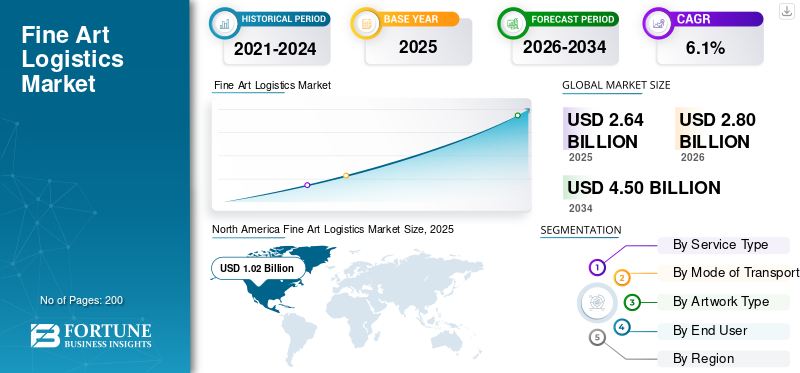
The global fine art logistics market size was valued at USD 2.64 billion in 2025. The market is projected to grow from USD 2.80 billion in 2026 to USD 4.50 billion by 2034, exhibiting a CAGR of 6.1% during the forecast period.
The market includes specialized type of transportation, storage, packaging, customs clearance, installation, and insurance services for artworks, antiques, sculptures, and collectibles. The market is growing due to rising international art exhibitions, museum exchanges, online art sales, and increasing demand from private collectors and auction houses. Strong focus on climate-controlled transport, security, and damage prevention is driving adoption of professional fine art logistics services across global markets.
Key drivers of the market include rising global art trade, increasing museum exhibitions, growing online auction sales, and higher demand from private collectors. The need for secure packaging, climate-controlled transportation, insurance, customs handling, and professional storage is further boosting demand for specialized fine art logistics services globally.
Major players in the market include DHL Group, Crown Fine Art, Gander & White, Momart, Crozier Fine Arts, and Helu-Trans Group, competing through climate-controlled transportation, secure storage, custom crating, exhibition logistics, insurance support, customs handling, and digital tracking solutions for high-value artworks and collectibles.
Download Free sample to learn more about this report.
FINE ART LOGISTICS MARKET TRENDS
Adoption of Digital Tracking and Climate-Controlled Solutions to Shape Market Trends
A key trend in the market is the increasing use of digital tracking, condition monitoring, and climate-controlled transport solutions. Artworks are highly sensitive to temperature, humidity, vibration, light exposure, and handling errors, making real-time shipment visibility more important. Logistics companies are integrating sensors, GPS systems, digital inventory tools, and condition-reporting platforms to improve transparency and reduce risk during transport and storage. Climate-controlled packaging and secure warehousing are also gaining importance as museums, auction houses, and private collectors demand higher protection standards. This trend is shifting the market from basic transportation toward technology-enabled, premium logistics services that provide greater accountability, faster communication, and improved confidence for high-value artwork movements.
MARKET DYNAMICS
MARKET DRIVERS
Download Free sample to learn more about this report.
Rising Global Art Trade and Cross-Border Exhibitions to Drive Specialized Logistics Demand
The growing movement of artworks across countries for auctions, museum exhibitions, private collections, and art fairs is a major driver for the market. High-value paintings, sculptures, antiques, and collectibles require expert handling, climate controlled transport, secure packaging, and customs documentation. Leading art markets such as the U.S., U.K., and China continue to account for a major share of global art sales, supporting steady international shipment volumes. Online art sales also remain above pre-pandemic levels, increasing demand for safe last-mile delivery and shipment tracking. As collectors, galleries, and museums expand globally, professional logistics providers are becoming essential for reducing damage, theft, delay, and compliance risks. These development drives the fine art logistics market growth.
MARKET RESTRAINTS
High Operating Costs and Insurance Requirements to Restrain Market Expansion
The market faces restraint due to the high cost of specialized infrastructure and risk management. Unlike general logistics, fine art transportation requires trained handlers, custom crating, shock-resistant packaging, temperature and humidity control, GPS tracking, secure warehouses, and specialized vehicles. These services raise operating costs and make professional logistics expensive for small galleries, independent artists, and emerging collectors. In addition, artworks often need high-value insurance coverage, detailed condition reporting, and strict security protocols, further increasing service pricing. Any damage during handling or transit can create significant financial and reputational losses. As a result, cost-sensitive customers may rely on basic courier services or limit international shipments, reducing adoption among smaller market participants.
MARKET OPPORTUNITIES
Expansion of Online Art Platforms to Create New Growth Opportunities
The expansion of online art platforms is creating strong opportunities for fine art logistics providers. Digital auctions, gallery websites, and online marketplaces have allowed collectors to purchase artworks across borders without physically visiting galleries or fairs. Online art sales were still significantly above pre-pandemic levels in 2024, showing that digital channels remain an important part of the art ecosystem. This shift creates demand for reliable packaging, authentication support, shipment visibility, insurance coordination, customs clearance, and safe delivery to private homes. Logistics providers can benefit by offering end-to-end solutions designed for e-commerce-style art transactions. Companies that integrate digital booking, real-time tracking, and flexible delivery services are well positioned to serve galleries, auction houses, and new collectors.
MARKET CHALLENGES
Complex Customs Regulations and Artwork Documentation Obstruct International Shipments
Managing cross-border documentation remains a major obstacle in the market. Artworks often require export permits, import declarations, provenance records, cultural heritage clearances, tax documents, insurance certificates, and condition reports. Regulations vary by country and may be stricter for antiques, archaeological objects, religious artifacts, endangered-material items, or culturally significant artworks. Any error in classification, valuation, or paperwork can cause shipment delays, penalties, seizure risks, or missed exhibition deadlines. This creates pressure on logistics providers to maintain strong customs expertise and local partner networks. The challenge becomes greater when artworks move through multiple jurisdictions for fairs, auctions, museum loans, or private sales, where timing and compliance are equally critical.
Segmentation Analysis
By Service Type
Extensive Cross-Border Art Movement and Exhibition Logistics to Propel Transportation Segmental Dominance
Based on service type, the market is categorized into transportation, packaging & crating, warehousing & storage, installation & handling, and others.
The transportation segment dominates the market due to the rising movement of paintings, sculptures, antiques, and collectibles across museums, galleries, auction houses, art fairs, and private collections. High-value artworks require secure, climate-controlled, and damage-free movement through air, road, sea, and rail freight. Increasing international exhibitions, cross-border art sales, and online auctions continue to support steady demand for specialized transportation services with tracking, insurance coordination, and expert handling.
The packaging & crating segment is projected to expand at a CAGR of 7.0% over the forecast period. Growing demand for customized crates, shock-resistant materials, humidity protection, and artwork-specific packaging is increasing adoption, especially for fragile, rare, and high-value pieces during domestic and international shipments.
By Mode of Transportation
High-Value Cross-Border Shipments and Time-Sensitive Deliveries to Boost Air Freight Segmental Dominance
Based on mode of transportation, the market is categorized into air freight, road freight, sea freight, and rail freight.
The air freight segment dominates the market due to its speed, security, and suitability for high-value international artwork shipments. Museums, auction houses, galleries, and private collectors prefer air freight for time-sensitive exhibitions, auctions, and cross-border transfers. It reduces transit time, lowers exposure risk, and supports controlled handling for fragile paintings, sculptures, antiques, and collectibles. Premium security, tracking, customs coordination, and insurance support further strengthen its leading position.
The rail freight segment is projected to expand at a CAGR of 8.7% over the forecast period. Growing demand for cost-efficient, lower-emission, and secure inland movement of artworks across regional routes is supporting adoption, particularly where rail networks connect major cultural hubs, museums, galleries, and storage facilities.
To know how our report can help streamline your business, Speak to Analyst
By Artwork Type
Strong Collector Demand and Frequent Exhibition Movement to Bolster Paintings Segmental Dominance
Based on artwork type, the market is categorized into paintings, sculptures, antiques & collectibles, and others.
The paintings segment dominates the market due to high global demand for framed artworks, canvases, and rare masterpieces among museums, galleries, auction houses, and private collectors. Paintings are frequently transported for exhibitions, auctions, restoration, and private sales, creating continuous demand for specialized packing and secure movement. Their sensitivity to humidity, temperature, vibration, and light exposure further increases the need for climate-controlled logistics, expert handling, and insurance-backed transportation services.
The sculptures segment is projected to expand at a CAGR of 7.2% over the forecast period. Rising demand for contemporary sculptures, public art installations, and museum displays is increasing the need for customized crating, heavy-lift handling, secure transport, and specialized installation support.
By End User
Institutional Collections and International Exhibitions to Propel Museums Segmental Dominance
Based on end user, the market is categorized into museums, art galleries, auction houses, and others.
The museums segment dominates the market due to the frequent movement of artworks for temporary exhibitions, cultural exchanges, restoration projects, and long-term collection transfers. Museums require highly specialized logistics services, including climate-controlled transportation, condition reporting, secure storage, custom packaging, and professional installation. Large public and private museums manage valuable and fragile collections, making risk mitigation essential. Their reliance on trusted logistics providers for domestic and international artwork movement supports consistent segment demand.
The art galleries segment is projected to expand at a CAGR of 6.8% over the forecast period. Rising participation in art fairs, online sales, and cross-border gallery exhibitions is increasing demand for secure packaging, transportation, storage, and last-mile delivery services for artworks sold to collectors.
Fine Art Logistics Market Regional Outlook
By geography, the market is categorized into Europe, North America, Asia Pacific, Latin America, and the Middle East & Africa.
North America
North America Fine Art Logistics Market Size, 2025 (USD Billion)
To get more information on the regional analysis of this market, Download Free sample
North America dominates the market due to strong presence of museums, auction houses, private collectors, galleries, and high-value art transactions. The U.S. leads regional demand, supported by major art hubs such as New York, Los Angeles, and Miami. Frequent exhibitions, private collection movements, and international auction shipments create steady demand for climate-controlled transport, secure storage, customs handling, and professional installation services. Strong insurance practices and mature logistics infrastructure further support regional leadership.
U.S. Fine Art Logistics Market
The U.S. market is estimated at around USD 0.96 billion in 2026, driven by strong museum networks, auction houses, private collectors, international exhibitions, and rising demand for secure, climate-controlled artwork transportation and storage.
Europe
Europe holds the second-largest fine art logistics market share and is projected to grow at a CAGR of 5.7% over the forecast period. The region benefits from a dense concentration of museums, heritage institutions, galleries, auction houses, and cultural events across the U.K., France, Germany, Italy, and Spain. Strong cross-border art movement within Europe supports demand for specialized handling, storage, and documentation services. Established art fairs, private collections, and restoration activities further strengthen the region’s role in fine art logistics.
U.K. Fine Art Logistics Market
The U.K. market is estimated at around USD 0.29 billion in 2026, supported by London’s strong auction ecosystem, art galleries, museums, private collections, and frequent cross-border movement of high-value artworks.
Germany Fine Art Logistics Market
The German market is estimated at around USD 0.14 billion in 2026, driven by established museums, cultural institutions, art fairs, and growing demand for specialized storage, packaging, and secure transportation services.
Asia Pacific
Asia Pacific is the third-largest market, driven by expanding art collection activity, rising high-net-worth individuals, and growing participation in international art fairs and auctions. China, Japan, India, South Korea, and Southeast Asian markets are witnessing increased demand for secure transportation and storage of paintings, sculptures, antiques, and collectibles. Growth in luxury investments and private galleries is also supporting logistics demand. However, market maturity varies by country, with developed art hubs leading professional service adoption.
China Fine Art Logistics Market
China’s market is estimated at around USD 0.27 billion in 2026, supported by expanding art investments, rising private collectors, auction activity, luxury assets, and increasing demand for professional artwork handling and transportation.
Japan Fine Art Logistics Market
The Japanese market is estimated at around USD 0.056 billion in 2026, driven by museum exhibitions, traditional art preservation, private collections, and demand for careful handling, climate-controlled storage, and secure artwork movement.
Middle East & Africa
The Middle East & Africa market is gradually expanding due to rising investments in museums, cultural districts, luxury collections, and international exhibitions. The UAE and Saudi Arabia are developing strong cultural infrastructure, supporting demand for fine art transport, secure storage, and exhibition logistics. Growing art events, private collectors, and government-backed cultural initiatives are encouraging professional logistics adoption. However, limited specialized service networks in some African markets may slow broader regional penetration.
UAE Fine Art Logistics Market
The UAE market is estimated at around USD 0.06 billion in 2026, supported by growing cultural districts, museums, luxury collectors, international exhibitions, and rising demand for premium art storage and transport services.
Latin America
Latin America is emerging as a developing market for fine art logistics, supported by growing gallery networks, private collectors, cultural exhibitions, and regional art fairs. Brazil and Mexico remain key contributors due to their active art communities and expanding museum activities. Demand is increasing for secure packaging, local transportation, and storage services, particularly for exhibitions and private sales. However, limited high-end logistics infrastructure and customs complexity may restrict faster growth compared to mature markets.
Brazil Fine Art Logistics Market
The Brazilian market is estimated at around USD 0.051 billion in 2026, driven by expanding galleries, cultural exhibitions, private collectors, regional art fairs, and increasing need for secure packaging, storage, and artwork transportation.
COMPETITIVE LANDSCAPE
Key Industry Players
Established Players Strengthen Market Position Through Specialized Fine Art Logistics Services
The global fine art logistics market is moderately competitive, with established players focusing on specialized transportation, climate-controlled storage, custom crating, insurance support, and secure handling services. Companies such as DHL Group, Crown Fine Art, Crozier Fine Arts, Gander & White, Momart, and Helu-Trans Group compete through global networks, museum-grade facilities, trained art handlers, and advanced tracking systems. Market participants are strengthening their service portfolios to support museums, galleries, auction houses, private collectors, and art fairs that require reliable movement of high-value and fragile artworks across domestic and international routes.
Competition is increasingly driven by service quality, risk management, geographic reach, and technology integration rather than price alone. Leading providers are investing in temperature- and humidity-controlled warehouses, digital inventory management, real-time shipment visibility, and customized packaging solutions to differentiate their offerings. Strategic partnerships with museums, galleries, insurers, and customs brokers are also helping companies expand their client base. Smaller regional players compete by offering flexible, location-specific services, while global firms maintain an advantage through cross-border expertise, compliance capabilities, and integrated end-to-end fine art logistics solutions.
LIST OF KEY FINE ART LOGISTICS COMPANIES PROFILED IN REPORT
- DHL Group (Germany)
- Crown Fine Art (Hong Kong)
- Crozier Fine Arts (U.S.)
- Gander & White Shipping (U.K.)
- Momart (U.K.)
- Helu-Trans Group (Singapore)
- Hasenkamp (Germany)
- UOVO (U.S.)
- Cadogan Tate (U.K.)
- Constantine Fine Art Logistics (U.K.)
- Masterpiece International (U.S.)
- MTAB (Sweden)
KEY INDUSTRY DEVELOPMENTS
- February 2026: Crown Fine Art partnered with MemeStrategy to safeguard high-value trading cards through institutional-grade vaulting, controlled environments, discreet logistics, and secure preservation services, expanding its collectible-focused fine art logistics offering.
- January 2026: UOVO acquired Vault Fine Art Services, expanding its Central Texas presence and strengthening its storage, logistics, and collections-management network for fine art, archives, and high-value collectibles.
- August 2025: Crozier Fine Arts partnered with the International Society of Appraisers to support members with logistics insights, storage knowledge, and transportation expertise, strengthening professional standards across appraisal and fine art logistics services.
- August 2025: Hasenkamp entered a strategic partnership with MTAB in Scandinavia, strengthening its Northern European market presence and deepening services in art, cultural goods, and specialized logistics.
- April 2025: Constantine participated in ARTIM 2025 in Mallorca, reinforcing its international fine art logistics network, strengthening partner relationships, and supporting best-practice standards for cross-border art transport, installation, and specialist handling services.
- October 2024: DHL Global Forwarding divested its Norwegian fine art logistics business to MTAB AB, transferring a premium door-to-door art logistics, storage, packaging, installation, and exhibition-handling operation to a Nordic specialist.
- August 2024: Gander & White launched a 48-foot tractor trailer for its California-New York art shuttle, adding temperature monitoring, security alarms, and high-capacity transport for galleries, museums, collectors, and large artworks.
REPORT COVERAGE
The global fine art logistics market analysis provides an in-depth study of market size and forecast by all the market segments included in the report. It includes details on the market dynamics and market trends expected to drive the market during the forecast period. It offers information on the technological advancements, new product launches, key industry developments, and details on partnerships, mergers & acquisitions. The market research report also encompasses a detailed competitive landscape, including market share and profiles of key operating players.
Request for Customization to gain extensive market insights.
Report Scope & Segmentation
| ATTRIBUTE | DETAILS |
| Study Period | 2021-2034 |
| Base Year | 2025 |
| Estimated Year | 2026 |
| Forecast Period | 2026-2034 |
| Historical Period | 2021-2024 |
| Growth Rate | CAGR of 6.1% from 2026-2034 |
| Unit | Value (USD Billion) |
| Segmentation | By Service Type, By Mode of Transportation, By Artwork Type, By End User, and By Region |
| By Service Type |
|
| By Mode of Transportation |
|
| By Artwork Type |
|
| By End User |
|
| By Region |
|
Frequently Asked Questions
Fortune Business Insights says that the global market value stood at USD 2.64 billion in 2025 and is projected to reach USD 4.50 billion by 2034.
In 2025, the North America’s market value stood at USD 1.02 billion.
The market is expected to exhibit a CAGR of 6.1% during the forecast period.
The air freight segment is leading the market by mode of transportation.
Rising global art trade and cross-border exhibitions to drive specialized logistics demand.
North America held the largest market share in 2025.



- 2021-2034
- 2025
- 2021-2024
- 200
Get 30-60 hrs Free Customization
Expand Regional and Country Coverage, Segments Analysis, Company Profiles, Competitive Benchmarking, and End-user Insights.




















Related Reports
-
US +1 833 909 2966 ( Toll Free )
-
Get In Touch With Us