Fixed Wing VTOL UAV Market Size, Share & Industry Analysis, By Platform Configuration (Tilt-Rotor, Lift + Cruise, Tail-Sitter, and Tilt-Wing), By Size Class (MTOW) (<5 kg, 5–25 kg, 25–150 kg, & >150 kg), By Propulsion System (Hybrid-Electric, Fully Electric, Hydrogen Fuel Cell, & Conventional ICE), By Range & Endurance (Short Range (<50 km / <2 hrs), Medium Range (50–200 km / 2–6 hrs), & Long Range / BVLOS (>200 km / 6+ hrs)), By Autonomy Level (Remotely Piloted, Semi-Autonomous, and Fully Autonomous), By Application (Military, Commercial, and Civil), and Regional Forecast, 2026-2034
 Download Free Sample
Fixed Wing VTOL UAV Market Size and Future Outlook
 Listen to Audio Version
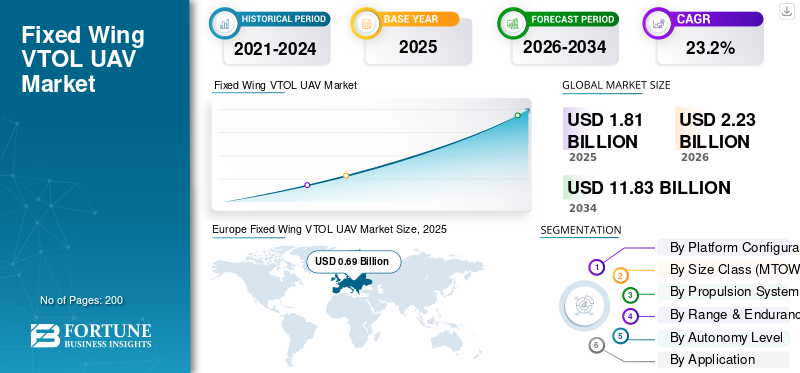
The global fixed wing VTOL UAV market size was valued at USD 1.81 billion in 2025 and is projected to grow from USD 2.23 billion in 2026 to USD 11.83 billion by 2034, exhibiting a CAGR of 23.2% during the forecast period. Europe dominated the fixed wing VTOL UAV market with a market share of 38.12% in 2025.
Fixed wing VTOL UAVs are unmanned aircraft that combine vertical take-off and landing with the cruise efficiency of fixed wing. These vehicles are capable of operating without runways as well as offering better range, longer flight, and greater payload capacity than multirotor drones. The market growth is driven by the increasing use in military ISR, border surveillance, mapping, infrastructure inspection, agriculture, disaster management and commercial applications. This surging usage is supported by improving UAV technologies, lower operational costs, and expanding extended visual line of sight / BVLOS missions.
The competitive landscape includes key players such as Quantum Systems, AeroVironment, Shield AI, DeltaQuad, Wingtra, TEKEVER, and JOUAV. These companies are focusing on defense contracts, payload integration, production scale-up, and longer-endurance platforms.
Download Free sample to learn more about this report.
FIXED WING VTOL UAV MARKET KEY TAKEAWAYS
 Global Market Size & Forecast
- 2025 Market Size: USD 1.81 billion
- 2026 Market Size: USD 2.23 billion
- 2034 Forecast Market Size: USD 11.83 billion
- CAGR: 23.20% from 2026–2034
 Market Share
- Europe dominated the market with a 38.12% share in 2025.
- The Lift + Cruise segment held the largest market share in 2025.
- The Small (5–25 kg) segment held the largest market share in 2025.
 Key Regional Highlights
Europe
Dominated the market in 2025 and is projected to grow at a 21.6% CAGR, driven by defense modernization, tactical ISR, and border surveillance demand.
North America
Expected to grow at a 24.2% CAGR, supported by defense investments, BVLOS adoption, and expanding commercial UAV applications.
Asia Pacific
Projected to record the fastest growth at a 25.2% CAGR, driven by defense modernization, maritime surveillance, agriculture, and infrastructure inspection.
U.S.
Reached USD 0.33 billion in 2025 and is projected to grow at a 23.9% CAGR during the forecast period.
Japan
Growth is supported by increasing investments in advanced UAV technologies, defense modernization, and expanding adoption of autonomous aerial systems.
Read More

Fixed Wing VTOL UAV MARKET TRENDS
Shift toward Missionized Fixed-Wing eVTOL Platforms to Support Market Growth
The global market is shifting toward platforms that offer runway independence, long range, real-time intelligence, and modular payload capabilities. This can be seen in the defense, border control, marine patrols, public safety, and high-end commercial sectors, where the user requires a longer flight time than offered by a multirotor UAV, yet lacks the facilities for a runway launch. With advances in UAV technology, buyers are increasingly valuing autonomy, security, electro-optical/infrared (EO/IR) sensors, on-board data processing, and lifetime support in their purchasing decisions.
MARKET DYNAMICS
MARKET DRIVERS
Download Free sample to learn more about this report.
Rising Tactical ISR and Border-Surveillance Demand to Drive Market Growth
A major factor propelling the global fixed wing VTOL UAV market growth is the mounting need for runway independent intelligence, surveillance, and reconnaissance activities. Defense, border control, and maritime security operators need to have UAVs that can take off from small spaces, have increased range, can fly for long periods without using runways, and have payload capacity to perform different missions. Overall, the market is expanding due to the advantages they have over other types of drones such as multirotor drones and conventional fixed-wing UAVs.
In April 2025, AeroVironment secured a USD 46.6 million contract from the Italian Ministry of Defence for its JUMP 20 VTOL medium UAS. The five-year contract covers JUMP 20 air vehicles, engineering services, initial sustainment, and onsite technical support.
MARKET RESTRAINTS
Slow BVLOS Approval and Airspace-Integration Complexity May Restrain the Market Growth
A major restraint for the market is the slow and uneven approval process for BVLOS and extended visual line of sight operations. These platforms deliver the most value when they fly longer routes for infrastructure inspection, agriculture, border surveillance, disaster management, and commercial mapping. However, many countries still require case-by-case permissions, risk assessments, detect-and-avoid capability, remote ID compliance, and operator approvals. This increases deployment time, raises operational costs, and slows large-scale UAV operations, especially for commercial users that need repeatable long-distance missions rather than one-off trials.
MARKET OPPORTUNITIES
BVLOS and Extended Visual Line of Sight Approvals to Create New Commercial Growth Opportunities
A key opportunity in the market is the outline of longer-range drone missions within BVLOS and extended visual line of sight structures. Fixed-wing VTOL designs are mainly well suited to these missions, combining the vertical take-off and long flight, wide area coverage, more powerful payloads, and lower operating costs of fixed-wing aircraft with the vertical take-off capabilities of multirotors. Pipeline monitoring, agriculture, mining, emergency response, and disaster management can grow beyond small pilot projects as regulators move toward approval pathways for BVLOS operation in commercial applications such as powerline inspection. This creates a stronger revenue opportunity for OEMs, payload suppliers, software providers, and service operators across the global fixed wing VTOL ecosystem.
MARKET CHALLENGES
GNSS Jamming and Electronic-Warfare Exposure to Create Challenges for Market Growth
A significant challenge for the market is reliable navigation, control and data transmission in contested or degraded environments. Many fixed wing VTOL platforms rely on GNSS, datalinks, autopilot software and sensor fusion for extended flight, BVLOS missions and long-distance UAV operations. When navigation signals are jammed or spoofed, operators could encounter route deviation, mission loss, and emergency recovery issues or diminished confidence in autonomous functions. This increases the demand for anti-jam navigation, inertial backup systems, encrypted communications and resilient mission software, which can increase operational costs and slow adoption for price-sensitive users.
Impact of Ongoing Conflicts
Ongoing Conflicts to Accelerate ISR-Led Market Growth
The Russia-Ukraine war, Middle East conflicts, Red Sea instability, and wider border-security tensions are increasing the demand for runway-independent ISR platforms. Defense forces now need UAVs that can launch from confined locations, fly longer missions, carry EO/IR and surveillance payloads, and continue operating in contested environments where jamming, spoofing, and rapid redeployment are real concerns. This directly supports the demand for fixed wing VTOL UAV platforms given that they offer better endurance than multirotors and easier deployment than conventional fixed-wing UAVs. The impact is the strongest in military and civil-security applications, but it also pushes improvements in autonomy, secure datalinks, payload capacity, and mission software across the wider market.
In April 2025, AeroVironment secured a USD 46.6 million contract from the Italian Ministry of Defence for JUMP 20 VTOL medium UAS, including air vehicles, engineering services, sustainment, and onsite technical support. The platform offers 30 lb payload capacity, 13+ hours endurance, and 185 km operational range, which shows how NATO countries are moving toward mission-ready VTOL ISR systems in response to the changing security environment.
Segmentation Analysis
By Platform Configuration
Lift + Cruise Segment Dominated the Market Due to Enhanced Mission Reliability
In terms of platform configuration, the market is categorized into Tilt-Rotor, Lift + Cruise, Tail-Sitter, and Tilt-Wing.
The lift + cruise segment held the largest fixed wing VTOL UAV market share in 2025, given that this UAV segment provides the most practical combination of vertical take-off capability and fixed-wing endurance. This design employs dedicated lift motors for take-off and landing and a separate cruise propulsion system for longer-range flight, enhanced energy efficiency and improved mission reliability. This architecture is more scalable than complex tilt-rotor or tilt-wing systems and more stable for longer missions than many tail-sitter designs. Therefore, it is suitable for defense, public safety, mapping, border surveillance and commercial inspection missions.
The tilt-rotor segment is expected to grow at the highest CAGR of 26.3% over the forecast period.
To know how our report can help streamline your business, Speak to Analyst
By Size Class (MTOW)
Small (5–25 kg) Segment Led the Market due to Portable ISR Demand and Mission Flexibility
On the basis of size class (MTOW), the market is classified into micro / mini (<5 kg), small (5–25 kg), medium (25–150 kg), and large / MALE (>150 kg).
The small (5–25 kg) segment dominated the market in 2025, given its place in the most practical operating band for defense, civil-government, and commercial users. These platforms are large enough to carry useful EO/IR, mapping, communications, or light ISR payloads, but still compact enough for field teams to transport, launch, and recover without runway infrastructure. This weight class also fits many high-growth use cases, including border surveillance, tactical reconnaissance, infrastructure inspection, mining, agriculture, and disaster-response operations, resulting in segment dominance.
The large / MALE (>150 kg) segment is expected to show the fastest growth, registering a CAGR of 24.6% over the forecast period.
By Propulsion System
Fully Electric (Battery) Segment Led the Market due to Lower Operating Cost and Wider Small-UAV Adoption
On the basis of propulsion system, the market is classified into hybrid-electric, fully electric (battery), hydrogen fuel cell, and conventional ICE / gasoline.
The fully electric (battery) segment garnered the largest market size in 2025, given that most small and tactical fixed-wing VTOL platforms are designed with electric propulsion for simpler maintenance, lower noise, faster deployment, and lower operational costs. Battery-electric systems are mainly suitable for mapping, agriculture, infrastructure inspection, public safety, border monitoring, and short-to-medium-range ISR missions where users value portability and quick field readiness.
The hydrogen fuel cell segment is expected to emerge as the fastest growing segment, registering a CAGR of 39.5% over the forecast period.
By Range & Endurance
Medium Range Segment Dominated the Market driven by Balanced Coverage and Practical Mission Endurance
On the basis of range & endurance, the market is classified into short range (<50 km / <2 hrs), medium range (50–200 km / 2–6 hrs), and long range / BVLOS (>200 km / 6+ hrs).
The medium range (50-200 km / 2-6 hrs) segment held the largest share in the global market in 2025 due to its suitability for the operating window needed for most commercial, civil-government, and tactical ISR missions. These UAVs have suitable endurance to be used for mapping, infrastructure inspection, border monitoring, mining, agriculture, emergency response and surveillance missions without the higher cost and complexity of long-range BVLOS platforms. This range class provides the most practical segment of repeatable fixed wing VTOL UAV operations for many buyers, representing the best compromise of coverage, payload capacity, battery efficiency, operational costs and field deployment flexibility.
The long range / BVLOS (>200 km / 6+ hrs) segment is expected to emerge as the fastest growing segment, registering a CAGR of 28.3% over the forecast period.
By Autonomy Level
Remotely Piloted Segment Dominated the Market due to Rising Human Operator Supervised Missions
The market is further divided by autonomy level into remotely piloted, semi-autonomous, and fully autonomous.
The remotely piloted segment held the largest market share in 2025, given that most defense, commercial, and civil-government UAV missions still require a human operator to supervise flight, emergency response, and airspace compliance. Even where platforms support automated take-off, landing, waypoint navigation, and payload tracking, buyers usually retain remote-pilot control for mission assurance, regulatory approval, and safety accountability. This is mainly important for ISR, mapping, infrastructure inspection, border surveillance, and disaster-response missions where operators need to adjust flight paths, monitor live video, and respond to changing field conditions. As a result, fully autonomous systems are growing, but remotely piloted operations remain the baseline for most fixed-wing VTOL deployments today.
The fully autonomous segment is expected to emerge as the fastest growing segment, registering a CAGR of 44.8% over the forecast period.
By Application
Military Segment Dominated the Market due to Rising Tactical ISR and Security Procurement
Based on application, the market is segmented into military, commercial, and civil/govt.
The military segment accounted for the largest market share in 2025, as defense users usually require higher-value systems with longer endurance, stronger payload capacity, secure datalinks, EO/IR sensors, ground control systems, training and lifecycle support. Fixed-wing VTOL platforms are increasingly chosen for tactical ISR, border surveillance, maritime monitoring and expeditionary missions as they can operate without runways while still offering better range and longer flight times than multirotor drones. This results in the military segment being larger in revenues, even where commercial applications may have higher unit volumes.
The military segment consists of ISR & surveillance, SIGINT / EW, target acquisition & BDA, logistics / resupply, and communication relay. The commercial segment comprises precision agriculture, survey, mapping & GIS, infrastructure inspection, last-mile delivery, and maritime monitoring. Furthermore, the civil/govt application segment consist of border & coast surveillance, disaster response & SAR, environmental monitoring, law enforcement, and meteorology & research.
The civil/govt segment is expected to show the second fastest growth, registering a CAGR of 23.7% over the forecast period.
Fixed Wing VTOL UAV Market Regional Outlook
By geography, the market is categorized into North America, Europe, Asia Pacific, the Middle East & Africa, and Latin America.
Europe
Europe Fixed Wing VTOL UAV Market Size, 2025 (USD Billion)
To get more information on the regional analysis of this market, Download Free sample
Europe held the largest share of the global market in 2025 and is anticipated to grow at a CAGR of 21.6% during the forecast period. The regional demand moved toward tactical ISR, border surveillance, Ukraine-linked drone procurement and NATO-aligned modernization. The area has a good mix of demand side and supply side momentum. Germany, the Netherlands, Italy, the U.K., France, Poland, Ukraine and Russia are contributing in terms of military UAV adoption, ISR needs and industrial scale-up. European buyers want platforms independent of runways that can provide longer endurance, higher payload capacity, secure data links and resilient operations in contested environments, which directly supports fixed-wing VTOL adoption across defense and civil security missions.
In October 2024, the Netherlands Ministry of Defence announced an approx. USD 46.16 million procurement from DeltaQuad for advanced ISR drones for Ukraine. The Ministry stated that these drones are used for real-time battlefield information, intelligence gathering, and surveillance, and must be able to resist jamming and operate autonomously when temporarily disconnected from base.
France Fixed Wing VTOL UAV Market
The France market reached approximately USD 0.08 billion in 2025, equivalent to around 12.46% of Europe revenues.
Germany Fixed Wing VTOL UAV Market
The Germany market reached approximately USD 0.14 billion in 2025 and is anticipated to grow at a CAGR of 23.3% during the forecast period.
North America
North America holds the significant market share and is anticipated to grow at a CAGR of 24.2% during the forecast period. The region, largely driven by the U.S. defense, homeland security, maritime surveillance, and commercial inspection ecosystem. The region boasts a robust UAV OEM presence, advanced payload integration, BVLOS regulatory movement, and a demand for runway-independent ISR platforms. The proposed U.S. BVLOS rule is important as it will enable wider drone adoption in infrastructure inspection, agriculture, public safety, and long-haul commercial operations, directly strengthening the use case for fixed-wing VTOL platforms.
U.S. Fixed Wing VTOL UAV Market
Based on the strong contribution of North America to the market and the dominance of U.S. within the region, the U.S. market stood at around USD 0.33 billion in 2025, growing at a CAGR of 23.9% over the forecast period.
Asia Pacific
Asia Pacific is anticipated to grow at the highest CAGR of 25.2% over the forecast period, driven by the demand for defense modernization, maritime surveillance, border monitoring, agriculture, mining, infrastructure inspection and public sector mapping. Australia is a clear procurement anchor in this region. For instance, in July 2024, Quantum-Systems announced approx. USD 60 million in DEF129-SUAS contracts for Vector/Scorpion fixed-wing eVTOL systems, including acquisition, training, maintenance, engineering, logistics and support services. This suggests that the demand in the Asia Pacific is moving away from basic survey drones to mission-ready fixed-wing VTOL UAVs.
China Fixed Wing VTOL UAV Market
The Chinese market revenues stood at around USD 0.15 billion in 2025, representing roughly 36.52% of the Asia Pacific sales.
India Fixed Wing VTOL UAV Market
The India market stood at around USD 0.06 billion in 2025, accounting for roughly 13.84% of Asia Pacific revenues.
Middle East & Africa
The Middle East & Africa market is anticipated to grow at a CAGR of 22.4% over the forecast period, driven by the product demand across applications such as defense ISR, border surveillance, maritime monitoring, oil & gas infrastructure security and public-sector security missions. The region is more defense intensive than Latin America as there are multiple countries with active security, maritime, and infrastructure protection requirements. The global military spending went up in all five regions in 2024 to USD 2.718 trillion, according to SIPRI, with the Middle East registering the largest increase due to the war in Gaza and wider regional conflicts.
GCC Countries Fixed Wing VTOL UAV Market
The GCC market revenues stood at around USD 0.12 billion in 2025, representing roughly 49.82% of the Middle East & Africa sales.
Latin America
Latin America holds a comparatively smaller market share but is expected to grow at a CAGR of 23.0% during the forecast period. Latin America is more commercial and civil-use oriented, with demand coming from agriculture, mining, environmental monitoring, forestry, infrastructure inspection, public safety, and selective border-security missions. Brazil and Mexico are the leading country markets given that they combine larger use cases with public-sector and commercial adoption potential.
Brazil Fixed Wing VTOL UAV Market
The Brazil market reached a value of around USD 0.05 billion in 2025, representing roughly 50.95% of the Latin America sales.
COMPETITIVE LANDSCAPE
Key Industry Players
Key Players Focus on Missionized VTOL Platforms and Defense-Led Expansion to Gain an Edge over Business Rivals
The global fixed-wing VTOL UAV market landscape depicts competition among prominent players, which is based on the vehicles’ endurance, load-carrying capacity, autonomy, secure data transmission, software solutions, and field support. The demand for the advanced fixed-wing vertical take-off and landing UAVs from the segments, such as defense intelligence, surveillance, and reconnaissance, border patrol, maritime surveillance, and commercial use, will continue fueling the market growth.
Quantum Systems, AeroVironment, Shield AI, and DeltaQuad have a significant impact on the growth of the military and security-related segment of the market. Wingtra and JOUAV influence mapping and infrastructure inspection, agriculture, and other civil-government UAV uses. The market records a shift from the drone itself to its mission-specific features.
LIST OF KEY FIXED WING VTOL UAV COMPANIES PROFILED
- Quantum-Systems GmbH (Germany)
- AeroVironment, Inc. (U.S.)
- Shield AI, Inc. (U.S.)
- DeltaQuad B.V. (Netherlands)
- Wingtra AG (Switzerland)
- TEKEVER Ltd. (Portugal)
- JOUAV Automation Tech Co., Ltd. (China)
- Atmos UAV B.V. (Netherlands)
- Threod Systems OÜ (Estonia)
- Censys Technologies Corporation (U.S.)
- Wingcopter GmbH (Germany)
- ALTI UAS (South Africa)
- UAVOS Inc. (U.S.)
- Avy B.V. (Netherlands)
- Bluebird Aero Systems Ltd. (Israel)
KEY INDUSTRY DEVELOPMENTS
- April 2026: Quantum-Systems announced that the U.S. Army selected Vector AI for the Company-Level sUAS Directed Requirement 2 initiative under a contract valued at USD 15.30 million.
- December 2025: JSW Group and Shield AI announced a USD 90.00 million investment to establish a V-BAT military drone manufacturing facility in Hyderabad, India. The facility will support manufacturing, assembly, testing, technology transfer, and manpower training for V-BAT Group 3 UAS production.
- September 2025: Quantum Systems announced its expansion in the U.K. with a planned investment of approximately USD 54.00 million over five years. The company established Quantum-Systems Ltd. UK after acquiring Nordic Unmanned UK and plans to build service, support, training, logistics, maintenance, repair, and test infrastructure.
- May 2025: Quantum Systems raised approximately USD 172.80 million in a funding round led by Balderton Capital, with participation from strategic backers including Airbus Defence and Space and Hensoldt. The funding supports production scale-up as the demand for dual-use and defense drones expands in Europe.
- April 2025: AeroVironment secured a USD 46.60 million contract from the Italian Ministry of Defence for the JUMP 20 VTOL medium UAS. The five-year contract includes air vehicles, engineering services, initial sustainment, and onsite technical support.
- October 2024: The Netherlands Ministry of Defence announced an approximately USD 46.01 million worth procurement from DeltaQuad for ISR drones for Ukraine. The procurement supports real-time battlefield intelligence, surveillance, jamming resistance, and autonomous operation requirements.
- July 2024: Quantum-Systems secured two contracts from the Commonwealth of Australia under the DEF129-SUAS program, totaling approximately USD 59.40 million. The contract covers Vector/Scorpion fixed-wing eVTOL systems, training, maintenance, engineering, logistics, and support services, with deliveries beginning in April 2025.
- June 2024: The U.S. Coast Guard awarded Shield AI a contract valued at around USD 198.00 million to provide cutter-based maritime unmanned aircraft system services using the V-BAT platform.
REPORT COVERAGE
The global fixed wing VTOL UAV market analysis provides an in-depth study of the market size, market segmentation, company profiling, and forecast by all the key market segments included in the report. It includes details on the market dynamics and trends that are expected to drive the market during the forecast period. It offers information on technological advancements, new product launches, developments by key industry experts, and details on strategic partnerships, mergers, and acquisitions. The market research report also encompasses detailed competitive landscape with information on the market share and profiles of key market players.
Request for Customization to gain extensive market insights.
Report Scope & Segmentation
| ATTRIBUTE | DETAILS |
| Study Period | 2021-2034 |
| Base Year | 2025 |
| Estimated Year | 2026 |
| Forecast Period | 2026-2034 |
| Historical Period | 2021-2024 |
| Growth Rate | CAGR of 23.2% from 2026 to 2034 |
| Unit | Value (USD Billion) |
|
Segmentation |
By Platform Configuration
|
|
By Size Class (MTOW)
|
|
|
By Propulsion System
|
|
|
By Range & Endurance
|
|
|
By Autonomy Level
|
|
|
By Application
|
|
|
By Region
|
Frequently Asked Questions
Fortune Business Insights says that the global market value stood at USD 1.81 billion in 2025 and is projected to reach USD 11.83 billion by 2034.
In 2025, the Europe market value stood at USD 0.69 billion.
The market is expected to exhibit a CAGR of 23.2% during the forecast period.
The Lift + Cruise segment led the market by platform configuration in 2025.
The rising tactical ISR and border-surveillance demand are key factors driving the market growth.
Key players in the market include Quantum-Systems GmbH, AeroVironment, Inc., Shield AI, Inc., DeltaQuad B.V., Wingtra AG, TEKEVER Ltd., JOUAV Automation Tech Co., Ltd., Atmos UAV B.V., Threod Systems OÜ, and Censys Technologies Corporation.
Europe dominated the market in 2025.



- 2021-2034
- 2025
- 2021-2024
- 200
Get 30-60 hrs Free Customization
Expand Regional and Country Coverage, Segments Analysis, Company Profiles, Competitive Benchmarking, and End-user Insights.




















-
US +1 833 909 2966 ( Toll Free )
-
Get In Touch With Us