Flight Route Optimization Market Size, Share & Industry Analysis, By Component (Software and Service), By Deployment (On-Premise and Cloud-based), By End-User (Commercial Airlines, Business Jets, and Others), and Regional Forecast, 2026-2034
 Download Free Sample
KEY MARKET INSIGHTS
 Listen to Audio Version
The global flight route optimization market size was valued at USD 6.81 billion in 2025. The market is projected to grow from USD 7.55 billion in 2026 to USD 17.00 billion by 2034, exhibiting a CAGR of 10.68% during the forecast period. North America dominated the flight route optimization market with a market share of 33.13% in 2025.
Flight route optimization focuses on enhancing the efficiency of flight operations through advanced software solutions. It involves the use of sophisticated algorithms and data analytics to determine the most efficient paths that aircraft can take during long-route travel. This process aims to reduce fuel consumption and operational costs and enhances safety and compliance with regulatory requirements. Airlines are increasingly adopting advanced route planning software to enhance fleet efficiency, optimize flight schedules, and maximize profitability by investigating extensive data sets, predicting market demand, and assessing route viability. Few key players in the market include Honeywell International Inc. Jeppesen, SITA aviation and among others. Honeywell's GoDirect Flight Services provides advanced pre-flight and in-flight solutions, including optimized flight planning, air traffic services, and real-time navigation updates. Jeppesen specializes in optimized flight planning through its JetPlan software, which calculates efficient routes by incorporating factors like weather and air traffic.
The advantages of implementing flight route optimization systems are diverse. These solutions enable airlines to save fuel costs by identifying the shortest and most efficient routes, which is particularly important given the volatility of fuel prices. Additionally, optimized routes contribute to reduced carbon emissions, aligning with the industry's growing focus on sustainability and environmental responsibility. Furthermore, real-time data utilization enables airlines to adapt to changing weather conditions quickly or air traffic situations, enhancing overall operational efficiency and safety. With digital transformation within the aviation industry, the integration of technologies, such as Artificial Intelligence (AI), Machine Learning (ML), and big data analytics into flight route optimization systems will further enhance their capabilities and effectiveness. All these factors collectively contribute to the market growth.
The COVID-19 pandemic highly impacted market growth. As international travel restrictions and lockdowns were implemented during the pandemic, passenger traffic plummeted, leading many airlines to reduce their flight schedules or suspend operations altogether. This significant decline in demand directly affected the need for route optimization solutions, as fewer flights led to less reliance on complex planning software during the height of the pandemic.
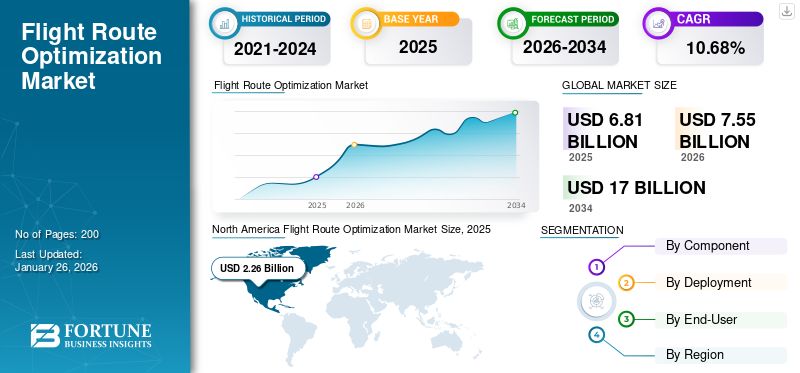
Download Free sample to learn more about this report.
FLIGHT ROUTE OPTIMIZATION MARKET KEY TAKEAWAYS
 Global Market Size & Forecast
- 2025 Market Size: USD 6.81 billion
- 2026 Market Size: USD 7.55 billion
- 2034 Forecast Market Size: USD 17.00 billion
- CAGR: 10.68% from 2026–2034
 Market Share
- North America dominated the flight route optimization market with a market share of 33.13% in 2025.
- The software segment is projected to dominate the market with a share of 58.97% in 2026.
- The segment is likely to grow with a CAGR of 11.25% during the forecast period (2025-2032).
 Key Regional Highlights
North America
The market reached USD 2.26 billion in 2025, accounting for 33.13% share, supported by technological advancements and strong aviation infrastructure.
Europe
The market generated USD 1.97 billion in 2025, representing 28.92% share, supported by sustainability initiatives and demand for fuel-efficient aviation solutions.
Asia Pacific
The region accounted for 23.87% share in 2025, valued at USD 1.63 billion, with growth driven by fleet expansion and airport modernization initiatives.
U.S.
The market is projected to reach USD 1.80 billion by 2026, driven by major aviation companies and increasing adoption of advanced flight optimization systems.
Japan
The market is expected to reach USD 0.48 billion in 2026, supported by digital transformation in aviation and adoption of advanced air traffic management technologies.
Read More

Flight Route Optimization Market Trends
Introduction of AI Technologies is a Prominent Market Trend
Key trends shaping this market include the integration of AI and ML, which enable airlines to analyze vast amounts of data quickly and accurately, leading to more efficient flight planning and execution. These technologies enhance decision-making processes by providing real-time insights into weather conditions, air traffic, and other factors that influence flight routing.
One of the most significant trends is the use of AI-powered software solutions that automate and optimize route planning. For instance, companies, such as Airspace Intelligence have developed tools, such as Flyways, which utilize machine learning algorithms to analyze historical and real-time data. This software can suggest optimal flight paths based on various parameters, including wind patterns and air traffic congestion. In May 2021, during a trial with Alaska Airlines, dispatchers accepted 32% of the software’s suggestions, demonstrating its potential to improve operational efficiency. The continuous learning capability of these systems allows them to adapt over time, enhancing their recommendations based on past decisions made by human operators.
AI systems can adjust routes in real time based on changing conditions, such as unexpected weather events or airspace restrictions. This adaptability not only improves fuel efficiency but also reduces delays, contributing to a more reliable travel experience for passengers. The ability to process large datasets quickly enables airlines to respond promptly to unforeseen circumstances, ensuring that routes remain optimal even in dynamic environments.
Download Free sample to learn more about this report.
Case study
Alaska Airlines' Partnership with Airspace Intelligence
In May 2021, Alaska Airlines partnered with Airspace Intelligence to utilize its innovative platform, Flyways AI, revolutionizing flight operations through AI and ML.
Key Features of Flyways AI
Flyways AI continuously analyzes all scheduled and active flights across the U.S., identifying optimal routes that avoid turbulence and congestion. The platform leverages extensive datasets, including weather patterns, air traffic volumes, and airspace constraints, to generate optimized flight routes.
Impact on Fuel Efficiency and Sustainability:
Within the first six months of testing, the system identified potential reductions in mileage and fuel usage for 64% of the airline's mainline flights. Dispatchers implemented 32% of these recommendations, demonstrating the value placed on AI-driven insights. As a result, Alaska Airlines saved 480,000 gallons of fuel and avoided approximately 4,600 tons of carbon emissions during this period. Between January and September 2022, Flyways AI contributed to an average time saving of 2.7 minutes per flight. Furthermore, In August 2024, Alaska Airlines renewed its partnership with Airspace Intelligence, strengthening its commitment to utilizing AI for operational efficiency and sustainability.
MARKET DYNAMICS
Market Drivers
Increasing Fuel Price Volatility to Drive Market Growth
Fluctuating fuel prices significantly impact airline profitability and operational costs, making fuel efficiency a top priority for airline companies. This volatility heightens the need for effective route optimization solutions as airlines seek to minimize fuel consumption through smarter flight planning. Advanced flight route optimization software enables airlines to analyze various factors such as weather patterns, air traffic, and aircraft performance to determine fuel-efficient routes. By optimizing flight paths, airlines can reduce unnecessary fuel burn and operational costs, ultimately enhancing their bottom line. This focus on cost management is highly critical in a competitive landscape where profit margins are often tight, prompting airlines to invest in technologies that provide real-time analytics and predictive insights into fuel usage.
Growing Need to Adhere to Regulatory Policies and Inclination toward Environmental Sustainability Tend to Drive Market Growth
As environmental sustainability becomes increasingly important in the aviation industry, regulatory compliance related to emissions and noise restrictions is driving the adoption of flight route optimization solutions. Governments and regulatory bodies are imposing stricter regulations on carbon emissions, encouraging airlines to adopt more environmentally friendly practices. Flight route optimization software helps airlines comply with these regulations by enabling them to choose routes that minimize their carbon footprint while still meeting operational requirements. Additionally, optimizing routes not only reduces emissions but also enhances public perception of airlines as environmentally responsible units. This shift toward sustainability is becoming a competitive differentiator in the market, encouraging airlines to leverage advanced technologies that support both regulatory compliance and environmental goals.
Market Restraints
Data Integration and Quality Issues Related to Software Adoption Impact Market Growth
Effective airline route optimization relies heavily on accurate and comprehensive data inputs, including real-time weather information, air traffic conditions, fuel prices, and aircraft performance metrics. Airlines often use a variety of legacy systems for operations, making it challenging to gather and integrate data from multiple sources seamlessly.
Inaccuracies or gaps in data can lead to inconsistent analyses and poor decision-making regarding route planning. For instance, if weather data is outdated or air traffic information is not accurately reflected in the optimization software, it could result in suboptimal routing decisions that could increase fuel consumption or lead to delays. Furthermore, maintaining high-quality data requires continuous monitoring and updating of systems, which can be resource-intensive.
The complexity of managing vast amounts of data also poses challenges for airlines with limited IT infrastructure or expertise. As a result, the reliance on accurate data for effective flight route optimization can hinder the adoption of these solutions, particularly in regions where technological capabilities are still developing.
Market Opportunities
4D Trajectory Optimization in Aviation Sector is a major Market Opportunity
The concept of 4D Trajectory Optimization (4D-TO) represents a significant market opportunity in the flight route optimization sector, driven by its ability to enhance operational efficiency, reduce costs, and support sustainability goals. 4D-TO integrates time as the fourth dimension alongside latitude, longitude, and altitude to optimize flight paths in real-time, considering factors like weather, air traffic, and aircraft performance.
Additionally, advancements in Air Traffic Management (ATM) systems are accelerating the adoption of 4D-TO. Programs like System Wide Information Management (SWIM) facilitate better sharing of data between ground and air operations, enabling seamless implementation of 4D trajectories. Benefits include reduced airspace congestion, fewer trajectory distortions, and improved predictability of air traffic operations. As airlines increasingly prioritize both economic and ecological goals, 4D trajectory optimization offers a transformative tool for modernizing flight operations while addressing industry challenges.
Segmentation Analysis
By Component
Software Segment Dominated Market Due to its Critical Role in Enhancing Operational Efficiency and Decision-Making Processes for Airlines
Based on the component, the market is categorized into software and service.
The software segment is projected to dominate the market with a share of 58.97% in 2026. Advanced flight planning software utilizes sophisticated algorithms and real-time data analytics to optimize flight paths, considering various variables, such as weather conditions, air traffic, and fuel consumption. Thus, significant developments have occurred in the software segment.
The service segment is anticipated to experience considerable expansion throughout the forecast duration, driven by the growing need for ongoing support and maintenance of optimization systems. As airlines increasingly rely on sophisticated software solutions for their operations, they also require comprehensive services that include installation, training, technical support, and system updates.
By Deployment
Owing to its Scalability and Cost Effectiveness, the Cloud-Based Segment Dominates the Market
By deployment, the market is classified into on-premise and cloud-based.
The cloud-based segment is expected to lead the market, contributing 58.37% globally in 2026 and is projected to grow at the highest CAGR during the study period. Cloud-based solutions typically require lower upfront investments than on-premise systems. Airlines can operate on a subscription model, which allows for predictable fare management and pricing, budgeting, and reduced financial risk. The segment is anticipated to capture 59% of the market share in 2025.
The on-premise segment is anticipated to grow significantly during the forecast period. Many organizations prefer on-premise deployments due to their control over their IT environment. Airlines can customize their systems to meet specific operational requirements, ensuring that their route optimization tools align closely with the unique business processes. The segment is likely to grow with a CAGR of 11.25% during the forecast period (2025-2032).
By End-User Analysis
To know how our report can help streamline your business, Speak to Analyst
Commercial Airlines Segment Dominated the Market due to the High Volume of Operations Domestically and Internationally
Based on the end-user, the market is divided into commercial airlines, business jets, and others.
The Commercial airlines segment will account for 45.07% market share in 2026 and are expected to grow rapidly during the forecast period. Commercial airlines operate a vast number of flights daily, necessitating sophisticated route optimization solutions to manage complex schedules efficiently. This need is further amplified by the increasing passenger numbers, which demands airlines to maximize their operational efficiency for maintaining profitability.
The business jet segment is experiencing robust growth during the study period. Flight route optimization software for business jet operators allows them to customize flight plans based on individual client requirements, including preferred departure times, destinations, and in-flight services. The segment is expected to grow with a substantial CAGR of 11.57% during the forecast period (2025-2032).
FLIGHT ROUTE OPTIMIZATION REGIONAL OUTLOOK
The global market regions are segmented into North America, Europe, Asia Pacific, and the rest of the world.
North America Flight Route Optimization Market Size, 2025 (USD Billion)
To get more information on the regional analysis of this market, Download Free sample
North America
In 2025, North America represented USD 2.26 billion, accounting for 33.13% of the worldwide market, and is projected to grow to USD 2.51 billion in 2026. The U.S. dominated the country level market in North America. The region is experiencing rapid growth primarily due to its advanced aviation industry and the presence of major airlines. The region's robust infrastructure and technological advancements facilitate the adoption of sophisticated route planning management software. Supportive regulations and initiatives aimed at modernizing air traffic management systems further boost the flight route optimization market growth. In the U.S., the rise in e-commerce and last-mile delivery demands has fueled the need for sophisticated route optimization solutions. The U.S. market is foreseen to grow with a value of USD 1.8 billion in 2026.
Asia Pacific
Asia Pacific contributed 23.87% to the global market in 2025, with a valuation of USD 1.63 billion, and is projected to reach USD 1.81 billion in 2026. The region is projected to rise at a significantly high CAGR during the forecast period. Governments are investing heavily in airport infrastructure and air traffic management systems, creating opportunities for advanced optimization technologies. Airlines are increasingly adopting digital solutions that leverage data analytics for better decision-making regarding flight routes. China is expected to reach a market value of USD 0.65 billion in 2026. Furthermore, the rise in commercial fleets in the region is also anticipated to boost the market. For instance, in December 2024, The Tata Group-owned Air India announced the orders for 10 A350 widebody and 90 single-aisle A320 Family planes. Furthermore, it has chosen Airbus’ Flight Hour Services-Component (FHS-C) for its expanding A350 fleet. Air India’s complete orderbook for Airbus planes now totals 344, with six A350-900s that have already been delivered. India is projected to be valued at USD 0.35 billion in 2026, while Japan is set to reach USD 0.48 billion in the same year.
Europe
The Europe market generated USD 1.97 billion in 2025, representing 28.92% of the global market landscape, and is expected to reach USD 2.18 billion in 2026. The region is witnessing substantial growth in the flight route optimization market share, driven by a strong presence of low-cost carriers and an increasing emphasis on sustainability in air transport. European airlines are under pressure to comply with stringent environmental regulations, encouraging investments in technologies that optimize fuel efficiency and reduce emissions. In September 2024, The Air France-KLM Group announced a multi-year plan to optimize flight routes using advanced analytics and AI technologies. The U.K. market is expected to hold USD 0.78 billion in 2026. This initiative aims to reduce CO2 emissions by 30% by 2030, demonstrating their commitment to regulatory compliance regarding environmental standards. Germany is set to reach a market value of USD 0.54 billion in 2026, while France is predicted to be worth USD 0.20 billion in 2025.
Rest of the World
Rest of the World contributed approximately USD 0.96 billion to the global market in 2025, accounting for 14.09% share, and is expected to reach USD 1.05 billion in 2026. The rest of the world is anticipated to show moderate growth during the study period. This includes regions, such as Latin America, the Middle East & Africa, and others. Airlines in these regions are forming partnerships with technology firms to adopt advanced airline route optimization solutions. The significant rise in air travel in the region owing to travel and tourism is another factor contributing to regional growth.
COMPETITIVE LANDSCAPE
Key Industry Players
Key Players are Centering on Technological Progress and Product Development to Fulfil Airline Industry Requirements
The global flight route optimization market is made up of major players, including Boeing, Airbus, Sabre, Jeppesen, and SITA. These players are concentrating on technological progress and product innovations that are leveraging advanced technologies to enhance operational efficiency, reduce costs, and improve overall service delivery in the aviation sector. The integration of AI, machine learning, and big data analytics into flight planning and scheduling systems enhances decision-making capabilities, leading to optimized routes that save fuel and reduce emissions. With ongoing investments in innovative solutions and recent developments aimed at improving routing capabilities, these companies are well-positioned to meet the evolving demands of the airline industry while addressing regulatory challenges related to environmental sustainability.
List of Key Flight Route Optimization Companies Profiled:
- The Boeing Company (U.S.)
- Airbus SE (Netherlands)
- FL3XX (Austria)
- International Business Machines Corporation (U.S.)
- Honeywell International Inc. (U.S.)
- Lufthansa Systems AG (Germany)
- Air Support AS (Denmark)
- Collins Aerospace (U.S.)
- Amadeus IT Group SA (Spain)
- Sabre GLBL Inc (U.S.)
- Nav Canada (Canada)
- SITA Aviation (Italy)
- Jeppesen (U.S.)
KEY INDUSTRY DEVELOPMENTS
- September 2024 – Delta Air Lines commenced a new codeshare agreement with Scandinavian Airlines (SAS), expanding route access for customers traveling from North America to over 50 destinations in northern Europe. This partnership enhanced route optimization by providing more efficient connections and scheduling options for travelers.
- September 2024 – Emirates announced plans to increase flight frequencies between Dubai and Johannesburg, reinstating capacity to pre-pandemic levels. This strategic route optimization aims to meet rising demand and improve service efficiency on this critical international route.
- June 2024 – SITA revealed a new collaboration with ITA Airways aimed at enhancing the company’s worldwide network infrastructure. This collaboration encompassed the transition from the airline’s Multiprotocol Label Switching (MPLS) network to SITA’s newly introduced Connect Go SASE platform. SITA provides a future-ready Software-Defined Networking (SDN) and Secure Service Edge (SSE) solution.
- February 2024 – Collins Aerospace announced an upgrade to its FlightHub offering by integrating the Flight Profile Optimization (FPO) solution. This enhancement provides pilots with real-time route recommendations, improving fuel efficiency and reducing CO2 emissions. The FPO technology allows for dynamic adjustments based on changing weather conditions, enabling more efficient flight planning and execution.
- October 2023 – Dassault Aviation introduced FalconWays, a new flight planning tool designed to help Falcon pilots select the most fuel-efficient routes. The tool utilizes updated global wind data and optimization algorithms, allowing pilots to reduce fuel consumption by up to 7% during flights.
REPORT COVERAGE
The flight route optimization market report offers in-depth details about the market, highlighting top companies, diverse product types, and key product applications. Moreover, the report provides valuable insights into market insights, market segmentation, technological advancements, market growth rate, and the competitive landscape. It also delves into the demand for optical communication and networking while highlighting key industry developments.
Request for Customization to gain extensive market insights.
REPORT SCOPE AND SEGMENTATION
|
ATTRIBUTE |
DETAILS |
|
Study Period |
2021-2034 |
|
Base Year |
2025 |
|
Estimated Year |
2026 |
|
Forecast Period |
2026-2034 |
|
Historical Period |
2021-2024 |
|
Growth Rate |
CAGR of 10.68% during the 2026-2034 |
|
Unit |
Value (USD Billion) |
|
Segmentation |
By Component
|
|
By Deployment
|
|
|
By End-User
|
|
|
By Region
|
Frequently Asked Questions
Fortune Business Insights stated that the global market size was valued at USD 7.55 billion in 2026 and is projected to reach USD 17.00 billion by 2034.
Registering a CAGR of 10.68%, the market will show rapid growth during the study period of 2026-2034.
The software segment will be the fastest-growing component segment in this market during the study period.
Boeing, Airbus, Sabre, Jeppesen, and SITA, among others, are key global players in the market.
North America dominated the flight route optimization market with a market share of 33.13% in 2025.
The U.S. dominated the market in 2026.



- 2021-2034
- 2025
- 2021-2024
- 200
Get 30-60 hrs Free Customization
Expand Regional and Country Coverage, Segments Analysis, Company Profiles, Competitive Benchmarking, and End-user Insights.




















-
US +1 833 909 2966 ( Toll Free )
-
Get In Touch With Us