Fluorescein Angiography Market Size, Share & Industry Analysis, By Type (Traditional Fluorescein Angiography), By Application (Age-related Macular Degeneration), By End Use, and Regional Forecast, 2026-2034
 Download Free Sample
Fluorescein Angiography Market Size & Industry Overview
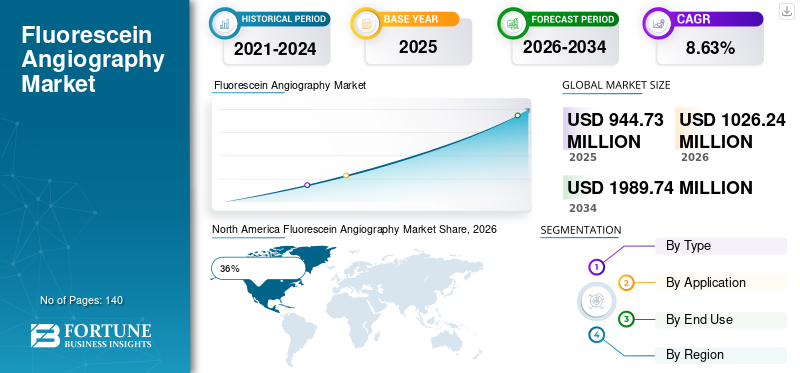
The global fluorescein angiography market size was valued at USD 944.73 million in 2025. The market is projected to grow from USD 1026.24 million in 2026 to USD 1989.74 million by 2034, exhibiting a CAGR of 8.63% during the forecast period.

The fluorescein angiography market is expanding steadily due to the increasing burden of retinal disorders, diabetic eye diseases, vascular abnormalities, and age-related vision complications. Fluorescein angiography remains a critical diagnostic procedure used by ophthalmologists to evaluate retinal blood circulation and detect abnormalities in retinal vessels. The growing adoption of advanced retinal imaging systems, integration of digital imaging technologies, and increasing screening programs for diabetic retinopathy are supporting market expansion. Healthcare facilities are investing in high-resolution ophthalmic imaging equipment to improve diagnostic accuracy and treatment planning. Rising awareness regarding preventive eye care and growing demand for early-stage disease identification continue to strengthen the fluorescein angiography market size and fluorescein angiography market growth worldwide.
The United States accounts for nearly 29% of the global fluorescein angiography market share due to the high prevalence of diabetic retinopathy, age-related macular degeneration, and retinal vascular diseases. More than 38 million Americans live with diabetes, creating significant demand for retinal screening procedures. Advanced ophthalmology centers, strong adoption of digital fundus cameras, and widespread insurance coverage support market penetration. The country has over 19,000 practicing ophthalmologists and a large network of eye clinics utilizing fluorescein angiography for diagnosis and monitoring. Increasing elderly populations and continuous investment in ophthalmic imaging technologies continue to support the Fluorescein Angiography Industry Analysis across the U.S. healthcare ecosystem.
Download Free sample to learn more about this report.
Fluorescein Angiography Market Key Takeaways
 Global Market Size & Forecast
- 2025 Market Size: USD 944.73 Million
- 2026 Market Size: USD 1,026.24 Million
- 2034 Forecast Market Size: USD 1,989.74 Million
- CAGR: 8.63% from 2026-2034
 Market Share
- The market in North America dominated with a revenue share of 36% in 2025.
- Traditional Fluorescein Angiography dominated with approximately 56% market share.
- Hospitals and clinics dominated with approximately 64% market share.
 Key Regional Highlights
North America
North America dominated the market with a 36% share in 2025, supported by advanced ophthalmic imaging infrastructure.
Europe
Europe accounted for 28% of the market, driven by rising demand for retinal disease diagnosis and treatment planning.
Asia-Pacific
Asia-Pacific held a 25% market share, supported by increasing prevalence of retinal disorders and expanding eye care facilities.
U.S.
The U.S. market is supported by advanced ophthalmology services and increasing adoption of retinal imaging technologies.
Japan
Japan accounted for 22% of the Asia-Pacific market, supported by an aging population and growing demand for retinal disease diagnosis.
Read More

Fluorescein Angiography Market Latest Trends
The fluorescein angiography market trends indicate a strong transition toward digital retinal imaging platforms and artificial intelligence-assisted diagnostics. Healthcare providers are increasingly adopting ultra-widefield imaging systems capable of capturing larger retinal areas in a single scan. These systems improve diagnostic efficiency and reduce examination time, making them highly valuable in high-volume ophthalmology clinics. Portable retinal imaging devices are gaining popularity in community screening programs, especially for diabetic retinopathy management. Several manufacturers are introducing compact imaging systems designed for remote diagnostics and teleophthalmology applications. Integration of cloud-based image storage and automated image interpretation software is further improving workflow efficiency.
Download Free sample to learn more about this report.
The fluorescein angiography market research report also highlights rising demand for multimodal imaging systems that combine fluorescein angiography with optical coherence tomography and fundus photography. Hospitals and specialty eye centers increasingly prefer integrated solutions because they provide comprehensive retinal assessment. Growing adoption of artificial intelligence algorithms for lesion detection, vessel mapping, and disease progression analysis is transforming ophthalmic diagnostics. Increasing investments in retinal disease management programs and expanding healthcare infrastructure in emerging economies continue to create new opportunities across the Fluorescein Angiography Industry Report landscape.
Fluorescein Angiography Market Dynamics
DRIVER
Rising Prevalence of Retinal Diseases and Diabetic Retinopathy
The increasing incidence of retinal disorders represents the strongest growth driver for the fluorescein angiography market growth. More than 530 million people worldwide are affected by diabetes, creating a substantial patient pool vulnerable to diabetic retinopathy. Age-related macular degeneration affects millions of elderly individuals globally and remains a leading cause of vision loss. Fluorescein angiography plays a vital role in identifying retinal leakage, ischemia, vascular abnormalities, and neovascularization. Ophthalmologists increasingly rely on angiographic imaging for treatment planning and disease monitoring. Government-led blindness prevention programs and routine retinal screening initiatives are further increasing procedure volumes. The growing elderly population, rising healthcare awareness, and improved access to ophthalmic services continue to strengthen demand for advanced retinal imaging solutions and support long-term fluorescein angiography market outlook.
RESTRAINT
Availability of alternative retinal imaging technologies
The increasing use of alternative retinal diagnostic modalities creates a significant restraint for the fluorescein angiography market analysis. Optical coherence tomography angiography provides non-invasive visualization of retinal blood vessels without requiring dye injection. Many healthcare providers prefer newer imaging technologies due to reduced patient discomfort and lower risk of allergic reactions. Fluorescein angiography involves intravenous dye administration, which may occasionally result in nausea, allergic responses, or temporary skin discoloration. Small clinics may hesitate to invest in angiography equipment because of maintenance expenses and specialized operational requirements. Furthermore, reimbursement variations across different healthcare systems can limit procedural adoption. These factors contribute to competitive pressure within the retinal imaging segment and may moderate expansion rates in certain regions.
OPPORTUNITY
Expansion of Teleophthalmology and Portable Imaging Systems
The rapid development of teleophthalmology programs presents significant opportunities for the fluorescein angiography market opportunities landscape. Healthcare systems are increasingly implementing remote eye screening initiatives to improve access in underserved regions. Portable retinal cameras and compact angiography systems allow ophthalmologists to evaluate patients outside traditional hospital environments. Rural healthcare centers are adopting mobile retinal imaging platforms to support early diagnosis of diabetic retinopathy and retinal vascular disorders. Artificial intelligence-enabled image interpretation is improving diagnostic consistency and reducing dependence on specialist availability. Emerging economies are investing heavily in digital healthcare infrastructure, creating favorable conditions for portable ophthalmic imaging deployment. These developments are expected to accelerate adoption among community health centers, ambulatory facilities, and specialty ophthalmology networks.
CHALLENGE
High Equipment Costs and Shortage of Trained Professionals
The Fluorescein Angiography Industry Analysis identifies equipment affordability and workforce limitations as major operational challenges. Advanced angiography systems require substantial capital investment, making procurement difficult for smaller healthcare facilities. Installation costs, software integration expenses, and periodic equipment upgrades further increase ownership costs. Many developing regions continue to experience shortages of trained retinal specialists capable of accurately interpreting angiographic findings. Healthcare providers must invest in specialized training programs to maximize diagnostic value from advanced imaging technologies. Regulatory compliance requirements and quality assurance standards also increase operational complexity. Limited availability of skilled personnel may delay technology adoption in certain markets, particularly in low-resource healthcare settings where ophthalmic infrastructure remains underdeveloped.
Fluorescein Angiography Market Segmentation
By Type
Traditional Fluorescein Angiography accounts for approximately 56% market share and remains the dominant segment within the fluorescein angiography market size. This diagnostic technique continues to serve as the clinical standard for evaluating retinal blood flow, vascular leakage, and neovascularization. Ophthalmologists rely extensively on traditional fluorescein angiography for diagnosing diabetic retinopathy, retinal vein occlusion, and age-related macular degeneration. More than 60% of retinal specialty clinics continue to utilize conventional angiographic workflows due to proven diagnostic reliability. Hospitals and eye care centers maintain strong demand for traditional systems because they offer detailed visualization of retinal vasculature.
To know how our report can help streamline your business, Speak to Analyst
By Application
Age-related Macular Degeneration represents approximately 33% market share within the fluorescein angiography market. The increasing prevalence of AMD among populations above 60 years of age is driving demand for accurate retinal imaging procedures. Fluorescein angiography enables clinicians to identify abnormal blood vessel growth, leakage patterns, and disease progression. Early diagnosis is essential for treatment planning and preserving visual function. Ophthalmology clinics increasingly incorporate angiographic imaging into routine AMD assessment protocols. Growing awareness regarding age-related vision disorders and expanding elderly demographics continue to strengthen segment demand.
By End Use
Hospitals and clinics account for nearly 64% market share within the fluorescein angiography market share structure. These facilities serve as primary centers for retinal disease diagnosis, treatment planning, and patient monitoring. Large hospital networks possess advanced ophthalmic imaging infrastructure capable of supporting high patient volumes. Specialty eye hospitals are expanding investments in multimodal imaging platforms integrating fluorescein angiography, optical coherence tomography, and digital fundus photography. Ambulatory surgical centers are also increasing adoption due to growing outpatient ophthalmology procedures. Rising demand for comprehensive retinal evaluations and increasing referrals from primary healthcare providers continue to support utilization. The Fluorescein Angiography Industry Report demonstrates that hospitals and clinics remain the dominant end-use segment due to superior diagnostic capabilities and specialist availability.
Fluorescein Angiography Market Regional Outlook
North America Fluorescein Angiography Market Share, 2026 (%)
To get more information on the regional analysis of this market, Download Free sample
North America
North America holds approximately 36% of the global fluorescein angiography market share, making it the leading regional market. The region benefits from highly developed healthcare infrastructure and widespread availability of specialized ophthalmology services. Rising cases of diabetic retinopathy, retinal vein occlusion, and age-related macular degeneration continue to drive demand for retinal imaging procedures. Healthcare providers increasingly invest in advanced angiography systems that offer enhanced image quality and faster diagnosis. The presence of major ophthalmic device manufacturers supports continuous technological innovation. Strong reimbursement frameworks encourage hospitals and clinics to adopt modern retinal diagnostic equipment. Growing awareness regarding preventive eye care is increasing patient screening rates. Research institutions actively support the development of next-generation ophthalmic imaging technologies. Expanding elderly populations further contribute to procedure volumes. These factors collectively strengthen the fluorescein angiography market growth across North America.
Europe
Europe accounts for nearly 28% of the global fluorescein angiography market share and remains a significant contributor to industry expansion. The region benefits from well-established healthcare systems and extensive access to ophthalmology specialists. Increasing prevalence of age-related retinal disorders is creating sustained demand for advanced retinal imaging technologies. Hospitals and eye clinics continue upgrading diagnostic infrastructure to improve clinical outcomes. Government-supported healthcare programs promote regular eye examinations and early disease detection. Digital fluorescein angiography systems are increasingly integrated into routine retinal assessments. The growing elderly population across European countries further supports market demand. Healthcare providers are adopting multimodal imaging platforms for comprehensive retinal evaluation. Strong regulatory standards encourage the use of technologically advanced diagnostic equipment. Continuous innovation and healthcare investments continue to support fluorescein angiography market trends throughout Europe.
Germany Fluorescein Angiography Market
Germany contributes approximately 24% of the European fluorescein angiography market share and represents one of the largest national markets in the region. The country possesses a highly advanced healthcare infrastructure supported by specialized ophthalmology centers and university hospitals. Increasing rates of diabetic retinopathy and age-related macular degeneration are driving demand for retinal imaging procedures. German healthcare providers are among the earliest adopters of advanced ophthalmic technologies. Hospitals continue investing in digital angiography platforms to improve diagnostic accuracy and patient outcomes. Strong healthcare funding supports modernization of retinal diagnostic facilities. Research institutions play an important role in advancing ophthalmic imaging innovations. Growing awareness regarding vision preservation contributes to higher screening rates. The aging population further increases demand for retinal disease diagnosis. These factors support continued fluorescein angiography market outlook growth in Germany.
United Kingdom Fluorescein Angiography Market
The United Kingdom accounts for approximately 19% of the European fluorescein angiography market share. Rising prevalence of diabetes and retinal vascular diseases continues to generate demand for advanced ophthalmic diagnostics. Public healthcare programs emphasize early identification of vision-threatening conditions through regular screening initiatives. Hospitals and specialist eye clinics are investing in upgraded retinal imaging systems to improve service efficiency. Increasing adoption of digital angiography technologies enhances diagnostic capabilities across healthcare facilities. Teleophthalmology programs are expanding access to retinal disease assessment in remote areas. Growing awareness regarding diabetic eye complications supports higher patient screening volumes. Healthcare providers continue focusing on early intervention strategies to prevent vision loss. The presence of advanced clinical research programs contributes to technological progress. These factors collectively support positive fluorescein angiography market growth in the United Kingdom.
Asia-Pacific
Asia-Pacific holds approximately 25% of the global fluorescein angiography market share and is among the fastest-expanding regions. Rapid growth in diabetic populations is significantly increasing demand for retinal disease diagnostics. Governments are investing heavily in healthcare modernization and ophthalmology infrastructure development. Large patient populations create substantial opportunities for retinal imaging equipment manufacturers. Hospitals and specialty clinics are adopting advanced digital angiography systems to improve diagnostic efficiency. Teleophthalmology and portable retinal imaging technologies are gaining popularity across rural healthcare settings. Increasing disposable incomes are improving access to specialized eye care services. Awareness campaigns promoting retinal disease screening are expanding throughout the region. Technological advancements and growing healthcare expenditures continue to support adoption. These factors position Asia-Pacific as a major contributor to fluorescein angiography market opportunities.
Japan Fluorescein Angiography Market
Japan accounts for approximately 22% of the Asia-Pacific fluorescein angiography market share. The country’s aging demographic profile creates significant demand for retinal disease diagnosis and monitoring. Age-related macular degeneration remains one of the primary indications for fluorescein angiography procedures. Japanese healthcare providers actively adopt advanced imaging technologies to improve clinical precision. Hospitals and specialty eye centers are equipped with sophisticated ophthalmic diagnostic systems. Continuous investments in artificial intelligence-assisted retinal analysis are enhancing diagnostic workflows. Strong healthcare accessibility supports widespread utilization of retinal imaging services. Research organizations continue contributing to innovation in ophthalmology technologies. Increasing awareness regarding early detection of retinal diseases encourages routine examinations. These factors strengthen the fluorescein angiography market analysis across Japan.
China Fluorescein Angiography Market
China represents approximately 35% of the Asia-Pacific fluorescein angiography market share, making it the largest market within the region. Rapid urbanization and increasing diabetes prevalence are driving demand for retinal diagnostic procedures. Government healthcare reforms continue improving access to ophthalmology services throughout the country. Hospitals are investing significantly in advanced retinal imaging equipment to address growing patient volumes. Public awareness regarding diabetic retinopathy and vision preservation is steadily increasing. Large-scale healthcare infrastructure expansion supports greater adoption of angiography technologies. Digital healthcare initiatives are encouraging integration of telemedicine and retinal imaging platforms. Growing healthcare expenditure further strengthens equipment procurement activities. Domestic and international manufacturers continue expanding their presence in the market. These developments support strong fluorescein angiography market forecast prospects in China.
Rest of World
The Rest of World region accounts for approximately 11% of the global fluorescein angiography market share. Countries across Latin America, the Middle East, and Africa are gradually expanding access to advanced ophthalmic diagnostic services. Rising incidence of diabetes-related eye diseases is increasing the need for retinal imaging procedures. Governments and private healthcare providers are investing in specialized eye care facilities and diagnostic technologies. Urban hospitals are increasingly adopting digital fluorescein angiography systems to improve clinical capabilities. International healthcare collaborations support technology transfer and professional training programs. Public health initiatives focused on blindness prevention are encouraging earlier diagnosis of retinal disorders. Healthcare infrastructure improvements continue to enhance access to ophthalmology services. Growing awareness regarding preventive eye care is supporting market expansion. These factors contribute to steady fluorescein angiography market growth across the Rest of World region.
List of Top Fluorescein Angiography Companies
- Carl Zeiss Meditec, Inc.
- NIDEK Co., Ltd.
- Kowa Company Ltd.
- Topcon Medical Systems, Inc.
- Optomed Oy (Ltd.)
- CenterVue SpA
- Canon, Inc.
Top Two Companies with Highest Market Share
- Carl Zeiss Meditec, Inc. – Approximately 22% market share
- Topcon Medical Systems, Inc. – Approximately 18% market share
Investment Analysis and Opportunities
The fluorescein angiography market opportunities landscape is attracting substantial investment from medical device manufacturers, ophthalmology networks, and healthcare technology providers. Investment activity is increasingly focused on digital retinal imaging systems, artificial intelligence integration, and portable ophthalmic diagnostics. Healthcare providers are modernizing imaging infrastructure to improve patient throughput and diagnostic precision. Retinal disease screening programs are expanding globally, creating opportunities for equipment suppliers and software developers.
Investors are showing strong interest in teleophthalmology platforms capable of supporting remote retinal evaluation. Emerging economies present particularly attractive opportunities due to expanding healthcare access and increasing diabetic populations. Manufacturers are allocating larger research budgets toward ultra-widefield imaging technologies and cloud-based image management systems. Strategic partnerships between hospitals and technology providers are accelerating commercialization of advanced diagnostic platforms.
New Product Development
Product innovation remains a central focus within the fluorescein angiography market. Manufacturers are developing advanced imaging systems capable of capturing higher-resolution retinal images while reducing examination times. Ultra-widefield imaging technologies have emerged as a major development area because they allow clinicians to visualize larger retinal regions without multiple image acquisitions.
Artificial intelligence integration represents another important innovation trend. New software platforms can automatically identify retinal abnormalities, quantify vascular changes, and assist clinicians in disease classification. These capabilities improve diagnostic consistency and workflow efficiency. Portable retinal imaging devices are also gaining momentum, enabling ophthalmic examinations in community healthcare settings and remote regions.
Five Recent Developments (2023-2025)
- In 2023, Optomed expanded development of AI-enabled retinal imaging solutions designed to improve diabetic retinopathy screening efficiency.
- In 2023, several leading ophthalmic imaging manufacturers introduced enhanced ultra-widefield retinal imaging capabilities for broader retinal visualization.
- In 2024, healthcare providers increased adoption of integrated multimodal retinal imaging platforms combining angiography and optical coherence tomography.
- In 2024, major ophthalmic device companies expanded teleophthalmology-focused diagnostic solutions supporting remote retinal evaluations.
- In 2025, manufacturers accelerated investment in cloud-connected retinal imaging systems to improve image sharing, storage, and collaborative diagnosis workflows.
Report Coverage
The fluorescein angiography market Report provides comprehensive analysis of industry performance, competitive dynamics, technological developments, and regional demand patterns. The study evaluates key factors influencing adoption across hospitals, specialty ophthalmology centers, ambulatory surgical facilities, and diagnostic clinics. Detailed segmentation analysis examines market performance by type, application, and end-use category.
Request for Customization to gain extensive market insights.
The report covers major drivers including rising prevalence of diabetic retinopathy, increasing incidence of age-related macular degeneration, growing elderly populations, and expanding retinal screening initiatives. Market restraints, opportunities, and challenges are examined to provide a balanced assessment of industry conditions. Regional analysis evaluates demand across North America, Europe, Asia-Pacific, and Rest of World markets while identifying country-specific growth influences.
Frequently Asked Questions
Fortune Business Insights says that the global Fluorescein Angiography Market value stood at USD 944.73 million in 2025 and is projected to reach USD 1,989.74 million by 2034.
The market is expected to exhibit a CAGR of 8.63% during the forecast period of 2026-2034.
The Traditional Fluorescein Angiography segment dominated with approximately 56% market share, supported by its proven diagnostic reliability and detailed visualization of retinal vasculature.
Key players include Carl Zeiss Meditec, Inc., NIDEK Co., Ltd., Kowa Company Ltd., Topcon Medical Systems, Inc., Optomed Oy (Ltd.), and CenterVue SpA.
Major trends include the shift toward digital retinal imaging and AI-assisted diagnostics, along with rising adoption of portable and multimodal imaging systems. North America led the market with a 36% share.



- 2021-2034
- 2025
- 2021-2024
- 140
-

(Offer valid till 30th Sep 2026)
Get 30-60 hrs Free Customization
Expand Regional and Country Coverage, Segments Analysis, Company Profiles, Competitive Benchmarking, and End-user Insights.













.webp)






-
US +1 833 909 2966 ( Toll Free )
-
Get In Touch With Us