Follicle Stimulating Hormones Market Size, Share & Industry Analysis, By Type (Recombinant FSH, Urinary-derived FSH, and FSH Combination Products), By Product (Follitropin Alfa, Follitropin Beta, Urofollitropin, and Menotropins), By Application (Controlled Ovarian Stimulation for IVF/ICSI, Ovulation Induction, and Male Infertility/Spermatogenesis Induction), By Patient Group (Male and Female), By Route of Administration (Subcutaneous and Intramuscular), By Distribution Channel (Hospital Pharmacies, Retail Pharmacies & Drug Stores, and Online Pharmacies), and Regional Forecast, 2026-2034
 Download Free Sample
Follicle Stimulating Hormones Market Size and Future Outlook
 Listen to Audio Version
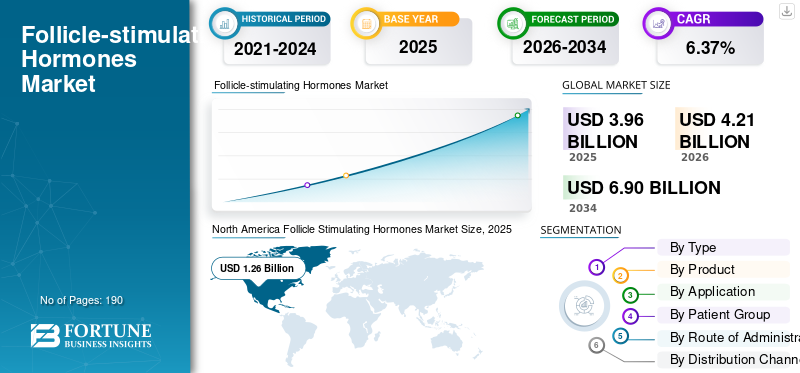
The follicle stimulating hormones market size was valued at USD 3.96 billion in 2025. The market is projected to grow from USD 4.21 billion in 2026 to USD 6.90 billion by 2034, exhibiting a CAGR of 6.37% during the forecast period. North America dominated the follicle stimulating hormones market with a market share of 31.81% in 2025.
The market growth is supported by the rising demand for infertility treatment, ovulation induction, and assisted reproductive technologies such as in vitro fertilization. FSH products stimulate follicular development and egg production in women and may also support sperm production in selected male infertility cases. The market includes recombinant FSH, urinary-derived FSH, and FSH combination products, with recombinant formulations increasingly used due to their standardized dosing, self-administration options, and availability through pre-filled injection pens. Growing infertility rate, delayed parenthood, expanding fertility-clinic networks, and increasing awareness of reproductive treatment are encouraging wider product adoption. In April 2023, WHO reported that around 17.5% of the adult population, that is roughly 1 in 6 worldwide experience infertility during their lifetime, creating a substantial long-term treatment requirement. Continued development of personalized ovarian-stimulation protocols, biosimilar products and combination therapies is expected to improve treatment choice and support market growth.
- For instance, in May 2025, Gedeon Richter strengthened its collaboration with Granata Bio by signing a binding term sheet for the co-development of Bemfola, Richter’s recombinant follicle-stimulating hormone product, for the U.S. market. The collaboration combines Richter’s manufacturing and reproductive health capabilities with Granata Bio’s U.S. clinical, regulatory and commercial expertise. The development highlights the increasing focus of market participants on expanding access to recombinant FSH therapies and strengthening their presence in major fertility-treatment markets.
Furthermore, key players, such as Merck KGaA, Ferring, Organon & Co., and Chemical Works of Gedeon Richter Plc., are actively participating in new product launches, strategic collaborations, and acquisitions, as well as regulatory approval and investment initiatives to expand market presence.
Download Free sample to learn more about this report.
FOLLICLE STIMULATING HORMONES MARKET TRENDS
Increasing Industry Partnerships for the Commercialization of Fertility Hormone Products is a Prominent Market Trend
Increasing licensing, supply, and commercialization partnerships between established pharmaceutical companies and fertility-drug developers are emerging as a global trend. These collaborations and partnerships allow product developers to use the commercial capabilities of larger companies while reducing the time and investment required for independent market entry. These partnerships are particularly important for recombinant and long-acting FSH products, as their development requires specialized manufacturing, clinical validation and country-specific regulatory approvals. Such collaborations can accelerate product launches, expand geographic availability and strengthen competition in assisted reproductive technology sectors. Continued partnership activity is therefore expected to broaden treatment options and support the commercial adoption of advanced FSH formulations.
- For instance, in September 2024, Organon collaborated with Shanghai Bao Pharmaceutical and Suzhou Centergene Pharmaceuticals for SJ02, an investigational long-acting FSH product. This development provided the company with commercialization rights for SJ02 in mainland China. The partnership combined Organon’s women’s-health expertise and commercial infrastructure.
MARKET DYNAMICS
MARKET DRIVERS
Download Free sample to learn more about this report.
Expansion of IVF/ICSI and ART Treatment Volumes to Drive Market Growth
One of the key factors driving the follicle stimulating hormones market growth is increasing number of IVF, ICSI, and other assisted reproductive technology procedures being carried out. These procedures are expected to increase demand for assisted reproductive technologies and follicle-stimulating hormone products directly. Controlled ovarian stimulation is a key stage of IVF and ICSI treatment, where FSH-based medicines are administered to promote the development of multiple ovarian follicles and enable the collection of sufficient eggs for fertilization. As fertility clinics expand their capacity and more patients undergo repeated treatment cycles, the consumption of recombinant FSH, urinary-derived FSH, and combination products is expected to rise.
- For instance, in June 2026, the Human Fertilisation & Embryology Authority in the U.K. reported that in 2024, 64,000 patients underwent over 100,000 treatments and freezing cycles at HFEA-licensed clinics. The number of IVF patients has also nearly tripled over the past 30 years, indicating sustained growth in ART utilization and supporting long-term demand for ovarian-stimulation medicines.
Market Drivers - Impact & CAGR Contribution (2026–2034)
| Rank | Market Drivers | Expected Impact on Market Growth | Estimated Gross Market Growth Contribution (USD Billion) | Impact: 2026-2028 | Impact: 2029-2031 | Impact: 2032-2034 |
|---|---|---|---|---|---|---|
| 1 | Expansion of IVF/ICSI and other ART treatment volumes | High | 2.60% | High | High | High |
| 2 | Rising infertility prevalence and delayed parenthood. | High | 1.95% | Medium | High | High |
| 3 | Expansion of fertility clinics and ART infrastructure | High | 1.45% | High | High | Medium |
| 4 | Growing adoption of recombinant FSH and patient-friendly delivery systems | Medium-High | 1.20% | Medium | High | High |
| 5 | Geographic expansion of biosimilar and lower-cost FSH products | Medium | 1.00% | Medium | Medium | High |
| 6 | Others | Low | 0.90% | Low | Low | Low |
| Total Gross Growth Contribution | 9.10% | |||||
Source: Fortune Business Insights
Download Free sample For In-Depth Market Drivers & Impact Forecasts
MARKET RESTRAINTS
High Out-of-Pocket Costs and Uneven Reimbursement to Hamper Market Expansion
The high cost of infertility treatment assisted reproductive technology and inconsistent reimbursement coverage are expected to restrict the adoption of follicle-stimulating hormone products. FSH medicines form an important part of ovarian-stimulation protocols, but their cost is generally added to consultation, monitoring, laboratory and embryo-transfer expenses. Where public funding or insurance coverage is unavailable, patients must finance a substantial portion of treatment themselves, which can delay treatment initiation, reduce the number of repeat cycles and cause some patients to discontinue therapy. Reimbursement also varies considerably across countries and local healthcare authorities, resulting in unequal access based on patients’ location and financial capacity. These financial barriers may particularly affect premium recombinant and combination FSH products, limiting treatment volumes and slowing overall market growth.
- For instance, in June 2026, the U.K. Human Fertilisation and Embryology Authority reported that the proportion of NHS-funded IVF cycles declined from 35% in 2019 to 28% in 2024 and was only 25% in England. The reduction indicated that a growing share of patients must depend on privately funded treatment, increasing their exposure to fertility-drug and procedure costs.
Market Restraints - Impact & Negative CAGR Contribution (2026–2034)
| Rank | Market Restraints | Expected Impact on Market Growth | Estimated Reduction in Market Size (USD Billion) (2026-2034) |
Impact: 2026-2028 | Impact: 2029-2031 | Impact: 2032-2034 |
|---|---|---|---|---|---|---|
| 1 | High out-of-pocket treatment costs and uneven reimbursement | High | 1.05% | High | High | Medium |
| 2 | Safety risks and need for intensive treatment monitoring | Medium-High | 0.70% | High | Medium | Medium |
| 3 | Complex biologic manufacturing and regulatory requirements | Medium | 0.58% | Medium | Medium | High |
| 4 | Others | Low | 0.40% | Low | Low | Low |
| Total Market Reduction | 2.73% | |||||
Source: Fortune Business Insights
Download Free sample For In-Depth Market Restraints & Risk Analysis
MARKET OPPORTUNITIES
Geographic Expansion of Biosimilar and Generic FSH Products to Create New Growth Opportunities
The expansion of biosimilar and generic follicle-stimulating hormone products into underserved and high-cost fertility markets presents a significant growth opportunity for manufacturers. Several countries continue to depend heavily on premium branded FSH therapies, limiting treatment access for patients who pay a substantial share of fertility-treatment expenses themselves. Introduction of more affordable alternatives can reduce ovarian-stimulation costs, improve medicine availability, and enable a larger number of patients to initiate or repeat IVF and other assisted reproductive treatment cycles. Geographic expansion through licensing agreements and regional commercial partners can also help manufacturers navigate local regulatory requirements and establish distribution networks without building an independent commercial infrastructure. As physicians and fertility clinics gain confidence in comparable lower-cost products, wider availability of biosimilar and generic FSH therapies is expected to expand the treated patient population and create higher market revenue.
- For instance, in October 2024, Meitheal Pharmaceuticals, Inc. expanded its biosimilars portfolio with an exclusive commercial licensing agreement with King Friend Industry Co., Ltd. to market and distribute three biosimilars in the U.S. across diabetes, oncology, fertility, and autoimmune disorders. The planned U.S. expansion highlights how entry into markets dominated by branded products can improve patient access while creating new commercial opportunities for biosimilar FSH manufacturers.
MARKET CHALLENGES
Shortage of Fertility Specialists and ART Infrastructure to Restrict Market Penetration in Emerging Economies
The limited availability of fertility specialists and trained fertility nurses remains a major challenge for the market in emerging economies. Follicle-stimulating hormone therapies used in IVF and ICSI require specialist-led dose selection, regular hormonal testing, and ultrasound monitoring to manage ovarian response and reduce treatment-related risks. However, fertility centers and supporting laboratories are often concentrated in major urban areas, leaving patients in smaller cities and rural regions with limited access to treatment. Inadequate clinical training, shortages of specialized personnel and insufficient laboratory infrastructure restrict the number of ART cycles that healthcare systems can perform. This reduces the eligible treated population and limits the commercial uptake of recombinant, urinary-derived and combination FSH products despite the high underlying burden of infertility.
- For instance, a 2025 study published by Global Public Health reported that Assisted Reproductive Technology (ART) access across sub-Saharan Africa remained limited, with services available in only 21 countries. These capacity gaps illustrate how shortages of trained specialists and ART facilities can restrict ovarian-stimulation procedures and consequently limit demand for FSH medicines.
Segmentation Analysis
By Type
Recombinant FSH Segment Dominated Due to High Purity and Greater Dosing Consistency
Based on type, the market is categorized into recombinant FSH, urinary-derived FSH, FSH combination products, and others.
In 2025, the recombinant FSH segment dominated the market due to its high purity, predictable biological activity, and consistent dosing across treatment cycles. These characteristics allow fertility specialists to adjust ovarian-stimulation doses more accurately according to the patient’s ovarian reserve, age, and treatment response. Recombinant products are also widely available in pre-filled pens and multiple-dose formats, which improves administration convenience and support treatment adherence. Their established use in IVF/ICSI, ovulation induction, and selected male infertility treatments creates a broader commercial base than urinary-derived formulations, encouraging key players to innovate their offerings.
- For instance, in October 2025, Granata Bio Corporation collaborated with Georgetown Equity Partners to develop a next-generation hypoglycosylated recombinant FSH therapy. The investment in an advanced recombinant formulation highlights the continued commercial and clinical focus on improving FSH potency, treatment response, and patient outcomes.
The FSH combination products segment is expected to grow at a CAGR of 5.98% over the forecast period.
To know how our report can help streamline your business, Speak to Analyst
By Product
Menotropins/hMG Segment Dominated Due to its Higher Use in Controlled Ovarian Stimulation
Based on product, the market is segmented into follitropin alfa, follitropin beta, urofollitropin, menotropins/hMG, corifollitropin alfa, and others.
The menotropins/hMG segment accounted for the largest follicle stimulating hormones market share in 2025. This high share was allocated due to its established use in controlled ovarian stimulation and its combined FSH and luteinizing hormone activity. The presence of both hormonal activities allows clinicians to support follicular recruitment and maturation within a single treatment product, particularly in women who may require additional LH activity. The segment also includes several branded and lower-cost highly purified hMG products, expanding its availability across developed and emerging markets. Treatment commonly involves daily administration for several days, resulting in substantial product consumption per ART cycle.
- For instance, in April 2025, Ferring completed the formal validation of a new manufacturing process for the active pharmaceutical ingredient used in MENOPUR. They were progressing with the required regulatory submissions. The development strengthens the company’s integrated manufacturing capabilities and supports reliable supply of its highly purified hMG product as demand for ovarian-stimulation treatment continues to increase.
The corifollitropin alfa segment is projected to grow at a CAGR of 8.42% during the forecast period.
By Application
Controlled Ovarian Stimulation for IVF/ICSI Dominated Due to High Gonadotropin Consumption per Cycle
Based on application, the market is segmented into controlled ovarian stimulation for IVF/ICSI, ovulation induction, male infertility/spermatogenesis induction, fertility preservation, and others.
In 2025, controlled ovarian stimulation for IVF/ICSI held the dominant position in the market. The segment requires repeated administration of FSH-containing medicines to develop multiple follicles before egg retrieval, supporting its dominance. Compared to conventional ovulation induction, IVF and ICSI protocols generally use higher daily doses over several consecutive days, resulting in greater hormone consumption per patient. Therefore, rising IVF/ICSI volumes directly increase demand for recombinant FSH, menotropins, and combination products. The continued expansion of fertility centres and ART capacity further strengthens the contribution of this application to market revenue.
- For instance, in April 2026, the American Society for Reproductive Medicine reported that IVF births in the U.S. had exceeded 100,000 in a single year. The record number of IVF-conceived births indicates the increasing scale of ART utilization and the associated requirement for ovarian-stimulation medicines.
The fertility preservation segment is projected to grow at a 6.85% CAGR during the forecast period.
By Patient Group
Female Segment Dominated Due to Extensive Use in Ovarian Stimulation and Ovulation Induction
Based on patient group, the market is segmented into male and female.
The female segment dominated the market as applications including IVF/ICSI stimulation, ovulation induction, and fertility preservation involve direct administration of the hormone to women. During ART treatment, FSH is used to recruit and develop multiple ovarian follicles, making it a central component of nearly every conventional stimulated IVF cycle. Female patients may also require repeated cycles, dose adjustments, and combination treatment with LH-containing products, thus increasing overall medicine consumption.
- For instance, in November 2024, the U.K. Human Fertilisation and Embryology Authority reported that the number of single women receiving IVF or donor-insemination treatment increased from approximately 1,400 in 2012 to 4,800 in 2022. The number of female same-sex couples receiving treatment also increased from around 1,300 to 3,300, demonstrating the widening female patient base for fertility treatment.
The male segment is projected to grow at a CAGR of 6.45% over the forecast period.
By Route of Administration
Subcutaneous Segment Dominated Market Due to Convenient Self-Administration
Based on route of administration, the market is segmented into subcutaneous and intramuscular.
The subcutaneous segment captured the major share of the market in 2025. Most modern recombinant FSH and highly purified gonadotropin products are designed for administration under the skin. Subcutaneous delivery is compatible with pre-filled pens, multi-dose cartridges, and fine needles, enabling patients to administer daily treatment at home after receiving appropriate training. This reduces dependence on repeated clinic visits and allows patients to follow complex ovarian-stimulation schedules more conveniently. These advantages have encouraged manufacturers and fertility specialists to favor subcutaneous formulations.
- For instance, in July 2024, the Scottish Medicines Consortium accepted REKOVELLE, a recombinant FSH product supplied as a solution for injection in a pre-filled pen, for use within NHS Scotland under agreed access arrangements. The recommendation illustrated continued integration of patient-friendly subcutaneous pen formulations into fertility-treatment pathways.
The intramuscular segment is projected to grow at a CAGR of 3.27% during the forecast period.
By Distribution Channel
Specialist Administration and Centralized Institutional Procurement Supported Dominance of Hospital Pharmacies
Based on distribution channel, the market is segmented into hospital pharmacies, retail pharmacies & drug stores, and online pharmacies.
In 2025, hospital pharmacies dominated as FSH therapies are generally prescribed as part of specialist-led infertility treatment and require close coordination with fertility clinics. Hospital pharmacies can coordinate medicine availability with scheduled treatment cycles, support urgent dose modifications, and manage the procurement of several products used within the same IVF protocol. Gonadotropin treatment must also be undertaken by physicians experienced in infertility management and requires access to appropriate monitoring facilities. These factors support the concentration of FSH dispensing within hospitals and hospital-associated ART centres.
- For instance, in September 2025, Victoria’s Public Fertility Care programme, led by the Royal Women’s Hospital and delivered with ten participating health services, announced the birth of its 250th baby. The expansion of fertility treatment through an integrated hospital network illustrates how increasing ART volumes can strengthen institutional procurement and dispensing of ovarian-stimulation medicines through hospital-based channels.
The online pharmacies segment is projected to grow at a CAGR of 11.49% over the forecast period.
Follicle Stimulating Hormones Market Regional Outlook
By geography, the market is categorized into Europe, North America, Asia Pacific, Latin America, and Middle East & Africa.
North America
North America Follicle Stimulating Hormones Market Size, 2025 (USD Billion)
To get more information on the regional analysis of this market, Download Free sample
North America was valued at USD 1.19 billion in 2024 and maintained its growth momentum with a leading position in 2025 at USD 1.26 billion. This market is witnessing growth due to high IVF/ICSI treatment volumes, advanced healthcare infrastructure, and increasing insurance and employer-supported fertility benefits.
U.S. Follicle Stimulating Hormones Market
Given North America's substantial contribution and the U.S. dominance in the region, the U.S. market is estimated at around USD 1.22 billion in 2026, accounting for roughly 28.99% of the global market.
Europe
Europe is projected to grow at 5.70% CAGR over the forecast years, the second-highest among all regions, and reach a valuation of USD 1.42 billion by 2026. The continued rise in ART procedures supports market growth. Also, established public fertility programs and improving reimbursement in several countries are strengthening demand for FSH-based stimulation therapies.
U.K. Follicle Stimulating Hormones Market
The U.K. market is estimated at USD 0.20 billion in 2026, accounting for roughly 4.72% of the global market.
Germany Follicle Stimulating Hormones Market
Germany's market is projected to reach approximately USD 0.24 billion in 2026, equivalent to around 5.71% of the global market.
Asia Pacific
Asia Pacific accounted for the third-largest share in the market in 2025 and is estimated to reach USD 1.08 billion in 2026. The region is expanding due to delayed parenthood, declining fertility rates, increasing infertility awareness, and rapid growth of private fertility-clinic networks. Government initiatives to improve fertility-treatment access are also supporting higher adoption of FSH products. These factors are anticipated to support regional market growth.
Japan Follicle Stimulating Hormones Market
The Japanese market in 2026 is estimated at around USD 0.25 billion, accounting for approximately 5.92% of the global market.
China Follicle Stimulating Hormones Market
China's market is projected to be among the largest worldwide, with 2026 revenues estimated at around USD 0.31 billion, accounting for approximately 7.36% of global sales.
India Follicle Stimulating Hormones Market
The Indian market is estimated at around USD 0.13 billion in 2026, accounting for roughly 3.05% of global revenue.
Latin America and the Middle East & Africa
The Latin America region is expected to witness significant growth in this market during the forecast period and reach a valuation of USD 0.16 billion in 2026. The regional growth is driven by rising treatment awareness and increasing availability of assisted reproduction across major urban markets. In the Middle East & Africa, the GCC is set to reach USD 0.06 billion in 2026.
South Africa Follicle Stimulating Hormones Market
The South African market is projected to reach approximately USD 0.03 billion by 2026, accounting for roughly 0.67% of global revenue.
COMPETITIVE LANDSCAPE
Key Industry Players
Focus on Portfolio Expansion and Strategic Innovation by Key Players to Strengthen Market Position
The follicle stimulating hormones market has a moderately consolidated competitive structure, with companies such as Merck KGaA, Ferring, Organon & Co., Chemical Works of Gedeon Richter Plc.., IBSA Institut Biochimique SA, and Theramex holding a significant market presence. The leading position of these companies is attributed to their established recombinant and urinary-derived gonadotropin portfolios, strong relationships with fertility clinics, broad geographic distribution, and continued investment in patient-friendly delivery systems. Key companies are also focusing on personalized FSH dosing, long-acting formulations, biosimilar development, and strategic licensing arrangements to improve treatment convenience and expand access across major fertility-treatment markets.
- For instance, in March 2026, Gedeon Richter acquired a reproductive-health discovery portfolio from Celmatix, including a first-in-class oral FSH receptor agonist. The investigational product is intended to support more patient-friendly ovarian stimulation by potentially reducing dependence on injectable hormone administration. The acquisition highlighted the increasing focus of leading market players on external innovation to strengthen their long-term position in fertility care.
Other notable players in the global market are expected to prioritize biosimilar launches, regional product registrations, strategic partnerships, and expansion into emerging fertility markets to strengthen their position during the forecast period.
LIST OF KEY FOLLICLE STIMULATING HORMONE COMPANIES
- Merck KGaA (Germany)
- Ferring (Switzerland)
- Organon & Co. (U.S.)
- Gedeon Richter Plc. (Hungary)
- IBSA Institut Biochimique SA (Switzerland)
- Theramex (U.K.)
- Changchun GeneScience Pharmaceutical Co., Ltd. (China)
- LG Chem (South Korea)
- Mankind Pharma Limited (India)
- Livzon Pharmaceutical Group Inc. (China)
- Qilu Pharmaceutical Co., Ltd. (China)
- Intas Pharmaceuticals Ltd. (India)
- Gufic Biosciences Limited (India)
- ASKA Pharmaceutical Co., Ltd. (Japan)
KEY INDUSTRY DEVELOPMENTS
- April 2026: Mochida Pharmaceutical Co., Ltd. entered into a partnership agreement with Qilu Pharmaceutical Co., Ltd. to develop and commercialize a follitropin alfa biosimilar in Japan. Mochida will lead the Japanese development and regulatory process, while both companies will collaborate toward the product’s commercial launch.
- December 2025: Anhui Anke Biotechnology collaborated with Shanghai Bao Pharmaceutical for a long-acting recombinant FSH-CTP product. The product completed its first commercial shipment in November 2025 and was introduced to the Chinese market through Anke Biotechnology’s distribution network.
- July 2025: Anhui Anke Biotechnology collaborated with Suzhou Shengji Pharmaceutical, a subsidiary of Bao Pharmaceutical, for SJ02, a recombinant human FSH-CTP fusion-protein injection. The partnership granted Anke exclusive sales and marketing rights across mainland China, Hong Kong, Macau, and Taiwan.
- May 2025: Jingze Biopharmaceutical received approval from China’s NMPA for Zepanxi, a recombinant human follicle-stimulating hormone injection. The follitropin alfa biosimilar was developed for ovulation induction and controlled ovarian stimulation in patients undergoing assisted reproductive treatment.
- October 2024: Celmatix Inc. received nomination for its lead compound in its oral Follicle Stimulating Hormone Receptor (FSHR) agonist drug development program. The development represented a major milestone, with the potential to transform fertility treatments for both men and women.
REPORT COVERAGE
The report provides a detailed follicle stimulating hormones market analysis across key segments, including type, product, application, patient group, route of administration, and distribution channel. It also examines major treatment areas such as controlled ovarian stimulation for IVF/ICSI, ovulation induction, male infertility, and fertility preservation. The market report also offers market insights across major regions, including North America, Europe, Asia Pacific, Latin America, and Middle East & Africa, along with country-level assessments where applicable. The report further includes market dynamics, such as key growth drivers, restraints, challenges, trends, and opportunities, along with the competitive landscape, recent product launches, regulatory approvals, partnerships, collaborations, acquisitions, and portfolio expansion strategies adopted by leading companies operating in the market.
Request for Customization to gain extensive market insights.
Report Scope & Segmentation
| ATTRIBUTE | DETAILS |
| Study Period | 2021-2034 |
| Base Year | 2025 |
| Estimated Year | 2026 |
| Forecast Period | 2026-2034 |
| Historical Period | 2021-2024 |
| Growth Rate | CAGR of 6.37% from 2026 to 2034 |
| Unit | Value (USD Billion) |
| Segmentation | By Type, Product, Application, Patient Group, Route of Administration, Distribution Channel, and Region |
| By Type |
|
| By Product |
|
| By Application |
|
| By Patient Group |
|
| By Route of Administration |
|
| By Distribution Channel |
|
| By Region |
|
Research Methodology
1. Bottom Up Approaches
Approach 1: Revenues and Market Share of Major FSH Manufacturers
- Collection of fertility and FSH-related revenues from annual reports, SEC filings, investor presentations, earnings releases, company websites, and product disclosures of Merck KGaA/EMD Serono, Ferring, Organon, Gedeon Richter, IBSA, Theramex, LG Chem, Mankind Pharma/BSV, Intas Pharmaceuticals, Livzon, Qilu Pharmaceutical, and other relevant manufacturers.
- Product-level mapping of GONAL-f, Pergoveris, Menopur, Rekovelle, Follistim/Puregon, Elonva, Bemfola, Ovaleap, Fostimon, Meriofert, Foligraf, Humog, and other FSH products.
- Separation of FSH revenues from broader fertility-drug revenues using product mix, geographic sales, treatment indication, dosage form, and reported brand performance.
- Adjustment for licensing income, non-FSH fertility drugs, distributor margins, retail markups, intercompany transactions, and clinic service revenues.
- Estimation of unreported company revenues using product availability, country footprint, treatment volumes, price positioning, and relative brand penetration.
- Summation of company-level manufacturer revenues to estimate the global market and calculate indicative company market shares.
Approach 2: Product-Level Sales, Dosage and Price-Volume Analysis
- Identification of commercially marketed FSH products by manufacturer, active ingredient, dosage strength, presentation, route of administration, and country.
- Collection of product volumes from government tenders, hospital procurement records, distributor disclosures, import-export data, pharmacy indicators, and company production information.
- Collection of ex-factory prices, manufacturer selling prices, reimbursement prices, official pharmaceutical prices, and hospital tender prices.
- Removal of wholesaler margins, retail margins, taxes, dispensing fees, fertility-clinic markups, and administration charges.
- Conversion of pens, cartridges, vials, ampoules, and syringes into standardized international units and treatment-cycle equivalents.
- Application of average dosage per treatment cycle for IVF/ICSI stimulation, ovulation induction, male infertility, and fertility preservation.
- Estimation of product-level market value using: Units sold × Manufacturer selling price per unit.
- Aggregation of product sales by Type, Product, Application, Patient Group, Route of Administration, Distribution Channel, country, region, and global market.
Approach 3: Patient, Treatment-Cycle and Epidemiology Model
- Assessment of reproductive-age population, infertility prevalence, diagnosed cases, treatment-seeking patients, and treatment-eligible male and female patients by country.
- Collection of IVF/ICSI cycles, ovulation-induction cycles, fertility-preservation cycles, and eligible spermatogenesis-induction cases from national ART registries and clinical sources.
- Application of FSH-treatment penetration by indication and country, considering clinical practice, affordability, reimbursement, and availability.
- Allocation of treated cycles across recombinant FSH, urinary-derived FSH, FSH Combination Products, and Others.
- Mapping of product utilization across follitropin alfa, follitropin beta, urofollitropin, menotropins/hMG, corifollitropin alfa, and Others.
- Estimation of average FSH dose, number of treatment cycles per patient, treatment duration, cycle cancellation, dose adjustment, and product wastage.
- Multiplication of treated cycles by average units consumed and country-specific manufacturer prices to estimate market value.
- Country-level estimates are summed to arrive at regional and global market sizes.
2. Top Down Approaches
Approach 1: Parent-Market and Addressable-Market Allocation Analysis
- Analysis of the global fertility-drugs market, gonadotropin market, assisted-reproduction pharmaceutical expenditure, and infertility-treatment ecosystem as relevant parent markets.
- Estimation of the proportion attributable to gonadotropins based on IVF/ICSI cycles, ovulation-induction treatments, male infertility treatment, and fertility-preservation activity.
- Estimation of the FSH share within gonadotropins after excluding standalone hCG, standalone LH, GnRH agonists, GnRH antagonists, progesterone, estrogen, clomiphene, letrozole, and other non-FSH therapies.
- Allocation of the addressable market across recombinant FSH, urinary-derived FSH, and FSH Combination Products using treatment protocols, product availability, reimbursement, and prescribing preferences.
- Regional allocation based on ART cycles, infertility-treatment access, fertility-clinic infrastructure, manufacturer presence, reimbursement coverage, and manufacturer-price levels.
- Country allocation based on treatment volumes, branded versus biosimilar penetration, patient affordability, public funding, and distribution-channel structure.
3. List of Key Sources
- Annual reports, 10-K/20-F filings, investor presentations, earnings releases, and company product portfolios
- Merck KGaA, Ferring, Organon, Gedeon Richter, IBSA, Theramex, LG Chem, Mankind Pharma/BSV, Intas Pharmaceuticals, Livzon, Qilu Pharmaceutical, and other relevant manufacturers
- FDA, EMA, European Commission, PMDA, NMPA, CDSCO, and TGA
- CDC National ART Surveillance System, SART, ASRM, ESHRE European IVF Monitoring Programme, HFEA, ICMART, ANZARD, and Japan Society of Obstetrics and Gynecology
- WHO, OECD, World Bank, Eurostat, United Nations Population Division, and national statistical agencies
- Government tender portals, hospital procurement records, national medicine-price databases, reimbursement schedules, and formulary documents
- Product labels, prescribing information, regulatory approvals, clinical guidelines, peer-reviewed studies, patent information, and import-export databases
4. Primary Interviews
Supply Side Interviews: 60%
- Key respondents: Discussions with FSH manufacturers, fertility-drug distributors, hospital procurement teams, specialty pharmacies, contract manufacturers, and regional commercial partners to validate product revenues, manufacturer prices, supply volumes, product mix, channel structure, geographic coverage, and competitive positioning. Respondents may include sales directors, business-development executives, product managers, regional managers, market-access professionals, supply-chain managers, and distributors.
Demand Side Interviews: 40%
- Key Respondents: Discussions with reproductive endocrinologists, fertility specialists, IVF-clinic directors, hospital pharmacists, embryologists, procurement personnel, and reimbursement stakeholders to validate treatment cycles, average FSH dosage, prescribing preferences, recombinant-versus-urinary adoption, patient affordability, reimbursement conditions, treatment duration, cancellation rates, and country-level utilization patterns.
Frequently Asked Questions
According to Fortune Business Insights, the global market value stood at USD 3.96 billion in 2025 and is projected to reach USD 6.90 billion by 2034.
In 2025, North America’s market value stood at USD 1.26 billion.
The market is expected to grow at a CAGR of 6.37% over the forecast period of 2026-2034.
The recombinant FSH type segment is expected to lead the market.
Expansion of IVF/ICSI and ART treatment volumes is driving market growth.
Merck KGaA, Ferring, Organon & Co., and Chemical Works of Gedeon Richter Plc. are among the major players in the global market.
North America accounted for the largest market share in 2025.



- 2021-2034
- 2025
- 2021-2024
- 190
Get 30-60 hrs Free Customization
Expand Regional and Country Coverage, Segments Analysis, Company Profiles, Competitive Benchmarking, and End-user Insights.













.webp)






Related Reports
-
US +1 833 909 2966 ( Toll Free )
-
Get In Touch With Us