Food Additives Market Size, Share By Type (Food Emulsifiers , Mono- & Di-glycerides and their Derivatives, Lecithin, Sorbitan Esters, Polyglycerol Esters), Hydrocolloids (Xanthan gum, Gelatin, GuarGum), Enzymes (Carbohydrases, Proteases, Lipases), Flavors, Sugar Substitutes (Sucralose, Stevia) By Source (Natural & Synthetic), By Form (Dry & Liquid), By Application (Food (Dairy & Non-Dairy Products, Bakery & Confectionery Products, Supplements & Seafood and Meat Alternative Products, Cereal, Savory & Snacks, Dressing & Condiments) & Beverages ( Functional Drinks) & Regional Forecast, 2026-2034
 Download Free Sample
Food Additives Market Size & Industry Overview
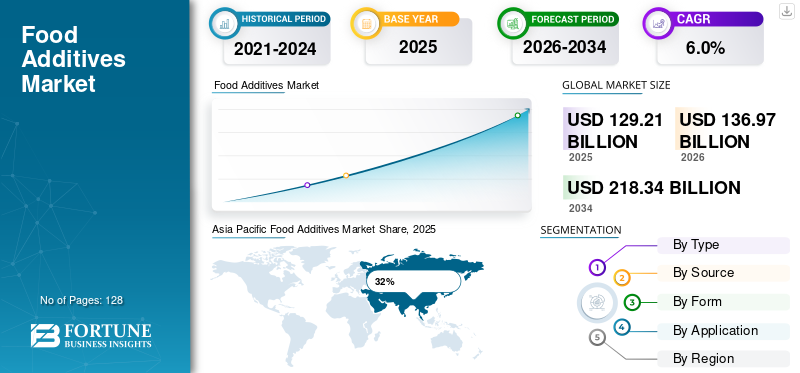
The global food additives market size was valued at USD 129.21 billion in 2025. The market is projected to grow from USD 136.97 billion in 2026 to USD 218.34 billion by 2034, exhibiting a CAGR of 6.0% during the forecast period. The market in Asia Pacific dominated with a revenue share of 32% in 2025.

The food additives market encompasses a wide range of substances added to food products to enhance taste, texture, appearance, shelf life, and stability. Food additives play a critical role in modern food manufacturing by supporting large-scale processing, consistent quality, and extended product durability. food additives market analysis highlights strong demand from processed food, packaged beverages, bakery, dairy, and convenience food segments. The market is shaped by changing consumer preferences, evolving food safety regulations, and the need for functional performance in complex formulations. food additives market insights indicate increasing importance of additives that support clean labeling, functional nutrition, and production efficiency, making additives an essential component of global food supply chains.
The USA food additives market is driven by a highly developed food processing industry and strong demand for packaged and convenience foods. Food manufacturers in the United States rely on additives to maintain consistency, safety, and sensory appeal across large production volumes. food additives market analysis shows extensive use of emulsifiers, enzymes, flavors, and sugar substitutes in bakery, beverages, dairy, and ready-to-eat products. Regulatory oversight shapes additive selection and formulation practices. food additives market insights highlight growing focus on ingredient transparency, functional performance, and reformulation strategies to meet evolving consumer expectations. Domestic innovation and strong distribution networks support steady market demand.
Download Free sample to learn more about this report.
food additives market Key Takeaways
 Global Market Size & Forecast
- 2025 Market Size: USD 129.21 Billion
- 2026 Market Size: USD 136.96 Billion
- 2034 Forecast Market Size: USD 218.34 Billion
- CAGR: 6.0% from 2026–2034
 Market Share
- Asia-Pacific dominated the market with a revenue share of 32% in 2025.
- Food emulsifiers accounted for approximately 32% of the food additives market share.
- Natural food additives accounted for approximately 46% of the food additives market share.
 Key Regional Highlights
Asia Pacific
Asia-Pacific held the largest regional share at 32%, supported by rising food processing and packaged food demand.
North America
North America accounted for 29% of the market, driven by demand for functional and processed food products.
Europe
Europe captured 27% of the market, supported by established food manufacturing and growing demand for natural additives.
United Kingdom
The U.K. accounted for 6% of Europe’s market, reflecting steady demand for food additives.
Japan
Japan represented 5% of the Asia-Pacific market, supported by its developed food processing industry.
Read More

food additives market Latest Trends
food additives market trends indicate a clear shift toward functional and performance-driven additives that support texture stability, flavor enhancement, and shelf-life extension without compromising product quality. food additives market analysis highlights increasing use of emulsifiers and hydrocolloids to improve mouthfeel and processing efficiency in processed foods. Enzymes are gaining traction for their ability to optimize production processes and reduce formulation complexity.
Another major trend is the growing demand for sugar substitutes and flavor systems that support reduced-sugar and low-calorie formulations. food additives market insights show rising interest in reformulation efforts that balance taste, nutrition, and regulatory compliance. Manufacturers are also focusing on improving additive compatibility with clean-label strategies while maintaining functional benefits. Technological advancements in blending, stabilization, and ingredient delivery systems are further shaping innovation. These trends reflect a market increasingly aligned with efficiency, scalability, and evolving dietary preferences.
Download Free sample to learn more about this report.
food additives market Dynamics
DRIVER
Rising consumption of processed and convenience foods
The primary driver of the food additives market is the rising global consumption of processed and convenience foods. Busy lifestyles, urbanization, and changing eating habits have increased demand for packaged foods with longer shelf life and consistent quality. food additives market analysis shows that additives such as emulsifiers, flavors, enzymes, and hydrocolloids are essential for maintaining texture, taste, and stability in mass-produced foods. Food manufacturers rely on additives to ensure product safety and uniformity across large production batches. Food Additives Industry Report insights indicate that expanding food service and retail distribution channels further strengthen this driver by increasing the need for scalable and reliable food formulations.
RESTRAINT
Regulatory scrutiny and ingredient perception concerns
A key restraint in the food additives market is increasing regulatory scrutiny and consumer concern regarding additive safety and ingredient transparency. food additives market Research Report findings show that stringent approval processes and labeling requirements can limit the adoption of certain additives. Negative perception of synthetic additives influences reformulation decisions. Manufacturers must invest in compliance, testing, and documentation. food additives market insights indicate that regulatory variation across regions adds complexity to global product launches, potentially slowing innovation and market expansion.
OPPORTUNITY
Reformulation and functional ingredient innovation
A major opportunity in the food additives market lies in reformulation initiatives and functional ingredient innovation. Food manufacturers are actively seeking additives that enhance nutritional profiles while preserving sensory quality. food additives market Opportunities are expanding in sugar reduction, texture enhancement, and process optimization. food additives market analysis highlights strong demand for additives that enable clean-label positioning without sacrificing performance. Collaboration between ingredient suppliers and food producers supports development of customized solutions, creating long-term growth potential.
CHALLENGE
Balancing functionality, cost, and consumer expectations
One of the main challenges facing the food additives market is balancing functional performance with cost efficiency and consumer acceptance. Food Additives Industry Analysis shows that replacing traditional additives with alternative solutions can increase formulation costs and complexity. Maintaining taste, texture, and shelf stability while meeting clean-label expectations is challenging. food additives market insights indicate that manufacturers must continuously optimize formulations and sourcing strategies to remain competitive while addressing evolving consumer and regulatory demands.
food additives market Segmentation
By Type
Food emulsifiers account for approximately 32% of the food additives market share, making them one of the most dominant additive categories. These ingredients are essential for stabilizing mixtures of oil and water, improving texture, and extending shelf life in processed foods. food additives market analysis shows strong usage in bakery, dairy, confectionery, and processed meat products, where consistency and mouthfeel are critical. Mono- and di-glycerides are widely used for dough conditioning and crumb softness. Lecithin supports emulsification and flow properties in chocolate and beverages. Sorbitan and polyglycerol esters enhance stability in fat-based formulations. Processing efficiency benefits drive adoption, Cost-effectiveness supports large-scale use,regulatory acceptance strengthens demand. This segment remains central to industrial food manufacturing.
Hydrocolloids represent nearly 21% of the food additives market share, driven by their ability to modify viscosity, texture, and stability. These additives are widely used as thickeners, gelling agents, and stabilizers across sauces, dairy products, desserts, and beverages. food additives market insights highlight strong demand for xanthan gum in dressings and sauces due to shear stability. Gelatin is extensively used in confectionery and dairy for gelling and mouthfeel enhancement. Guar gum supports water retention and texture improvement in bakery and frozen foods. Functional versatility drives usage. Processing stability is a key advantage. Clean-label compatibility supports growth. Supply consistency influences sourcing. This segment continues to expand with texture-focused innovation.
Enzymes account for approximately 18% of the food additives market share, supported by their role in improving processing efficiency and product quality. Enzymes are used to modify carbohydrates, proteins, and fats during food production. food additives market analysis shows strong adoption in bakery, brewing, dairy, and beverage processing. Carbohydrases improve dough handling and sweetness development. Proteases enhance protein functionality and texture. Lipases support flavor development in dairy products. Enzymes reduce processing time and waste. Dosage precision is critical. Regulatory compliance influences formulation. Cost savings support adoption. This segment benefits from efficiency-driven manufacturing trends.
Flavors contribute approximately 17% of the food additives market share, driven by the need to enhance taste profiles and maintain product consistency. Both natural and synthetic flavors are widely used across beverages, snacks, dairy, and ready-to-eat foods. food additives market insights show strong demand for flavor systems that support reformulation, especially in reduced-sugar and low-fat products. Flavor masking is important for functional foods. Customization supports brand differentiation. Stability during processing is essential. Sensory performance drives value. Innovation in flavor delivery systems continues. This segment remains consumer-experience driven.
Sugar substitutes account for nearly 12% of the food additives market share, supported by rising demand for reduced-sugar and calorie-conscious products. food additives market analysis highlights strong usage in beverages, dairy, and confectionery. Sucralose provides high-intensity sweetness with stability. Stevia supports plant-based positioning. Taste optimization remains critical. Blending strategies improve sensory acceptance. Regulatory approvals influence adoption. Reformulation demand supports growth. This segment continues to expand with health-focused consumption trends.
To know how our report can help streamline your business, Speak to Analyst
By Source
Natural food additives account for approximately 46% of the food additives market share, reflecting growing demand for ingredients derived from plant, animal, and microbial sources. These additives are widely used in clean-label, organic, and health-focused food products. food additives market analysis shows strong adoption of natural flavors, enzymes, hydrocolloids, and sweeteners in premium product categories. Consumer preference for transparency and recognizable ingredients supports this segment. Manufacturers use natural additives to enhance brand positioning and nutritional perception. However, sourcing variability and higher costs can limit large-scale deployment. Consistency remains a challenge. Regulatory acceptance varies by region. Innovation in extraction and stabilization supports growth. Long-term supplier partnerships are important. This segment continues to expand alongside health-driven consumption trends.
Synthetic food additives represent approximately 54% of the food additives market share, driven by their cost efficiency, functional reliability, and wide regulatory acceptance. These additives are essential for large-scale food processing and mass-market products. food additives market insights highlight strong reliance on synthetic emulsifiers, preservatives, and sweeteners to maintain texture, flavor, and shelf stability. Synthetic additives provide predictable performance across high-volume production. Supply availability is stable and scalable. Manufacturing efficiency supports adoption. Compliance documentation is well established. Cost competitiveness remains a key advantage. Reformulation challenges exist but are manageable. This segment continues to dominate mainstream food manufacturing.
By Form
Dry food additives account for approximately 62% of the food additives market share, making them the most widely used form across food manufacturing applications. Dry additives are preferred for their long shelf life, ease of storage, and compatibility with bulk handling systems. food additives market analysis highlights strong use in bakery, dairy, snacks, and processed foods. Powders and granules allow precise dosing and formulation control. Stability under heat and pressure is a key advantage. Transport efficiency supports widespread use. Contamination risk is lower compared to liquids. Automation compatibility improves efficiency. Consistent quality supports repeat usage. This form remains the industry standard for high-volume production.
Liquid food additives represent approximately 38% of the food additives market share, supported by applications requiring rapid dispersion and uniform blending. These additives are commonly used in beverages, sauces, dressings, and liquid dairy products. food additives market insights show that liquid formats improve processing speed and sensory consistency. Flavor systems and enzymes benefit from liquid delivery. Equipment compatibility is essential. Shelf life is shorter than dry forms. Storage conditions influence handling. Precision mixing enhances performance. Liquid additives support formulation flexibility. This segment continues to grow in beverage and ready-to-consume applications.
By Application
Food applications account for approximately 74% of the food additives market share, making this the dominant application segment globally. Food additives are extensively used to enhance texture, flavor, shelf life, and visual appeal across a wide range of food categories. In dairy and non-dairy products, additives support stability, mouthfeel, and consistency. Bakery and confectionery products rely on emulsifiers and enzymes for structure and softness. Supplements and meat alternative products use additives for binding and nutritional functionality. Cereals and snacks depend on flavor systems and texture enhancers. Dressings and condiments require stabilizers and emulsifiers to maintain uniformity. food additives market analysis highlights strong dependence on additives for large-scale food processing. Product consistency is critical. Regulatory compliance shapes formulation choices. This segment remains the primary volume and value driver.
Beverages account for approximately 26% of the food additives market share, driven largely by growth in functional and fortified drink categories. Food additives are used in beverages to enhance flavor, stability, sweetness, and nutritional delivery. Functional drinks rely on additives such as enzymes, flavors, sweeteners, and stabilizers to maintain performance and shelf stability. food additives market insights show increasing use of sugar substitutes to support reduced-calorie formulations. Additives also help manage pH balance and clarity in liquid products. Rapid dispersion and uniform blending are essential requirements. Processing efficiency influences additive selection. Clean-label considerations are shaping reformulation strategies. Innovation in functional beverages supports demand. This segment continues to expand alongside health and wellness consumption trends.
food additives market Regional Outlook
North America
North America accounts for approximately 29% of the food additives market share, supported by a highly developed food and beverage processing industry. The region demonstrates strong demand for emulsifiers, enzymes, flavors, and sugar substitutes across packaged foods, dairy, bakery, and functional beverages. food additives market analysis highlights widespread reformulation efforts aimed at reducing sugar, fat, and artificial ingredients while maintaining sensory quality. Regulatory oversight strongly influences additive selection and compliance documentation. Clean-label initiatives are shaping innovation strategies, particularly in natural additives. Beverage manufacturers rely heavily on stabilizers and sweeteners for functional drinks. Advanced processing infrastructure supports high additive usage. Consumer demand for convenience foods sustains volume. Supply chain reliability is critical. The region reflects maturity, innovation, and regulation-driven consumption.
Europe
Europe holds nearly 27% of the food additives market share, driven by strong regulatory governance and sophisticated food manufacturing practices. food additives market analysis shows extensive use of emulsifiers, hydrocolloids, enzymes, and flavors in bakery, dairy, confectionery, and ready-to-eat foods. Sustainability and ingredient transparency are key decision factors influencing additive selection. Manufacturers prioritize compliance with stringent food safety standards and labeling requirements. Clean-label reformulation is widespread, particularly in Western Europe. Functional and fortified food demand supports additive usage. Beverage innovation contributes to steady growth. Processing efficiency and quality consistency are essential. Cross-border food trade supports scale. The market reflects structured growth with strong emphasis on safety and quality.
Germany food additives market
Germany represents approximately 9% of the global food additives market share, supported by its advanced food processing sector and strong regulatory framework. food additives market analysis highlights high usage of emulsifiers, enzymes, and hydrocolloids in bakery, dairy, and processed meat alternatives. German manufacturers emphasize precision formulation, quality assurance, and compliance. Clean-label initiatives influence ingredient sourcing. Functional foods and nutritional products contribute to demand. Additives support shelf stability and product consistency. Technological innovation drives formulation efficiency. Export-oriented food production supports scale. Sustainability standards are increasingly influential. Long-term supplier partnerships are common. The market reflects high-value, regulation-driven consumption.
United Kingdom food additives market
The United Kingdom contributes around 6% of the food additives market share, driven by packaged food consumption and beverage innovation. food additives market analysis highlights demand from bakery, ready meals, dairy alternatives, and functional beverages. Reformulation initiatives aimed at sugar reduction and clean labeling are shaping additive usage. Regulatory compliance influences ingredient approvals and labeling. Manufacturers rely on flavors, sweeteners, and stabilizers to maintain sensory quality. Convenience food demand supports steady volume. Import reliance exists for certain additives. Product differentiation is a key focus. Innovation in plant-based foods drives usage. The market reflects stable demand with reformulation-led growth.
Asia-Pacific
Asia Pacific Food Additives Market Share, 2025 (%)
To get more information on the regional analysis of this market, Download Free sample
Asia-Pacific dominates with approximately 32% of the food additives market share, driven by rapid urbanization, expanding middle-class consumption, and large-scale food processing growth. food additives market analysis shows strong demand across bakery, snacks, beverages, dairy, and instant foods. Population growth supports volume expansion. Cost efficiency and scalability influence additive selection. Regulatory frameworks are strengthening across key countries. Functional foods and fortified beverages are gaining traction. Domestic manufacturing capacity is expanding. Traditional and modern diets coexist, driving diverse additive usage. Export-oriented food production supports scale. Innovation is accelerating. The region reflects high-volume, fast-evolving market dynamics.
Japan food additives market
Japan accounts for nearly 5% of the food additives market share, supported by high-quality food manufacturing and stringent safety standards. food additives market analysis highlights strong demand for flavors, enzymes, and stabilizers in processed foods, beverages, and functional nutrition products. Precision, consistency, and safety are critical requirements. Clean-label positioning influences formulation. Functional drinks and fortified foods support additive usage. Domestic innovation is strong. Import dependence exists for select additives. Shelf-life extension is essential. Packaging compatibility matters. Regulatory compliance drives sourcing decisions. The market reflects disciplined, quality-focused consumption.
China food additives market
China represents approximately 14% of the food additives market share, driven by massive food processing capacity and expanding packaged food consumption. food additives market analysis highlights strong demand in bakery, snacks, beverages, dairy, and convenience foods. Urbanization supports processed food adoption. Cost efficiency remains critical. Regulatory oversight is tightening, improving quality standards. Domestic additive production is extensive. Functional food demand is rising. Export-oriented food manufacturing supports scale. Innovation in formulation is increasing. Supply chain integration strengthens reliability. The market shows rapid expansion and increasing sophistication.
Rest of the World
The Rest of the World region holds around 8% of the food additives market share, driven by growing packaged food consumption and food security initiatives. food additives market analysis highlights demand from bakery, beverages, sauces, and processed foods. Import dependence is high. Regulatory frameworks are evolving. Shelf-life extension is a priority. Cost sensitivity influences additive choice. Infrastructure development supports consumption growth. Beverage additives see rising demand. Local production is limited but growing. Long-term growth potential exists. The market reflects emerging, volume-driven demand.
List of Top Food Additives Companies
- Cargill, Incorporated
- BASF SE
- ADM
- IFF
- Kerry Group plc
- Ingredion Incorporated
- Tate & Lyle
- Givaudan
- Darling Ingredients Inc.
- Hansen Holding A/S
Top two companies with the highest market share
- Cargill, Incorporated : 16% market share
- ADM: 14% market share
Investment Analysis and Opportunities
Investment activity in the food additives market is strongly focused on capacity expansion, formulation innovation, and alignment with evolving consumer and regulatory expectations. Food manufacturers and ingredient suppliers are allocating capital toward advanced processing technologies that improve additive functionality, stability, and application versatility. food additives market analysis indicates rising investment in natural and plant-derived additives to support clean-label reformulation strategies. Enzyme technology and sugar reduction solutions are attracting significant attention due to their ability to enhance processing efficiency while improving nutritional profiles.
food additives market Opportunities are expanding in functional foods, fortified beverages, and plant-based product categories, where additives play a critical role in texture, taste, and shelf stability. Investments in regional production facilities strengthen supply reliability and reduce logistics risks. Strategic partnerships between additive producers and food manufacturers enable co-development of application-specific solutions. Automation and digital quality control systems improve consistency and compliance. Emerging markets present opportunities through rising packaged food consumption. Overall, investment momentum favors suppliers offering scalable, compliant, and performance-driven additive solutions aligned with long-term food industry transformation.
New Product Development
New product development in the food additives market is centered on enhancing functionality while meeting clean-label, nutritional, and processing efficiency requirements. Manufacturers are developing next-generation emulsifiers and hydrocolloids that deliver improved texture and stability with reduced usage levels. food additives market trends show strong innovation in enzyme systems that optimize production processes and improve yield across bakery, dairy, and beverage applications.
Sugar substitute development focuses on improving taste profiles and blending solutions to overcome bitterness and aftertaste challenges. Flavor innovation emphasizes masking capabilities for functional ingredients and reduced-sugar formulations. Additive producers are also enhancing solubility and dispersion characteristics, particularly for beverage and ready-to-consume products. Packaging and delivery systems are being optimized to preserve additive performance. food additives market analysis highlights increased collaboration with food manufacturers during product development stages. These innovations support faster reformulation cycles, regulatory compliance, and differentiation in competitive food markets.
Five Recent Developments (2023–2025)
- Expansion of natural and plant-based food additive portfolios to support clean-label demand
- Introduction of advanced enzyme systems to improve processing efficiency and product consistency
- Development of improved sugar substitute blends for reduced-sugar food and beverage formulations
- Capacity expansion initiatives to strengthen regional supply chains
- Increased collaboration between additive suppliers and food manufacturers for customized solutions
Report Coverage of food additives market
The food additives market Report provides comprehensive coverage of industry structure, additive categories, and application dynamics across global regions. It examines segmentation by type, source, form, application, and geography to present a detailed understanding of market behavior. food additives market analysis within the report evaluates drivers, restraints, opportunities, and challenges shaping formulation strategies and procurement decisions.
Request for Customization to gain extensive market insights.
The report includes regional outlooks highlighting regulatory environments, consumption patterns, and manufacturing maturity. Competitive landscape coverage reviews leading companies, strategic positioning, and innovation focus areas. food additives market Research Report insights address investment trends, new product development, and supply chain considerations. Coverage spans food and beverage applications, functional nutrition, and clean-label reformulation. Designed for B2B stakeholders, the report supports strategic planning by delivering actionable intelligence on food additives market Outlook, operational priorities, and long-term industry evolution without reliance on financial projections.
|
By Type |
By Source |
By Form |
By Application |
By Geography |
|
|
|
|
|
Frequently Asked Questions
Fortune Business Insights says that the global market value stood at USD 129.21 billion in 2025 and is projected to reach USD 218.34 billion by 2034.
The market is expected to exhibit a CAGR of 6.0% during the forecast period of 2026-2034.
The food application segment led the market, accounting for approximately 74% of the market share. Its dominance is driven by extensive additive use for improving texture, flavor, shelf life, and consistency across food products.
Key players include Cargill, Incorporated; BASF SE; ADM; IFF; Kerry Group plc; and Ingredion Incorporated.
Key trends include rising demand for functional, performance-driven additives and growing adoption of sugar substitutes and flavor systems for reduced-sugar and low-calorie formulations. Asia-Pacific led regionally with approximately 32% market share, supported by urbanization and expanding food processing.



- 2021-2034
- 2025
- 2021-2024
- 128
-

(Offer valid till 30th Sep 2026)
Get 30-60 hrs Free Customization
Expand Regional and Country Coverage, Segments Analysis, Company Profiles, Competitive Benchmarking, and End-user Insights.


















-
US +1 833 909 2966 ( Toll Free )
-
Get In Touch With Us