Food Fortifying Agents Market Size, Share & Industry Analysis, By Ingredient Type (Proteins and Amino Acids, Vitamins and Minerals, Prebiotics and Dietary Fibers, Botanical & Phytonutrient Fortifiers, Probiotics & Postbiotics, and Specialty Fortifying Ingredients), By Source (Synthetic, Plant-Derived, Animal-Derived, and Fermentation-Derived), By Form (Dry / Powder Form, Liquid Form, and Microencapsulated), By Application (Dietary Supplements, Food Products, Sports & Active Nutrition, Beverages, Clinical & Medical Nutrition, and Others) and Regional Forecast, 2026-2034
 Download Free Sample
Food Fortifying Agents Market Size and Future Outlook
 Listen to Audio Version
The food fortifying agents market size was valued at USD 83.39 billion in 2025 and is projected to grow from USD 88.26 billion in 2026 to USD 144.54 billion by 2034, exhibiting a CAGR of 6.36% during the forecast period. Asia pacific dominated the food fortifying agents market with a market share of 33.98% in 2025.
Food fortifying agents include vitamins, minerals, proteins, amino acids, fibers, and other nutrients that are added to foods and drinks to boost their nutritional value and address specific dietary needs. These agents are widely used in dairy products, cereals, bakery products, infant nutrition, beverages, edible oils, rice, flour, and functional foods. The market is growing rapidly due to increasing awareness about preventive healthcare, rising demand for nutrient-rich foods, and government-led fortification initiatives aimed at reducing micronutrient deficiencies. To combat widespread nutrient deficiencies, manufacturers now enrich everyday products by creating fortified food and beverages with essential vitamins and minerals.
Companies such as Cargill Incorporated, Archer Daniels Midland, BASF SE, and others are some key players operating in this market. New product launch and partnership is the key strategy is boosting product sales and supporting the market growth.
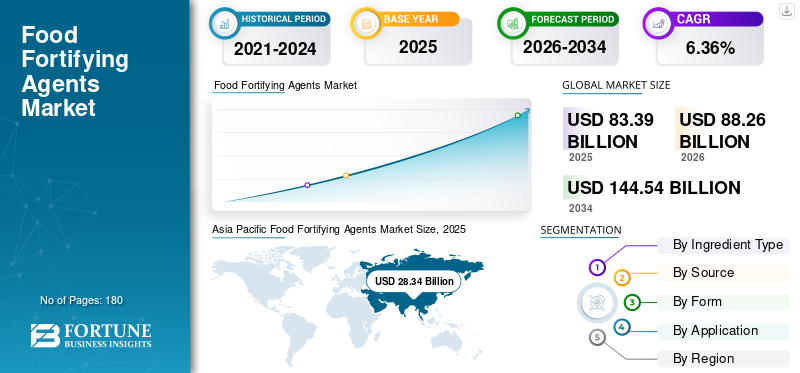
Download Free sample to learn more about this report.
Food Fortifying Agents Market Takeaways
 Global Market Size & Forecast
- 2025 Market Size: USD 83.39 billion
- 2026 Market Size: USD 88.26 billion
- 2034 Forecast Market Size: USD 144.54 billion
- CAGR: 6.36% from 2026–2034
 Market Share
- Asia Pacific dominated the food fortifying agents market with a market share of 33.98% in 2025.
- The proteins and amino acids segment held the largest food fortifying agents market share in 2025.
- Synthetic / chemically synthesized segment accounted for the largest market share in 2025.
 Key Regional Highlights
Asia Pacific
The Asia Pacific market was valued at USD 28.34 billion in 2025 and is the leading region in the world.
North America
The market in North America reached a valuation of USD 21.47 billion in 2025.
Europe
The European market reached a valuation of USD 22.03 billion in 2025.
U.S.
In 2025, the U.S. market reached USD 18.21 billion.
Japan
The Japan market in 2025 reached a valuation of around USD 3.13 billion, accounting for roughly 3.75% of global market revenues.
Read More

FOOD FORTIFYING AGENTS MARKET TRENDS
Bioavailable Nutrients, Clean-Label Inputs, and Customized Premixes Reshape Fortification Strategies
Demand for clean-label products is encouraging the use of naturally derived fortifying ingredients that align with consumer preferences. There is a growing use of customized premixes that combine multiple vitamins, minerals, amino acids, and functional ingredients into a single solution, simplifying manufacturing while improving consistency. There is also a growing demand for bioavailable nutrients, clean-label fortification, and nutrient blends that serve multiple purposes. Manufacturers are using more chelated minerals, natural-source vitamins, and new nutrient delivery systems to help with absorption and effectiveness. Plant-based fortified foods and drinks are becoming more popular as people seek alternatives to traditional dairy and animal-based nutrition. Digital nutrition tools, personalized health tracking, and data-driven diet advice are influencing new products usage and hence manufacturers are developing fortification strategies that address specific nutrition needs and suit different lifestyles.
MARKET DYNAMICS
MARKET DRIVERS
Download Free sample to learn more about this report.
Micronutrient Deficiency Reduction and Preventive Nutrition Demand Accelerate Use of Food Fortifying Agents
Food fortifying agents are experiencing strong demand due to the increasing focus on addressing micronutrient deficiencies through everyday food consumption. Governments, public health organizations, and food manufacturers are promoting nutrient-enriched foods to combat deficiencies related to iron, vitamin D, vitamin A, folic acid, iodine, and zinc. Rising consumer awareness regarding preventive healthcare is encouraging the purchase of fortified dairy products, cereals, infant nutrition products, beverages, and staple foods. Food manufacturers are also leveraging fortification to enhance product value and differentiate offerings in increasingly competitive markets. Urbanization, changing dietary habits, and greater consumption of processed and packaged foods have further expanded the reach of fortified products and supported the food fortifying agents market growth.
MARKET RESTRAINTS
Nutrient Stability Challenges and Regulatory Variation Increase Fortification Complexity
The market faces challenges related to nutrient stability, formulation complexity, regulatory compliance, and cost management. Many vitamins and minerals are sensitive to heat, light, moisture, oxygen, and processing conditions, making it difficult to maintain nutrient potency throughout manufacturing and shelf life. Some fortifying agents can change the taste, color, texture, or appearance of a product. Regulations differ widely between countries regarding allowed nutrient levels, health claims, labeling rules, and required fortification programs. Concerns about adding too many nutrients, along with changing scientific advice on nutrient intake, can make it difficult to market products and limit how flexible companies can be with their fortification plans.
MARKET OPPORTUNITIES
Targeted Nutrition and Advanced Delivery Technologies Create New Growth Pathways
Significant market opportunities are emerging from personalized nutrition, targeted fortification programs, and innovation in nutrient delivery technologies. Food manufacturers are increasingly developing products tailored to specific demographic groups such as children, pregnant women, elderly consumers, athletes, and individuals with particular nutritional requirements. Plant-based foods, alternative proteins, and functional beverages are also creating new application areas for fortifying agents. In addition, partnerships between governments, public health agencies, and food manufacturers are expected to support broader adoption of fortified foods as a cost-effective approach to improving population-level nutritional deficiency. Manufacturers use encapsulation, microencapsulation, and controlled-release systems to keep nutrients stable and reduce changes in taste or texture in fortified foods and drinks.
Segmentation Analysis
By Ingredient Type
High Consumer Demands for Protein-Enriched Nutrition Drives Dominance of Proteins and Amino Acids Segment
The market is segmented by ingredient type into proteins and amino acids, vitamins and minerals, prebiotics and dietary fibers, botanical & phytonutrient fortifiers, fatty acids & nutritional lipids, probiotics & postbiotics, and specialty fortifying ingredients.
The proteins and amino acids segment held the largest food fortifying agents market share in 2025 as they are used in many types of fortified foods, such as infant and sports nutrition, meal replacements, dairy, bakery items, drinks, and products for older adults. Amino acids are also used to meet specific needs in medical nutrition, baby formulas, and drinks with added nutritional benefits. Their wide range of uses, strong consumer demand, and transform regular foods into performance or wellness products support segment growth. Governments and public health organizations worldwide combat widespread micronutrient deficiencies by fortifying staple food with essential vitamins and minerals such as iron, zinc, and folic acid.
The vitamins and minerals holds the second-largest market share, and is expected to grow at a CAGR of 6.31% during the forecast period. They are important for public health, supporting fortification and managing deficiencies. These nutrients are supported by regulations, required fortification programs, and strong consumer awareness of vitamins and minerals including vitamin D, iron, calcium, folic acid, zinc, iodine, and vitamin A.
By Source
Standardized Potency, Lower Cost, and Reliable Scale Drive Leadership of Synthetic/ Chemically Synthesized Fortifying Agents
Based on source, the market is segmented into synthetic / chemically synthesized, natural / plant-derived, animal-derived, and microbial / fermentation-derived.
Synthetic / chemically synthesized segment accounted for the largest market share in 2025. Synthetic or chemically synthesized fortifying agents are used most often as they provide consistent strength, high purity, lower production costs, and ease of large-scale production. Food manufacturers add these agents to products such as flour, rice, dairy, drinks, baby food, cereals, and processed foods as it is easier to control and monitor the dosage than with many natural extracts.
Natural / plant-derived make up the second-largest share of the market and is expected to grow at a CAGR of 6.39% during the forecast period. More consumers want clean-label, plant-based, and less processed nutrition. These ingredients are found in premium fortified foods, drinks, plant-based dairy alternatives, functional snacks, and health-focused products. In these categories, where the source of ingredients matters, health conscious consumers often let it guide their buying choices. Brands use natural vitamin extracts, botanical minerals, algae-based nutrients, and plant based proteins to highlight their products as natural, vegan, sustainable, or made with familiar ingredients.
By Application
Large-Scale Fortification Programs Leads to the Food Products Segment’s Leading Position in the Market
The market is segmented, by application into dietary supplements, food products, sports & active nutrition, animal nutrition, beverages, clinical & medical nutrition, and others.
The food products segment led the global market in 2025 as staple food fortification programs further increase demand for vitamins, minerals, proteins, amino acids, and nutrient premixes at industrial scale. Since food products require continuous ingredient replenishment across large production batches, they create recurring demand for fortifying agents. This makes food products the dominant application segment, especially where governments and manufacturers use everyday foods to address population-level nutrient gaps. Food manufacturers add fortification to boost nutrition, support front-of-pack claims, meet public health rules, and help their products stand out in a crowded market.
Dietary supplements is another major segment that has a CAGR of 7.00% during the forecast period. Dietary supplements make up the second-largest share of the market as they contain concentrated vitamins, minerals, amino acids, proteins, and other nutrients aimed at specific health needs.
By Form
To know how our report can help streamline your business, Speak to Analyst
Superior Stability and Compatibility with Large-Scale Food Processing Strengthen the Dominance of Dry/Powder Forms
The market is segmented, by form into dry / powder form, liquid form, and microencapsulated / stabilized form.
The dry / powder form segment led the global market in 2025. Powdered forms are most common as they are more stable, easier to handle, longer-lasting, and less expensive to transport in large-scale food fortification. Vitamins, minerals, proteins, amino acids, and nutrient premixes are often supplied as powders. This makes it easy to weigh, blend, pack, and incorporate them into products such as flour, cereals, dairy powders, bakery mixes, infant nutrition, snacks, and beverage premixes. Powdered fortifying agents work well for centralized premix manufacturing, where several nutrients are mixed into standard formulas for industrial clients.
Liquid form segment accounted for the second largest market share in 2025 and are expected to register a CAGR of 6.45% during the forecast period. They work well in products where fortifying agents need to dissolve or mix directly, such as in beverages, dairy drinks, edible oils, syrups, sauces, and liquid nutrition products. However, liquids are less popular than powders as they often need stronger packaging, cost more to transport, have a shorter shelf life, and require stricter storage conditions. Liquids can also be less stable as they are more susceptible to oxidation, pH changes, light, and microbial activity.
Food Fortifying Agents Market Regional Outlook
By geography, the market is categorized into Europe, North America, Asia Pacific, South America, and the Middle East & Africa.
Asia Pacific
Asia Pacific Food Fortifying Agents Market Size, 2025 (USD Billion)
To get more information on the regional analysis of this market, Download Free sample
The Asia Pacific market was valued at USD 28.34 billion in 2025 and is the leading region in the world. Asia Pacific is the fastest-growing region due to its diverse and large population, rising consumption of processed foods, and government programs that support better nutrition. Countries such as China, India, Japan, Indonesia, and others in Southeast Asia are driving demand for fortified staples, dairy products, infant nutrition, beverages, and affordable functional foods.
Manufacturers are focusing on nutrients such as iron, vitamin D, calcium, iodine, zinc, protein, and amino acids. Growth in this sector depends on balancing between effective nutrients, affordable prices, local taste preferences, and the needs of large-scale food production.
India Food Fortifying Agents Market
The India market in 2025 was valued around USD 4.64 billion, accounting for roughly 5.57% of global market revenues.
China Food Fortifying Agents Market
China’s market in 2025 was valued around USD 10.13 billion, representing roughly 12.15% of global market share. China’s market is driven by infant nutrition, fortified dairy, beverages, cereals, snacks, and government nutrition improvement efforts. Urban consumers increasingly seek products supporting immunity, growth, energy, bone health, and digestive wellness.
Japan Food Fortifying Agents Market
The Japan market in 2025 reached a valuation of around USD 3.13 billion, accounting for roughly 3.75% of global market revenues.
North America
The market in North America reached a valuation of USD 21.47 billion in 2025. The market is growing as people seek more functional foods, protein-rich products, and fortified options such as dairy, cereals, beverages, and infant nutrition. The U.S. is ahead in this market due to active product reformulation, a focus on preventive health, and well-developed categories that combine supplements and foods. Manufacturers add vitamins, minerals, proteins, fibers, and amino acids to their products to help with immunity, bone health, sports nutrition, and healthy aging.
U.S. Food Fortifying Agents Market
In 2025, the U.S. market reached USD 18.21 billion. The market is well-established, and fortifying agents are added to products such as cereals, dairy, beverages, baked goods, sports nutrition foods, plant-based alternatives, infant nutrition, and meal replacements. Many reformulated products include ingredients such as proteins, amino acids, vitamin D, calcium, iron, B vitamins, fiber, and electrolytes. Manufacturers focus on clean-label premixes, bioavailable nutrients, and claims that fit FDA labeling expectations.
Europe
The European market reached a valuation of USD 22.03 billion in 2025. Strict nutrition rules, established fortified food options, and a high demand for clean-label nutrients shape the European market. Germany, the U.K., France, and the Nordic countries are leading markets by using fortified dairy, cereals, bakery products, infant nutrition, and plant-based foods. Manufacturers focus on minerals that are easy to absorb, vitamins from natural sources, and premixes that do not affect taste, since consumers are wary of excessive fortification. The market is growing due to an aging population, people adopting vegan diets, and efforts to close micronutrient gaps.
Germany Food Fortifying Agents Market
The market in Germany in 2025 reached SD 4.43 billion, representing roughly 5.31% of global market revenues. Germany’s market is influenced by strict regulatory expectations, cautious consumer attitudes toward artificial enrichment, and strong demand for clean-label nutrition.
U.K. Food Fortifying Agents Market
The U.K. market reached USD 3.10 billion in 2025, equivalent to around 3.72% of global market sales.
South America and Middle East & Africa
Over the forecast period, South America is expected to experience significant growth in this market. The South America market in 2025 recorded USD 4.96 billion. Brazil, Argentina, Chile, and Colombia lead the South American market for food fortifying agents. In these countries, fortified flour, dairy, beverages, cereals, and infant nutrition are key areas of use. Efforts to improve public health and a growing interest in functional foods are driving demand for vitamins, minerals, proteins, and amino acid blends. Middle East & Africa region reached a valuation of USD 6.59 billion in 2025. Gulf countries prefer premium fortified dairy, infant nutrition, beverages, and wellness foods. In contrast, African markets focus more on fortifying staple foods. The UAE and Saudi Arabia have a strong demand for imported fortified foods and clean-label nutrition. Meanwhile, South Africa, Nigeria, Kenya, and Egypt focus more on fortifying flour, oil, and cereals. Growth in this market depends on factors such as affordability, government nutrition programs, distribution networks, and access to local premixes.
Israel Food Fortifying Agents Market
Israel market is set to grow at a CAGR of 4.71% during the forecast period. The market is driven by premium packaged foods, imported fortified products, infant nutrition, dairy, beverages, and wellness-focused retail. High expatriate diversity creates demand for fortified foods targeting children, women, athletes, and health-conscious adults.
COMPETITIVE LANDSCAPE
Key Industry Players
Regulatory Fortification Mandates and Nutritional Reformulation Demand Intensify Competition Among Ingredient Suppliers
The food fortifying agents market is characterized by competition among micronutrient manufacturers, specialty ingredient suppliers, premix developers, mineral producers, and biotechnology companies. Competitive positioning of major manufacturers such as Cargill Incorporated, Archer Daniels Midland, BASF SE, and others is largely determined by ingredient stability, bioavailability, regulatory compliance, formulation compatibility, and large-scale supply capabilities rather than commodity pricing alone. Government and public health fortification programs offer big opportunities for suppliers who can meet high standards for quality, traceability, and effectiveness. Leading companies stand out by offering custom premixes, using encapsulation, improving nutrient stability, and making sure fortified foods are tasty.
LIST OF FOOD FORTIFYING AGENTS COMPANIES PROFILED
- Cargill Incorporated (U.S.)
- Archer Daniels Midland (U.S.)
- BASF SE (Germany)
- DuPont de Nemours, Inc., (U.S.)
- Novonesis (Denmark)
- Tate & Lyle (U.K.)
- Nestle S.A. (Switzerland)
- General Mills (U.S.)
- dsm-firmenich (U.S.)
- International Flavors & Fragrances Inc. (U.S.)
KEY INDUSTRY DEVELOPMENTS
- March 2026: DSM-Firmenich partnered with MedAccess to ensure affordable vitamin A and to develop edible oil fortification, while improving nutrition in vulnerable communities.
- September 2024: Arla Foods Ingredients launched a new campaign to inspire dairy manufacturers to create innovative high-protein products. The ‘Go High in Protein’ campaign showcased the Arla Foods Ingredients Nutrilac ProteinBoost range of patented microparticulated whey proteins, which are rich in all the essential amino acids.
- May 2022: SternLife and SternVitamin launched vegan protein bars, water-soluble powder supplements, and micronutrient premixes in the market. The new products were showcased at the Vitafoods Europe 2022 event in Geneva, Switzerland.
- November 2021: ADM completed the acquisition of Sojaprotein, a leading European provider of non-GMO soy ingredients. The company is involved in a significant expansion of ADM’s global alternative protein capabilities to meet growing demand for plant-based foods and beverages.
- November 2021: Kerry launched Emulgold, a naturally sourced soluble dietary fiber ingredient for the white bread manufacturing market. The fortified bread can provide up to 300% increase in fiber per serving.
REPORT COVERAGE
The global food fortifying agents market research provides an in-depth study of market size & forecast by all the market segments included in the report. The market analysis includes details on the dynamics and trends expected to drive the market during the forecast period. It offers information on the technological advancements, new product launches, key industry developments, and details on partnerships, mergers & acquisitions. The market forecast also encompasses detailed competitive landscape with information on the market segmentation, market share and profiles of key operating players.
Request for Customization to gain extensive market insights.
Report Scope & Segmentation
| ATTRIBUTE | DETAILS |
| Study Period | 2021-2034 |
| Base Year | 2025 |
| Estimated Year | 2026 |
| Forecast Period | 2026-2034 |
| Historical Period | 2021-2024 |
| Growth Rate | CAGR of 6.36% from 2026-2034 |
| Unit | Value (USD Billion) |
| Segmentation | By Ingredient Type, By Source, By Form, By Application and Region |
| By Ingredient Type |
|
| By Source |
|
| By Form |
|
| By Application |
|
| By Region |
|
Frequently Asked Questions
Fortune Business Insights says that the global market value stood at USD 83.39 billion in 2025 and is projected to reach USD 144.54 billion by 2034.
In 2025, Asia Pacific’s market value stood at USD 28.34 billion.
The market is expected to exhibit a CAGR of 6.36% during the forecast period.
By application, food products support segment led the global market in 2025.
Micronutrient deficiency reduction and preventive nutrition demand accelerate use of food fortifying agents.
Cargill Incorporated, Archer Daniels Midland, and BASF SE are few of the players in the market.
Asia Pacific held the largest market share in 2025.
Bioavailable nutrients, clean-label inputs, and customized premixes reshape fortification strategies.



- 2021-2034
- 2025
- 2021-2024
- 180
Get 30-60 hrs Free Customization
Expand Regional and Country Coverage, Segments Analysis, Company Profiles, Competitive Benchmarking, and End-user Insights.


















Related Reports
-
US +1 833 909 2966 ( Toll Free )
-
Get In Touch With Us