Freestanding Canopy Market Size, Share & Industry Analysis, By Canopy Type (Standard Canopies, Retractable Canopies, Tensioned Canopies, Hybrid Canopies), By Material (Metal, Fabric, Wood, Glass), By Application (Residential, Commercial, Industrial), By Height (Low Profile, Medium Profile, High Profile), By Shape (Rectangular, Square, Round, Oval) and Regional Forecast, 2026-2034
 Download Free Sample

Freestanding Canopy Market Overview
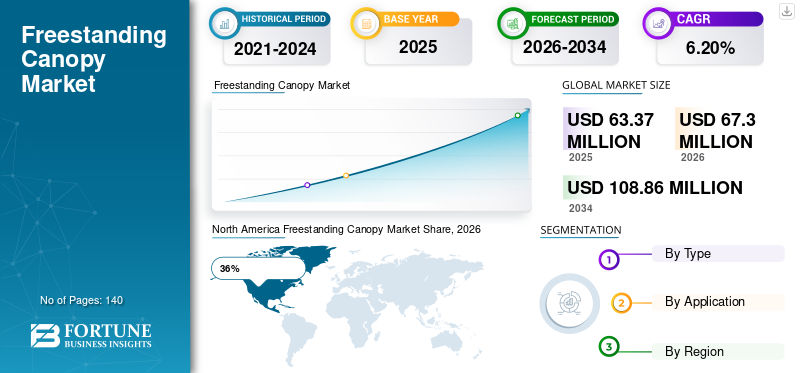
The freestanding canopy market size was valued at USD 20.88 billion in 2025. The market is projected to grow from USD 22.02 billion in 2026 to USD 33.67 billion by 2034, exhibiting a CAGR of 5.45% during the forecast period.

The Freestanding Canopy Market is expanding as residential, hospitality, commercial, recreational, and event spaces increasingly require flexible outdoor shade and shelter solutions. Freestanding canopies provide covered space without depending on permanent building attachment, supporting patios, restaurants, resorts, outdoor events, parking areas, markets, and recreational facilities. Product differentiation is centered on frame strength, weather resistance, fabric performance, portability, architectural appearance, customization, and installation flexibility. The Freestanding Canopy Market Report evaluates standard, retractable, tensioned, and hybrid canopy systems while examining material selection, applications, height, shape, distribution, and regional demand. Current Freestanding Canopy Market Trends emphasize durable construction, attractive designs, modular configurations, and multifunctional outdoor spaces.
The USA Freestanding Canopy Market benefits from strong outdoor-living activity, hospitality development, recreational events, commercial landscaping, and demand for flexible outdoor spaces. Residential users increasingly install canopies around patios, pools, gardens, and entertainment areas, while restaurants, hotels, resorts, sports venues, and event organizers use freestanding structures to increase functional outdoor capacity.
The U.S. market also has an established ecosystem of manufacturers, distributors, garden and outdoor retailers, installers, and commercial buyers. Demand is shifting toward stronger frames, weather-resistant fabrics, modular accessories, customized branding, and solutions designed for repeated outdoor use. Portable canopy suppliers are also expanding options for different dimensions and professional applications.
Download Free sample to learn more about this report.
Freestanding Canopy Market Key Takeaways
 Global Market Size & Forecast
- 2025 Market Size: USD USD 20.88 Billion
- 2026 Market Size: USD 22.02 Billion
- 2034 Forecast Market Size: USD 33.67 Billion
- CAGR: 5.45% from 2026-2034
 Market Share
- The market in North America dominated with a revenue share of 36% in 2025.
- The household segment accounted for approximately 63% of the market share.
- The online distribution segment accounted for approximately 58% of the market share.
 Key Regional Highlights
North America
North America held the largest regional share at 36% in 2025.
Europe
Europe accounted for 29% of the global market, supported by demand for home comfort products.
Asia-Pacific
Asia-Pacific represented 26% of the global market, driven by rising consumer spending and expanding e-commerce.
U.S
The U.S. is a major market due to strong household demand and growing interest in sleep comfort and temperature control.
Japan
Japan accounted for 22% of the Asia-Pacific market, supported by advanced home appliances and increasing focus on sleep wellness.
Read More

Freestanding Canopy Market Latest Trends
The latest Freestanding Canopy Market Trends show a movement toward multifunctional outdoor structures rather than simple temporary shade products. Customers increasingly expect canopies to provide protection from sunlight, rain, wind, and changing temperatures while remaining visually compatible with residential and commercial architecture. Retractable configurations are gaining attention where users want to control exposure to sunlight, while tensioned and hybrid designs appeal to buyers seeking stronger aesthetics and larger covered areas.
Customization is becoming an important competitive factor. Businesses are using branded canopies for outdoor dining, exhibitions, markets, promotional events, hospitality areas, and customer-service spaces. Custom graphics, sidewalls, awnings, lighting attachments, ventilation accessories, and modular extensions are helping manufacturers increase the functional value of canopy systems.
Download Free sample to learn more about this report.
Sustainability is another emerging theme in the Freestanding Canopy Market Analysis. Buyers are showing greater interest in durable materials, recyclable components, longer service life, repairable parts, and designs that reduce replacement frequency. At the same time, climate-responsive engineering is becoming more important, with manufacturers developing structures capable of managing wind, rain, heat, and UV exposure.
Freestanding Canopy Market Dynamics
Drivers
Growing demand for outdoor living, hospitality, and multifunctional outdoor spaces.
The growing use of outdoor areas for dining, relaxation, entertainment, recreation, and commercial activities is a major driver of Freestanding Canopy Market Growth. Residential property owners increasingly view patios, gardens, poolside areas, and terraces as extensions of indoor living environments. A freestanding canopy can create a defined outdoor room while avoiding the construction complexity associated with permanent building additions. The commercial sector provides another substantial demand base. Restaurants and hospitality businesses use outdoor canopies to provide additional seating and improve customer comfort. Resorts, hotels, sports facilities, event organizers, retail properties, and recreational venues can deploy canopy systems where permanent construction is undesirable or where flexibility is important. North American market research has specifically identified hospitality, tourism, outdoor dining, and residential outdoor living as important demand factors.
Weather protection further strengthens adoption. Modern canopy fabrics and frames can be engineered for UV protection, moisture resistance, wind stability, and improved durability. Some professional systems include reinforced frames, weather-resistant tops, sidewalls, and anchoring solutions. For B2B customers, the Freestanding Canopy Market Opportunities are particularly attractive where one structure can serve several functions. A restaurant can use a canopy for outdoor dining, an event company can use it for temporary hospitality areas, and a retailer can use a customized canopy for product demonstrations. This multifunctionality increases the commercial utility of the product.
Restraints
Seasonal purchasing patterns, installation limitations, and competition from alternative shade structures.
Seasonality remains a restraint for the Freestanding Canopy Industry because demand is closely connected with weather conditions, outdoor-event calendars, tourism seasons, and residential renovation cycles. Retailers must manage inventories according to local climates, while manufacturers must balance product availability with the risk of carrying excess seasonal stock. Freestanding canopies also compete with pergolas, shade sails, umbrellas, retractable awnings, gazebos, permanent roofs, and other outdoor structures. In some applications, customers may choose a permanent architectural solution when long-term integration is more important than flexibility. In other situations, low-cost umbrellas can meet basic shading requirements without requiring a larger canopy investment.
Installation can also become a barrier for larger or more permanent systems. Commercial buyers may require site preparation, anchoring, engineering assessments, permits, or professional installation depending on local requirements and the structure's intended use. These additional considerations can lengthen procurement cycles. Material costs also influence purchasing decisions. Steel, aluminum, specialized fabrics, glass, treated wood, hardware, and weather-resistant coatings can raise the total acquisition cost. B2B buyers increasingly evaluate lifecycle value rather than simply the initial purchase price, placing pressure on manufacturers to demonstrate durability, maintenance advantages, warranty support, and replacement-part availability.
Opportunities
Expansion of customized, climate-adapted, modular, and smart outdoor canopy systems.
Product customization represents a significant opportunity in the Freestanding Canopy Market. Businesses increasingly want outdoor structures that complement brand identity, architectural design, and customer experience. Custom colors, printed graphics, integrated signage, sidewalls, lighting, counters, awnings, and modular accessories can transform a basic shade structure into a branded commercial environment. Climate adaptation offers another important opportunity. Canopies operating in hot, rainy, windy, or cold environments require different combinations of fabrics, frame structures, ventilation, drainage, anchoring, and enclosure systems. Manufacturers that develop region-specific designs can address a wider range of commercial and residential requirements.
Smart canopy systems are also creating new possibilities. Motorized retractable roofs, automated weather sensors, integrated lighting, remote controls, and environmental monitoring could increase demand among hospitality and premium residential customers. Such products can move the market beyond conventional shade structures toward responsive outdoor-space management. Modular construction is especially relevant for B2B buyers. Restaurants, resorts, event venues, and retail operators may prefer systems that can be expanded or reconfigured as space requirements change. Modular canopy portfolios allow manufacturers to sell accessories and extensions alongside the primary structure, increasing recurring commercial relationships.
Challenges
Balancing durability, portability, aesthetics, safety, and cost across diverse applications.
Manufacturers face a difficult engineering challenge because customers expect freestanding canopies to be lightweight enough for practical handling while remaining stable in outdoor conditions. A stronger frame can increase weight and transportation requirements, while a lighter structure may require more careful anchoring or have limitations in demanding environments. Weather performance is particularly important. Wind can generate substantial forces on canopy tops and frames, while rain can create water pooling if drainage is poorly designed. UV exposure can gradually affect fabric appearance and material performance. Manufacturers therefore need appropriate fabric coatings, reinforced seams, structural connections, and anchoring options. E-Z UP, for example, highlights wind testing, anchoring solutions, reinforced frames, UV protection, and water-resistant construction across its canopy range.
Design complexity is another challenge. Residential customers may prioritize appearance, while industrial buyers may prioritize strength and serviceability. Hospitality customers may demand architectural integration, and event companies may focus on portability and rapid deployment. A single product cannot optimize all characteristics simultaneously. Supply-chain consistency also remains important. Canopies require frames, covers, fasteners, bags, sidewalls, accessories, and replacement components. Delays in any major component can disrupt delivery. Companies with diversified sourcing, strong inventory planning, replacement-part programs, and regional distribution capabilities can reduce these risks.
Freestanding Canopy Market Segmentation
By Canopy Type
Standard Canopies accounted for an estimated 41% share of the canopy-type segment in the analysis. These systems provide straightforward overhead protection and are commonly selected when buyers prioritize affordability, ease of deployment, and broad usability. Standard designs are relevant to residential patios, gardens, recreational activities, temporary events, markets, outdoor gatherings, and small commercial operations. The main competitive advantage of standard canopies is their versatility. Manufacturers can produce multiple sizes and frame configurations while using standardized components, enabling distributors and retailers to maintain broad product portfolios. Standard models can also be combined with sidewalls, carrying systems, weight systems, lighting, and other accessories. For B2B buyers, standard canopies are attractive for volume procurement because they can support recurring seasonal requirements. Event rental businesses can maintain fleets of standardized structures, while retailers can merchandise several sizes for different customer groups. The segment also provides an entry point for customers who may later upgrade to premium or customized systems.
Retractable Canopies represented an estimated 27% share of the canopy-type segment. Their principal advantage is adjustable coverage. Users can extend or retract the canopy according to sunlight, weather, operating requirements, or desired outdoor ambience. This characteristic makes retractable products particularly relevant to restaurants, hotels, resorts, premium residences, and leisure facilities. The category is increasingly connected with premium outdoor-space design. Motorized systems, remote controls, integrated lighting, weather sensors, and automated positioning can add convenience and functionality. Commercial properties can use retractable structures to adapt outdoor seating areas throughout the day. B2B demand is supported by the desire to create flexible spaces without permanently enclosing them. Restaurants can operate open-air areas during favorable weather and provide coverage when needed. Residential customers can similarly adjust outdoor areas based on seasonal conditions.
Tensioned Canopies represented an estimated 18% share. These structures use tensioned fabric or membrane systems to create a distinctive architectural appearance. They are particularly suitable for projects where visual design, large-span coverage, and contemporary aesthetics are important. Applications include hospitality facilities, recreational spaces, public areas, commercial developments, educational campuses, and premium residential landscapes. The geometry of tensioned fabric can provide attractive shade while creating recognizable architectural features. The segment requires greater attention to engineering, fabric tension, anchoring, structural loading, drainage, and installation. Consequently, B2B purchasing is often project-oriented rather than simple retail purchasing. Manufacturers and installers with technical design capabilities can gain an advantage in larger projects.
Hybrid Canopies represented an estimated 14% share of the canopy-type segment. Hybrid systems combine characteristics of different canopy approaches, such as rigid frame elements with fabric roofs, retractable components with fixed sections, or architectural structures with modular shade accessories. This segment is well suited to buyers seeking a balance between aesthetics, flexibility, durability, and weather protection. Hotels and restaurants can use hybrid configurations to create sophisticated outdoor areas, while residential users can combine fixed and adjustable coverage. Hybrid designs provide manufacturers with opportunities to differentiate products through engineering and customization. However, greater component complexity can increase installation requirements and maintenance considerations. Companies capable of integrating structural, fabric, mechanical, and accessory components can address higher-value B2B projects.
To know how our report can help streamline your business, Speak to Analyst
By Material
Metal accounted for an estimated 46% share of the material segment. Steel and aluminum are widely used because they provide structural strength and allow manufacturers to create frames capable of supporting different roof and accessory configurations. Aluminum is particularly attractive where corrosion resistance and lower weight are important, while steel is often selected when greater structural robustness is required.
Fabric represented an estimated 32% share. Fabric roofs provide lightweight coverage and allow significant flexibility in shape, color, branding, and replacement. Modern canopy fabrics can include UV-resistant, water-resistant, flame-resistant, and mildew-resistant characteristics depending on product design and intended application.
Wood represented an estimated 13% share and is primarily relevant to architectural and residential applications where natural appearance is a purchasing priority. Treated or engineered wood can create premium outdoor environments, although maintenance requirements and weather exposure need to be considered.
Glass represented an estimated 9% share. Glass is mainly relevant to premium architectural projects requiring natural light, visual openness, and permanent-style construction. Laminated or tempered glazing can be incorporated into sophisticated canopy systems, but structural and installation requirements make the segment more specialized.
By Application
Residential applications represented an estimated 44% share. Homeowners use freestanding canopies for patios, gardens, poolside areas, outdoor kitchens, dining spaces, and recreational zones. Demand is supported by the broader movement toward outdoor living and the desire to improve usable residential space without major building extensions.
Commercial applications represented an estimated 42% share. Restaurants, hotels, resorts, retail properties, event venues, sports facilities, and entertainment businesses use canopies to create flexible outdoor areas. Commercial buyers frequently prioritize durability, appearance, branding, installation support, and long-term maintenance.
Industrial applications represented an estimated 14% share. These uses include temporary work areas, equipment protection, loading zones, storage-related shelter, employee areas, and specialized operational spaces. Industrial customers typically prioritize structural stability, weather resistance, usable coverage, and operational practicality.
By Height
Low Profile freestanding canopies represent an estimated 29% share of the height segment. These structures are designed for applications where moderate coverage and a compact footprint are preferred. They are commonly used in residential gardens, patios, terraces, poolside areas, recreational locations, small retail spaces, and temporary event settings. Their lower structural height can provide a less imposing appearance while simplifying transportation, installation, and routine maintenance. The Freestanding Canopy Market Analysis indicates that low-profile products appeal strongly to customers seeking practical shade solutions without extensive structural requirements. Manufacturers are focusing on lightweight frames, weather-resistant covers, improved anchoring systems, and easy-assembly designs. B2B buyers can use these canopies for outdoor seating, promotional areas, market stalls, and temporary customer spaces. Their relatively simple configuration also supports replacement-cover and accessory sales.
Medium Profile freestanding canopies account for an estimated 48% share of the height segment and represent the most versatile configuration. These structures provide a practical balance between headroom, covered area, structural stability, and visual appearance. They are widely applicable across residential patios, restaurants, hotels, resorts, recreational facilities, event venues, gardens, and commercial properties. The Freestanding Canopy Market Report identifies medium-profile systems as an important category because they can accommodate both everyday and professional applications. Businesses can configure them with sidewalls, lighting, branding, heating accessories, and modular extensions. Residential users may select them for outdoor dining and entertainment areas. Manufacturers are improving frame strength, corrosion resistance, fabric durability, and installation efficiency. Demand is also supported by buyers seeking adaptable structures that can remain useful across different seasons and operating conditions.
High Profile freestanding canopies represent an estimated 23% share of the height segment. These structures are generally selected where greater clearance, larger usable areas, or specialized commercial functionality is required. Typical applications include large restaurants, hospitality properties, event venues, recreational facilities, industrial locations, exhibition areas, and architectural outdoor spaces. High-profile systems require greater attention to structural stability, anchoring, wind resistance, drainage, and installation planning. Consequently, B2B buyers often evaluate technical specifications and professional installation capabilities before procurement. The Freestanding Canopy Industry Analysis highlights opportunities for manufacturers offering engineered frames, reinforced connections, durable roofing materials, and customized dimensions. High-profile designs can also incorporate lighting, branding, side panels, and modular extensions. Their suitability for larger commercial environments makes them important for projects where standard low-height canopy systems cannot provide adequate clearance or functional flexibility.
By Shape
Rectangular freestanding canopies represent an estimated 51% share of the shape segment. Their straightforward geometry provides efficient coverage for patios, restaurant seating areas, event spaces, market stalls, recreational facilities, and commercial outdoor zones. Straight edges make rectangular structures relatively easy to position alongside walkways, furniture arrangements, buildings, and other outdoor installations. The Freestanding Canopy Market Trends indicate continued preference for rectangular configurations because they provide practical space utilization and support modular expansion. Manufacturers can produce rectangular structures in multiple dimensions to accommodate different customer requirements. B2B customers may also customize covers with logos, colors, lighting, and sidewalls. Their functional layout makes rectangular canopies suitable for both temporary and semi-permanent applications, while standardized frame components can simplify transportation, installation, maintenance, and replacement of damaged covers.
Square freestanding canopies account for an estimated 25% share of the shape segment. They are particularly suitable for compact outdoor areas where balanced coverage and straightforward placement are important. Residential gardens, patios, recreational areas, small commercial spaces, market stalls, and temporary events represent common application environments. Square designs can simplify manufacturing because standardized dimensions allow frames, covers, connectors, and accessories to be produced in repeatable configurations. The Freestanding Canopy Market Research Report highlights their appeal among customers seeking easy installation and predictable space coverage. Commercial users can deploy square canopies for promotional activities, outdoor customer areas, and temporary exhibitions. Residential users may use them for dining, relaxation, and shade. Lightweight frames, portable configurations, durable fabrics, and improved anchoring systems are supporting product development within this category.
Round freestanding canopies represent an estimated 14% share of the shape segment. Their curved configuration provides a distinctive appearance compared with conventional rectangular and square systems. They are particularly attractive for hospitality venues, gardens, resorts, recreational locations, outdoor celebrations, exhibitions, and event environments where visual presentation is an important purchasing factor. The Freestanding Canopy Market Outlook indicates that round structures occupy a specialized but valuable position within premium outdoor applications. Their shape can create a centralized gathering area and complement circular seating or landscaping arrangements. Manufacturers are developing lightweight frames, durable fabric covers, reinforced connectors, and improved anchoring solutions for these structures. B2B customers may also request customized colors, branding, lighting, side curtains, and decorative elements. The category offers opportunities for suppliers targeting hospitality, event management, landscaping, and premium residential projects.
Oval freestanding canopies account for an estimated 10% share of the shape segment. These structures occupy a specialized category focused on distinctive architectural appearance, efficient gathering spaces, and premium outdoor environments. They can be used in gardens, resorts, hotels, upscale residential properties, recreational venues, public spaces, and event locations. The curved profile of an oval canopy can create a softer visual transition within landscaped environments while providing a spacious central area for seating or activities. The Freestanding Canopy Market Insights suggest that demand is more closely connected with customized and design-oriented projects than with basic temporary applications. Manufacturers can differentiate through engineered frames, specialized fabrics, customized dimensions, integrated lighting, and decorative finishes. Because oval structures may require more specialized fabrication and installation, they are particularly relevant to B2B projects where aesthetics, customization, and architectural integration are major purchasing considerations.
Freestanding Canopy Market Regional Outlook
North America
North America Freestanding Canopy Market Share, 2025 (%)
To get more information on the regional analysis of this market, Download Free sample
North America 36% North America holds the largest share of the global Freestanding Canopy Market, supported by residential outdoor-living activity, hospitality demand, recreational infrastructure, event usage, and established distribution channels. The United States remains the primary demand center, with Canada also contributing through residential, commercial, and tourism-related applications. The U.S. market has strong demand for both portable and higher-end canopy systems. Restaurants and hotels increasingly use outdoor areas to create additional customer capacity, while homeowners install canopies around patios, pools, gardens, and entertainment areas. The market also benefits from a broad product ecosystem covering steel and aluminum frames, fabric tops, sidewalls, replacement covers, weights, bags, and customization options. Commercial buyers increasingly value professional appearance and operational flexibility. Custom branding allows event organizers, retailers, food-service businesses, and exhibitors to use canopies as temporary marketing environments. Weather-resistant products are also gaining importance as buyers expect greater durability and year-round utility. Canada presents opportunities for seasonal outdoor applications, hospitality, recreation, and residential landscaping. Mexico provides additional potential through tourism, outdoor dining, commercial development, and warm-climate applications. The North American Freestanding Canopy Market Analysis therefore emphasizes premium outdoor living, commercial outdoor spaces, event infrastructure, customization, and weather-resistant construction.
Europe
Europe 29% Europe represents a significant Freestanding Canopy Market, supported by hospitality, tourism, outdoor dining, residential landscaping, recreational facilities, and architectural development. European buyers often place considerable importance on aesthetics, sustainability, integration with surrounding buildings, and material quality. Outdoor dining is a particularly important application in many European markets. Restaurants and hospitality operators use freestanding canopies to provide sheltered seating while retaining an open-air atmosphere. Tourism destinations similarly use shade structures around resorts, cafes, leisure facilities, and public spaces. Sustainability considerations are influencing purchasing decisions. Durable aluminum, recyclable components, long-life fabrics, repairable structures, and environmentally conscious manufacturing can help companies differentiate their offerings. Architectural canopies with customized dimensions and premium finishes are relevant to commercial and public projects. Germany and the United Kingdom are major national markets, while France, Italy, Spain, and other European countries contribute through tourism, hospitality, residential outdoor renovation, and landscaping. The European Garden and outdoor-living culture creates a broad customer base for both standardized and specialized canopy systems.
Germany Freestanding Canopy Market
Germany 24% of Europe’s market Germany is an important national market for freestanding canopies because of its established residential landscaping sector, outdoor hospitality activity, commercial construction, and preference for durable engineered products. Restaurants and hospitality venues can use canopies to extend outdoor seating areas while maintaining protection from variable weather. German buyers commonly place emphasis on structural quality, longevity, functional design, and environmental considerations. This creates opportunities for aluminum structures, durable fabrics, modular systems, and products that can be maintained or repaired rather than replaced. Residential demand is connected with gardens, patios, terraces, and recreational spaces. Compact urban properties can benefit from freestanding shade structures that do not require extensive permanent construction. Commercial landscaping projects provide another opportunity, particularly where canopy appearance must complement modern architecture. The Germany Freestanding Canopy Market Outlook is therefore shaped by premium outdoor design, engineering standards, sustainability, hospitality development, and flexible space utilization. B2B suppliers that provide installation guidance, technical specifications, replacement components, and customization can strengthen their competitive position.
United Kingdom Freestanding Canopy Market
United Kingdom 19% of Europe’s market The United Kingdom market benefits from outdoor hospitality, residential garden improvement, recreational events, and demand for flexible weather protection. Restaurants, pubs, hotels, event venues, and leisure businesses use canopy structures to make outdoor areas more usable under changing weather conditions. Residential consumers also use freestanding canopies for gardens, patios, barbecues, entertainment, and outdoor dining. Product selection is influenced by dimensions, appearance, portability, rain resistance, and ease of installation. For B2B buyers, the United Kingdom offers opportunities for commercial-grade products with reinforced structures, customizable covers, sidewalls, heating accessories, and modular configurations. Seasonal weather variability creates demand for products that can handle both sun and rain while remaining practical to maintain. The UK market also benefits from online purchasing and specialist outdoor retailers. Manufacturers can reach niche customer groups through targeted digital merchandising, including products for hospitality, events, residential gardens, and recreational use.
Asia-Pacific
Asia-Pacific 26% Asia-Pacific represents a rapidly developing market for freestanding canopy systems, supported by urbanization, hospitality investment, recreational infrastructure, residential outdoor improvement, and expanding commercial construction. China, Japan, South Korea, Australia, India, and Southeast Asian economies represent varied demand environments. Urbanization is particularly important because many residential and commercial properties need shade without extensive permanent construction. Compact balconies, terraces, restaurants, shopping areas, resorts, and recreational venues can use freestanding structures to create functional outdoor areas. Climate conditions also create strong demand for weather-responsive products. Manufacturers that offer UV-resistant fabrics, ventilation, rain management, corrosion-resistant frames, and heat-adapted configurations can address regional requirements. China provides scale and manufacturing opportunities, while Japan has a mature consumer market with strong interest in compact, organized outdoor spaces. Australia contributes demand from residential and recreational applications. The Asia-Pacific Freestanding Canopy Market Opportunities increasingly center on localized product development, e-commerce, hospitality, and modular outdoor infrastructure.
Japan Freestanding Canopy Market
Japan 18% of Asia-Pacific market Japan has a specialized Freestanding Canopy Market influenced by compact urban spaces, residential gardens, hospitality, recreational facilities, outdoor events, and the need for efficient space utilization. Limited outdoor space in many urban environments encourages interest in compact structures that can provide useful shade without requiring large footprints. Japanese customers tend to value product quality, precise construction, clean aesthetics, and efficient use of space. This supports demand for carefully engineered canopy systems, compact retractable products, and visually refined structures. Commercial applications include restaurants, hotels, recreational facilities, temporary events, and public areas. Products with simple installation, manageable dimensions, and reliable weather protection can be particularly suitable for these applications. The Japan market also offers opportunities for premium materials, modular accessories, and technologically enhanced products. Manufacturers that combine compact design with structural reliability can target both residential and commercial customers.
China Freestanding Canopy Market
China 39% of Asia-Pacific market China is the largest country-level market within the Asia-Pacific regional assessment, supported by its large population, extensive manufacturing capabilities, urban development, hospitality expansion, and growing interest in outdoor leisure. Commercial properties increasingly use outdoor structures for dining, recreation, events, retail activities, and public spaces. Residential consumers are also creating outdoor areas around balconies, terraces, gardens, and suburban properties. Affordable standard canopies remain relevant, while premium buyers increasingly seek attractive structures and better weather performance. Domestic manufacturing provides advantages in component availability, product variety, and supply-chain responsiveness. Chinese producers can develop steel and aluminum frames, fabric covers, retractable systems, and modular accessories for both domestic and export markets. The China Freestanding Canopy Market Analysis highlights strong potential for localized designs, e-commerce distribution, commercial projects, hospitality applications, and climate-adapted structures.
Rest of World
Rest of World 9% The Rest of World Freestanding Canopy Market includes South America, the Middle East, and Africa, with demand shaped by climate, tourism, commercial development, residential landscaping, recreation, and outdoor events. South America provides opportunities through hospitality, residential outdoor spaces, restaurants, resorts, and event-related applications. Brazil and other Latin American markets can support demand for weather-resistant shade structures suitable for warm climates. Hospitality businesses and recreational venues can use freestanding canopies to expand outdoor customer areas without major permanent construction. The Middle East presents opportunities for premium shade structures because high solar exposure increases the practical importance of shaded outdoor environments. Hotels, resorts, shopping destinations, residential developments, and public spaces can use large-scale canopies for comfort and architectural enhancement. Africa represents a more diverse opportunity landscape. Market penetration depends on infrastructure, distribution networks, purchasing power, and local climate. Portable and affordable canopy systems can have advantages where permanent construction is less practical. The Rest of World Garden and outdoor canopy Market Opportunities include regional distribution partnerships, localized designs, affordable product formats, heat-resistant materials, tourism infrastructure, and commercial outdoor-space development.
List of Top Freestanding Canopy Companies
- ShelterLogic (US)
- Caravan Canopy (US)
- E-Z UP (US)
- Abba Patio (US)
- Quik Shade (US)
- King Canopy (US)
- Coleman (US)
- Tentsile (GB)
- Alvantor (US)
Top Two Companies by Market Share
- ShelterLogic: 13%
- E-Z UP: 12%
Investment Analysis and Opportunities
Investment activity in the Freestanding Canopy Market is increasingly focused on product differentiation rather than basic frame-and-fabric manufacturing. Investors can find opportunities in premium retractable systems, architectural tensioned structures, durable materials, modular products, customization technologies, and commercial installation services. The hospitality sector remains an attractive customer base because restaurants, resorts, and event venues need flexible outdoor areas. Residential outdoor renovation provides another opportunity, particularly for premium patio, garden, poolside, and entertainment applications.
Manufacturing investments can target lightweight aluminum frames, corrosion-resistant steel, high-performance fabrics, automated mechanisms, modular connectors, and improved anchoring systems. Distribution businesses can also benefit by supplying replacement covers, sidewalls, weights, lighting, heaters, and other accessories. The Freestanding Canopy Market Research Report indicates that companies capable of combining manufacturing with design, installation, customization, and after-sales service may build stronger B2B relationships. Digital configuration tools can simplify custom orders and enable customers to visualize canopy dimensions, colors, branding, and accessories before purchase.
New Product Development
New product development in the Freestanding Canopy Market is increasingly centered on weather performance, lightweight engineering, modular functionality, and improved user convenience. Manufacturers are introducing reinforced frames, flexible structural components, improved ventilation, water-management features, and accessory mounting systems. E-Z UP's recent product portfolio illustrates this direction through professional canopy models, ventilated designs, customizable systems, awnings, brackets, lighting-related accessories, and weather-oriented configurations. Its newer MAX products use flexible structural elements designed to respond to environmental forces and improve rain runoff.
Customization is another product-development priority. Canopies can be configured with printed graphics, branded sidewalls, awnings, counters, lighting, and other event components. This expands the product from a shade structure into a multifunctional commercial platform. Future development is likely to emphasize automated retractable mechanisms, smart weather sensing, solar-integrated lighting, recyclable fabrics, modular expansion, quick-release components, and improved repairability. Product developers are also likely to create more application-specific systems for restaurants, events, residential patios, industrial workspaces, and recreational facilities.
Five Recent Developments (2023-2025)
- 2023 – E-Z UP expanded professional canopy customization: The company continued developing custom shelter configurations for professional and commercial users, supporting branded outdoor environments and event applications.
- 2024 – ShelterLogic advanced canopy-related intellectual property: A ShelterLogic pop-up canopy patent was granted in 2024, covering an expandable canopy frame and locking mechanism intended to facilitate deployment and structural positioning.
- 2024 – Caravan Canopy maintained certified fabric offerings: Caravan Canopy received a California flame-retardant certification covering its applicable small-tent products, supporting compliance-oriented product positioning for event and outdoor applications.
- 2024 – ShelterLogic strengthened its replacement-cover ecosystem: The company's canopy portfolio continued supporting replacement tops and accessories, reflecting growing attention to extending product usability and maintaining installed structures.
- 2025 – E-Z UP introduced and promoted expanded canopy configurations: Its newer portfolio included Eclipse MAX, Endeavor MAX, larger professional configurations, stabilizer wall systems, canopy awnings, mounting accessories, and weather-oriented products, reflecting continued innovation around durability, modularity, and commercial usability.
Report Coverage of Freestanding Canopy Market
The Freestanding Canopy Market Report covers canopy design categories, material selection, application environments, structural height, canopy shape, regional demand, competitive positioning, investment opportunities, and new product development. The segmentation framework evaluates standard, retractable, tensioned, and hybrid canopy systems to identify differences in functionality, installation, durability, and purchasing behavior. Material analysis covers metal, fabric, wood, and glass, while application analysis considers residential, commercial, and industrial users. The report additionally evaluates low-profile, medium-profile, and high-profile structures and rectangular, square, round, and oval configurations.
Request for Customization to gain extensive market insights.
Geographically, the Freestanding Canopy Market Analysis covers North America, Europe, Asia-Pacific, South America, and the Middle East and Africa, with detailed attention to the United States, Germany, the United Kingdom, Japan, and China. The regional assessment considers outdoor living, hospitality, tourism, urban development, climate requirements, commercial construction, and distribution networks. The Freestanding Canopy Industry Report is designed for manufacturers, distributors, retailers, outdoor-living companies, hospitality operators, event businesses, architects, installers, investors, and commercial procurement teams. The Freestanding Canopy Market Insights support portfolio planning, regional expansion, product positioning, competitive benchmarking, supply-chain planning, customization strategies, and identification of emerging Freestanding Canopy Market Opportunities.
Frequently Asked Questions
Fortune Business Insights says that the global market value stood at USD 20.88 billion in 2025 and is projected to reach USD 33.67 billion by 2034.
The market is expected to exhibit a CAGR of 5.45% during the forecast period of 2025-2034.
High-end Residential/Commercial canopies led the type segment with approximately 68% market share, driven by demand for premium aesthetics, durability, weather resistance, and advanced functionality.
Key players include Poggesi, ShadeFX, FIM S.r.l, Tucci, The Shade Experts USA, and BambrellaUSA.
Major trends include rising demand for motorized systems, weather-resistant fabrics, and integrated lighting, alongside growing adoption of sustainable materials and modular designs. North America leads regionally with approximately 36% market share.


- 2021-2034
- 2025
- 2021-2024
- 140
-

(Offer valid till 15th Dec 2026)
Get 30-60 hrs Free Customization
Expand Regional and Country Coverage, Segments Analysis, Company Profiles, Competitive Benchmarking, and End-user Insights.















-
US +1 833 909 2966 ( Toll Free )
-
Get In Touch With Us