Freight Forwarding Market Size, Share & Industry Analysis By Mode of Transport (Air, Waterways, Road, and Rail), By Service Type (International and Domestic), By Shipment Type (LCL/LTL and FCL/FTL), By Industry (Manufacturing, Automotive, Pharmaceuticals & Healthcare, FMCG, and Others), and Regional Forecast, 2026-2034
 Download Free Sample
(Offer valid till 15th Oct 2026)

Freight Forwarding Market Size and Future Outlook
 Listen to Audio Version
The global freight forwarding market size was valued at USD 325.18 billion in 2025 and is projected to grow from USD 336.61 billion in 2026 to USD 536.51 billion by 2034, exhibiting a CAGR of 6.0% during the forecast period. Asia Pacific dominated the market, accounting for 42.17% of the market share in 2025.
Freight forwarding is a logistics service that plans, coordinates, and manages the movement of goods across domestic or international locations. It involves transportation booking, customs clearance, documentation, consolidation, warehousing, risk management, and ensuring timely, cost-efficient, and compliant deliveries across various modes of transportation. The market is driven by rising global trade, e-commerce growth, supply chain digitalization, demand for multimodal transport, cross-border logistics needs, improved infrastructure, and an increasing focus on cost efficiency, reliability, speed, and value-added logistics services.
Major players in the market include DHL Global Forwarding, Kuehne + Nagel, DSV, and DB Schenker. These companies compete by expanding their multimodal networks, enhancing digital platforms, improving tracking, and investing in automation, warehousing, and customs services to support efficient global cargo movement.
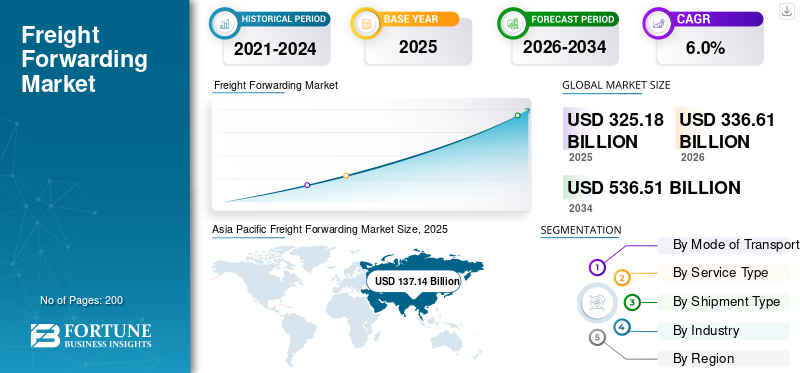
Download Free sample to learn more about this report.
Freight Forwarding Market Key Takeaways
 Market Size & Forecast
- 2025 Market Size: USD 325.18 Billion
- 2026 Market Size: USD 336.61 Billion
- 2034 Forecast Market Size: USD 536.51 Billion
- CAGR: 6.0% from 2026–2034
 Market Share
- Asia Pacific dominated the freight forwarding market with a 42.17% share in 2025.
- Waterways led the mode of transport segment due to cost-efficient bulk cargo movement.
- International freight forwarding dominated the service type segment owing to growing cross-border trade activities.
 Key Regional Highlights
Asia Pacific
Asia Pacific generated USD 137.14 billion in 2025 and remained the largest regional market with a 42.17% share.
Europe
Europe held the second-largest market share, supported by strong multimodal transport networks and export activities.
North America
North America maintained stable growth driven by advanced logistics infrastructure and expanding cross-border trade.
U.S.
The market benefits from extensive international trade, major ports, and continued investments in logistics infrastructure.
Japan
Freight forwarding demand is supported by strong manufacturing output, export activity, and advanced logistics systems.
Read More

MARKET DYNAMICS
MARKET DRIVERS:
Global Trade Expansion Strengthens Demand for the Market
Steadily increasing global trade volumes continue to fuel the need for efficient freight forwarding services. As businesses expand internationally, demand rises for reliable cross-border transportation, customs management, and multimodal logistics solutions. Growth in manufacturing, international sourcing, and regional production hubs further accelerates cargo movement. Freight forwarders benefit from handling complex documentation, route optimization, and supply chain coordination. This expanding global trade ecosystem significantly boosts forwarding service requirements across air, sea, road, and rail networks. In October 2025, the World Trade Organization (WTO) reported that world merchandise trade volume rose 4.9% year-on-year in the first half of 2025.
MARKET RESTRAINTS:
High Logistics Costs Limit the Market Growth
Rising operational expenses, including fuel prices, container charges, warehousing fees, labor shortages, and port congestion, increase the cost structure for freight forwarders. These elevated costs can reduce profitability and make it harder for forwarders to offer competitive pricing to customers. Small and mid-sized players face increased pressure due to limited bargaining power with carriers. Additionally, fluctuating global freight rates and unpredictable economic conditions restrict growth, as shippers become more cautious with logistics spending in cost-sensitive trade environments. In September 2025, UNCTAD reported that global shipping faces substantial decarbonization costs, noting a 5% rise in maritime GHG emissions in 2024, with only 8% of the global fleet capable of using alternative fuels.
MARKET OPPORTUNITIES:
Digital Supply Chain Platforms Offer Transformational Growth Potential
The rapid adoption of digital logistics platforms presents a major opportunity for freight forwarders. Automated documentation, AI-based demand forecasting, real-time tracking, and predictive analytics streamline operations while enhancing transparency for customers. Cloud-based freight marketplaces improve carrier selection and pricing accuracy. Forwarders embracing digitalization can offer faster quotes, optimized routing, and improved visibility, strengthening competitiveness. As global shippers prioritize technology-driven logistics, forwarders implementing advanced digital capabilities can capture new business and deliver more efficient, scalable services. This drives the freight forwarding market growth globally. In May 2025, Nippon Express Holdings launched its new service, NX Lead Logistics Solutions, a comprehensive logistics offering that centralizes order and shipment management, provides real-time visibility across transport modes, optimizes end-to-end supply-chain processes, and offers risk management to ensure business continuity and cost-effectiveness.
FREIGHT FORWARDING MARKET TRENDS:
Increased Use of Multimodal Logistics Solutions to Shape the Market Evolution
Global supply chains are shifting toward multimodal logistics to reduce transit times, improve reliability, and manage disruptions. Freight forwarders increasingly integrate air–sea, sea–rail, and road–rail combinations to optimize cost and delivery performance. Customers seek flexible transport options to navigate port delays, capacity shortages, and geopolitical uncertainties. This trend pushes forwarders to expand modal partnerships, invest in technology for coordination, and design more resilient transport routes. Multimodal logistics is emerging as a defining trend in modern forwarding operations. In September 2025, Gulftainer announced expansion of its multimodal logistics network, opening new hubs and inland container depots linking sea, land, and future rail routes via Etihad Rail.
MARKET CHALLENGES:
Supply Chain Disruptions Pose Persistent Operational Challenges
Freight forwarders face ongoing challenges from unpredictable supply chain disruptions, including port closures, natural disasters, geopolitical tensions, labor strikes, and equipment shortages. Such disruptions create volatility in transit schedules, freight capacity, and pricing. Forwarders must constantly adjust plans, reroute shipments, and manage customer expectations, increasing operational pressure. These challenges require stronger contingency planning, real-time visibility tools, and diversified transport networks. Persistent unpredictability remains a major obstacle to maintaining stable, efficient freight forwarding industry operations.
Download Free sample to learn more about this report.
Segmentation Analysis
By Mode of Transport
Cost-Efficient Bulk Cargo Movement Augments Waterways Segment Demand
Based on mode of transport, the market is segmented into air, waterways, road, and rail.
Waterways remain the leading mode in the market due to their exceptional cost efficiency in transporting large, heavy, and bulk cargo over long distances. Global trade heavily depends on maritime routes for containerized shipments, energy commodities, and raw materials. Extensive port infrastructure, increased vessel capacity, and optimized shipping lanes strengthen its dominance. Despite slower transit times, sea freight offers unmatched scalability and lower carbon emissions. Its strong role in international commerce ensures consistent demand, making waterways the most widely utilized mode of transport.
The route enables faster, more reliable trade between the Gulf and East Africa, bypassing traditional bottlenecks, a significant boost for regional connectivity and supply-chain resilience. Air freight is expected to experience significant growth over the forecast period due to rising demand for efficient logistics, rapid deliveries, high-value and time-sensitive goods, and expanding cross-border e-commerce shipments, supported by improved air cargo capacity and digital logistics solutions.
By Service Type
International Freight Forwarding Leads on the Account of Expanding Global Trade Networks
Based on service type, the market is categorized into international and domestic.
International freight forwarding dominates the market as businesses increasingly expand cross-border operations, requiring efficient coordination of global shipments, customs regulations compliance, and multimodal transport. Growing international trade agreements, export–import activities, and globalized manufacturing enhance reliance on international forwarding services. Forwarders played a central role in managing documentation, tariffs, and international regulations while offering end-to-end visibility.
Investments in global warehousing, ocean freight, and air freight capacity, and digital customs solutions further strengthen this segment’s leadership, making it the most widely demanded service type all over the globe. The international segment is also the fastest-growing segment as cross-border e-commerce surges, global sourcing expands, and shippers seek faster, digitally enabled logistics solutions that ensure seamless customs clearance and reliable international delivery performance. In August 2025, the Integrated Cargo Terminal (ICT) at Sardar Vallabhbhai Patel International Airport (Ahmedabad) handled about 5,000 metric tonnes of cargo. It secured nearly 70% of the city’s international air-freight traffic within its first month, signaling a major boost in regional cargo capacity.
By Shipment Type
High Volume Shipments and Cost Efficiency Commanding the FCL/FTL’s Leadership
By shipment type, the market is segmented into LCL/LTL and FCL/FTL.
FCL/FTL dominates the shipment type segment because it offers shippers full container or truck capacity, ensuring better cost efficiency for large-volume shipments. Businesses prefer FCL/FTL for its reduced risk of cargo damage, faster transit times, streamlined handling, and fewer consolidation requirements. This mode is widely used in manufacturing, automotive, chemicals, and retail supply chains where bulk or continuous shipments are common. Its reliability, predictable scheduling, and ability to support long-haul transport solidify FCL/FTL as the leading choice for global freight movement.
In February 2024, CargoPartners launched a new Full Container Load (FCL) shipping service from India to the Benelux region (Netherlands, Belgium). The weekly service, from Indian ports Mundra or Nhava Sheva, uses standard, reefer, open-top, and flat-rack containers, with transit times of 19 to 30 days to destinations such as Rotterdam or Antwerp. LCL/LTL is expanding fastest as SMEs, e-commerce sellers, and cost-sensitive shippers increasingly choose shared container or truck space for flexible, affordable transportation of smaller shipment volumes without requiring full-capacity loads.
By Industry
High-Volume Global Production and Trade Caters to Manufacturing Sector’s Dominance
By industry, the market is segregated into manufacturing, automotive, pharmaceuticals & healthcare, FMCG, and others.
Manufacturing dominates the market as global production networks rely heavily on the uninterrupted movement of raw materials, components, and finished goods. Industries such as automotive, electronics, machinery, metals, and textiles generate consistent, large-volume cargo flows that require efficient multimodal logistics coordination. Manufacturers depend on forwarders for inventory management, just-in-time delivery, customs clearance, and optimized international routing. The expansion of global supply chains, nearshoring, and increased cross-border procurement drives the segmental demand.
Pharmaceuticals and healthcare are growing at the fastest rate due to increasing demand for temperature-controlled logistics, time-sensitive medical shipments, biologics growth, and strict regulatory compliance requiring specialized, high-reliability freight forwarding solutions. In October 2025, Fujitsu Limited announced a joint pilot project with Logistics Knight Japan and Isuzu Motors to build an integrated pharmaceutical-logistics platform. The initiative will monitor temperature and inventory across the network, enable pallet-unit transport, and enhance freight efficiency, aiming to stabilize drug distribution and reduce waste.
To know how our report can help streamline your business, Speak to Analyst
Freight Forwarding Market Regional Outlook
By geography, the market is categorized into Europe, North America, Asia Pacific, and the Rest of the World.
Asia Pacific
Asia Pacific Freight Forwarding Market Size, 2025 (USD Billion)
To get more information on the regional analysis of this market, Download Free sample
Asia Pacific dominates the freight forwarding market due to its large manufacturing ecosystem, extensive export capacity, and strong maritime trade lanes. China, India, Japan, South Korea, and Southeast Asia collectively drive massive containerized and air freight volumes. Continuous port development, digital logistics adoption, and high e-commerce penetration further strengthen the region’s position. Rapid industrialization, supply chain diversification, and increasing intra-Asian trade contribute to the region’s exceptional growth rate, making the Asia Pacific both the largest and fastest-growing market. In July 2025, CEVA Logistics inaugurated a new 4,300-square-metre international road transport (TIR) center in Alashankou, China, within the bonded cross-border e-commerce zone.
Europe
Europe holds the second-largest freight forwarding market share due to its interconnected multimodal transport systems spanning road, rail, air, and major seaports. Strong export activities in automotive, industrial machinery, chemicals, and pharmaceuticals sustain high freight volumes. The EU's unified trade regulations and efficient cross-border logistics enhance market stability. Investments in green logistics, automation, and digital freight platforms strengthen operational efficiency.
Despite economic fluctuations, Europe’s well-established supply chains and strategic geographic positioning preserve it as one of the major global freight forwarding hubs. In October 2025, L&L Products inaugurated a new Central European logistics hub in Wroclaw, Poland, developed with Geodis. The hub aims to cut transport times by up to 10 hours per shipment loop, speed deliveries, reduce CO₂ emissions via shorter routes, and support scalable growth, improving resilience and supply-chain efficiency across Europe.
North America
North America exhibits a stable freight forwarding market growth supported by robust trade corridors, especially with Canada and Mexico through USMCA. The region benefits from advanced logistics infrastructure, widespread digital adoption, and strong demand from manufacturing, automotive, aerospace, and high-value goods sectors. Major ports, efficient rail networks, and sophisticated warehousing strengthen supply chain efficiency. Rising e-commerce activity and cross-border shipping requirements fuel additional growth. The region’s stable regulatory environment and investment in automation and sustainability solutions help maintain consistent market growth.
The U.S. demonstrates strong freight forwarding demand supported by its extensive international trade activities, advanced logistics infrastructure, and high reliance on air and sea freight. Key industries such as automotive, aerospace, electronics, pharmaceuticals, and retail drive consistent cargo movement. Major ports, world-class airports, and integrated rail and road networks enhance efficiency.
Growth in e-commerce, reshoring initiatives, and an increase in cross-border shipments with Canada and Mexico strengthen the market’s momentum in the country. Continued investments in automation, digital freight platforms, and sustainability further improve the U.S. freight forwarding landscape. In March 2025, CMA CGM Group announced a USD 20 billion investment over the next four years to enhance U.S. maritime transportation, logistics, and supply-chain infrastructure.
Rest of the World
The Rest of the World shows moderate yet improving growth as regions such as the Middle East, Africa, and Latin America invest heavily in logistics corridors, port upgrades, and free trade zones. Emerging consumer markets, diversification of exports, and increased focus on connecting regional supply chains support freight forwarding demand.
Growing participation in global trade, rising industrial activities, and greater interest from multinational companies contribute to steady progress. Although challenges such as political instability and infrastructure gaps persist, overall market potential remains significant. In September 2023, Zencargo, a U.K.-based digital freight-forwarding firm, launched operations in the UAE, joining the Ministry of Economy & Tourism UAE NextGenFDI program to expand across MENA.
COMPETITIVE LANDSCAPE
Key Industry Players:
Global Integration, Multimodal Strength, and Digital Capabilities Define the Market’s Competitiveness
The global freight forwarding market is dominated by players such as DHL Global Forwarding, Kuehne Nagel, DSV, and DB Schenker, known for extensive multimodal networks and advanced logistics capabilities. These companies invest heavily in digital freight platforms, automated warehouses, and real-time tracking to improve efficiency and visibility. Strategic acquisitions, cross-border partnerships, and expanded ocean-air capacity strengthen their global reach. In November 2025, DHL Express Turkiye and Turkiye Exporters Assembly (TİM) launched a major export-logistics partnership offering exporters preferential shipping rates to 28 countries and import coverage from 12 Americas nations.
LIST OF KEY FREIGHT FORWARDING MARKET COMPANIES PROFILED:
- DHL Global Forwarding (Germany)
- Kuehne+Nagel (Switzerland)
- DSV (Denmark)
- DB Schenker (Germany)
- Expeditors International (U.S.)
- CH Robinson (U.S.)
- Nippon Express Holdings (Japan)
- Kintetsu World Express (Japan)
- Sinotrans (China)
- CEVA Logistics (France)
- Bolloré Logistics (France)
- Yusen Logistics (Japan)
- Hellmann Worldwide Logistics (Germany)
- GEODIS (France)
- Agility Logistics (Kuwait)
- Maersk Logistics (Denmark)
- Freightways International Logistics (UAE)
- BDP International (U.S.)
KEY INDUSTRY DEVELOPMENTS:
- June 2026, CEVA Logistics launched a new air charter program connecting Hanoi with Chicago three times weekly while renewing its Wuxi–Chicago service. The strategic objective was to strengthen controlled transpacific capacity and support China-plus-one supply chains. Technologies involved included air-charter operations, cargo consolidation, gateway processing, ground-network integration, and international freight-forwarding services.
- May 2026, A.P. Moller – Maersk launched its FI2 ocean service connecting Far East Asia with the Indian Subcontinent through Shanghai, Ningbo, Nansha, Tanjung Pelepas, Nhava Sheva, Pipavav, and Port Qasim. The strategic objective was to provide additional China–India capacity. Capabilities involved included weekly ocean transport, port connectivity, DFC rail integration, cargo routing, and freight-forwarding support.
- March 2026, DHL Global Forwarding launched new weekly air-freight services connecting Shanghai with Leipzig and Liège with Hong Kong, expanding controlled capacity between Asia and Europe. The strategic objective was to improve reliability on major trade lanes. Technologies involved included dedicated air capacity, hub connectivity, network integration, schedule management, and international freight-forwarding services.
- November 2025, Mahindra Logistics and L'Oréal India launched an all-women-operated warehouse in Indore, Madhya Pradesh. The new facility will support distribution across central India, serving markets such as Jabalpur, Bhopal, Singrauli, and more, enabling faster replenishment cycles, reduced transit times, and improved inventory control and fulfilment for L’Oréal’s product range.
- September 2025, Scan Global Logistics (SGL) strengthened its global footprint by expanding into India with new offices in Mumbai, Chennai, and Delhi, and plans to scale to 15 to 20 locations nationwide. The expansion enhances SGL’s multimodal capabilities, supports growing trade flows, and positions the company to serve India’s rapidly developing manufacturing, technology, and e-commerce sectors with integrated, end-to-end logistics solutions.
- January 2025, Apex Logistics, a Kuehne+Nagel company, announced the acquisition of a majority stake in Andes Integración Logística, a leading air-freight specialist in Mexico. The deal strengthens Apex’s presence in Latin America and expands its cross-border air cargo, perishables, and time-critical logistics capabilities across the region.
- December 2024, DP World planned to open six new freight-forwarding offices across Brazil by 2026, four in 2025 and two more in 2026.
- December 2024, Amazon officially launched Amazon Freight and Amazon Shipping in India, offering full-truckload services ranging from 5 to 40 feet for intra- and inter-city freight, as well as last-mile parcel delivery across over 14,000 pin codes.
REPORT COVERAGE
The global freight forwarding market analysis provides an in-depth study of the market size & forecast by all the market segments included in the report. It includes details on the market dynamics and freight forwarding market trends expected to drive the market in the forecast period. It offers information on the technological advancements, new product launches, key automotive industry developments, and details on partnerships, mergers & acquisitions. The market report scope also encompasses a detailed competitive landscape with information on the market share and profiles of key operating players.
Request for Customization to gain extensive market insights.
Report Scope & Segmentation
|
ATTRIBUTE |
DETAILS |
|
Study Period |
2021-2034 |
|
Base Year |
2025 |
|
Forecast Period |
2026-2034 |
|
Historical Period |
2021-2024 |
|
Growth Rate |
CAGR of 6.0% from 2026-2034 |
|
Unit |
Value (USD Billion) |
|
Segmentation |
By Mode of Transportation, By Service Type, By Shipment Type, By Industry, and By Region |
|
Mode of Transport |
|
|
Service Type |
|
|
Shipment Type |
|
|
Industry |
|
|
By Region |
North America (By Mode of Transportation, By Service Type, By Shipment Type, By Industry, and By Country)
Europe (By Mode of Transportation, By Service Type, By Shipment Type, By Industry, and By Country)
Asia Pacific (By Mode of Transportation, By Service Type, By Shipment Type, By Industry, and By Country)
Rest of the World (By Mode of Transportation, By Service Type, By Shipment Type, By Industry, and By Country) |
Frequently Asked Questions
Fortune Business Insights says that the global market value stood at USD 325.18 billion in 2025 and is projected to reach USD 536.51 billion by 2034.
In 2025, the market value stood at USD 137.14 billion.
The market is expected to exhibit a CAGR of 6.0% during the forecast period.
The manufacturing segment led the market in terms of industry.
Global trade expansion strengthens demand for freight forwarding services, drives the market growth.
Key players in the global Freight Forwarding market include DHL Express, FedEx Corporation, UPS, SF Express, and Aramex.
Asia Pacific held the largest share in the market in 2025.



- 2021-2034
- 2025
- 2021-2024
- 200
-
(Offer valid till 15th Oct 2026)
Get 30-60 hrs Free Customization
Expand Regional and Country Coverage, Segments Analysis, Company Profiles, Competitive Benchmarking, and End-user Insights.




















-
US +1 833 909 2966 ( Toll Free )
-
Get In Touch With Us