Fungal Keratitis Treatment Market Size, Share & Industry Analysis, By Type (Antiviral Drugs, Antihistamines, Vaccines, Other), By Distribution Channel, and Regional Forecast, 2026-2034
 Download Free Sample
Fungal Keratitis Treatment Market Overview
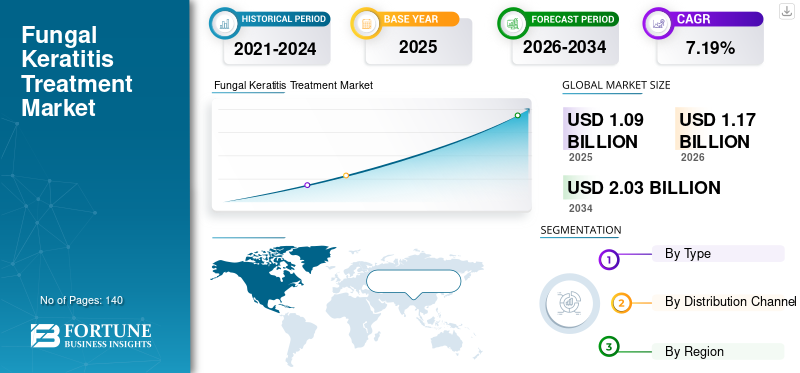
The global fungal keratitis treatment market size was valued at USD 1.09 billion in 2025. The market is projected to grow from USD 1.17 billion in 2026 to USD 2.03 billion by 2034, exhibiting a CAGR of 7.19% during the forecast period.

The fungal keratitis treatment market is gaining significant attention across the global ophthalmology sector due to the increasing burden of fungal eye infections and rising awareness regarding early diagnosis. Fungal keratitis is a severe corneal infection that can result in vision impairment if left untreated, creating sustained demand for antifungal therapeutics and specialized eye care solutions. The fungal keratitis treatment market report highlights expanding treatment adoption in hospitals, ophthalmology clinics, and specialty care centers. Growing use of topical antifungal medications, improvements in diagnostic technologies, and increasing healthcare expenditure on ocular diseases continue to strengthen market expansion. Pharmaceutical manufacturers are actively investing in innovative formulations and advanced drug delivery systems.
The USA fungal keratitis treatment market remains one of the most developed segments within the global industry due to strong healthcare infrastructure and widespread access to ophthalmology services. The country records a substantial number of fungal eye infection cases associated with contact lens use, ocular trauma, and immunocompromised patient populations. Advanced diagnostic laboratories, specialized eye hospitals, and extensive clinical research activities support market development. The fungal keratitis treatment market analysis indicates that demand for natamycin-based therapies, combination antifungal treatments, and improved ophthalmic formulations continues to increase across the United States. Increased awareness campaigns regarding corneal infections further contribute to treatment adoption and patient management efficiency.
Download Free sample to learn more about this report.
fungal keratitis treatment market Key Takeaways
 Global Market Size & Forecast
- 2025 Market Size: USD 1.09 Billion
- 2026 Market Size: USD 1.17 Billion
- 2034 Forecast Market Size: USD 2.03 Billion
- CAGR: 7.19% from 2026-2034
 Market Share
- North America dominated with a revenue share of 36% in 2025.
- Other treatments accounted for nearly 58% of the market share.
- Hospitals held approximately 46% of the market share by distribution channel.
 Key Regional Highlights
North America
North America led the market with a 36% regional share in 2025.
Asia-Pacific
Asia-Pacific accounted for 28% of the global market, supported by increasing ophthalmology care demand.
Europe
Europe represented 27% of the market, driven by established healthcare infrastructure and treatment access.
U.S
Strong demand for advanced ophthalmic treatments supported by developed healthcare infrastructure.
Japan
Accounted for 18% of the Asia-Pacific fungal keratitis treatment market.
Read More

fungal keratitis treatment market Latest Trends
The fungal keratitis treatment market trends reveal a growing emphasis on rapid diagnosis, precision ophthalmology, and advanced antifungal therapies. Healthcare providers are increasingly adopting molecular diagnostic technologies capable of identifying fungal pathogens within shorter timeframes, enabling faster treatment initiation. The market is also witnessing rising demand for preservative-free ophthalmic formulations that improve patient compliance and reduce irritation.
Download Free sample to learn more about this report.
Another important trend shaping the Fungal Keratitis Treatment Industry Analysis is the expansion of hospital-based eye care networks in emerging economies. Improved access to ophthalmologists and corneal specialists has accelerated diagnosis rates. Drug manufacturers are focusing on enhanced ocular penetration technologies designed to improve therapeutic effectiveness. Topical natamycin remains widely utilized, while interest in voriconazole-based formulations continues to increase in complex cases.
fungal keratitis treatment market Dynamics
DRIVER
Rising Prevalence of Fungal Eye Infections and Corneal Disorders
The primary growth driver for the fungal keratitis treatment market is the increasing incidence of fungal corneal infections worldwide. Agricultural workers, contact lens users, elderly individuals, and patients with weakened immune systems represent major risk groups. Tropical and subtropical regions continue to report elevated infection rates due to environmental exposure to fungal organisms. Healthcare systems are prioritizing early diagnosis and intervention because untreated fungal keratitis can lead to permanent vision damage. The fungal keratitis treatment market growth is further supported by increasing awareness among ophthalmologists regarding aggressive antifungal treatment protocols. Rising patient visits to specialized eye care facilities and greater availability of antifungal medications are also contributing to stronger market penetration across both developed and developing healthcare environments.
RESTRAINT
Limited Effectiveness of Existing Therapies in Severe Infections
Despite therapeutic advancements, treatment limitations remain a significant restraint within the fungal keratitis treatment market. Many antifungal agents exhibit restricted corneal penetration, reducing effectiveness in deep fungal infections. Some patients require prolonged treatment durations extending several weeks, which can negatively impact compliance. Delayed diagnosis often worsens outcomes and increases the need for surgical intervention. Drug resistance among specific fungal strains also creates treatment complexities. The Fungal Keratitis Treatment Industry Report indicates that healthcare providers frequently encounter challenges when managing advanced infections involving Fusarium and Aspergillus species. High dependence on specialized ophthalmic expertise and limited access to advanced diagnostic facilities in rural regions continue to restrict treatment efficiency and market expansion.
OPPORTUNITY
Expansion of Advanced Ophthalmic Drug Delivery Technologies
Significant opportunities are emerging through the development of innovative ocular drug delivery systems. Pharmaceutical companies are investing in sustained-release formulations, nanoparticle-based therapies, and improved topical delivery platforms designed to enhance drug penetration. The fungal keratitis treatment market opportunities segment is expected to benefit from increasing regulatory support for ophthalmic innovation. Growth in specialty eye hospitals and rising healthcare investments across Asia-Pacific countries further create favorable conditions for market expansion. Clinical research programs investigating combination antifungal therapies are generating new treatment possibilities. As healthcare providers seek more effective solutions for difficult fungal infections, manufacturers capable of delivering advanced ophthalmic products are expected to strengthen their competitive positioning and increase market share.
CHALLENGE
Delayed Diagnosis and Shortage of Specialized Eye Care Services
One of the major challenges affecting the fungal keratitis treatment market forecast is delayed disease recognition. Symptoms frequently resemble other ocular infections, leading to misdiagnosis and postponed treatment initiation. In several low-income regions, access to corneal specialists remains limited, reducing treatment effectiveness. Diagnostic equipment shortages and inadequate laboratory support further complicate disease management. The fungal keratitis treatment market Insights indicate that patients living in remote agricultural communities often reach healthcare facilities only after significant disease progression. Additionally, treatment costs associated with long-term therapy, repeated consultations, and potential surgical interventions create financial burdens. Addressing these challenges requires expanded ophthalmology infrastructure, improved clinician training, and greater availability of advanced diagnostic technologies.
fungal keratitis treatment market Segmentation
By Type
Antiviral Drugs account for approximately 18% market share within broader ocular infection management segments associated with fungal keratitis treatment support. Although fungal keratitis is primarily managed through antifungal therapies, antiviral medications are often prescribed when differential diagnosis includes viral corneal infections. Healthcare providers use these products during initial treatment evaluation before laboratory confirmation is obtained. The fungal keratitis treatment market Research Report indicates that integrated ophthalmology treatment approaches frequently involve multiple therapeutic categories to ensure comprehensive patient management. Increased diagnostic screening and improved laboratory testing have strengthened the appropriate utilization of antiviral medications.
Antihistamines represent nearly 14% market share and play an important supportive role in ocular symptom management. Patients experiencing irritation, redness, itching, and inflammatory reactions often receive antihistamine-based therapies alongside primary treatment protocols. The fungal keratitis treatment market analysis highlights growing utilization of combination ophthalmic care strategies aimed at improving patient comfort during recovery. Increasing availability of advanced eye care products has expanded treatment options across hospitals and retail pharmacies. Manufacturers continue introducing improved formulations that reduce discomfort while supporting clinical management.
Vaccines contribute approximately 10% market share within the broader research-oriented segment of the Fungal Keratitis Treatment Industry. While no widely established fungal keratitis vaccine exists for routine clinical use, ongoing research and development activities are creating opportunities within preventive ophthalmology. Biotechnology firms and pharmaceutical companies are exploring immunological approaches targeting fungal pathogens responsible for severe corneal infections. The fungal keratitis treatment market opportunities landscape reflects increasing investment in preventive healthcare technologies. Academic institutions and research organizations continue evaluating novel vaccine candidates and immune-based therapeutic strategies.
The Other category holds nearly 58% market share and includes antifungal medications, combination therapies, topical formulations, and advanced ophthalmic treatment products. This segment dominates the fungal keratitis treatment market because antifungal agents remain the primary standard of care. Natamycin, voriconazole, amphotericin B, and related therapies account for substantial prescribing volumes globally. Increasing prevalence of fungal infections, rising ophthalmology consultations, and greater treatment accessibility continue strengthening segment leadership. Pharmaceutical companies are actively investing in improved formulations capable of enhancing corneal penetration and therapeutic effectiveness.
By Distribution Channel
Distribution channels account for 100% of application-based market activity and remain critical to overall industry performance. Hospitals hold approximately 46% market share due to their role in managing severe fungal keratitis cases requiring specialist intervention and diagnostic support. Retail pharmacies and drug stores collectively represent around 34% market share, supported by increasing availability of prescription ophthalmic products. Specialty eye clinics contribute nearly 20% market share through focused ophthalmology services and follow-up care. The fungal keratitis treatment market Outlook indicates that distribution efficiency significantly influences treatment accessibility and patient outcomes. Expansion of healthcare networks, digital prescription systems, and specialty pharmaceutical distribution platforms continues strengthening product availability across both urban and rural healthcare environments.
fungal keratitis treatment market Regional Outlook
North America
North America commands approximately 36% of the global fungal keratitis treatment market Share. The region benefits from advanced ophthalmology networks, strong healthcare spending, and broad access to diagnostic technologies. The United States remains the largest contributor due to extensive specialist availability and high treatment awareness. Increasing use of contact lenses, rising incidence of corneal injuries, and growth in elderly populations continue supporting market demand. Healthcare providers increasingly implement rapid diagnostic tools capable of identifying fungal pathogens with greater accuracy. Pharmaceutical manufacturers maintain strong commercial presence through extensive distribution networks and ongoing clinical development programs. The fungal keratitis treatment market forecast for North America remains favorable because healthcare institutions continue investing in advanced eye care infrastructure. Research organizations actively collaborate with pharmaceutical companies to develop next-generation ophthalmic therapies. Hospitals and specialty eye clinics increasingly adopt integrated treatment approaches involving antifungal medications, imaging technologies, and surgical interventions when required.
Europe
Europe accounts for nearly 27% market share within the global fungal keratitis treatment market. Strong healthcare systems, widespread insurance coverage, and established ophthalmology research programs support regional growth. Countries across Western Europe demonstrate high treatment accessibility and extensive specialist availability. Healthcare providers emphasize early diagnosis and evidence-based treatment protocols to reduce vision complications associated with fungal infections. The Fungal Keratitis Treatment Industry Report indicates growing investment in ophthalmic diagnostics and pharmaceutical innovation throughout Europe. Demand for advanced antifungal therapies continues increasing as healthcare institutions focus on improving patient outcomes. Academic research centers actively participate in clinical investigations evaluating novel ocular treatment approaches. Specialty eye hospitals contribute significantly to regional treatment volumes by managing complex corneal infection cases.
Germany Fungal Keratitis Treatment Market
Germany represents approximately 29% of the European fungal keratitis treatment market Share. The country benefits from highly developed healthcare infrastructure, strong pharmaceutical manufacturing capabilities, and extensive ophthalmology expertise. Hospitals and specialized eye clinics maintain advanced diagnostic capabilities supporting accurate identification of fungal pathogens. Rising demand for targeted antifungal therapies and increased utilization of modern imaging technologies contribute to market growth. Germany’s research ecosystem actively supports innovation in ocular disease management through collaborations involving universities, biotechnology firms, and pharmaceutical companies. Strong reimbursement frameworks and consistent healthcare investments continue strengthening treatment accessibility throughout the country.
United Kingdom Fungal Keratitis Treatment Market
The United Kingdom contributes nearly 23% of the European fungal keratitis treatment market Share. The market benefits from widespread access to ophthalmology services and increasing awareness regarding corneal infection management. Public healthcare programs support early diagnosis initiatives and encourage specialist referrals when fungal infections are suspected. Hospitals continue adopting advanced laboratory testing methods that improve diagnostic accuracy. The fungal keratitis treatment market Research Report indicates growing demand for improved antifungal formulations and patient-focused treatment strategies. Research institutions across the United Kingdom remain actively involved in clinical investigations aimed at enhancing therapeutic effectiveness and reducing long-term visual complications.
Asia-Pacific
Asia-Pacific holds approximately 28% market share and remains one of the fastest expanding regions within the fungal keratitis treatment market. High disease prevalence, large population bases, and substantial agricultural workforces contribute to elevated infection rates. Countries throughout South Asia and Southeast Asia report significant fungal keratitis incidence due to environmental exposure and occupational risks. Healthcare investments are expanding rapidly, improving patient access to specialized ophthalmology services. The fungal keratitis treatment market growth in Asia-Pacific is supported by increasing healthcare infrastructure development and greater awareness regarding ocular infections. Governments and healthcare organizations are implementing programs focused on blindness prevention and early disease intervention. Pharmaceutical manufacturers are expanding regional operations to meet growing treatment demand. Hospitals and specialty eye centers continue increasing adoption of advanced diagnostic technologies.
Japan Fungal Keratitis Treatment Market
Japan accounts for approximately 18% of the Asia-Pacific fungal keratitis treatment market Share. The country benefits from sophisticated healthcare infrastructure and advanced ophthalmology research capabilities. High adoption of innovative diagnostic systems supports early disease identification and effective treatment planning. Pharmaceutical companies continue introducing advanced ophthalmic formulations designed to improve therapeutic outcomes. Aging demographics contribute to increasing demand for specialized eye care services. Hospitals and research institutions maintain active involvement in clinical studies focused on fungal infection management. Strong healthcare coverage and extensive specialist availability continue supporting stable market expansion throughout Japan.
China Fungal Keratitis Treatment Market
China represents nearly 30% of the Asia-Pacific fungal keratitis treatment market Share, making it one of the region’s largest contributors. Rapid healthcare modernization, expanding hospital networks, and increased awareness regarding eye diseases support market growth. Rising urbanization and improved access to healthcare services have strengthened diagnosis and treatment rates. Pharmaceutical manufacturers continue increasing production capabilities to address growing demand for ophthalmic medications. The fungal keratitis treatment market Insights indicate that government healthcare initiatives focused on vision preservation are further enhancing treatment accessibility. Continued investment in medical technology and specialist training supports long-term market development.
Rest of World
The Rest of World region accounts for approximately 9% market share and includes Latin America, the Middle East, and Africa. market growth is supported by improving healthcare infrastructure and increasing awareness regarding fungal ocular infections. Several countries are investing in specialized eye care facilities capable of diagnosing and managing complex corneal diseases. Rising prevalence of diabetes and other risk factors associated with ocular complications contributes to treatment demand. The fungal keratitis treatment market analysis highlights expanding pharmaceutical distribution networks across emerging economies. International healthcare partnerships are helping strengthen diagnostic capabilities and improve treatment accessibility. Governments and non-government organizations continue supporting blindness prevention initiatives and ophthalmology training programs.
List of Top Fungal Keratitis Treatment Companies
- Alvogen
- Bausch Health
- Gilead Biosciences, Inc.
- Glenmark Pharmaceuticals
- Leadiant Biosciences
- Merck & Co. Inc.
- Aurolab
- Eyevance Pharmaceuticals LLC
- Novo Holdings A/S (Xellia Pharmaceuticals)
- Pfizer Inc
Top Two Companies with Highest Market Share
- Bausch Health – 17% market share
- Pfizer Inc. – 14% market share
Investment Analysis and Opportunities
The fungal keratitis treatment market opportunities landscape continues attracting investment from pharmaceutical manufacturers, biotechnology companies, ophthalmology device developers, and healthcare providers. Investors are increasingly focusing on advanced antifungal therapies capable of addressing resistant fungal strains and improving treatment outcomes. Significant funding is being directed toward novel drug delivery systems that enhance corneal penetration and reduce treatment duration.
The fungal keratitis treatment market forecast indicates growing opportunities within emerging economies where healthcare infrastructure expansion is increasing patient access to specialist eye care. Hospital groups are investing in dedicated ophthalmology centers equipped with advanced diagnostic technologies. Venture capital firms and strategic investors are supporting startups developing innovative ocular therapeutics and artificial intelligence-based diagnostic platforms.
New Product Development
Innovation remains a critical component of the fungal keratitis treatment market growth strategy. Pharmaceutical companies are actively developing advanced topical antifungal formulations designed to achieve deeper corneal penetration and improved therapeutic effectiveness. Research efforts are increasingly focused on nanoparticle-based delivery technologies that allow controlled drug release and enhanced ocular absorption.
The fungal keratitis treatment market Research Report identifies rising interest in combination therapies capable of targeting multiple fungal pathogens simultaneously. Manufacturers are evaluating formulations that integrate antifungal and anti-inflammatory properties to improve recovery outcomes. Improved preservative-free ophthalmic solutions are also gaining attention due to their ability to reduce patient discomfort during prolonged treatment periods.
Five Recent Developments (2023-2025)
- Bausch Health expanded ophthalmology portfolio initiatives focused on advanced ocular infection management during 2024.
- Pfizer increased research activities involving anti-infective ophthalmic treatment programs in 2025.
- Glenmark Pharmaceuticals strengthened specialty eye care distribution capabilities across emerging markets during 2024.
- Aurolab expanded ophthalmology manufacturing capacity to support growing demand for eye care products in 2023.
- Eyevance Pharmaceuticals advanced commercial activities related to specialty ophthalmic therapeutics and infection management solutions during 2025.
Report Coverage of fungal keratitis treatment market
The fungal keratitis treatment market report provides extensive analysis of industry structure, treatment categories, competitive positioning, technological developments, and regional performance trends. Coverage includes detailed evaluation of antifungal therapies, supportive ophthalmic treatments, distribution channels, and emerging product innovations shaping market dynamics. The report examines demand patterns across hospitals, specialty eye clinics, and pharmaceutical distribution networks.
Request for Customization to gain extensive market insights.
The Fungal Keratitis Treatment Industry Analysis further assesses major growth drivers including increasing disease prevalence, expanding healthcare infrastructure, and rising awareness regarding early diagnosis. Market restraints, opportunities, and challenges are evaluated to provide a comprehensive understanding of industry conditions. Regional assessments cover North America, Europe, Asia-Pacific, and Rest of World markets with emphasis on market share distribution and healthcare trends.
Frequently Asked Questions
Fortune Business Insights says that the global market value stood at USD 1.09 billion in 2025 and is projected to reach USD 2.03 billion by 2034.
The market is expected to exhibit a CAGR of 7.19% during the forecast period of 2026-2034.
Other was the leading type segment, accounting for nearly 58% of the market, driven by the inclusion of antifungal medications, combination therapies, topical formulations, and advanced ophthalmic treatments.
Key players include Alvogen, Bausch Health, Gilead Biosciences, Inc., Glenmark Pharmaceuticals, Leadiant Biosciences, and Merck & Co. Inc.
Major trends include growing adoption of rapid molecular diagnostics and advanced antifungal therapies, along with rising demand for preservative-free ophthalmic formulations. North America leads regionally with approximately 36% market share.



- 2021-2034
- 2025
- 2021-2024
- 140
-

(Offer valid till 30th Sep 2026)
Get 30-60 hrs Free Customization
Expand Regional and Country Coverage, Segments Analysis, Company Profiles, Competitive Benchmarking, and End-user Insights.













.webp)






-
US +1 833 909 2966 ( Toll Free )
-
Get In Touch With Us