Gas Analyzers Market Size, Share & Industry Analysis, By Technology (Electrochemical, Infrared (NDIR/IR), Paramagnetic, Zirconia (ZrO2), and Tunnel Diode Laser (TDL)/Laser Based), By Type (Fixed Gas Analyzers, Portable Gas Analyzers, and In-Line/Process Gas Analyzers), By End-Use Industry (Oil and Gas, Chemical and Petrochemical, Power Generation, Healthcare and Medical, Food and Beverage, and Others), and Regional Forecast, 2026-2034
 Download Free Sample
Gas Analyzers Market Size and Future Outlook
 Listen to Audio Version
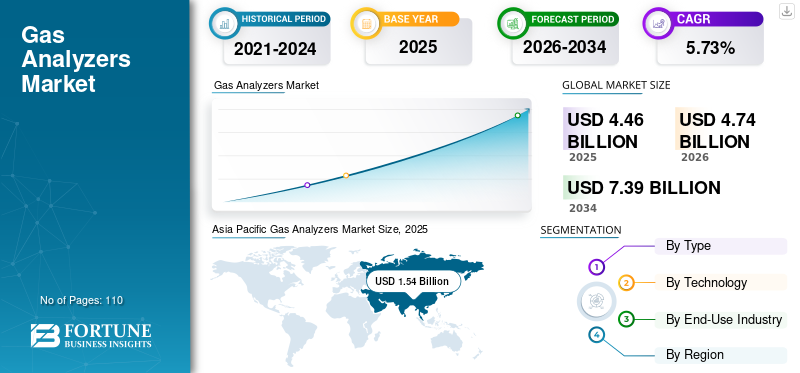
The global gas analyzers market size was valued at USD 4.46 billion in 2025 and is projected to grow from USD 4.74 billion in 2026 to USD 7.39 billion by 2034, exhibiting a CAGR of 5.73% during the forecast period. Asia Pacific dominated the gas analyzers market with a market share of 34.53% in 2025.
Gas analyzers are used to measure and monitor a wide range of gas concentrations, depending on the application and industry. It is widely used to monitor gas levels for safety, process control, environmental compliance, and quality assurance across industries such as oil & gas, chemicals, healthcare, and power generation. Gas analyzer measure a wide range of gases, including oxygen (O₂), carbon dioxide (CO₂), carbon monoxide (CO), nitrogen oxides (NOx), sulfur dioxide (SO₂), methane (CH₄), hydrogen (H₂), hydrogen sulfide (H₂S), ammonia (NH₃), and volatile organic compounds (VOCs), to ensure safety, and regulatory compliance across industries. Gas analyzers are increasingly integrated with remote monitoring capabilities, enabling real-time tracking of gas concentrations across industrial and environmental applications. These systems enable operators to access data remotely, perform predictive maintenance, and respond quickly to abnormal gas levels, enhancing safety and operational efficiency.
The growing enforcement of stringent environmental regulations and emission requirements across industries is the main factor driving the gas analyzer sector, forcing firms to implement sophisticated monitoring systems to ensure compliance. The demand for gas-based analyzer, which are used to ensure effective process control and operational safety, is growing rapidly as industries such as oil and gas, chemicals, and power generation industrialize. Increasing knowledge of workplace safety and the necessity to identify hazardous and toxic gases is also driving adoption among industrial plants.
ABB, Siemens, and Horiba Ltd. are considered major vendors in the market due to their strong technological capabilities, broad product portfolios, and global presence across key industrial sectors. These companies offer advanced gas analysis solutions integrated with automation and digital monitoring systems, making them highly preferred in industries such as oil & gas, power generation, chemicals, and environmental monitoring.
Download Free sample to learn more about this report.
GAS ANALYZERS MARKET Key Takeaways
 Global Market Size & Forecast
- 2025 Market Size: USD 4.46 billion
- 2026 Market Size: USD 4.74 billion
- 2034 Forecast Market Size: USD 7.39 billion
- CAGR: 5.73% from 2026–2034
 Market Share
- Asia Pacific dominated the market with a 34.53% share in 2025.
- Fixed gas analyzers held a 67.88% share in 2025.
- Electrochemical technology accounted for a 37.23% share in 2025.
 Key Regional Highlights
Asia Pacific
Asia Pacific reached USD 1.54 billion in 2025.
North America
North America reached USD 1.27 billion in 2025.
Europe
Europe reached USD 1.09 billion in 2025.
U.S.
Market reached USD 1.03 billion in 2025.
Japan
Market growth is supported by advanced industrial monitoring adoption.
Read More

GAS ANALYZERS MARKET TRENDS
Increasing Investments in Environmental Monitoring Infrastructure to Drive Market Growth
Increasing investments in environmental monitoring infrastructure are driving significant growth in the market, as governments and regulatory bodies worldwide prioritize air quality management and pollution control. Public and private sector funding is being directed toward the development of monitoring stations, smart cities, and industrial emission tracking systems to ensure compliance with environmental standards. This has led to a higher deployment of advanced gas analyzers for continuous monitoring of pollutants such as CO₂, NOx, and SOx across urban and industrial areas. Additionally, rising concerns over climate change and public health are encouraging industries to adopt reliable gas measurement solutions, further boosting demand.
In January 2024, the cutting-edge AP-380 series of analyzers from HORIBA, Ltd., a world leader in analytical and measurement technologies, is designed to meet a wide range of air quality monitoring requirements. The AP-380 series includes five models, each tailored for specific trace gas monitoring needs: APMA-380 for carbon monoxide, APSA-380 for sulfur dioxide, APOA-380 for ozone, APNA-380 for nitrogen oxides, and APHA-380 for hydrocarbons. This product development aligns with the growing investment in environmental monitoring infrastructure, as governments and industries worldwide expand air quality monitoring networks to address rising pollution levels and comply with stringent environmental regulations.
MARKET DYNAMICS
MARKET DRIVERS
Download Free sample to learn more about this report.
Rising Industrialization in Oil and Gas, Chemicals, and Power Generation to Drive Market Growth
Rising industrialization in sectors such as oil & gas, chemicals, and power generation is a key driver of the gas analyzers market growth, as these industries rely heavily on precise gas monitoring for efficient and safe operations. In oil & gas and chemical processing, gas-based analyzers are essential for detecting hazardous gases, preventing leaks, and optimizing processes. At the same time, in power generation, they are widely used for combustion control and emission monitoring. As industrial activities expand, the need to comply with stringent environmental and safety regulations is increasing, further accelerating the adoption of advanced gas analysis systems.
In February 2026, the Rosemount QX1000 Continuous Gas Analyzer, recently launched by Emerson, is designed for use in continuous emissions monitoring systems (CEMS) and a wide range of industrial applications across the oil & gas, chemical, and power generation sectors. To meet stringent performance standards, the QX1000 uses quantum-cascade laser direct absorption spectroscopy for multiple gases and paramagnetic oxygen (O₂) detection, ensuring high accuracy and reliability.
MARKET RESTRAINTS
High Initial Investment and Maintenance Costs to Restrain the Market Growth
High capital and lifecycle costs act as a major barrier to the widespread adoption of such analyzers, particularly among cost-sensitive end users. Advanced gas-based analyzers such as infrared (NDIR), paramagnetic, zirconia, and laser-based systems require sophisticated components, precision engineering, and robust enclosures for harsh environments (oil & gas, chemicals, power plants). This significantly increases the initial procurement cost, especially for multi-gas and continuous monitoring systems.
Beyond installation, ongoing maintenance expenses further restrict market growth. Gas analyzers require periodic calibration using certified gases, frequent sensor replacement, and regular servicing to maintain accuracy and regulatory compliance. In industries with continuous operations, maintenance downtime also translates into productivity losses.
Additionally, skilled personnel and infrastructure requirements (e.g., calibration setups, integration with control systems) increase the total cost of ownership. For small and medium enterprises (SMEs) and facilities in developing regions, these cumulative costs often lead to delayed investments or a preference for lower-cost, less advanced alternatives.
MARKET OPPORTUNITIES
Rising Demand in Healthcare and Laboratories to Drive Market Growth
The growing use of gas analyzers in healthcare and laboratory settings is significantly driving market expansion, as they play a critical role in ensuring accuracy, safety, and compliance. In healthcare, gas-based analyzers are widely used to monitor medical gases, including oxygen, carbon dioxide, and anesthetic gases, in applications such as anesthesia delivery, respiratory care, and intensive care units. Accurate gas measurement is essential to ensure patient safety and effective treatment, thereby driving consistent demand from hospitals and clinics.
In laboratories and research facilities, such analyzers are essential for precise gas composition analysis, calibration processes, and experimental validation across pharmaceuticals, biotechnology, and environmental research. Increasing R&D activities, especially in drug development and clinical diagnostics, are further driving demand for high-precision analytical instruments.
In April 2026, Maxtec and Perma Pure announced their merger under Salaera, a new parent organization, to create a worldwide technology platform devoted to the integrity of breath and gas systems. This action establishes one of the most all-inclusive platforms in the industry for respiratory care, diagnostics, healthcare, and laboratory applications, life sciences, air quality monitoring, and industrial gas analysis. The combined business is well-positioned to dominate a market driven by the growing need for precise, connected, and data-rich systems by further enhancing its expertise in gas analyzers for laboratory and medical settings.
MARKET CHALLENGES
High Capital and Lifecycle Costs to Hamper Market Growth
The widespread use of such analyzers is severely hampered by their high lifecycle and capital expenditures, particularly in developing countries and cost-conscious sectors. Advanced gas analyzers, such as infrared (NDIR), paramagnetic, and laser-based systems, use sophisticated sensing technologies, high-precision components, and robust designs that are necessary for demanding industrial settings. This results in a significant upfront investment, particularly for continuous monitoring and multi-gas systems used in the oil and gas, chemical, and electricity production industries.
Segmentation Analysis
By Technology
Portable Safety and Environmental Monitoring Applications Drives Electrochemical Segment Growth
Based on the technology, the market is classified into electrochemical, infrared (NDIR/IR), paramagnetic, zirconia (ZrO2), and tunnel diode laser (TDL)/laser-based.
Electrochemical dominates the market, with a 37.23% share in 2025. Due to its high sensitivity, affordability, and versatility across a wide range of applications, the market is dominated by the electrochemical sector. Electrochemical sensors are highly effective at detecting hazardous gases such as carbon monoxide (CO), hydrogen sulfide (H2S), oxygen (O2), and nitrogen oxides (NOx). However, they are widely used across industries, including environmental monitoring, healthcare, chemicals, and oil & gas.
The paramagnetic segment is the fastest-growing segment in the market. The paramagnetic segment is projected to grow at a CAGR of 6.67% during the forecast period. The paramagnetic section of gas analyzers is widely preferred as it is highly precise and reliable for measuring oxygen (O2), which is essential in many sectors. Paramagnetic analyzers are made specifically for oxygen identification and use non-consumable sensor technology, which extends their operational life and reduces maintenance costs when compared to electrochemical alternatives.
By Type
Demand for Continuous Monitoring and Enhanced Industrial Safety Compliance Drives Fixed Gas Analyzers Segment Growth
By type, the market is categorized into fixed gas analyzers, portable gas analyzers, and in-line/process gas analyzers.
The fixed gas analyzer segment dominates the market and accounted for a 67.88% share in 2025. The segment is driving the market's growth due to its essential function in continuous monitoring and industrial safety, fixed gas analyzers are experiencing considerable growth in the market. Real-time detection of hazardous gases is critical across industries such as oil and gas, chemicals, power generation, and manufacturing to prevent accidents, protect workers, and comply with regulations. As a result, these systems are extensively used in these sectors. Fixed gas analyzers, unlike portable equipment, offer continuous monitoring, increased reliability, and integration with control systems (SCADA/DCS), allowing for automated alerts and process optimization.
The portable gas analyzer segment is the fastest-growing segment in the market and is growing with a CAGR of 6.44%. Due to their versatility, simplicity, and growing need for on-site, real-time monitoring, portable gas analyzers are the fastest-expanding sector in the market. These devices are lightweight, compact, and ideal for field use across sectors such as oil & gas, mining, chemicals, and environmental monitoring.
By End-User Industry
To know how our report can help streamline your business, Speak to Analyst
Demand for Continuous Gas Monitoring to Enhance Safety and Optimize Processes Drives Oil and Gas Segment Growth
By end-user industry, the market is categorized into oil and gas, chemical and petrochemical, power generation, healthcare and medical, food and beverage, and others.
The oil and gas segment dominates the market and accounted for 26.80% of gas analyzers market share in 2025. The increasing demand for real-time gas monitoring to ensure safety, efficiency, and regulatory compliance across expanding exploration, production, and refining operations is driving the oil and gas industry's expansion. The industry's move toward sophisticated gas analyzers is also being fueled by increased investment in LNG infrastructure, tougher emissions regulations, and greater emphasis on leak detection and process optimization.
The healthcare and medical segment is the fastest-growing segment in the market. The segment is growing with a CAGR of 8.45%. As accurate gas measurement is essential in life-support and diagnostic applications, the healthcare and medical industry is becoming a leading sector in the market. To accurately measure oxygen, carbon dioxide, and other medical gases, which are crucial for patient safety and treatment efficacy, gas analyzers are widely used in ventilators, anesthesia machines, and respiratory monitoring systems.
Gas Analyzers Market Regional Outlook
By region, the market is categorized into Europe, North America, Asia Pacific, Latin America, and the Middle East & Africa.
Asia Pacific
Asia Pacific Gas Analyzers Market Size, 2025 (USD Billion)
To get more information on the regional analysis of this market, Download Free sample
The Asia Pacific region has a dominating share of the market. Asia Pacific accounted for an estimated USD 1.54 billion in 2025 and USD 1.65 billion in 2026. Due to rapid industrialization and rising energy demand in nations such as China, India, and Southeast Asia, the market in the Asia Pacific is growing. The area is seeing major investments in the oil and gas, chemical, electricity production, and manufacturing industries, all of which need ongoing gas monitoring to ensure process efficiency and safety. The use of cutting-edge gas-based analyzer is also being driven by ever-stricter environmental legislation in China, India, and other countries that aims to curb air pollution and industrial emissions.
China Gas Analyzers Market
In 2025, the China market reached USD 0.61 billion. The main driver of China's market is the nation's aggressive push toward industrial modernization and digital process control across critical industries. To improve efficiency and automation in Chinese industries under initiatives such as "Made in China 2025," there is an increasing integration of sophisticated monitoring systems, such as gas analyzer, to reduce operational losses and optimize production processes.
In March 2026, Honeywell released a novel gas sensor that uses optical Nondispersive Infrared (NDIR) technology to detect combustible gases in industrial environments, including methane, propane, and butane. By enabling precise, continuous monitoring of hydrocarbon gases, the NDIR Hydrocarbon Gas Sensor enhances the performance of gas analyzer systems. It contributes to protecting employees and infrastructure in sectors such as the petroleum, mining, petrochemical, and plastics industries, where accurate gas analysis is essential for operational efficiency and safety.
India Gas Analyzers Market
The Indian market in 2025 was valued at around USD 0.25 billion, accounting for roughly 16.00% of the global market. The market is growing within a distinct framework driven by regulatory enforcement, energy diversification, and infrastructure-led industrial expansion, rather than solely by legacy industrial demand. A key driver is India’s increasing implementation of environmental compliance mechanisms such as Continuous Emission Monitoring Systems (CEMS) mandated by bodies such as the Central Pollution Control Board (CPCB), pushing industries to adopt such analyzers for real-time emissions tracking.
North America
North America was valued at roughly USD 1.27 billion in 2025 and is estimated to reach USD 1.35 billion in 2026. Due to technological advancements and asset optimization strategies across established industries, the North America market is expanding, but not due to new industrial growth. To increase operational efficiency, reduce downtime, and extend asset life, firms in the U.S. and Canada are increasingly emphasizing replacing outdated monitoring systems with modern, high-precision analyzers.
U.S. Gas Analyzers Market
The U.S. market was valued at around USD 1.03 billion in 2025. The U.S. market is expanding primarily due to the nation's robust innovation ecosystem and the widespread adoption of cutting-edge measurement technologies across specific industries. In contrast to other areas, growth is primarily driven by R&D-intensive sectors such as aerospace, semiconductors, pharmaceuticals, and biotechnology, where highly accurate gas analysis is essential to product quality.
Europe
The Europe market in 2025 was valued at USD 1.09 billion and is projected to reach USD 1.15 billion in 2026. The main factors driving the expansion of the European industry are the region's aggressive decarbonization plan, which is driven by regulation, and its shift toward industrial sustainability. The EU Green Deal, the Industrial Emissions Directive (IED), and carbon-reduction goals are examples of stringent climate regulations that are forcing industries to use sophisticated analyzers for accurate emissions monitoring and reporting. In contrast, in other regions, such regulations primarily drive growth.
U.K. Gas Analyzers Market
The U.K. market in 2025 was valued at around USD 0.14 billion, representing roughly 12.70% of the global market. The U.K. market is expanding as the country's emphasis on repurposing infrastructure and transforming energy systems intensifies, particularly in the transition from traditional fossil fuels to low-carbon energy sources. The U.K. is actively building carbon capture clusters, biogas plants, and hydrogen-ready infrastructure, all of which require sophisticated gas-based analyzers to monitor gas composition, purity, and process performance.
Germany Gas Analyzers Market
The Germany market in 2025 was valued at around USD 0.24 billion, accounting for roughly 21.80% of the global market. Germany's industry is expanding primarily due to its strong foundation in sophisticated production and process engineering, where accuracy and efficiency are key. The adoption of high-performance gas-based analyzers in production environments is driven by the emphasis German industries place on process precision, quality assurance, and operational reliability, particularly in the automotive, chemical, and industrial equipment sectors.
Latin America and Middle East & Africa
Latin America and the Middle East & Africa accounted for USD 0.28 billion and USD 0.34 billion, respectively, in 2025. The Latin America market is growing primarily due to the region’s resource-driven industrial expansion and increasing foreign investments in extractive industries. Countries such as Brazil, Mexico, and Chile are witnessing rising activity in oil & gas, mining, and metals, where such analyzers are essential for safety monitoring and process control in challenging operating environments.
The main driver of growth in the Middle East & Africa industry is the region's focus on reducing operational risk and managing asset integrity in harsh conditions. The harsh climate of the region makes it essential for industries such as oil and gas, mining, and heavy manufacturing to maintain ongoing gas monitoring to prevent equipment malfunctions, protect employees, and ensure continuous production.
GCC Gas Analyzers Market
The GCC market in 2025 was valued at around USD 0.18 billion, representing roughly 51.00% of the global market. The GCC market is expanding due to the region's emphasis on developing value-added processing and downstream diversification. In an effort to lessen reliance on crude exports, nations such as Saudi Arabia and the United Arab Emirates are increasingly investing in petrochemicals, refining, and gas processing facilities. This is fueling demand for sophisticated gas-based analyzers for quality assurance.
COMPETITIVE LANDSCAPE
Key Industry Players
Advanced and Connected Gas Analyzers Drive Safety, Compliance, and Process Efficiency across Industries
To boost their market share, gas analyzer manufacturers are increasingly emphasizing technological innovation, digital integration, and application-specific solutions. They are developing sophisticated analyzers that use methods such as electrochemical sensing, laser-based spectroscopy, and NDIR to improve accuracy, reaction time, and reliability. In addition, vendors are integrating cloud-based and IoT platforms into their systems to facilitate predictive maintenance, remote diagnostics, and real-time monitoring.
In May 2023, the IR800G Rack Type Infrared Gas Analyzer, the IR810G Wall and Panel Mount Type Infrared Gas Analyzer, and the IR810S Explosion-protected model Infrared Gas Analyzer (wall mount) were introduced. These are a new generation of Non-Dispersive Infrared method (NDIR) gas analyzers by Yokogawa Electric Corporation. These were added to its OpreX Analyzers product line meeting a wide range of installation and operational requirements. These new NDIR gas analyzers are anticipated to play a significant role in reducing greenhouse gas emissions, which are directly linked to global warming. They achieve this by simultaneously and continuously measuring the concentrations of NO, SO2, CO2, CO, CH4, and O2 with great precision.
LIST OF KEY GAS ANALYZERS COMPANIES PROFILED
- Siemens AG (Germany)
- Emerson Electric Co. (U.S.)
- Honeywell International Inc. (U.S.)
- Yokogawa Electric Corporation (Japan)
- Thermo Fischer Scientific Inc. (U.S.)
- Endress+Hauser Group (Switzerland)
- AMETEK Inc. (U.S.)
- Horiba Ltd. (Japan)
- Servomax Group Ltd. (U.K.)
- ABB (Switzerland)
KEY INDUSTRY DEVELOPMENTS
- February 2026: ABB introduced its first complete gas analyzer package for Carbon Capture, Utilization, and Storage (CCUS) applications by combining three tried-and-tested ABB technologies into a single, simplified solution. The new product offers a comprehensive, real-time measurement set to identify CO₂ contamination and ensure compliance throughout the entire CCUS value chain. The solution will aid in decarbonizing sectors that are difficult to reduce, such as cement, waste-to-energy, oil refining, bioenergy, LNG, power production, and chemicals.
- September 2025: The industry-leading Dansensor CheckMate 4 headspace gas analyzer from AMETEK MOCON, the world's top provider of gas measurement solutions, introduced two new Small Volume modules. These modules are designed to improve the functionality of gas analyzer systems, an increasingly important need across sectors, by providing accurate oxygen measurements in packaging with very little headspace. Dansensor offers cutting-edge gas analyzer testing solutions for Modified Atmosphere Packaging (MAP), where headspace gas analysis is essential to maintaining product quality and extending shelf life. Gas analyzer applications, including coffee capsules, pharmaceutical blister packs, medical vials, and ampoules, now have unrivaled accuracy and reliability thanks to the new Small Volume modules.
- January 2025: The strategic partnership for process automation between the Swiss measurement technology expert Endress+Hauser and SICK, a German-based worldwide supplier of sensor-based automation solutions, began. The two businesses are collaborating to develop cutting-edge technology solutions to decarbonize the process industry and improve customer service. Through the global Endress+Hauser Sales Centers, customers will now have access to a wider selection of products from a single source. The partnership "Endress+Hauser SICK GmbH+Co. KG" will broaden the range of solutions by enhancing the creation and manufacture of gas flow meter and analyzer technologies. To respond to the rising global demand for automation and digitalization, SICK is focusing on its core business of factory and logistics automation.
- June 2024: The PAS Sense product line established ENVEA as the sole provider of Lumasense A/S INNOVA goods. The PAS SENSE series, which will include multi-gas analyzer products, sampler/doser products, and related software products, will be produced, maintained, and distributed by the CAI ENVEA Group facility in California. For more than 15 years, CAI has been INNOVA's sole sales and service partner in the North American market. CAI is well-positioned to produce, service, and calibrate PAS SENSE photoacoustic spectroscopy devices with accuracy and reliability, thanks to its current staff, equipment, and gas cylinder inventory.
- May 2024: HORIBA STEC, Co., Ltd. will make the laser gas analyzer LG-100 Series available. This instrument is capable of measuring real-time variations in the partial pressure of silicon tetrafluoride (SiF4), which is created during the etching procedure utilized in semiconductor production. With these modifications, manufacturers can now determine whether the etching has reached an acceptable depth (endpoint*2). When producing semiconductors, the LG-100 reduces the risk of under- and over-etching*3, resulting in increased yield and productivity.
REPORT COVERAGE
The global gas analyzers market analysis provides an in-depth study of the market size & forecast across all market segments included in the report. It contains details on the market dynamics and market trends expected to drive the market in the forecast period. It offers information on technological advancements, new product launches, key industry developments, and partnerships, mergers & acquisitions. The market research report also includes a detailed competitive landscape, providing market share and profiles of key players.
Request for Customization to gain extensive market insights.
Report Scope & Segmentation
| ATTRIBUTE | DETAILS |
| Study Period | 2021-2034 |
| Base Year | 2025 |
| Estimated Year | 2026 |
| Forecast Period | 2026-2034 |
| Historical Period | 2021-2024 |
| Growth Rate | CAGR of 5.73% from 2026-2034 |
| Unit | Value (USD billion) |
| Segmentation | By Technology, Type, End-Use Industry, and Region |
| By Technology |
|
| By Type |
|
| By End-Use Industry |
|
| By Region |
|
Frequently Asked Questions
Fortune Business Insights says that the global market value stood at USD 4.46 billion in 2025 and is projected to reach USD 7.39 billion by 2034.
The market is expected to exhibit a CAGR of 5.73% during the forecast period.
The oil and gas segment led the market by end-use industry.
The rising industrialization in oil and gas, chemicals, and power generation to drive the market growth.
Siemens, ABB, and Horiba are among the prominent players in the market.
Asia Pacific region dominated the market with the highest share in 2025.
The rising demand in healthcare and laboratories to drive market growth.



- 2021-2034
- 2025
- 2021-2024
- 110
Get 30-60 hrs Free Customization
Expand Regional and Country Coverage, Segments Analysis, Company Profiles, Competitive Benchmarking, and End-user Insights.



















Related Reports
-
US +1 833 909 2966 ( Toll Free )
-
Get In Touch With Us