Gastrointestinal Stent Market Size, Share & Industry Analysis, By Product Type (Biliary Stents, Duodenal Stents, Colonic Stents, Esophageal Stents, and Others), By Material (Metal, Plastic, and Others), By Application (Biliary Disease, Colorectal Cancer, Inflammatory Bowel Disease, Esophageal Cancer, Gastric/Duodenal Cancer, and Others), By End-user (Hospitals & ASCs, Clinics, and Others), and Regional Forecast, 2026-2034
 Download Free Sample
 KEY MARKET INSIGHTS
 Listen to Audio Version
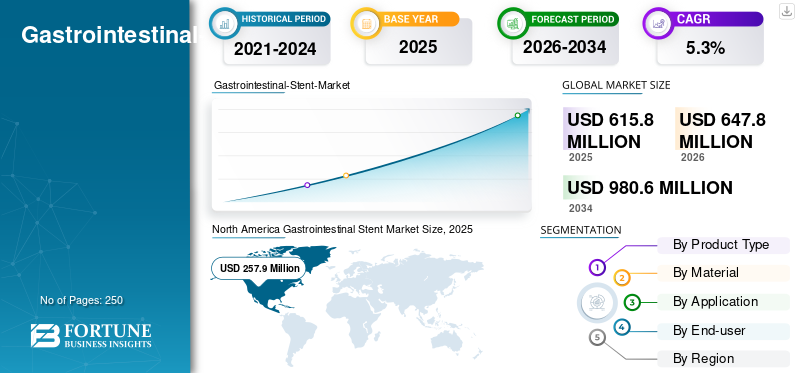
The global gastrointestinal stent market size was valued at USD 615.8 million in 2025. The market is projected to grow from USD 647.8 million in 2026 to USD 980.6 million by 2034, exhibiting a CAGR of 5.3% during the forecast period. North America dominated the global gastrointestinal stent market with a market share of 41.88% in 2025.
A gastrointestinal stent is a flexible tube composed of metal, plastic, or biodegradable materials that is inserted into the digestive tract, such as the stomach, esophagus, intestine, or bile duct, to relieve blockages caused by gastrointestinal disorders. The market growth is attributed to the significant burden of gastrointestinal issues, including biliary disease, esophageal cancer, colorectal cancer, and others.
The industry is led by major players, including Boston Scientific Corporation, Olympus Corporation, and others. These players have a diversified portfolio of gastrointestinal stents with various diameters, which is contributing to their high market share.
Download Free sample to learn more about this report.
Gastrointestinal Stent Market Takeaways
 Market Size & Forecast
- 2025 Market Size: USD 615.8 million
- 2026 Market Size: USD 647.8 million
- 2034 Forecast Market Size: USD 980.6 million
- CAGR: 5.3% from 2026–2034
 Market Share
- North America dominated the gastrointestinal stent market with a 41.88% share in 2025.
- Metal stents are expected to hold a 61.1% market share in 2026.
- Colonic stents are projected to grow at a CAGR of 5.6% during the forecast period.
 Key Regional Highlights
North America
North America remained the leading regional market, reaching USD 257.9 million in 2025 and maintaining its dominant position.
Europe
Europe is projected to record the second-highest regional growth rate of 5.4% and reach USD 189.2 million by 2026.
Asia Pacific
Asia Pacific is expected to reach USD 133.8 million by 2026, securing its position as the third-largest regional market.
U.S.
The market is estimated to reach USD 256.0 million in 2026, supported by growing adoption of gastrointestinal stenting procedures.
Japan
The market is anticipated to witness steady growth, driven by increasing demand for advanced gastrointestinal disease management and minimally invasive treatment options.
Read More

MARKET DYNAMICS
MARKET DRIVERS
Increasing Number of ERCP Procedures to Drive Market Growth
Over the past few years, there has been a surge in procedures of endoscopic retrograde cholangiopancreatography (ERCP). These minimally invasive interventions are used to diagnose and treat biliary and pancreatic duct disorders, which is anticipated to spur the demand for gastrointestinal stents, particularly biliary stents.
- For instance, according to data from the National Center for Biotechnology Information (NCBI) as of August 2022, more than 650,000 ERCP procedures are performed annually in the U.S.
Moreover, an increasing number of hospitals are performing these minimally invasive procedures due to favorable reimbursement in developed economies, which is further supporting the adoption of gastrointestinal stents. Such a scenario is projected to drive global gastrointestinal stent market growth.
MARKET RESTRAINTS
High Cost & Limited Reimbursement in Certain Countries to Restrict Market Growth
Despite their clinical significance, the high expense of gastrointestinal stenting procedures and the cost of self-expanding metal stents are limiting their adoption among healthcare facilities.
- For instance, according to an article published by Hangzhou Tangji Medical Technology Co., Ltd. in April 2025, the cost of a nitinol biliary stent ranges between USD 500 and USD 1,500, which is significantly higher than that of plastic stents.
Moreover, in several countries, gastrointestinal stents are not widely utilized due to limited reimbursement, which is expected to further hinder market expansion.
MARKET OPPORTUNITIES
Growth of Ambulatory Surgical Centers (ASCs) to Offer Lucrative Growth Opportunities
In recent years, there has been an increase in ambulatory surgery centers in the U.S., Japan, and Australia. Additionally, there is an increasing migration of therapeutic endoscopy into ASCs, which is reducing the burden on hospitals.
- For instance, according to the data published by the MedPAC, the count of Medicare-certified ASCs increased by 2.5% between 2022 and 2023, totaling 6,308 centers during that period.
Moreover, ASCs are adopting newer, advanced stents due to improved procedural efficiency. As a result, this offers a lucrative opportunity for manufacturers to target ASC-focused procurement models.
GASTROINTESTINAL STENT MARKET TRENDS
Clinical Guidelines Endorsing Specific Stenting Practices to Emerge as a Key Market Trend
Currently, the clinical guidelines globally are increasingly endorsing specific stenting practices, including colonic stenting, esophageal stenting for malignant strictures, and metal biliary stents for malignant obstructions.
This standardization is driving improved global adoption of gastrointestinal stents and reducing variability in procedural approaches, thereby enhancing treatment consistency and patient outcomes. Such alignment with clinical protocols is expected to support wider acceptance and integration into routine care worldwide.
Download Free sample to learn more about this report.
MARKET CHALLENGES
Shortage of Trained Professionals to Challenge Market Growth
In emerging and low-income markets, there are insufficiently trained endoscopists or ERCP specialists, which is creating a procedure gap.
- For instance, according to data from ScienceDirect in 2024, there is a shortage of endoscopists and a lack of quality data to guide practice in gastrointestinal endoscopy.
Additionally, the limited availability of gastroenterologists is leading to delayed diagnoses of gastrointestinal conditions, which is hampering the demand for procedures and further challenging market expansion.
Segmentation Analysis
By Product Type
Increasing Biliary Stenting Procedures Boosted the Segment’s Growth
Based on product type, the market is classified into biliary stents, duodenal stents, colonic stents, esophageal stents, and others.
To know how our report can help streamline your business, Speak to Analyst
The biliary stents segment accounted for the largest global gastrointestinal stent market share in 2025. The growth is mainly attributed to the increasing number of biliary stenting procedures for bile duct cancer and other related tissues, which is influencing key players to launch newer biliary stents.
The colonic stents segment is projected to grow at a CAGR of 5.6% during the forecast period.
By Material
Metal Segment Dominated due to its Larger Diameter
Based on material, the market is segmented into metal, plastic, and others.
The metal segment accounted for the largest share in 2025. Metal stents are generally preferred over plastic stents due to their larger diameter, which reduces the risk of occlusion or blockage, resulting in longer stent patency. As a result, the metal stents are being widely used in malignant cases, which is expected to fuel the segment’s growth. Furthermore, the segment is expected to hold a 61.1% share in 2026.
The plastic segment is projected to grow at a CAGR of 5.1% during the forecast period.
By Application
High Prevalence of Biliary Disease Encouraged the Segment’s Growth
Based on application, the market is segmented into biliary disease, colorectal cancer, inflammatory bowel disease, esophageal cancer, gastric/duodenal cancer, and others.
The biliary disease segment accounted for the largest share in 2025, attributed to the high prevalence of biliary diseases, such as biliary strictures and choledocholithiasis, which require stenting. Furthermore, the segment is expected to hold a 41.5% share in 2026.
- For instance, according to data published by the Journal of Clinical Gastroenterology and Hepatology in August 2024, 6.0% of the global population has gallstones, with higher rates in South America.
The esophageal cancer segment is projected to grow at a CAGR of 5.8% during the forecast period.
By End-user
Increasing Number of Procedures Performed in hospitals & ASCs Globally Drives the Segment Growth
Based on end-user, the market is segmented into hospitals & ASCs, clinics, and others.
In 2025, the global market was dominated by hospitals & ASCs. The growth is attributed to a higher volume of gastrointestinal stenting procedures performed in hospitals & ASCs due to the availability of expertise and high resources in these settings. Moreover, a large number of hospitals globally are supporting the utilization of gastrointestinal stents. Furthermore, the segment is set to hold 73.2% share in 2026.
- For instance, according to the 2025 edition of AHA Hospital Statistics, there are approximately 6,093 hospitals in the U.S.
The clinics segment is projected to grow at a CAGR of 5.4% during the forecast period.
Gastrointestinal Stent Market Regional Outlook
By geography, the market is categorized into North America, Europe, Asia Pacific, Latin America, and the Middle East & Africa.
North America Gastrointestinal Stent Market Size, 2025 (USD million)
To get more information on the regional analysis of this market, Download Free sample
North America
North America secured the dominant share in 2024, valued at USD 245.0 million, and maintained its leading position in 2025, with USD 257.9 million. The growth is attributed to the higher reimbursement rate in the U.S. and Canada, which is supporting the gastrointestinal stenting procedures. In 2026, the U.S. market is estimated to reach USD 256.0 million.
- For instance, in November 2025, Medicare covers endoscopic stent placement in the upper GI tract under CPT code 43266.
Europe
Europe is poised to expand at a notable rate in the forthcoming years. During the study timeframe, the region is projected to record a growth rate of 5.4%, the second-highest among all regions, and touch a valuation of USD 189.2 billion by 2026. This growth is attributed to the high demand for minimally invasive procedures, including gastrointestinal stent placement, and the presence of key players in the region. Owing to these factors, countries including the U.K. are anticipated to record the valuation of USD 26.1 million, Germany to record USD 49.7 million, and France to record USD 24.8 million in 2026.
Asia Pacific
The market in Asia Pacific is estimated to reach USD 133.8 million in 2026 and secure the position of the third-largest region in the market. In the region, and India are both estimated to reach USD 14.2 million and USD 42.6 million, respectively, in 2026.
Latin America and the Middle East & Africa
Latin America and the Middle East & Africa regions are expected to witness modest growth in the market. The market in 2026 is set to reach a valuation of USD 34.8 million, attributed to increasing awareness of the benefits of gastrointestinal procedures in the region. In the Middle East & Africa, the GCC is set to reach a value of USD 10.5 million by 2026.
COMPETITIVE LANDSCAPE
Key Industry Players
Key Players Focus on Expanding to Boost their Market Share
In 2025, Boston Scientific Corporation, Olympus Corporation, and Medtronic held the highest global gastrointestinal stent market share. Their strong performance is supported by their well-established portfolio of gastrointestinal stents of these companies.
Other key firms, including Merit Medical Systems, CONMED Corporation, Cook, and others, are involved in the commercialization of products, increasing product supply, and establishing distributor agreements to expand globally, which is expected to boost their market share.
LIST OF KEY GASTROINTESTINAL STENT MARKET COMPANIES PROFILED:
- Medtronic (Ireland)
- Boston Scientific Corporation (U.S.)
- CONMED Corporation (U.S.)
- Cook (U.S.)
- Cardinal Health (U.S.)
- ELLA – CS, s.r.o. (U.S.)
- W. L. Gore & Associates, Inc. (U.S.)
- Merit Medical Systems (U.S.)
- HOBBS MEDICAL INC. (U.S.)
KEY INDUSTRY DEVELOPMENTS
- July 2024: CGBIO announced that its biliary stent ARISTENT received approval from Japan’s Pharmaceuticals and Medical Devices Agency (PMDA), thereby accelerating its entry into the Japan market.
- January 2024: Olympus Corporation acquired Taewoong Medical, a South Korean manufacturer of gastrointestinal metallic stents, to enhance Olympus's GI EndoTherapy portfolio and strengthen its global presence in GI treatment solutions.
- November 2022: Boston Scientific Corporation acquired Apollo Endosurgery in 2023, adding endoluminal surgery and endobariatric devices that broaden its advanced GI therapeutic and stent-adjacent portfolio.
- October 2021: Boston Scientific Corporation received FDA 510(k) clearance and CE Mark approval for its Advanix biliary plastic stents designed to treat biliary strictures, including benign and malignant conditions.
- July 2020: Olympus Corporation added the HANAROSTENT Esophagus TTS stent to its expanding EndoTherapy portfolio, offering a fully covered self-expanding metal stent designed for palliative treatment of esophageal strictures and trachea-esophageal fistulas caused by malignant tumors.
REPORT COVERAGE
The global gastrointestinal stent market report provides a comprehensive analysis of all market segments, including key drivers, trends, opportunities, challenges, and restraints. It also highlights critical insights such as procedure volumes, incidence of key conditions, product launches, approvals, major industry developments, technological advancements, market share breakdowns, and profiles of leading companies operating in the market.
Request for Customization to gain extensive market insights.
Report Scope & Segmentation
| ATTRIBUTE | DETAILS |
| Study Period | 2021-2034 |
| Base Year | 2025 |
| Forecast Period | 2026-2034 |
| Historical Period | 2021-2024 |
| Growth Rate | CAGR of 5.3% from 2026-2034 |
| Unit | Value (USD Million) |
| Segmentation | By Product Type, Material, Application, End-user, and Region |
| By Product Type |
|
| By Material |
|
| By Application |
|
| By End-user |
|
| By Geography |
|
Frequently Asked Questions
Fortune Business Insights says that the global market value stood at USD 615.8 million in 2025 and is projected to reach USD 980.6 million by 2034.
In 2025, the market value stood at USD 257.9 million.
The market is expected to exhibit a CAGR of 5.3% during the forecast period (2026-2034).
The biliary stent segment led the market by product type.
The key factors driving the market are the increasing number of ERCP procedures worldwide.
Olympus Corporation, Boston Scientific Corporation, and Medtronic are some of the prominent players in the market.
North America dominated the market in 2025.



- 2021-2034
- 2025
- 2021-2024
- 250
Get 30-60 hrs Free Customization
Expand Regional and Country Coverage, Segments Analysis, Company Profiles, Competitive Benchmarking, and End-user Insights.













.webp)






Related Reports
-
US +1 833 909 2966 ( Toll Free )
-
Get In Touch With Us