Geosynthetics Market Size, Share and Industry Analysis, By Product (Geotextile Geogrid, Geonets, Geocells, Geofoam, Geosynthetic Clay Liner, Geocomposites), By Application and Regional Forecast, 2026-2034
 Download Free Sample
Geosynthetics Market Size and Industry Overview
 Listen to Audio Version
The global geosynthetics market size was valued at USD 19.47 billion in 2025 and is projected to grow from USD 21.54 billion in 2026 to USD 48.44 billion by 2034, exhibiting a CAGR of 10.66% during the forecast period. North America dominated the geosynthetics market with a market share of 37.81% in 2025. The geosynthetics market in the U.S. is projected to grow significantly, reaching an estimated value of USD 4.56 billion by 2032 driven by the significant growth in the infrastructural development attributed to the increased government spending on construction projects.
Growing construction activities coupled with rising applications in erosion control, landfills, separation, and filtration shall drive the global geosynthetics market demand. These are some of the materials which are made from different polymers preferably used to enhance, modify, or improve the behavior of various civil engineering works.
Geosynthetic materials have emerged as a new dimension in railroads, drainage systems, and road construction due to their high tensile strength and ability to develop subsurface drainage. The foremost functions performed by geosynthetics are drainage, filtration, separation, environmental protection, provision of a fluid barrier reinforcement, and reinforcement.
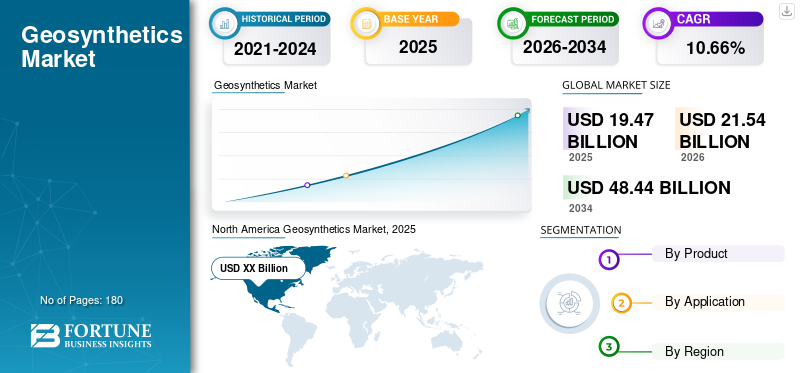
Download Free sample to learn more about this report.
GEOSYNTHETICS MARKET Key Takeaways
 Market Size & Forecast
- 2025 Market Size: USD 19.47 Billion
- 2026 Market Size: USD 21.54 Billion
- 2034 Forecast Market Size: USD 48.44 Billion
- CAGR: 10.66% from 2026–2034
 Market Share
- North America dominated the geosynthetics market with a 37.81% share in 2025.
- The geotextile segment held the largest market share due to its extensive use in soil stabilization, drainage, road construction, and erosion control applications.
- The construction and infrastructure sector accounted for the dominant share of geosynthetics demand globally.
 Key Regional Highlights
North America
North America led the global market in 2025, driven by mining expansion, infrastructure development, and advancements in geosynthetic materials.
Europe
Europe held the second-largest market share, supported by growing demand for green infrastructure and stringent environmental regulations.
Asia Pacific
Infrastructure upgrades, urbanization, and construction investments drive growth.
U.S.
The geosynthetics market is projected to reach USD 4.56 billion by 2032.
Japan
Transportation, flood control, and sustainable construction investments drive growth.
Read More

GEOSYNTHETICS MARKET TRENDS
Geo-Systems Facilitate Sustainable Construction
Sustainable building mainly involves the usage of sustainable building materials. Geosystems simplifies sustainable construction by decreasing the usage of natural materials such as sand and aggregates. For example, the depth of aggregate layer in a typical cross-section mainly for road construction can be reduced so that less mining is required.
Download Free sample to learn more about this report.
Highway Deep-Patch Geogrid Applications is a Cost-Effective Technique
Deep patch is a repair procedure that is broadly used on low-volume roads mainly in the Pacific Northwest. It is a cost-effective mitigation method that addresses settlement and shallow land sliding. Deep patches can be used to propagate and slow the development of roadway displacements over comparatively fast-moving landslides.
GROWTH FACTORS
Growing Construction Industry Shall Drive Market
Geosynthetic materials are utilized in several construction activities stages to control evaporation, enhance drainage, strengthen infrastructure, and limit erosion to promote the longevity & safety of structures. These materials separate, reinforce, and stabilize subgrade. Also, the base materials provide benefits of simplifying construction, thereby increasing the road life and reducing upcoming road maintenance. Geosynthetics also prevent accidents as they can tolerate vertical differential settlements and large lateral deformations. Geotextiles or geogridges are used to enhance performance or reduce the thickness of a permanent road.
Growing number of infrastructure spending in the U.S., Germany, Poland, the U.K., Russia, Australia, and India on account of increasing government investments on various infrastructure projects such as bridges, rails, roadways, airports, and harbors shall drive the overall industry growth. Construction practices and pavement designs need high-quality materials to fulfill various infrastructure standards. Favorable EU policies and amplified funding efforts have improved the overall railway business competitiveness which is likely to raise environmental awareness, thereby increasing the overall transportation desirability.
Rising Demand from Mining Industry to Boost Growth
In the mining sector, geosynthetic materials are used in creating waste barriers for the mining by-product. Mining produces solid wastes such as tailings and waste rock during the entire process, waste containment, and disposal. Geomembrane liners are significantly used in the mining industry for lining solutions, mainly evaporation ponds, heap leaching, and tailings impoundments. About 40% of the global geomembrane production is used by the mining sector. Also, companies are offering and producing various geomembrane solutions in the mining industry. For instance, Solmax offers LLDPE Geomembranes heap leach pads and solution ponds which are used in the mining method. GSE UltraFlex is a LLDPE geomembrane that is developed to meet the specific needs of the mining industry.
RESTRAINING FACTORS
Installation Damage Threat May Restrict the Market
Geotextiles are used in the construction of waste landfills, tunnels, ponds, dams, roads, or railways. Geotextiles suffer damages during the installation process which in turn, can cause unavoidable changes in their mechanical, hydraulic, and physical properties. These changes must be taken into consideration while designing infrastructure with geotextiles. However, the damages that occur during the installation process should be evaluated by field tests or laboratory tests.
Also, geogrids are damaged during exposure to low temperatures and UV light, which may hamper the overall market demand during the installation process. The degree of damage varies with temperature at the site during installation which may further hinder the geogrids market growth.
The damages that occur during the installation process can be evaluated by laboratory tests or by
field tests
GEOSYNTHETICS MARKET SEGMENTATION Analysis
By Product Analysis
To know how our report can help streamline your business, Speak to Analyst
Geotextiles Dominated the Market during the Forecast Period
Based on the product, the market is classified into geotextile, geogrids, geomembranes, geonets, geocells, geofoams, geosynthetic clay liners (GCLs), and geocomposites. Geotextiles account for the major share of the market. Increasing usage of geotextiles in construction applications such as railroads, roads, harbors, landfills, and drainage structures to enhance soil stabilization along with infrastructure spending by the government shall anticipate the industry growth. Increasing awareness towards the functional advantages of the product over traditional materials such as flexibility, high tensile strength permeability, and superior load-bearing capacity has increased the geotextile penetration in soil erosion, road construction, drainage, pavement repair, and agriculture industries. They are typically made from synthetic materials such as PVC, polyethylene, or polypropylene, which when properly embedded, can help contribute to the soil stabilization and prevent erosion. Also, companies such as GSE Solmax offers environmental nonwoven geotextiles which are made up of polypropylene, needle punched, and stable fiber engineered mainly for soil stabilization, drainage, liner protection, filtration, and separation applications to meet specific requirements of the customers.
Geogrids are made up of polymers such as polyester, HDPE, and polypropylene. They are used to reinforce retaining walls, road & railroad construction, and base reinforcement. They are used in road and railway development activities owing to reduced maintenance time, cost, and aggregate thickness of rail and road tracks. An increase in infrastructure spending along with growing transportation industry development are the key trends for the overall Geosynthetics market growth during the forecast timeframe. An increase in erosion damage on England’s southern coast may primarily fuel product demand. Also, high flood risk in Wales and England has led to the rise in the demand for sustainable urban drainage systems which is likely to drive the European geogrids market demand. The Geotextile segment is expected to hold a 30.47% share in 2018.
REGIONAL GEOSYNTHETICS MARKET Analysis
North America
North America Geosynthetics Market, 2025 (USD Billion)
To get more information on the regional analysis of this market, Download Free sample
The findings based on our research methodology, North America dominated the geosynthetics market with a market share of 38.55% in 2018. Demand for significant metals such as copper, silver, zinc, bauxite, and gold has enhanced the mining industry expansion in the U.S. which has bolstered the regional market demand. Increasing demand for metal from electronics, automobile, and construction industries has engaged most of the companies in project expansion related to mineral exploration. Rapid industrialization along with increase in ongoing infrastructure projects shall drive the geotextile market demand. Rising advancement in technology and intensive R&D activities has resulted in material development which requires less maintenance, shall foster the regional industry demand.
- North America witnessed a growth from USD 9.66 Billion in 2017 to USD 10.27 Billion in 2018.
Europe
Europe is expected to be the second dominant region in terms of geosynthetics market revenue on account of rising awareness towards environment-friendly infrastructure. Growing demand for residential buildings may boost infrastructure development in the European region. Increasing awareness towards rising carbon emissions and increasing environmental concerns have resulted in the demand for green infrastructure. Strict laws imposed regarding practices in industrial waste management and municipal sectors in Germany may promote geomembranes market demand.
Asia Pacific
Asia Pacific is expected to witness substantial growth during the forecast period due to rise in the novel and new infrastructure renovation & development. Rise in disposable income along with increasing government investments in industrial & commercial construction projects may augment the demand for energy-efficient buildings in the region.
KEY INDUSTRY PLAYERS
Strata Introduced Wide Flexible StrataGrid Geogrid and StrataWeb Geocells in India
In June 2019, Strata introduced HDPE geocells (StrataWeb) and flexible geogrids (StrataGrid) in its manufacturing plant in Gujarat, India. With the setting up of this new production plant, Strata will cater to both the international and domestic market demands. For the flexible geogrids series, the improvements comprise stress-strain values, low elongation, customizable lengths and widths, wide-width geogrid, and faster deliveries.
Key Players to Uphold their Market Position Across Different Geosynthetics-Related Areas
Major players operating in the geosynthetics industry are adopting strategies such as partnerships, new product launches & development, mergers & acquisitions, and agreements to enhance their market share and presence. Also, to build competitiveness, companies are increasing existing product offerings.
But, the majority of geosynthetics market share is highly fragmented and competitive among the small-scale and regional manufacturers to enhance business. Companies are offering geosynthetic materials including geotextile, geogrids, geomembranes, geocomposites, and others which are used in various end-use application industries. They are also concentrating on enhancing product properties including flexibility and permeability with the rise in manufacturing cost-effective and durable products.
List of Key Companies Profiled in Geosynthetics Market:
- Koninklijke Ten Cate bv
- GSE Environmental
- TENAX SPA
- Fibertex Nonwovens A/S
- Tensar International Corporation
- HUESKER
- Strata Systems, Inc.
- AGRU AMERICA, INC
- Global Synthetics
- Terram Geosynthetics Pvt. Ltd. (TGPL)
- CTM Geosynthetics
- Garware Technical Fibres Ltd.
- Tuflex India
- Texel
- Fibromat (M) Sdn Bhd.
- Techno Fabrics Geosynthetics Pvt. Ltd.
- SKAPS Industries
- Pietrucha Group
- Steklonit
- Maharshee Geomembrane (India) Pvt. Ltd.
KEY INDUSTRY DEVELOPMENTS:
- July 2019 - Ferguson Enterprises acquired Action Plumbing Supply and Innovative Soil Solutions to expand erosion control capabilities and geotextile business in the U.S.
- December 2017 – A Canadian-based company, Groupe Solmax, a provider of high-quality polyethylene (PE) geomembranes mainly for environmental and industrial applications, acquired manufacturer of geosynthetics lining, GSE Environmental. Both the companies will operate globally in the geosynthetics products business, delivering large manufacturing players with high-quality containment systems for industrial, domestic, or hazardous retention ponds, waste burial sites, heap leaching pads, and fracking.
REPORT COVERAGE
Request for Customization to gain extensive market insights.
The geosynthetics market report offers qualitative and quantitative insights and a detailed analysis of market size & growth rate for all possible segments in the market.
Along with this, the report provides an elaborative analysis of market dynamics, emerging trends, and competitive landscape. Key insights offered in the report are the adoption of geosynthetics market trends by individual segments, recent industry developments such as partnerships, mergers & acquisitions, consolidated SWOT analysis of key players, Porter’s five forces analysis, business strategies of leading market players, macro and micro-economic indicators, and key industry trends.
REPORT SCOPE & SEGMENTATION
|
ATTRIBUTE |
DETAILS |
|
Study Period |
2021-2034 |
|
CAGR |
10.66% (2026-2034) |
|
Revenue Forecast in 2034 |
USD 48.44 Billion |
|
Base Year |
2025 |
|
Forecast Period |
2026-2034 |
|
Historical Period |
2021-2024 |
|
Unit |
Value (USD million) Volume (Mn. Sqr. Mtrs.) |
|
Segmentation |
By Product
|
|
By Region
|
Frequently Asked Questions
As per Fortune Business Insights, the geosynthetics market is predicted to reach USD 48.44 billion by 2034 with a CAGR of 10.66% (2025 -2034).
Road construction, landfill & mining, containment & wastewater treatment, soil reinforcement, are some of the industries contributing towards the Market growth.
Geogrids are damaged during the exposure to adverse climatic conditions such as low temperatures and UV light which may hinder the industry growth. Volatility in raw material prices such as polypropylene, HDPE, polyester, and others may hinder the overall Market growth.
In the geosynthetics market, geotextile and geogrids are the leading segments. Increasing awareness of geotextile products owing to high tensile strength, superior load bearing capacity, permeability, and flexibility are leading to rise in the industry demand in various application industries.
Some of the factors driving the geosynthetics market are growth in the construction industry along with government spending on the infrastructure projects development.
In the geosynthetics market, some of the key players are GSE Environmental, Koninklijke Ten Cate bv, TENAX SPA, Fibertex, Tensar International Corporation, HUESKER, and Strata Systems.



- 2021-2034
- 2025
- 2021-2024
- 180
Get 30-60 hrs Free Customization
Expand Regional and Country Coverage, Segments Analysis, Company Profiles, Competitive Benchmarking, and End-user Insights.


















Related Reports
-
US +1 833 909 2966 ( Toll Free )
-
Get In Touch With Us