Glutaraldehyde Market Size, Share & Industry Analysis, By Product (Glutaraldehyde 25%, Glutaraldehyde 50%), By Application (Disinfection & Sterilization, Pesticide, Electron & Light Microscopy) and Regional Forecast, 2026-2034
 Download Free Sample
Glutaraldehyde Market Overview
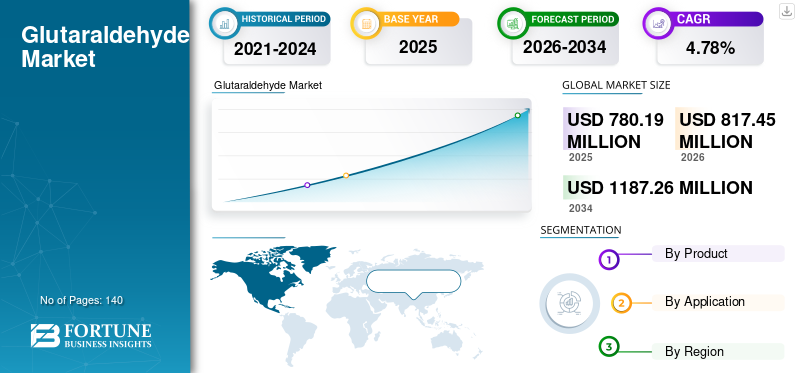
The global glutaraldehyde market size was valued at USD 780.19 million in 2025. The market is projected to grow from USD 817.45 million in 2026 to USD 1187.26 million by 2034, exhibiting a CAGR of 4.78% during the forecast period.

The glutaraldehyde market is witnessing strong industrial demand due to the increasing use of glutaraldehyde in healthcare disinfection, water treatment, leather tanning, oilfield applications, and laboratory sterilization processes. Glutaraldehyde is widely recognized as an effective biocidal and cross-linking chemical, making it essential for high-level disinfection in hospitals and industrial cleaning facilities. The growth of healthcare infrastructure, expansion of pharmaceutical manufacturing, and rising awareness regarding infection control are accelerating product adoption across multiple sectors. glutaraldehyde market trends indicate growing preference for concentrated formulations with improved stability and lower toxicity profiles. Manufacturers are also focusing on advanced packaging and safe handling technologies to improve operational efficiency and regulatory compliance in industrial environments.
The USA glutaraldehyde market continues to expand because of rising demand from hospitals, diagnostic laboratories, biotechnology facilities, and water treatment plants. The country maintains a strong consumption base due to stringent sterilization standards across healthcare institutions and industrial processing units. Increased use of glutaraldehyde in endoscope sterilization and surgical instrument cleaning has strengthened market penetration across medical applications. Industrial users in the oil and gas sector are also increasing adoption of glutaraldehyde-based biocides to control microbial growth in pipelines and storage systems. The Glutaraldehyde industry analysis for the USA highlights growing investments in specialty chemical manufacturing and healthcare sanitation technologies. Domestic suppliers are emphasizing environmentally controlled production systems and compliance with occupational safety regulations to maintain competitive positioning.
Download Free sample to learn more about this report.
Glutaraldehyde Market Key Takeaways
 Global Market Size & Forecast
- 2025 Market Size: USD 780.19 Million
- 2026 Market Size: USD 817.45 Million
- 2034 Forecast Market Size: USD 1,187.26 Million
- CAGR: 4.78% from 2026-2034
 market share
- North America dominated with a revenue share of 34% in 2025.
- Glutaraldehyde 50% accounted for nearly 42% of the market share.
- Disinfection & Sterilization held approximately 54% of the market share.
 Key Regional Highlights
North America
North America led the market with a 34% regional share in 2025.
Asia-Pacific
Asia-Pacific accounted for 31% of the global glutaraldehyde market, supported by expanding industrial and healthcare applications.
Europe
Europe represented 27% of the market, driven by demand for disinfection and specialty chemical applications.
U.S
Strong demand for glutaraldehyde across healthcare sterilization, industrial processing, and water treatment applications.
Japan
Accounted for 24% of the Asia-Pacific glutaraldehyde market.
Read More

Glutaraldehyde Market Latest Trends
The glutaraldehyde market is evolving with increasing adoption of high-efficiency disinfectant solutions across healthcare and industrial environments. One major glutaraldehyde market Trend is the growing use of automated sterilization systems in hospitals and research laboratories. Medical facilities are investing in advanced disinfection protocols to reduce hospital-acquired infections, creating stronger demand for glutaraldehyde formulations with improved microbial effectiveness. Manufacturers are also introducing stabilized glutaraldehyde products with extended shelf life and controlled vapor emissions to improve workplace safety and storage convenience.
Another important trend in the glutaraldehyde market research report is the rising use of glutaraldehyde in water treatment and oilfield operations. Industrial operators are increasingly relying on biocidal chemicals to control bacterial contamination in pipelines, cooling towers, and wastewater systems. Asia-Pacific manufacturing facilities are expanding production capacities to meet export demand from pharmaceutical and healthcare industries. Sustainable production methods and environmentally safer formulations are also gaining traction due to stricter chemical handling regulations worldwide. In addition, digital monitoring systems for chemical dosing and sterilization performance are improving operational precision, creating new opportunities within the glutaraldehyde market outlook for industrial and medical applications.
Download Free sample to learn more about this report.
Glutaraldehyde Market Dynamics
DRIVER
Rising Demand for Healthcare Sterilization and Infection Control Solutions
The increasing focus on infection prevention in hospitals, ambulatory surgical centers, and diagnostic laboratories is a major driver of the glutaraldehyde market growth. Healthcare institutions are implementing strict sterilization procedures for surgical instruments, endoscopes, and medical equipment, resulting in higher consumption of high-level disinfectants. Glutaraldehyde is widely preferred because of its effectiveness against bacteria, viruses, fungi, and spores. The expansion of healthcare infrastructure in emerging economies is further supporting market demand. Pharmaceutical manufacturers and biotechnology companies are also increasing usage of sterilization chemicals to maintain contamination-free production environments.
The glutaraldehyde industry report highlights rising awareness regarding healthcare-associated infections as a key factor supporting long-term market expansion. Aging populations and growing surgical procedure volumes are increasing the need for reusable medical instrument sterilization. Industrial users are simultaneously adopting glutaraldehyde for microbial control in water treatment and oilfield applications. Strong demand from both healthcare and industrial sectors is reinforcing the global glutaraldehyde market forecast and creating continuous opportunities for manufacturers and distributors.
RESTRAINT
Health Hazards and Stringent Chemical Handling Regulations
The glutaraldehyde market faces challenges due to concerns regarding occupational exposure and chemical toxicity. Prolonged exposure to glutaraldehyde vapors may cause respiratory irritation, skin sensitization, and eye discomfort among healthcare workers and industrial employees. Regulatory agencies across several countries have established strict workplace exposure limits and handling guidelines, increasing compliance costs for manufacturers and end users. Hospitals and laboratories are investing in ventilation systems and protective equipment to minimize exposure risks, which can increase operational expenditures.
The glutaraldehyde market analysis also indicates that some healthcare facilities are gradually exploring alternative disinfectants with lower toxicity profiles. Environmental concerns regarding disposal and wastewater contamination are adding additional pressure on chemical manufacturers. Companies operating in the glutaraldehyde industry are required to comply with evolving environmental regulations related to hazardous chemical storage, transport, and disposal. These regulatory complexities may limit market penetration in regions with stringent chemical safety frameworks, especially among small-scale users with limited compliance capabilities.
OPPORTUNITY
Expansion of Industrial Water Treatment and Oilfield Applications
The increasing demand for microbial control solutions in industrial operations is creating major opportunities within the glutaraldehyde market. Water treatment facilities, cooling towers, pulp and paper plants, and oilfield operations are increasingly using glutaraldehyde-based biocides to prevent bacterial contamination and biofilm formation. Industrial operators are prioritizing efficient microbial management systems to improve equipment performance and reduce maintenance costs. This trend is particularly strong in rapidly industrializing economies where water reuse and industrial sanitation are becoming essential operational priorities.
The glutaraldehyde market opportunities are also expanding because of growing investments in energy infrastructure and industrial wastewater management. Oil and gas companies are adopting glutaraldehyde formulations to protect pipelines and storage tanks from microbial corrosion. Manufacturers are developing specialized industrial-grade products with improved compatibility and performance under extreme operating conditions. Increased industrial automation and chemical dosing technologies are further supporting product adoption. These developments are expected to strengthen the long-term glutaraldehyde market outlook across industrial sectors beyond healthcare applications.
CHALLENGE
Availability of Alternative Disinfectants and Competitive Pricing Pressure
The glutaraldehyde market faces significant competitive challenges from alternative disinfectant chemicals such as hydrogen peroxide, peracetic acid, and ortho-phthalaldehyde. Some healthcare facilities prefer these alternatives because they offer shorter sterilization cycles or lower toxicity levels. The presence of substitute products increases pricing pressure on glutaraldehyde manufacturers, particularly in highly regulated healthcare markets. Companies must continuously improve product quality and safety standards to maintain market competitiveness.
The glutaraldehyde market Insights also reveal challenges related to raw material price fluctuations and supply chain disruptions. Chemical manufacturers depend on stable supply networks for production inputs, and volatility in raw material availability can affect profit margins and production schedules. Smaller manufacturers may struggle to compete with large multinational suppliers that possess stronger distribution systems and advanced production capabilities. Additionally, customer demand for eco-friendly and low-emission disinfectants is increasing, requiring ongoing investment in research and development to maintain market relevance.
Glutaraldehyde Market Segmentation
By Product
Glutaraldehyde 25% holds of the global glutaraldehyde market due to its widespread use in healthcare disinfection, industrial sterilization, and laboratory applications. This concentration is commonly utilized in hospitals and diagnostic facilities for instrument sterilization because it offers strong antimicrobial activity while maintaining manageable handling characteristics. Healthcare institutions prefer glutaraldehyde 25% for endoscope disinfection and reusable surgical equipment cleaning. The product is also used extensively in veterinary clinics, dental practices, and research laboratories where high-level disinfection standards are required. The glutaraldehyde market report indicates that glutaraldehyde 25% continues to experience growing demand from industrial water treatment and oilfield applications. Industrial operators favor this concentration because it can be diluted according to operational requirements, improving cost efficiency and flexibility.
Glutaraldehyde 50% accounts for nearly 42% share of the glutaraldehyde market and is primarily used in industrial processing, specialty chemical manufacturing, and large-scale biocidal applications. This high-concentration formulation is preferred in industries requiring stronger microbial control performance, including oil and gas, wastewater treatment, and leather processing operations. Industrial facilities often utilize glutaraldehyde 50% in concentrated dosing systems where high activity levels are necessary to control biofilm growth and bacterial contamination. The glutaraldehyde market research report highlights increasing demand for glutaraldehyde 50% in large industrial plants due to its efficiency in handling high-volume treatment requirements. Chemical manufacturers are developing customized industrial-grade solutions with improved stability under extreme temperature and pressure conditions. The segment is also benefiting from rising investments in industrial wastewater recycling and pipeline maintenance systems.
By Application
Disinfection & Sterilization represents approximately 54% share of the global glutaraldehyde market, making it the largest application segment. Hospitals, outpatient surgical centers, diagnostic laboratories, and dental clinics rely heavily on glutaraldehyde for high-level disinfection of reusable medical instruments. The increasing prevalence of minimally invasive procedures and reusable endoscopic devices has accelerated demand for reliable sterilization chemicals. Glutaraldehyde remains highly preferred because of its broad-spectrum antimicrobial effectiveness and compatibility with sensitive medical equipment. The glutaraldehyde market forecast shows strong demand growth for sterilization applications due to rising awareness regarding infection prevention standards. Healthcare providers are strengthening sterilization protocols to reduce contamination risks and improve patient safety outcomes.
To know how our report can help streamline your business, Speak to Analyst
The pesticide application segment contributes nearly 28% share of the glutaraldehyde market. Glutaraldehyde is utilized in agricultural and industrial pesticide formulations because of its strong biocidal properties and effectiveness against microbial contamination. Agricultural operators use glutaraldehyde-based products to protect irrigation systems and storage facilities from bacterial and fungal growth. Industrial pesticide manufacturers are also incorporating glutaraldehyde into specialty antimicrobial formulations for environmental sanitation and industrial cleaning applications. The glutaraldehyde market Insights reveal growing demand for microbial control chemicals in modern agriculture and industrial sanitation programs.
Electron & Light Microscopy accounts for around 18% share of the glutaraldehyde market and serves an important role in scientific research and laboratory analysis. Glutaraldehyde is widely used as a tissue fixative in microscopy because it preserves cellular structures and improves imaging quality for biological and medical studies. Research institutions, biotechnology laboratories, and pharmaceutical companies depend on glutaraldehyde-based fixation solutions for advanced microscopic analysis and diagnostic investigations. The glutaraldehyde market analysis indicates increasing use of microscopy techniques in medical diagnostics, life sciences research, and pharmaceutical development. Growing investments in biotechnology and biomedical research are supporting demand for high-purity glutaraldehyde formulations specifically designed for laboratory applications.
Glutaraldehyde Market Regional Outlook
North America
North America Glutaraldehyde Market Share, 2025 (%)
To get more information on the regional analysis of this market, Download Free sample
North America holds nearly 34% share of the global glutaraldehyde market due to strong healthcare infrastructure, advanced sterilization practices, and widespread industrial adoption of biocidal chemicals. The region demonstrates significant demand from hospitals, diagnostic laboratories, pharmaceutical manufacturers, and water treatment facilities. Strict infection prevention regulations across healthcare institutions are encouraging continuous use of glutaraldehyde-based disinfectants for reusable medical instruments and surgical equipment. Industrial sectors including oil and gas, wastewater management, and food processing are also major consumers of glutaraldehyde products.
The glutaraldehyde market outlook for North America remains favorable because of ongoing investments in healthcare modernization and industrial sanitation technologies. The United States dominates regional demand due to extensive healthcare spending and strong industrial chemical production capabilities. Manufacturers in the region are focusing on low-emission formulations, improved packaging technologies, and worker safety solutions to comply with evolving environmental and occupational standards. Rising awareness regarding microbial contamination control in industrial systems is also supporting long-term regional market growth.
Europe
Europe accounts for approximately 27% share of the glutaraldehyde market, supported by strong regulatory standards for healthcare disinfection and industrial hygiene management. Healthcare institutions across the region maintain rigorous sterilization protocols for reusable medical devices, increasing the use of glutaraldehyde-based disinfectants. Industrial demand is also rising due to the growing need for water treatment chemicals and microbial control solutions across manufacturing sectors.
The glutaraldehyde market trends in Europe indicate increasing preference for safer and stabilized disinfectant formulations with lower environmental impact. Regulatory authorities are encouraging chemical manufacturers to improve workplace safety and reduce hazardous emissions during production and application processes. Germany, France, and the United Kingdom remain major regional consumers due to strong healthcare infrastructure and industrial processing industries. Research laboratories and biotechnology facilities are also expanding usage of high-purity glutaraldehyde formulations for scientific analysis and pharmaceutical development applications.
Germany Glutaraldehyde Market
Germany represents nearly 29% share of the European glutaraldehyde market because of its advanced healthcare system, strong industrial manufacturing sector, and extensive pharmaceutical production activities. Hospitals and diagnostic laboratories in Germany maintain strict sterilization standards, creating stable demand for glutaraldehyde-based disinfectants. The country’s strong biotechnology and medical device industries are also contributing to higher usage of sterilization chemicals and laboratory-grade fixatives.
The Germany glutaraldehyde market analysis highlights increasing industrial demand from water treatment, chemical processing, and wastewater management sectors. German manufacturers are emphasizing environmentally controlled production technologies and sustainable chemical handling practices to comply with European safety regulations. Research institutions and academic laboratories are also increasing consumption of microscopy-grade glutaraldehyde for biomedical investigations. The country’s focus on industrial automation and healthcare innovation continues to support stable market expansion and product development activities across multiple industrial and healthcare sectors.
United Kingdom Glutaraldehyde Market
The United Kingdom contributes approximately 21% share of the European glutaraldehyde market due to strong healthcare sterilization requirements and growing investments in biotechnology research. Hospitals and healthcare facilities are increasing adoption of high-level disinfectants to support infection prevention strategies and reusable medical instrument processing. Diagnostic laboratories and pharmaceutical production centers also represent important sources of market demand within the country.
The United Kingdom Glutaraldehyde industry report indicates rising demand for advanced sterilization chemicals in research laboratories and life sciences facilities. Industrial users in water treatment and food processing sectors are adopting glutaraldehyde-based microbial control solutions to improve operational efficiency and sanitation standards. Chemical suppliers are focusing on enhanced safety packaging and regulatory compliance to strengthen their competitive positioning in the UK market. Increasing investments in healthcare infrastructure modernization and biotechnology innovation continue to support long-term growth opportunities within the national glutaraldehyde market.
Asia-Pacific
Asia-Pacific holds around 31% share of the global glutaraldehyde market and remains one of the fastest-growing regional markets because of expanding healthcare infrastructure, rapid industrialization, and increasing pharmaceutical manufacturing activities. Countries such as China, Japan, India, and South Korea are driving regional demand through rising healthcare expenditures and growing awareness regarding infection control. Industrial sectors including water treatment, oilfield operations, and chemical manufacturing are also increasing consumption of glutaraldehyde-based products.
The glutaraldehyde market research report highlights strong production expansion across Asia-Pacific due to lower manufacturing costs and growing export opportunities. Regional manufacturers are investing in large-scale chemical production facilities to meet rising global demand. Increasing adoption of advanced sterilization technologies in hospitals and diagnostic laboratories is further strengthening regional market growth. The region also benefits from expanding biotechnology research activities and government initiatives focused on improving healthcare sanitation standards.
Japan Glutaraldehyde Market
Japan represents approximately 24% share of the Asia-Pacific glutaraldehyde market because of its technologically advanced healthcare system and strong pharmaceutical research sector. Hospitals and medical laboratories in Japan utilize glutaraldehyde extensively for reusable medical device sterilization and infection control applications. The country’s aging population and increasing healthcare service demand are supporting stable consumption of sterilization chemicals across healthcare facilities.
The Japan glutaraldehyde market outlook also reflects growing use of laboratory-grade glutaraldehyde in biotechnology research and electron microscopy applications. Japanese manufacturers emphasize high-purity chemical formulations, advanced packaging systems, and workplace safety standards to maintain product quality and regulatory compliance. Industrial demand from water treatment and electronics manufacturing sectors is also contributing to market growth. Continuous investment in healthcare innovation and precision scientific research is expected to support long-term expansion of the Japan Glutaraldehyde industry analysis.
China Glutaraldehyde Market
China accounts for nearly 38% share of the Asia-Pacific glutaraldehyde market due to large-scale chemical manufacturing capacity and rapidly expanding healthcare infrastructure. Hospitals, pharmaceutical production facilities, and industrial processing plants represent major end users of glutaraldehyde products in the country. Increasing healthcare investments and stricter infection prevention standards are encouraging wider adoption of high-level disinfectants across medical institutions.
The China glutaraldehyde market forecast indicates strong growth potential from industrial wastewater treatment, oilfield operations, and biotechnology manufacturing. Domestic manufacturers are expanding production capabilities to support both domestic consumption and international exports. Government focus on industrial sanitation and environmental management is also increasing demand for microbial control chemicals. Research institutions and pharmaceutical laboratories are adopting specialized glutaraldehyde formulations for advanced biological analysis and drug development activities. Strong industrialization and healthcare modernization continue to strengthen China’s position within the global glutaraldehyde market.
Rest of World
The Rest of World region holds approximately 8% share of the global glutaraldehyde market, supported by rising healthcare investments and industrial sanitation requirements in Latin America, the Middle East, and Africa. Healthcare facilities across developing economies are increasing use of sterilization chemicals to improve infection prevention standards and support growing patient volumes. Industrial sectors including oil and gas, mining, and wastewater treatment are also contributing to regional product demand.
The glutaraldehyde market opportunities within the Rest of World region are expanding because of infrastructure development projects and increasing awareness regarding industrial hygiene management. Governments are investing in healthcare modernization and public sanitation initiatives, creating stronger demand for disinfectants and microbial control chemicals. Oil-producing nations in the Middle East are significant consumers of glutaraldehyde-based biocides for pipeline and drilling operations. Manufacturers are focusing on regional distribution partnerships and cost-effective product solutions to strengthen market penetration across emerging economies.
List of Top Glutaraldehyde Companies
- ACURO ORGANICS LIMITED
- ASP
- BASF SE
- Becta Laboratories
- Fengchen Group Co., Ltd
- Hebei Guanlang Biotechnology Co., Ltd.
- LANXESS
- Neogen Corporation
- Shandong Lircon Medical Technology Co., Ltd.
Top two companies with the highest market share
- BASF SE – 16%
- LANXESS – 13%
Investment Analysis and Opportunities
The glutaraldehyde market is attracting strong investments due to rising demand for sterilization chemicals, industrial biocides, and laboratory-grade disinfectants. Chemical manufacturers are expanding production capacities to meet increasing global consumption from healthcare, pharmaceutical, and water treatment industries. Investments in automated chemical production systems and environmentally controlled manufacturing facilities are improving operational efficiency and regulatory compliance. Emerging economies are becoming important investment destinations because of rapid healthcare infrastructure development and industrial expansion.
The glutaraldehyde market opportunities are also increasing in industrial wastewater treatment and oilfield microbial control applications. Companies are investing in advanced formulation technologies to develop low-emission and high-performance products suitable for strict environmental standards. Strategic partnerships between healthcare providers and chemical suppliers are supporting long-term procurement agreements for sterilization chemicals. Research institutions and biotechnology companies are creating additional demand for high-purity glutaraldehyde products used in microscopy and laboratory applications. Growing awareness regarding infection prevention and industrial hygiene management is expected to sustain investment activity across the global Glutaraldehyde industry report.
New Product Development
Manufacturers in the glutaraldehyde market are focusing on innovative product development to improve safety, performance, and operational efficiency. One important area of innovation involves stabilized glutaraldehyde formulations with reduced vapor emissions and enhanced shelf life. These products are designed to improve workplace safety in hospitals, laboratories, and industrial facilities while maintaining high antimicrobial effectiveness. Companies are also introducing ready-to-use sterilization solutions compatible with automated disinfection systems.
The glutaraldehyde market trends indicate rising development of specialized formulations for industrial water treatment and oilfield applications. Manufacturers are producing high-concentration products with improved stability under extreme operating conditions such as high temperature and pressure environments. Smart chemical dosing systems integrated with digital monitoring technologies are also gaining popularity in industrial operations. Research laboratories and biotechnology facilities are demanding ultra-pure glutaraldehyde solutions for advanced microscopy and biomedical investigations. Sustainable packaging technologies and environmentally safer production methods are becoming major innovation priorities among leading chemical manufacturers operating within the glutaraldehyde market.
Five Recent Developments (2023-2025)
- BASF SE expanded specialty biocide production capacity to support rising healthcare and industrial demand for disinfectant chemicals.
- LANXESS introduced advanced low-emission glutaraldehyde formulations designed for safer industrial and healthcare applications.
- Neogen Corporation strengthened its sterilization product portfolio through expansion of microbial control solutions for food safety and laboratory applications.
- Shandong Lircon Medical Technology Co., Ltd. increased production of hospital-grade disinfectants to meet rising healthcare sterilization requirements in Asia-Pacific.
- ASP introduced upgraded automated sterilization systems compatible with advanced glutaraldehyde disinfection technologies for healthcare facilities.
Report Coverage Of glutaraldehyde market
The glutaraldehyde market report provides detailed analysis of industry structure, product segmentation, application trends, regional performance, and competitive landscape across global markets. The report examines key demand drivers influencing market expansion, including healthcare sterilization requirements, industrial microbial control applications, and laboratory research activities. It also evaluates major restraints, challenges, and emerging opportunities affecting manufacturers, distributors, and end users operating within the industry.
Request for Customization to gain extensive market insights.
The glutaraldehyde market research report covers segmentation by type, application, and geography while analyzing production trends, regulatory developments, and technological innovations. Regional insights include detailed evaluation of North America, Europe, Asia-Pacific, and Rest of World markets along with country-level analysis for major economies. The report also profiles leading companies, product development activities, investment strategies, and industrial expansion initiatives shaping the competitive environment. Market participants can use the report to identify growth opportunities, assess industry dynamics, and develop strategic business plans for healthcare, industrial, and research-related glutaraldehyde applications.
Frequently Asked Questions
Fortune Business Insights says that the global market value stood at USD 780.19 million in 2025 and is projected to reach USD 1,187.26 million by 2034.
The market is expected to exhibit a CAGR of 4.78% during the forecast period of 2026-2034.
Disinfection & Sterilization was the leading application segment, driven by the growing use of glutaraldehyde for healthcare disinfection and sterilization processes.
Key players include BASF SE, LANXESS, The Dow Chemical Company, Neogen Corporation, ACURO ORGANICS LIMITED, and Becta Laboratories.
Major trends include rising demand for healthcare disinfection and sterilization and growing preference for concentrated formulations with improved stability and lower toxicity. The U.S. remains an important market, supported by healthcare, laboratory, and water-treatment demand.



- 2021-2034
- 2025
- 2021-2024
- 140
-

(Offer valid till 30th Sep 2026)
Get 30-60 hrs Free Customization
Expand Regional and Country Coverage, Segments Analysis, Company Profiles, Competitive Benchmarking, and End-user Insights.


















-
US +1 833 909 2966 ( Toll Free )
-
Get In Touch With Us