Go-Kart Market Size, Share & Industry Analysis, By Propulsion Type (Electric Go-Karts and Gasoline Go-Karts), By Product Type (Leisure Go-Karts, Racing Go-Karts, Junior / Kids Go-Karts, and Off-Road Go-Karts), By Component (Chassis, Engine/Motor, Battery (for electric karts), Tires & Wheels, and Others), By Seating Capacity (Single-Seater and Two-Seater), and Regional Forecast, 2026-2034
 Download Free Sample
(Offer valid till 15th Oct 2026)

Go-Kart Market Size & Future Outlook
 Listen to Audio Version
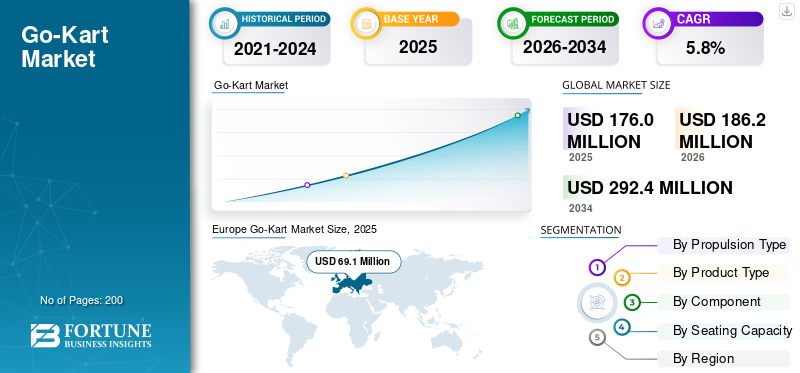
The global go-kart market size was valued at USD 176.0 million in 2025. The market is projected to grow from USD 186.2 million in 2026 to USD 292.4 million by 2034, exhibiting a CAGR of 5.8% during the forecast period. Europe dominated the go-kart market with a market share of 39.26% in 2025.
A go-kart is a compact, open-wheel vehicle built for recreational driving or kart racing. It usually has a low chassis, direct steering, small wheels, and either a gasoline engine or an electric motor. Go-karts are used on indoor and outdoor tracks and are widely witnessed as an entry point into motorsport as they are simple, agile, and performance-focused. Key drivers in the market include the expansion of indoor leisure karting, rising adoption of electric fleets, growing grassroots racing participation, and stronger family-entertainment demand. Commercial operators such as K1 Speed and TeamSport are scaling modern track networks, while accessible formats such as arrive-and-drive leagues are bringing more first-time users into karting and helping convert leisure demand into repeat usage. Major players include Sodikart, OTK Kart Group, Birel ART, CRG, and large operator-led brands such as K1 Speed. The main trend is a split between high-performance racing kart specialists and fast-growing rental/electric fleet providers. Manufacturers are increasingly focusing on durable rental platforms, electrification, safety upgrades, and global track-network partnerships to capture growth in leisure-led demand.
Download Free sample to learn more about this report.
Go-Kart Market Key Takeaways
 Market Size & Forecast
- 2025 Market Size: USD 176.0 million
- 2026 Market Size: USD 186.2 million
- 2034 Forecast Market Size: USD 292.4 million
- CAGR: 5.8% from 2026-2034
 Market Share
- Europe dominated the go-kart market with a 39.26% share in 2025.
- The electric go-karts segment is projected to grow at a CAGR of 8.7% during the forecast period.
- The battery segment is projected to grow at a CAGR of 10.1% during the forecast period.
 Key Regional Highlights
Europe
Europe remains the leading regional market due to its strong motorsport culture and extensive karting infrastructure.
North America
North America is witnessing steady growth driven by the expansion of indoor karting centers and electric kart fleets.
Asia Pacific
Asia Pacific is the fastest-growing region, supported by rising disposable incomes, urbanization, and increasing motorsport participation.
U.S.
The market is valued at USD 49.26 million in 2026, supported by large-scale karting operators and indoor entertainment venues.
Japan
The market is valued at USD 7.22 million in 2026, driven by a mature karting ecosystem and strong motorsport participation.
Read More

Go-Kart Market Trends
Expansion of Indoor Electric Karting Enhances Urban Entertainment Appeal
The global go-kart market growth is witnessing a strong shift toward indoor, electric karting formats, especially in urban areas where space, emissions, and noise constraints are critical. Electric go-karts enable operations inside malls, entertainment complexes, and city centers, attracting a broader customer base beyond traditional motorsport enthusiasts. These venues often integrate digital scoring, gamification, and immersive experiences, increasing repeat visits and revenue per user. The trend is particularly strong in developed, densely populated regions, where leisure experiences are evolving toward tech-enabled entertainment, encouraging operators to modernize fleets and scale standardized business models globally.
- In August 2023, the Palawan Sentosa launched HyperDrive, Singapore’s first indoor, gamified electric go-kart circuit, combining digital gameplay with electric karting to enhance the user experience.
Go-Kart Market Dynamics
Market Drivers
Download Free sample to learn more about this report.
Growth in Family Entertainment Centers and Leisure Activities Drives Market Demand
The increasing popularity of family entertainment centers (FECs) and experiential leisure activities is a key driver for the global market. Consumers are shifting spending toward experiences rather than physical goods, boosting demand for activities such as karting. Go-karting appeals to a wide range of demographics, including families, corporate groups, and young adults, making it a versatile attraction. Additionally, the rise of organized group events, birthday parties, and team-building activities is increasing utilization rates at karting venues. This growing demand for go-karts is encouraging operators to expand facilities and invest in modern fleets, thereby driving consistent go-kart sales globally.
- In March 2022, Andretti Indoor Karting & Games expanded its U.S. footprint with large-scale entertainment centers combining karting, arcade, and dining experiences to attract family and group audiences.
Market Restraints
High Initial Investment and Operational Costs Limit Market Expansion
One of the primary restraints in the market is the high capital investment required to establish and operate karting facilities. Setting up a professional indoor or outdoor karting track involves significant costs related to land acquisition or leasing, track construction, safety systems, and fleet procurement. Additionally, ongoing expenses such as maintenance, staffing, electricity, and regulatory compliance add to operational burdens. These cost factors can deter small and mid-sized investors from entering the market, especially in developing regions. As a result, expansion is often led by well-funded operators with access to capital and established operational expertise.
- In June 2021, TeamSport highlighted the complexity of operating multi-track karting venues, including infrastructure, safety systems, and fleet management, as part of its large-scale U.K. operations.
Market Opportunities
Emerging Markets Offer Untapped Potential for Karting Infrastructure Development
Emerging economies offer significant opportunities for the global market, driven by rising disposable incomes, urbanization, and growing interest in motorsports and leisure activities. Countries in the Asia Pacific, Latin America, and the Middle East are gradually developing entertainment infrastructure, including karting facilities. These regions often have relatively low organized karting penetration compared to Europe and North America, leaving ample room for expansion. Younger populations and growing middle-class segments further support rising demand for recreational and competitive driving experiences, positioning these markets as future growth engines.
- In January 2024, K1 Speed announced continued international expansion, including new locations across emerging markets, reflecting growing demand for karting entertainment outside traditional regions.
Market Challenges
Regulatory and Safety Compliance Requirements Pose Operational Challenges
Strict safety standards and regulatory requirements present ongoing challenges for go-kart manufacturers and operators globally. Karting facilities must comply with local safety norms, including track design, protective barriers, kart speed limitations, and driver safety equipment. Regulations may vary significantly across countries, making it difficult for operators to standardize operations internationally. Ensuring compliance requires continuous monitoring, maintenance, and staff training, increasing operational complexity. Additionally, any safety-related incidents can directly impact consumer trust and brand reputation, making safety management a critical priority.
- In February 2026, FIA Karting published its updated homologated circuit list, emphasizing strict safety and design standards required for certified karting tracks globally.
Go-Kart Market Segmentation Analysis
By Propulsion Type
Strong Performance Orientation and Established Infrastructure Sustain Gasoline Go-Kart Dominance
Based on propulsion type, the market is segmented into electric go-karts and gasoline go-karts.
Gasoline go-karts dominate the global market due to their established presence in racing and outdoor karting environments. These karts offer higher speed, greater endurance, and greater mechanical tuning flexibility, making them preferred in professional and competitive karting. Additionally, a large installed base of gasoline-powered fleets across outdoor tracks sustains replacement demand. While electrification is increasing, the transition remains gradual in racing ecosystems where performance characteristics are critical.
- In November 2023, CRG S.p.A. continued showcasing high-performance gasoline racing karts at international karting events, reinforcing the continued dominance of combustion-powered systems in competitive karting.
The electric go-karts segment is projected to grow at a CAGR of 8.7% over the forecast period.
By Product Type
Rising Popularity of Experiential Entertainment Drives Leisure Go-Kart Segment Growth
Based on product type, the market is segmented into leisure go-karts, racing go-karts, junior/kids go-karts, and off-road go-karts.
Leisure go-karts dominate the global market due to increasing demand from family entertainment centers, urban leisure hubs, and group-based activities. These karts are widely used in rental fleets and offer accessibility to a broad consumer base. The expansion of indoor karting venues and integration with entertainment complexes further strengthens this segment. High utilization rates and recurring customer visits make leisure karting a key revenue driver for operators globally. The segment is projected to grow at a CAGR of 6.6% over the forecast period.
- In July 2022, TeamSport reported operating over 37 karting venues in the U.K., serving more than 1.3 million customers annually, highlighting strong demand for leisure karting experiences.
To know how our report can help streamline your business, Speak to Analyst
By Component
Structural Importance of Chassis Maintains Dominance in Component Segment
Based on component, the market is segmented into chassis, engine/motor, battery (for electric karts), tires & wheels, and others.
By component, the chassis segment dominates the market as it forms the core structural framework of every kart. It directly influences handling, safety, and performance, making it a critical component across all kart types. Frequent usage, especially in commercial fleets, leads to wear and periodic replacement or upgrades. Additionally, racing applications require specialized chassis tuning, further driving demand. As all karts require a chassis irrespective of propulsion type, its share remains consistently high.
- In October 2023, OTK Kart Group continued expanding its racing chassis portfolio under brands such as Tony Kart and Kosmic Kart, emphasizing the central role of chassis innovation in kart performance.
The battery (for electric karts) segment is projected to grow at a 10.1% CAGR over the forecast period.
By Seating Capacity
Widespread Adoption Across Racing and Rental Fleets Drives Single-Seater Segment Dominance
Based on seating capacity, the market is segmented into single-seater and two-seater.
Single-seater go-karts dominate the global market as they are the standard configuration for both racing and most commercial rental applications. These karts offer better performance, control, and efficiency, making them suitable for competitive environments and high-turnover leisure operations. Their widespread adoption across professional karting circuits and indoor/outdoor tracks ensures consistent demand. The simplicity of design and operational efficiency further support their dominance across regions.
- In January 2024, FIA Karting continued promoting single-driver kart formats across its global championships, reinforcing the standardization of single-seater configurations in competitive karting.
The two-seater segment is projected to grow at a CAGR of 6.1% over the forecast period.
Go-Kart Market Regional Outlook
By region, the market is categorized into Europe, North America, Asia Pacific, South America, and the Middle East & Africa.
Europe
Europe Go-Kart Market Size, 2025 (USD Million)
To get more information on the regional analysis of this market, Download Free sample
Europe remains a leading region in the global go-kart market share due to its deep-rooted motorsport culture and extensive karting infrastructure. The presence of numerous FIA-recognized circuits and established kart manufacturers strengthens both racing and commercial segments. The region also benefits from a balanced mix of indoor and outdoor karting venues. Increasing electrification and fleet modernization are supporting growth, while strong participation in organized karting championships continues to sustain demand across different user groups.
U.K. Go-Kart Market
The U.K. is a key market in the region, valued at USD 13.69 million in 2026, driven by a large network of indoor karting venues and strong grassroots motorsport participation. The presence of major operators and structured karting pathways supports both leisure and competitive segments. High urban demand and growing adoption of electric karting further enhance market growth in the country.
Germany Go-Kart Market
Germany’s market is supported by its strong motorsport ecosystem and organized karting championships such as the DKM. The country has a well-developed racing culture and infrastructure, driving demand for high-performance karts. Additionally, increasing interest in recreational karting contributes to steady growth in both racing and leisure segments. It accounted for 28.30% of the European market share in 2026.
North America
North America is witnessing steady market growth, primarily driven by the expansion of indoor karting centers and the growing adoption of electric fleets. The region benefits from a well-established entertainment infrastructure and high consumer spending on experiential activities. Commercial operators continue to scale multi-location formats, improving accessibility and utilization rates. Additionally, the presence of organized karting events and grassroots racing supports consistent demand. Electrification trends and technological integration in karting experiences are further enhancing market attractiveness across urban centers.
U.S. Go-Kart Market
The U.S. dominates the North American market with USD 49.26 million in 2026, driven by its strong presence of large-scale karting operators and the widespread adoption of indoor entertainment formats. High consumer spending, corporate event demand, and family entertainment trends drive utilization. The country also supports a structured racing ecosystem, further strengthening demand for both leisure and performance-oriented go-karts across multiple states.
Asia Pacific
Asia Pacific is the fastest-growing region in the global market, supported by rising disposable incomes, urbanization, and increasing interest in motorsports. The region is witnessing the rapid expansion of indoor entertainment centers and karting facilities, particularly in major cities. Growing youth participation and improving motorsport infrastructure are further driving demand. While the market is still developing compared to Europe, it has strong growth potential due to a large population base and increasing investment in leisure and sports infrastructure.
China Go-Kart Market
China leads with a 40.5% share of the Asia-Pacific market in 2026, driven by expanding karting infrastructure and growing interest in motorsports. The presence of multiple FIA-grade circuits and national karting championships supports demand. Additionally, the growing development of urban entertainment centers is boosting the adoption of leisure karting across major cities.
Japan Go-Kart Market
Japan has a mature karting ecosystem valued at USD 7.22 million in 2026, strong participation in national championships, and a well-established motorsport culture. The country also shows early adoption of electric karting and organized racing formats, supporting stable demand. Its structured racing calendar contributes significantly to the overall market.
India Go-Kart Market
India is an emerging market with growing interest in karting, with a 10% CAGR over the forecast period, supported by rising motorsport awareness and infrastructure development. The presence of FIA-recognized circuits and national championships is strengthening the ecosystem. Rising disposable income and youth interest in experiential activities are expected to drive future growth.
South America
South America’s market is growing steadily from a smaller base, supported by a mix of leisure demand and increased visibility for organized racing. The region remains structurally narrower than Europe or North America. However, it benefits from formal karting activity, including the 2025 South American Karting Championship in Chile, which drew more than 60 drivers from seven countries. Chile also appears on the FIA homologated circuits list, confirming a real competitive infrastructure base. Growth is being led more by accessible leisure formats and entry-level participation than by large-scale commercial chains, which keeps expansion gradual but sustainable across the region.
Brazil Go-Kart Market
Brazil is the leading South American country market, with USD 3.98 million in 2026, as it combines the region’s strongest motorsport culture with the broadest potential leisure-user base. Its go-kart demand is supported by grassroots racing familiarity, urban entertainment demand, and a larger consumer base than neighboring markets. That makes Brazil the main anchor for both rental/leisure and amateur competitive karting growth in South America.
Argentina Go-Kart Market
Argentina remains an important country in the South American market, with a 3.5% CAGR, as its motorsport culture supports continued interest in competitive and recreational karting. The country’s growth is more measured than Brazil’s. However, it benefits from a strong enthusiast base, steady racing participation potential, and leisure demand in major urban areas, keeping the market relevant within the regional mix.
Middle East & Africa
The Middle East & Africa market is expanding through a combination of premium leisure development and concentrated motorsport infrastructure in the Gulf. The FIA homologated circuits list enlists two UAE circuits and multiple Bahrain circuits, while Qatar continues to run the Qatar Karting Championship and host the MENA Karting Championship Nations Cup. Saudi Motorsport Company also states that it is driving motorsport growth in line with Vision 2030. This gives the region a stronger formal karting base than South America and supports faster long-term growth, especially in leisure-led and destination-entertainment formats.
UAE Go-Kart Market
The UAE is one of the strongest markets in the Middle East & Africa region, with a 26.5% share of the Middle East & Africa market in 2026, as it combines premium entertainment demand with high-quality karting infrastructure. The FIA homologated list includes both Al Ain Raceway and Dubai Kartdrome in the UAE, giving it one of the most visible competitive karting platforms in the region. That depth supports both racing activity and upscale leisure karting demand.
Saudi Arabia Go-Kart Market
Saudi Arabia is one of the fastest-rising markets in the Middle East & Africa, with a 5.9% CAGR during the forecast period, as karting growth aligns with the country’s wider motorsport expansion strategy. Saudi Motorsport Company says it is driving motorsport growth under Vision 2030, and its official events pages highlight karting activity at the Jeddah Corniche Circuit. This supports both grassroots participation and the development of premium leisure formats.
Turkey Go-Kart Market
Turkey is a racing-heavy market with a value of USD 2.78 million in 2026, within the Middle East & Africa, due to a clearly active national competition structure. TOSFED reported that the opening race of the 2026 Türkiye Karting Championship featured 59 drivers across four categories, showing real competitive depth. That organized racing base supports ongoing demand for performance-oriented karts alongside slower-growing recreational activity.
Go-Kart Market Competitive Landscape
Key Industry Players
Rental Fleet Innovation, Electrification, and Track Expansion Drive Market Competitiveness
Advancements in electric kart technology, durable rental-fleet design, and the expansion of commercial karting centers shape the global market trends. Key players such as Sodikart, OTK Kart Group, Birel ART, CRG, RiMO Germany, and Biz Karts compete through high-performance racing chassis, low-maintenance rental karts, and electric fleet solutions tailored for indoor venues. Companies are strengthening their position by investing in electrification, enhancing safety systems, improving battery efficiency, and offering turnkey track solutions. Strategic partnerships with entertainment operators and global expansion of karting facilities are also key competitive strategies. Additionally, manufacturers focus on modular designs and cost optimization to serve both racing and leisure segments effectively.
- In May 2023, RiMO Germany introduced upgraded electric kart systems designed for indoor karting centers, focusing on improved battery performance, safety, and operational efficiency.
List of Key Go-Kart Companies Profiled
- Sodikart (France)
- OTK Kart Group (Italy)
- Birel ART (Italy)
- CRG S.p.A. (Italy)
- Tony Kart (Italy)
- Praga Kart (Czech Republic)
- RiMO GERMANY GmbH (Germany)
- Dino Leisure (Italy)
- Alpha Karting (Italy)
- Kart Republic (Italy)
- Mach1 Kart (Germany)
- TB Kart (Italy)
- Kosmic Kart (Italy)
- Exprit Kart (Italy)
- FA Kart (Italy)
Go-Kart Market Key Industry Developments
- April 2026: RGMMC Group announced a strategic partnership with Playseat to connect competitive karting with sim racing. The deal is relevant for the go-kart ecosystem as it links driver development, racing hardware familiarity, and commercial engagement pathways, helping karting brands broaden reach beyond tracks into simulator-led training and talent identification.
- January 2026: Birel ART announced a new technical partnership with IAME, under which IAME will supply engines to the Birel ART Racing Team in Mini, OK, OKJ, KZ, and KZ2 categories. The partnership is notable as it directly links a major kart chassis manufacturer with a leading kart engine supplier.
- December 2025: Tony Kart and Hitech formalized a long-term Karts to Cars Program for drivers aged 13 to 15. The collaboration is significant as it creates a structured development bridge from karting into single-seaters, combining Tony Kart’s racing platform with Hitech’s engineering, simulator, and performance resources to strengthen talent progression.
- September 2025: Lenovo and Gruppo CRG announced a multi-year partnership, making Lenovo the group’s technology partner and title sponsor of the Lenovo Kalì Kart Team. The collaboration stands out as it combines kart manufacturing with telemetry, data analytics, and production optimization, thereby strengthening CRG’s technical capabilities and team development platform.
- September 2025: OTK Kart Group and TM Kart announced a partnership to strengthen their leadership in competition karting. The agreement is strategically important as it connects a top kart chassis manufacturer with a major kart-engine producer, reinforcing the supply chain for complete racing karts, engines, and related performance components.
Go-Kart Market Report Coverage
The global go-kart market analysis provides an in-depth study of the market size & forecast across all market segments included in the report. It contains details on market research dynamics and trends expected to drive the market during the forecast period. It offers information on rapid technological advancements, new product launches, key industry developments, strategic partnerships, and mergers & acquisitions. The market forecast provides a comprehensive competitive landscape, including key players' global market share, emerging opportunities, and company profiles in the automotive kart industry.
Request for Customization to gain extensive market insights.
Report Scope & Segmentation
| ATTRIBUTE | DETAILS |
| Study Period | 2021-2034 |
| Base Year | 2025 |
| Estimated Year | 2026 |
| Forecast Period | 2026-2034 |
| Historical Period | 2021-2024 |
| Growth Rate | CAGR of 5.8% from 2026 to 2034 |
| Unit | Value (USD Million) |
| Segmentation | By Propulsion Type, Product Type, Component, Seating Capacity, and Region |
| By Propulsion Type |
|
| By Product Type |
|
| By Component |
|
| By Seating Capacity |
|
| By Region |
|
Frequently Asked Questions
Fortune Business Insights says that the global market value stood at USD 176.0 million in 2025 and is projected to reach USD 292.4 million by 2034.
In 2025, the market value stood at USD 69.1 million.
The market demand is expected to grow at a CAGR of 5.8% from 2026 to 2034.
Single-seater led the market share in the seating capacity segment.
The expansion of indoor karting, the rising adoption of electric fleets, and growing grassroots racing participation are driving market momentum.
Key market players include Sodikart, OTK Kart Group, Birel ART, and CRG.
The Europe region accounted for the largest share of the market in 2025.
North America, Europe, Asia Pacific, South America, and the Middle East & Africa regions are considered in the market.



- 2021-2034
- 2025
- 2021-2024
- 200
-
(Offer valid till 15th Oct 2026)
Get 30-60 hrs Free Customization
Expand Regional and Country Coverage, Segments Analysis, Company Profiles, Competitive Benchmarking, and End-user Insights.




















-
US +1 833 909 2966 ( Toll Free )
-
Get In Touch With Us