Goat Dairy Products Market Size, Share & Industry Analysis, By Product Type (Milk, Cheese, Butter, Yogurt, and Others), By Distribution Channel (Supermarkets/Hypermarkets, Convenience Stores, Specialty Stores, Online Retail, and Others), and Regional Forecast, 2026-2034
 Download Free Sample
(Offer valid till 15th Oct 2026)

KEY MARKET INSIGHTS
 Listen to Audio Version
The global goat dairy products market size was valued at USD 97.37 billion in 2025. The market is projected to grow from USD 104.54 billion in 2026 to USD 172.94 billion by 2034, exhibiting a CAGR of 6.49% during the forecast period. Asia Pacific dominated the goat dairy products market with a market share of 71.11% in 2025.
The global market comprises milk production, sale, and the manufacturing of dairy products made from the milk obtained from goat. It offers a variety of products made from goat milk, such as cheese, milk, yogurt, and others. The demand for such products is continuously rising, owing to increasing awareness of health benefits associated with goat milk and the rising popularity of goat milk-based infant formulas. In addition, goat dairy products offer a rich nutritional profile, containing essential minerals and a lower presence of allergens, further fueling their demand in the market.
Friesland Campina, Montchevre, Betin Inc., Holle baby food AG, Kendamil, and Meyenberg are the top players operating in the global market.
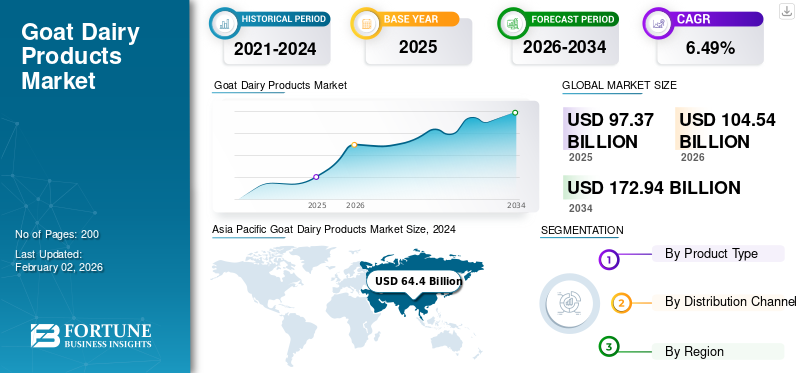
Download Free sample to learn more about this report.
Goat Dairy Products Market Key Takeaways
 Global Market Size & Forecast
- 2025 Market Size: USD 97.37 billion
- 2026 Market Size: USD 104.54 billion
- 2034 Forecast Market Size: USD 172.94 billion
- CAGR: 6.49% from 2026–2034
 Market Share
- Asia Pacific dominated the market with a 71.11% share in 2025.
- Milk segment held the largest market share in 2025.
- Supermarkets/Hypermarkets segment held the largest market share in 2025.
 Key Regional Highlights
North America
The market reached USD 5.57 billion in 2025 and is projected to reach USD 6.09 billion by 2026.
Asia Pacific
The market reached USD 69.24 billion in 2025 and is projected to reach USD 74.16 billion by 2026.
Europe
The market reached USD 12.42 billion in 2025 and is projected to reach USD 13.38 billion by 2026.
U.S.
The market is driven by rising demand for goat milk-based infant formula and goat cheese.
Japan
The market is supported by increasing demand for goat milk products and health-focused dairy consumption.
Read More

MARKET DYNAMICS
MARKET DRIVERS
Increasing Demand for Goat Milk in Infant Formulas to Drive Market Growth
The demand for goat milk in infant formulas has been increasing and gaining popularity as an alternative to cow's milk formula, owing to their low allergen content, efficient absorption, and perceived easier digestibility. It also contains high levels of essential amino acids, the building blocks of proteins crucial for growth and development. Moreover, goat milk has also received regulatory approval from agencies such as the European Food Safety Authority, indicating it as a safer infant-feeding option. Manufacturers are responding to this demand and innovating new products. For instance, in November 2020, Kendamil, a British brand, launched Kendamil Goat, a goat’s milk formula. The new product is the only British-made goat formula on the market and the first to contain Human Milk Oligosaccharides (HMOs).
MARKET RESTRAINTS
Low Consumer Awareness and Sub-optimal Market Penetration Impede Growing Momentum
The global goat dairy products market growth is mainly affected by the lack of awareness of such products across a large population based in developed/developing countries, along with their lower adoption rate. Many surveys conducted across various developing economies have revealed that consumers are not sufficiently aware of various goat dairy products and hence treat conventional dairy, such as cow milk, as the only reliable option. Goat milk is not acceptable to many consumers due to its typical flavor and cultural dislike, further impeding product sales.
MARKET OPPORTUNITIES
Increased Government Support to Offer Market Opportunities
Government and business leaders recognize the need for healthy goat dairy products, aim to improve farmers' economic status, increase milk production, and meet the growing demand for goat milk products. In countries such as India and China, producers are increasingly raising livestock in response to the increased consumer demand for goat milk and other products, with the substantial financial support provided by the government. For instance, in June 2025, the UP government in India launched a goat rearing scheme to boost the income of landless and impoverished livestock farmers from Scheduled Caste (SC) communities. The scheme would establish 750 goat farming units across all 75 state districts, and each district would receive 10 units.
GOAT DAIRY PRODUCTS MARKET TRENDS
Development of Innovative Products Helps in Fulfiling Modern Consumer Demands
The global market is projected to witness a promising growth trajectory owing to the increased focus of manufacturers on investing in innovations & new product developments in the market. The rising trend of clean-label products, such as non-GMO, fat-free, and preservative-free, is expected to provide a new platform for manufacturers to launch a whole new range of goat dairy variants. For instance, in June 2025, Ausnutria, one of the leaders in goat dairy, launched GOOT, its first full-range goat dairy brand in UAE and Saudi Arabia. The new range consists of preservative-free, natural, and premium goat dairy products with probiotic benefits, supporting gut health and overall well-being.
Download Free sample to learn more about this report.
Segmentation Analysis
By Product Type
Easier Digestibility and Lower Lactose Content Propel Milk Segment Expansion
Based on the product type, the market is segregated into milk, cheese, butter, yogurt, and others.
The milk segment dominates the global market, owing to accessibility to people with a sensitivity to cow's milk and growing awareness among consumers of its health benefits. Goat milk is known to contain higher protein, and the protein composition which is closer to breast milk. Moreover, the fat present in goat milk is easier to digest. It has a slightly lower lactose content than cow's milk, which makes it more popular among individuals with lactose intolerance or sensitivity, fueling its demand in the global market.
The cheese segment will grow significantly over the forecast period due to its easy digestibility compared to cheese derived from other ruminants. According to the Agricultural Marketing Resource Center, goat cheese has been one of the specialty food product market's fastest-growing cheeses in the past decade. Moreover, it has a characteristic flavor due to the presence of caprylic, capric, and caproic fatty acids, giving it a tangy flavor.
By Distribution Channel
Wide Availability and Convenient Shopping Experience Boost Supermarkets/Hypermarkets Segment Growth
Based on the distribution channel, the market is divided into supermarkets/hypermarkets, convenience stores, specialty stores, online retail, and others.
Supermarkets/hypermarkets dominate the global market, owing to their consumer convenience and wide availability of product offerings. These establishments offer consumers various dairy products such as milk, cheese, yogurt, and others under one roof, thus fueling bulk purchases. Furthermore, the increased consumption of goat dairy products among health-conscious consumers and lifestyle changes further solidifies the segment’s dominance in the global market.
The online retail segment will grow significantly in the coming years. The COVID-19 pandemic has propelled the trend toward online shopping. According to the Midwest Dairy, St. Paul, Minn., natural cheese and milk saw substantial increases in e-commerce sales during the pandemic. Moreover, several players operating in the market have been leveraging digital platforms for direct delivery of dairy foods, further fueling segment growth.
Goat Dairy Products Market Regional Outlook
By geography, the market is categorized into North America, Europe, Asia Pacific, South America, and the Middle East & Africa.
Asia Pacific
Asia Pacific Goat Dairy Products Market Size, 2025 (USD Billion)
To get more information on the regional analysis of this market, Download Free sample
The Asia Pacific region captured 71.11% of the global market in 2025, generating USD 69.24 billion in revenue, and is projected to reach USD 74.16 billion in 2026. China, India, Pakistan, and Bangladesh are known to be the world's largest goat milk producers and consumers. The region is considered home to various goat species due to the high concentration of these animals. According to the U.S. National Center for Biotechnology Information (NCBI), around 60% of the goat population is present in Asia Pacific. Goat dairy products industry plays a critical role in the Indian dairy sector, particularly where other forms of dairy farming are less viable.
India’s dominance in goat milk production is economically significant for the region as it offers a key source of livelihood and nutrition for millions of rural households. International manufacturers are also expanding their base in the region and focusing on launching innovative products to meet the rising demand. For instance, in July 2024, LittleOak, an Australian infant formula company, launched a palm oil-free, ready-to-drink (RTD) goat milk product in Asia Pacific. The new product will be available in key markets, including Singapore, Malaysia, and Vietnam.
Europe
In 2025, the Europe market stood at USD 12.42 billion, representing 12.75% of global demand, and is projected to grow to USD 13.38 billion in 2026. The market in Europe is growing, owing to a rise in demand for goat's cheese, yogurt, and milk. Government involvement is significant in research, extension, regulations, and support for local producer organizations and markets, further fueling the industry's growth. Most goat milk in the region is transformed into cheese in large dairy industries, which coexist with artisanal farm dairies and small local industries. These industries usually produce pure goat milk cheese mainly in France and blended cheeses in Spain or Greece. According to the European Union, in 2023, the production of goat milk cheese totaled approximately 219 million kilos. Besides cheese demand, there has been a growing popularity of pasteurized goat milk for direct consumption and powdered goat milk for infant formulas, further fueling the market growth.
North America
North America contributed approximately USD 5.57 billion to the global market in 2025, accounting for 5.72% share, and is expected to reach USD 6.09 billion in 2026. The consumption of goat dairy food continues to rise in North America, as consumers perceive it as a healthier and less allergenic alternative to cow's milk. The two primary reasons driving the North America goat milk market expansion are the rising demand for cheese in the fast-food industry and the growing use of goat milk as a therapeutic health food nutraceutical. Therefore, key players in the region have been formulating new infant products to meet the rising demand. For instance, in February 2025, Kabrita, a U.S.-based leading provider of goat milk nutrition, launched Goat Milk-Based Infant Formula for babies between 0-12 months in Canada. The new product is made with grass-fed goat milk and is the best alternative for babies who may experience sensitivity to cow's milk-based formulas.
South America
South America is expected to grow significantly in the global market. In South America, particularly Brazil and Argentina, dairy goats make an important contribution to smallholder livelihoods. Brazil is known to be one of South America's major dairy goat-producing countries, owing to well-established goat farming practices and diverse geography. According to the Food and Agriculture Organization, in 2019, the dairy goat farmers produced 26 million liters of goat milk on 15,720 farms in Brazil. Moreover, dairy goat food production is important in many parts of the region, particularly Argentina, owing to increased demand for goat cheese in the urban areas, further fueling the growth of the market.
Middle East & Africa
In 2025, Middle East & Africa generated USD 6.78 billion, contributing 6.96% to global market revenue, and is projected to grow to USD 7.25 billion in 2026. Goat dairy products have deep cultural roots in the Middle East & Africa. Goat cheese and yogurt are mostly produced by small-scale local processors and households using traditional regional methods. Moreover, the goat milk industry contributes significantly to food security by offering essential nutrients and a source of protein in the region. The Middle East & Africa goat milk market also boasts diverse goat breeds, such as the Nubian and Damascus goats, which are well-adapted to semi-arid and arid environments and vital for commercial dairy farming. However, lack of modern farming technologies, limited veterinary services, and limited market access have been major barriers to market growth. Research efforts have been practiced in order to improve milk yields through breeding programs, better management practices, and enhanced nutrition.
Latin America
Latin America recorded a market size of USD 3.37 billion in 2025, capturing 3.46% of the global market share, and is projected to reach USD 3.66 billion in 2026.
COMPETITIVE LANDSCAPE
Key Industry Players
Growing Top Companies’ Focus on Product Innovation Strategies to Fuel Industry Growth
The global goat dairy products market is highly fragmented, with the presence of local and international players. To gain a competitive advantage, prominent manufacturers of goat dairy products in the market are focusing on innovative product launches with a variety of new, trending flavors and formats. For instance, in August 2022, the Montchevre brand, owned by Saputo Cheese USA Inc., launched its new sweet and savory goat cheese flavors, including hibiscus berry goat cheese log and the topped goat cheese line. Friesland Campina, Montchevre, Betin Inc., Holle baby food AG, Kendamil, and Meyenberg are among the leading players operating in the global goat dairy market.
LIST OF KEY GOAT DAIRY PRODUCT COMPANIES PROFILED
- Friesland Campina (Netherlands)
- Montchevre, Betin Inc. (U.S.)
- Nestle S.A. (Switzerland)
- Dairy Farmers of America, Inc. (U.S.)
- Holle baby food AG (Switzerland)
- Kendamil (U.K.)
- Meyenberg (U.S.)
- Summerhill Goat Dairy (U.S.)
- Emami Group (India)
- St Helen's Farm (U.K.)
KEY INDUSTRY DEVELOPMENTS
- January 2025: Belle Chevre, Inc., an artisan goat cheese maker, launched its newest brand, Señor Cactus, which sales a product line of goat cheese dips made with pieces of prickly pear cactus.
- November 2024: Montchevre brand, one of the leading U.S. goat cheese manufacturers, launched two new cheese products, Montchevre's Mild Gouda-Style goat milk cheese and Montchevre's Cold Brew & Donuts goat cheese.
- October 2024: Kabrita expanded its U.S. access to goat milk infant formula with nationwide availability at Whole Foods Markets and Sprouts Farmers Markets.
- July 2023: Daiya Foods, a plant-based food company, launched two new dairy products, Goat Cheeze Flavour Crumbles and Feta Cheeze Flavour Crumbles, in Canada.
- October 2021: Yili Industrial Group Co., Ltd. acquired goat milk formula giant Ausnutria Dairy Co., Ltd. This transaction marked the largest merger and acquisition deal for China's dairy industry.
REPORT COVERAGE
The global goat dairy products market report provides market size & forecast by all the segments. It includes details on the market dynamics and trends expected to drive the market in the forecast period. It offers information about the key regions/countries, key industry developments, new product launches, and details on key countries' partnerships, mergers, and acquisitions. The market analysis also covers a detailed competitive landscape with information on the market share and profiles of key players.
Request for Customization to gain extensive market insights.
Report Scope & Segmentation
|
ATTRIBUTE |
DETAILS |
|
Study Period |
2021-2034 |
|
Base Year |
2025 |
|
Estimated Year |
2026 |
|
Forecast Period |
2026-2034 |
|
Historical Period |
2021-2024 |
|
Growth Rate |
CAGR of 6.49% from 2026-2034 |
|
Unit |
Value (USD Billion) |
|
Segmentation |
By Product Type
|
|
By Distribution Channel
|
|
|
By Region
|
Frequently Asked Questions
Fortune Business Insights says that the global market value stood at USD 97.37 billion in 2025 and is projected to reach USD 172.94 billion by 2034.
The market is expected to exhibit a CAGR of 6.49% during the forecast period of 2026-2034.
The milk segment leads the market by product type.
Increasing demand for goat milk in infant formulas to drive market growth
Friesland Campina, Montchevre, Betin Inc., Holle baby food AG, Kendamil, and Meyenberg are the top players in the market.
Asia Pacific dominated the market with a share of 71.11% in 2025.
Development of innovative products is the major key trend in the market.



- 2021-2034
- 2025
- 2021-2024
- 200
-
(Offer valid till 15th Oct 2026)
Get 30-60 hrs Free Customization
Expand Regional and Country Coverage, Segments Analysis, Company Profiles, Competitive Benchmarking, and End-user Insights.




















-
US +1 833 909 2966 ( Toll Free )
-
Get In Touch With Us