Grain Alcohol Market Size, Share & Industry Analysis, By Source (Corn, Wheat, Barley, Sorghum, and Others), By End-Use (Non-Food Use and Food-Use [Alcoholic Beverages, Flavours & Extracts, Food Coatings & Preservation, Vinegar & Fermented Foods, and Others]), and Regional Forecast, 2026-2034
 Download Free Sample
(Offer valid till 30th Sep 2026)

Grain Alcohol Market Size and Future Outlook
 Listen to Audio Version
The global grain alcohol market size was valued at USD 15.66 billion in 2025 and is projected to grow from USD 16.30 billion in 2026 to USD 22.88 billion by 2034, exhibiting a CAGR of 4.33% during the forecast period. North America dominated the grain alcohol market with a market share of 32.05% in 2025.
Grain alcohol refers to ethanol produced through the fermentation and distillation of cereal grains such as corn, wheat, barley, sorghum, rice, and rye. It is used across alcoholic beverages, food flavours and extracts, vinegar, preservation systems, pharmaceuticals, personal care, solvents, sanitizers, fuel blending, and other industrial applications. The market has gained strategic importance as grain-based alcohol offers a renewable, high-purity, scalable, and versatile input for both food and non-food industries. Moreover, steady global market growth is supported by the broad use of grain-derived ethanol across food, beverage, pharmaceutical, fuel, and industrial applications.
The global demand for grain alcohol is supported by leading producers and grain processors such as Archer Daniels Midland Company, Cargill, Incorporated, MGP Ingredients, Inc., Green Plains Inc., POET, LLC, Valero Energy Corporation, The Andersons, Inc., Alto Ingredients, Inc., CropEnergies AG, and Grain Processing Corporation, which maintain active positions in food-grade alcohol, beverage alcohol, industrial ethanol, bioethanol, and grain-based fermentation platforms.
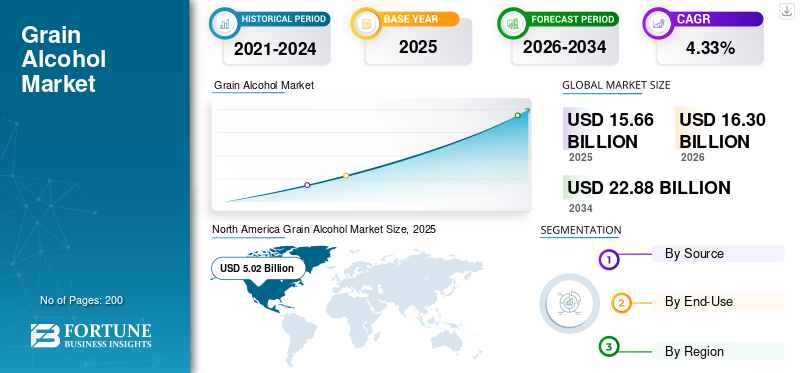
Download Free sample to learn more about this report.
Grain Alcohol Market Key Takeaways
 Global Market Size & Forecast
- 2025 Market Size: USD 15.66 billion
- 2026 Market Size: USD 16.30 billion
- 2034 Forecast Market Size: USD 22.88 billion
- CAGR: 4.33% from 2026–2034
 Market Share
- North America dominated the grain alcohol market with a 32.05% share in 2025.
- The non-food use segment is projected to grow at the fastest CAGR of 4.83% during the forecast period.
- The sorghum segment is projected to grow at the fastest CAGR of 6.27% during the forecast period.
 Key Regional Highlights
North America
North America was valued at USD 5.02 billion in 2025 and is projected to reach USD 6.61 billion by 2034.
Asia Pacific
Asia Pacific was valued at USD 4.97 billion in 2025 and is projected to reach USD 8.46 billion by 2034.
Europe
Europe was valued at USD 3.33 billion in 2025 and is projected to reach USD 4.58 billion by 2034.
U.S.
The market was valued at USD 4.37 billion in 2025.
Japan
Growing demand for premium alcoholic beverages and industrial ethanol applications is supporting market growth.
Read More

Grain Alcohol Market Trends
Rising Preference for Grain-Based Ethanol in Food, Beverage, Biofuel, and Industrial Applications to Shape Industry Trends
A major factor shaping market trends is the increasing use of grain-derived ethanol across beverage alcohol, food processing, sanitization, industrial solvents, pharmaceuticals, and fuel blending. Grain alcohol benefits from its wide raw material availability, established fermentation infrastructure, high purity, and compatibility with both food-grade and technical-grade applications. Corn remains the most important feedstock globally, particularly in North America, while wheat and barley are more prominent in Europe and parts of Asia for beverage and food-grade alcohol production. The beverage industry is also creating strong global market demand for neutral grain spirits, especially in vodka, gin, liqueurs, botanical spirits, and ready-to-drink alcoholic beverages. Rising urban consumption, cocktail culture, and interest in premium formulations are encouraging distillers to use high-purity grain alcohol as a key base ingredient.
- According to the Food and Agriculture Organisation (FAO), global cereal production was at 3,040 million tons in 2025, up 6.0% from the previous year, indicating a strong raw material base for grain-derived ethanol production.
MARKET DYNAMICS
Market Drivers
Download Free sample to learn more about this report.
Expanding Demand for Renewable Ethanol, Food-Grade Alcohol, and Grain-Based Beverage Inputs to Support Market Growth
The global grain alcohol market growth is strongly supported by the rising demand for renewable ethanol and food-grade alcohol across energy, beverages, food processing, and industrial applications. Grain alcohol is widely used in alcoholic beverages, flavour extraction, vinegar production, food coatings, pharmaceutical preparations, cosmetics, sanitizers, antifreeze, solvents, and fuel blending. Its broad end-use base reduces dependence on a single application and supports steady long-term market expansion. The market is further supported by the growing demand for grain-based ethanol in both food and non-food applications. Increasing adoption in beverages pharmaceuticals applications, industrial cleaning products, and bio-based solvents is strengthening demand from manufacturers that require high-purity, scalable, and renewable alcohol inputs.
- The S. is also the world’s largest ethanol producer, which produced over 16 billion gallons of ethanol in 2024, while the U.S. and Brazil together accounted for about 80% of global ethanol production. The U.S. ethanol base is especially relevant for the market since the vast majority of U.S. ethanol is produced from corn.
Market Restraints
Feedstock Price Volatility, Food-versus-Fuel Concerns, and Regulatory Pressure to Limit Market Expansion
The growth of the market is being restrained by volatility in corn, wheat, barley, and sorghum prices. Grain alcohol producers are exposed to fluctuations in crop yields, weather events, fertilizer costs, energy prices, freight costs, and international trade policies. Since grain is the largest input cost for many ethanol and beverage alcohol facilities, any sharp increase in grain prices can reduce margins and affect production economics.
Food-versus-fuel concerns also remain important, especially in regions where ethanol blending competes with food, feed, and livestock demand for corn and other cereals. In addition, beverage alcohol regulations, excise duties, denatured alcohol rules, residue limits for food-grade alcohol, and sustainability requirements add complexity for producers. Packaging and emissions regulations are also becoming more relevant for downstream alcoholic beverage and industrial ethanol users.
- The Food and Agriculture Organisation (FAO) data highlights this volatility, as global food prices reached record highs in 2022 due to drought, the Russia-Ukraine war, and supply-chain disruptions, before declining 13.7% in 2023, with the cereal price index falling 15.4%. In the U.S., around 5.45 billion bushels of corn were expected to be used for ethanol production in both 2023/24 and 2024/25, demonstrating the large-scale competition between fuel ethanol, animal feed, food processing, and export markets.
Market Opportunities
Premium Beverage Alcohol, Clean-Label Extracts, Bio-Based Solvents, and Renewable Fuel Programs to Unlock Growth Potential
The expansion of premium beverage alcohol, clean-label food extracts, bio-based solvents, and renewable fuel programs is expected to create substantial opportunities during the forecast period. Demand for neutral grain spirits is increasing in vodka, gin, ready-to-drink alcoholic beverages, botanical spirits, bitters, and flavour concentrates. Food manufacturers are also using grain alcohol in extracts, preservation systems, vinegar, fermented foods, and functional beverage ingredient platforms. The opportunity is further supported by increased demand for premium spirits, especially among younger urban consumers with rising disposable income and higher preference for branded, craft, and blended alcoholic beverages. This trend is encouraging beverage companies to use grain-derived neutral spirits in differentiated product formats.
- For instance, in August 2025, Uppal Brewers & Distillers (UBD) launched Madhvan, a new whisky that blends Indian grain spirits with Scotch malt whisky and is positioned at a premium entry point for young urban consumers. The liquid is described as a blend of Indian grain spirits with fine Scotch malt whisky, with tasting notes including ripe pear, tropical fruit, soft florals, toffee, honey, vanilla and a gentle spice finish, described as medium-bodied and clean finishing.
SEGMENTATION ANALYSIS
By End-Use
Food-Use Segment Dominated Market Due to Strong Demand from Alcoholic Beverages, Flavours, Extracts, and Fermented Food Applications
Based on end-use, the market is segmented into non-food use and food use, with food use further classified into alcoholic beverages, flavours & extracts, food coatings & preservation, vinegar & fermented foods, and others.
The food-use segment dominated the global market and was valued at USD 8.76 billion in 2025, owing to strong demand for alcoholic beverages, flavour extraction, vinegar production, fermented foods, food coatings, and processing ingredients. Grain alcohol is widely used in vodka, gin, liqueurs, bitters, botanical spirits, food extracts, tinctures, and preservation systems due to its purity, volatility, solubility, and compatibility with food-grade formulations. Within food-use, the alcoholic beverages segment remained the largest sub-segment, valued at USD 4.89 billion in 2025. This beverage segment is driven by the use of neutral grain spirits in vodka, gin, blended spirits, ready-to-drink alcoholic beverages, and premium craft formulations. The role of grain alcohol in beverage production remains significant as it provides a consistent, high-purity base for branded spirits, flavored alcoholic drinks, and botanical alcohol products.
The non-food use segment is projected to grow at the fastest CAGR of 4.83% during the forecast period, supported by rising demand from biofuels, sanitizers, industrial solvents, pharmaceuticals, personal care products, cleaning solutions, and chemical intermediates.
By Source
To know how our report can help streamline your business, Speak to Analyst
Corn Segment Dominated Market Due to Its Large Ethanol Production Base, High Starch Content, and Strong Industrial Use
Based on source, the market is segmented into corn, wheat, barley, sorghum, and others.
The corn segment dominated the global grain alcohol market share, valued at USD 7.08 billion in 2025, owing to its large production base, high starch content, cost efficiency, strong ethanol conversion yield, and extensive use in North American fuel ethanol and industrial alcohol production. Corn is widely preferred by ethanol producers as it supports large-scale fermentation, provides consistent alcohol yields, and generates valuable co-products such as distillers’ dried grains and corn oil.
The sorghum segment is projected to grow at the fastest CAGR of 6.27% during the forecast period, supported by its drought tolerance, suitability in dryland agriculture, increasing use as an alternative ethanol feedstock, and rising demand in regions where corn availability or pricing is less favorable.
Grain Alcohol Market Regional Outlook
Regionally, the market is studied across North America, Europe, Asia Pacific, South America, and the Middle East & Africa.
North America
North America Grain Alcohol Market Size, 2025 (USD Billion)
To get more information on the regional analysis of this market, Download Free sample
North America dominated the global market and was valued at USD 5.02 billion in 2025 and is projected to reach USD 6.61 billion by 2034, growing at a CAGR of 3.14% over the forecast period. Growth is driven by large-scale corn ethanol production, strong beverage alcohol demand, mature food processing industries, and established industrial alcohol applications in solvents, sanitizers, pharmaceuticals, and personal care.
U.S. Grain Alcohol Market
The U.S. dominates the North American market, valued at USD 4.37 billion in 2025. The market is supported by the country’s large corn production base, extensive ethanol infrastructure, high consumption of beverage alcohol, and strong demand from fuel blending and industrial alcohol applications.
Europe
Europe was valued at USD 3.33 billion in 2025 and is projected to reach USD 4.58 billion by 2034, growing at a CAGR of 3.64% over the forecast period. Growth is supported by beverage alcohol production, wheat- and barley-based distillation, food-grade ethanol demand, bio-based solvents, and renewable fuel policies.
Germany Grain Alcohol Market
Germany’s market was valued at USD 0.75 billion in 2025. Demand is supported by industrial alcohol, bioethanol blending, pharmaceutical applications, personal care products, and food processing.
U.K. Grain Alcohol Market
The U.K. market was valued at USD 0.42 billion in 2025. Growth is supported by beverage alcohol production, gin and vodka demand, flavour extracts, food applications, and the use of neutral grain spirit in branded and private-label alcoholic beverages.
Asia Pacific
Asia Pacific was valued at USD 4.97 billion in 2025 and is projected to reach USD 8.46 billion by 2034, growing at the fastest CAGR of 6.11% over the forecast period. Growth is driven by expanding beverage alcohol consumption, rising food processing activity, increasing industrial alcohol demand, fuel ethanol programs, and growing use of grain alcohol in pharmaceuticals, cosmetics, sanitizers, and flavours.
China Grain Alcohol Market
China dominates the regional market, and is set to reach approximately USD 1.81 billion in 2026. Growth is supported by its large food and beverage manufacturing base, high demand for industrial alcohol, pharmaceutical applications, flavour extracts, and grain-based spirits.
India Grain Alcohol Market
India’s market was valued at USD 1.18 billion in 2025. The market is supported by rising ethanol blending targets, expanding alcoholic beverage consumption, increasing demand for food-grade alcohol, and the use of grain-based ethanol as a supplement to sugarcane and molasses-based ethanol.
South America and Middle East & Africa
South America was valued at USD 1.15 billion in 2025 and is projected to reach USD 1.72 billion by 2034, growing at a CAGR of 4.64% over the forecast period. Growth is driven by rising alcohol consumption, food processing, industrial ethanol use, and fuel blending programs in Brazil, Argentina, and Colombia. Although sugarcane ethanol remains prominent in Brazil, grain alcohol is gaining relevance in corn-producing regions and industrial applications.
The Middle East & Africa market was valued at USD 1.20 billion in 2025 and is projected to reach USD 1.51 billion by 2034, growing at a CAGR of 2.54% over the forecast period. Growth is supported by industrial alcohol use, pharmaceuticals, cosmetics, food processing, sanitizers, and import-led beverage and food-grade alcohol demand.
Brazil Grain Alcohol Market
Brazil dominates the South American market, valued at USD 0.69 billion in 2025. Growth is supported by corn ethanol expansion, industrial alcohol demand, food processing, and the rising use of grain-based ethanol in regions where corn availability is strong.
COMPETITIVE LANDSCAPE
Key Industry Players
Key Players Focus on Grain Processing Integration, High-Purity Ethanol, Beverage Alcohol, Biofuel Expansion, and Industrial Applications to Strengthen Market Position
Key players in the global grain alcohol market are focusing on feedstock security, distillation efficiency, high-purity alcohol production, food-grade certification, biofuel capacity, and value-added co-products to strengthen their market position. Companies are expanding across corn ethanol, wheat alcohol, neutral grain spirits, industrial ethanol, beverage alcohol, bio-based solvents, and specialty fermentation ingredients. Strategic emphasis remains on integrated grain sourcing, renewable fuel demand, food and beverage applications, and downstream industrial partnerships.
Key Players in Grain Alcohol Market
|
Rank |
Company Name |
|
1 |
Archer Daniels Midland Company |
|
2 |
Cargill, Incorporated |
|
3 |
MGP Ingredients, Inc. |
|
4 |
Green Plains Inc. |
|
5 |
POET, LLC |
List of Key Grain Alcohol Companies Profiled
- Archer Daniels Midland Company (U.S.)
- Cargill, Incorporated (U.S.)
- MGP Ingredients, Inc. (U.S.)
- Green Plains Inc. (U.S.)
- POET, LLC (U.S.)
- Valero Energy Corporation (U.S.)
- The Andersons, Inc. (U.S.)
- Alto Ingredients, Inc. (U.S.)
- CropEnergies AG (Germany)
- Grain Processing Corporation (U.S.)
KEY INDUSTRY DEVELOPMENTS
- January 2026: CF Industries and POET launched a pilot project with major agricultural cooperatives to develop a low-carbon fertilizer supply chain. The project aims to reduce the carbon intensity of corn used by POET facilities for ethanol production.
- August 2025: POET signed an agreement to acquire Green Plains Obion, a bioethanol facility in Tennessee. The acquisition adds 120 million gallons of annual bioethanol capacity and expands POET’s portfolio to 35 bioprocessing facilities across nine U.S. states.
- July 2025: Maharashtra approved existing single-feed distilleries to operate as dual-feed units, allowing them to use grains such as maize and broken rice for ethanol production. The move allows distilleries to operate for longer periods during the year.
- May 2023: Jagatjit Industries announced plans to invest approximately USD 21.80 million to set up a grain-based ethanol manufacturing plant in Punjab, India, to serve rising fuel-blending demand.
- February 2022: MGP Ingredients announced a USD 12 million barrel warehouse expansion in Kentucky to meet rising demand for American whiskey. The project followed a USD 4 million expansion at Lux Row Distillers.
REPORT COVERAGE
The global grain alcohol market report analyzes the market in depth and highlights crucial aspects such as global market trends, market dynamics, supply chains, prominent companies, investment in research and development, and end-use. Besides this, the report also provides insights into the global market analysis and highlights significant industry developments.
Request for Customization to gain extensive market insights.
Report Scope & Segmentation
| ATTRIBUTE | DETAILS |
| Study Period | 2021-2034 |
| Base Year | 2025 |
| Estimated Year | 2026 |
| Forecast Period | 2026-2034 |
| Historical Period | 2021-2024 |
| Growth Rate | CAGR of 4.33% from 2026 to 2034 |
| Unit | Value (USD Billion) |
|
Segmentation |
By End-Use
|
|
By Source
|
|
|
By Region
|
Frequently Asked Questions
Fortune Business Insights says that the global market was valued at USD 15.66 billion in 2025 and is anticipated to reach USD 22.88 billion by 2034.
At a CAGR of 4.33%, the global market will exhibit steady growth over the forecast period.
By source, the corn segment led the market.
North America held the largest market share in 2025.
Expanding demand for renewable ethanol, food-grade alcohol, and grain-based beverage inputs to support market growth.
Archer Daniels Midland Company, Cargill, Incorporated, MGP Ingredients, Inc., Green Plains Inc., and POET, LLC, are the leading players in the market.
Rising preference for grain-based ethanol in food, beverage, biofuel, and industrial applications to shape industry trends.



- 2021-2034
- 2025
- 2021-2024
- 200
-
(Offer valid till 30th Sep 2026)
Get 30-60 hrs Free Customization
Expand Regional and Country Coverage, Segments Analysis, Company Profiles, Competitive Benchmarking, and End-user Insights.




















Related Reports
-
US +1 833 909 2966 ( Toll Free )
-
Get In Touch With Us