Ground Calcium Carbonate Market Size, Share & Industry Analysis by Application (Building & Construction, Pharmaceutical, Agriculture, Plastics, Pulp & Paper, Paints & Coatings, and Others), and Regional Forecast, 2026-2034
 Download Free Sample
KEY MARKET INSIGHTS
 Listen to Audio Version
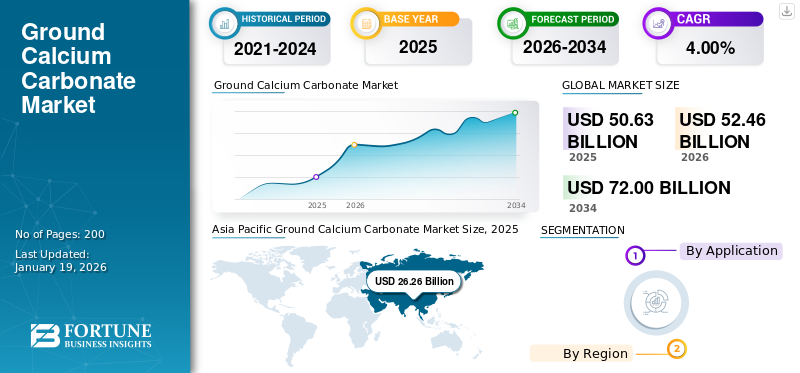
The global ground calcium carbonate market size was valued at USD 50.63 billion in 2025. The market is projected to grow from USD 52.46 billion in 2026 to USD 72 billion by 2034, exhibiting a CAGR of 4.0% during the period. Asia Pacific dominated the ground calcium carbonate market with a market share of 52% in 2025.
Ground Calcium Carbonate (GCC) is a naturally occurring mineral derived from sources such as limestone, marble, or chalk. It is widely used as a functional filler and coating pigment across various industries. GCC is valued for its high purity, whiteness, and low abrasiveness. It plays a vital role in applications such as paper production, plastics, paints and coatings, adhesives, and construction materials. The market is witnessing steady growth due to rising demand from the paper industry and the plastic industry. Rapid industrialization and expansion in the construction industry are also contributing to market growth. Additionally, the increasing preference for eco-friendly and cost-effective materials is supporting its adoption. The major manufacturers operating in the market include Imerys, Carmeuse, TLDVietnam, Minerals Technologies Inc., and Mississippi Lime Company.
Download Free sample to learn more about this report.
Ground Calcium Carbonate Market KEY TAKEAWAYS
 Global Market Size & Forecast
- 2025 Market Size: USD 50.63 billion
- 2026 Market Size: USD 52.46 billion
- 2034 Forecast Market Size: USD 72.00 billion
- CAGR: 4.0% from 2026–2034
 Market Share
- Asia Pacific dominated the ground calcium carbonate market with a 52.00% share in 2025.
- The plastics segment accounted for the largest market share in 2025.
- The paints & coatings segment is expected to witness steady growth during the forecast period.
 Key Regional Highlights
Asia Pacific
Asia Pacific reached USD 26.26 billion in 2025, driven by strong demand from paper, plastics, and construction industries.
North America
North America accounted for USD 12.27 billion in 2025, supported by growing demand from packaging and construction sectors.
Europe
Europe captured 10.00% of the global market in 2025, driven by sustainable manufacturing and eco-friendly materials.
U.S.
The market is witnessing steady growth, fueled by rising demand from packaging, automotive, and construction industries.
Japan
The market is growing due to increasing demand from paper, plastics, and industrial manufacturing sectors.
Read More

MARKET DYNAMICS
MARKET DRIVERS
Accelerating Industrialization and Infrastructure Development to Propel Product Demand
The increasing pace of industrialization and infrastructure development is significantly contributing to the rising demand for GCC. Widely used across industries such as paper, plastics, paints, and construction, GCC offers advantages such as high brightness, improved durability, and cost-effectiveness. In the construction sector, it is used as a key additive in cement, adhesives, and paints to enhance performance and reduce costs. Additionally, its role as a functional filler in packaging, automotive, and consumer goods further supports market expansion. As a result, these factors are expected to drive the global ground calcium carbonate market growth.
MARKET RESTRAINTS
Volatility in Raw Material and Energy Prices to Hinder Market Growth
The GCC market faces a significant challenge due to the fluctuating prices of essential raw materials such as limestone and energy. As limestone is the primary source for GCC, any increase in quarrying, processing, or transportation costs directly impacts the overall production expenses. Additionally, energy-intensive grinding and coating processes make manufacturers susceptible to shifts in fuel and electricity prices. These unpredictable cost fluctuations can affect profit margins and disrupt production planning. As a result, such volatility in raw material and energy costs is expected to restrain the growth of the GCC market over the forecast period.
MARKET OPPORTUNITIES
Emphasis on Sustainable Processing Methods to Support the Market Expansion
The increasing focus on environmentally responsible manufacturing is creating new growth opportunities for the market. Manufacturers are increasingly adopting sustainable practices such as energy-efficient grinding processes, closed-loop water systems, and low-emission processing technologies to reduce environmental impact. Additionally, the use of renewable energy sources in GCC processing facilities is gaining traction, helping companies meet regulatory standards and corporate sustainability goals. These efforts contribute to reducing the overall carbon footprint and also enhance the appeal of GCC as an eco-friendly material. As industries continue to prioritize sustainability, such initiatives are expected to support the expansion of the market over the coming years.
GROUND CALCIUM CARBONATE MARKET TRENDS
Growing Focus on Nano and Surface-Treated GCC to Enhance Performance and Application Range
The market is witnessing an increasing shift toward the use of nano-sized and surface-treated products. Nano GCC offers improved properties such as higher surface area, better dispersion, and enhanced mechanical strength. These qualities make it ideal for use in plastics, coatings, and pharmaceutical applications. Surface-treated ground calcium carbonate is also gaining traction. It is modified to improve compatibility with polymers and resins, enhance processing efficiency, and improve product performance in industries such as paints, adhesives, and rubber. This trend of advanced and customized forms of GCC reflects a strong focus on product innovation and is expanding the application of the material across a wider range of industrial sectors.
MARKET CHALLENGES
Stringent Environmental Regulations and Availability of Substitutes Create Challenges for Market Expansion
The production of ground calcium carbonate involves mining and processing activities that can lead to environmental degradation, including dust emissions and landscape disruption. This has led to strict environmental regulations regarding mining practices and waste management, compelling manufacturers to adopt sustainable and eco-friendly operations. Additionally, the growing availability of alternative mineral fillers and synthetic additives in industries such as plastics, paints, and paper poses a competitive threat. As a result, manufacturers are under pressure to enhance product quality and optimize production processes to maintain market relevance.
Download Free sample to learn more about this report.
Segmentation Analysis
By Application
Plastics Segment Dominated the Market in 2024 with Rising Demand for Lightweight and Cost-effective Fillers
Based on application, the market is segmented into building & construction, pharmaceutical, agriculture, plastics, pulp & paper, paints & coatings, and others.
The plastics segment held a dominant global ground calcium carbonate market share in 2024, driven by its widespread use as a filler that improves both product performance and cost efficiency. GCC is commonly incorporated into thermoplastics, thermosets, and elastomers. It enhances stiffness, impact strength, and dimensional stability. It also improves surface finish and thermal conductivity. These properties make it suitable for a wide range of plastic products. Applications include PVC pipes, cable insulation, plastic films, injection-molded components, and various packaging materials. Additionally, GCC reduces raw material costs, which makes it highly attractive for manufacturers. With the growing demand for lightweight, durable, and high-performance plastics, the use of GCC in this segment continues to expand.
The paints & coatings segment is witnessing steady growth in the GCC market due to the ability of the material to enhance opacity, brightness, and surface finish in various formulations. It also contributes to improved weather resistance, durability, and anti-corrosive performance. GCC is commonly used in decorative paints, industrial coatings, and protective applications. In addition, it helps regulate gloss and ensures a smooth, uniform appearance. With rising demand for high-quality, long-lasting, and cost-efficient coatings, the adoption of GCC in this segment continues to grow.
The pulp & paper segment also holds a substantial share of the market. GCC is widely used as a filler and coating material to enhance paper brightness, opacity, and print quality. It helps to improve the texture and appearance of both printing and packaging papers. As the demand rises for high-grade paper products, calcium carbonate is increasingly being chosen over more expensive and less sustainable materials. Technological advancements in paper production and a shift toward alkaline papermaking processes are further supporting the use of GCC in this segment.
Ground Calcium Carbonate Market Regional Outlook
By geography, the market is categorized into Asia Pacific, North America, Europe, Latin America, and the Middle East & Africa.
Asia Pacific
Asia Pacific Ground Calcium Carbonate Market Size, 2025 (USD Billion) To get more information on the regional analysis of this market, Download Free sample
The Asia Pacific market accounted for USD 26.26 billion in 2025, representing 52.00% of the global industry, and is expected to reach USD 27.3 billion in 2026. The Asia Pacific region dominates the global ground calcium carbonate market, driven by the easy availability of raw materials and strong demand from key industries. Rapid growth in manufacturing, especially in countries such as China, India, Japan, and South Korea, is boosting the use of GCC in paper, plastics, paints, and construction. Supportive government policies for industrial expansion and infrastructure projects are further enhancing market expansion. Additionally, population growth and expanding sectors such as packaging and automotive are accelerating product demand. The region’s strong production capacity and growing export opportunities continue to strengthen its role in the global GCC market.
North America
North America maintained a strong presence in the global market, reaching USD 12.27 billion in 2025, accounting for 24.00% share, and is expected to reach USD 12.71 billion in 2026. The market in North America is experiencing steady growth due to rising demand from the paper, plastics, and paints industries. In the U.S., strong demand from packaging, construction, and automotive sectors, along with ongoing investments in sustainable manufacturing, is significantly boosting market expansion. The shift toward sustainable and lightweight materials in sectors such as construction, packaging, and automotive is driving increased adoption. Government support for eco-friendly infrastructure and manufacturing practices in the U.S. and Canada further accelerates market growth. Additionally, advancements in product formulations, growing preference for cost-effective fillers, and increased use of GCC in adhesives and sealants are contributing to the market growth across the region.
Europe
In 2025, Europe generated USD 5.19 billion, contributing 10.00% to global market revenue, and is projected to grow to USD 5.36 billion in 2026. In Europe, the market is driven by strict environmental regulations and the growing demand for sustainable, high-quality materials across various industries. The shift toward eco-friendly products in paper, plastics, and construction is encouraging the use of GCC as a cost-effective and recyclable filler. Countries such as Germany, France, and the U.K. are investing in green technologies and advanced manufacturing processes, further supporting market growth. Additionally, the region’s focus on circular economy practices ensures continued demand for GCC for various applications.
Latin America
Latin America contributed 5.00% to the global market in 2025, with a valuation of USD 2.38 billion, and is projected to reach USD 2.45 billion in 2026. In Latin America, the market is growing steadily, supported by increasing demand from the paper, plastics, and construction industries. Countries such as Brazil and Mexico are witnessing a rise in manufacturing activities, infrastructure projects, and packaging production, all of which are boosting the consumption of GCC. Investments in industrial development and expansion of the automotive and building materials sectors are further fueling market growth. Additionally, the region’s growing emphasis on cost-effective and sustainable raw materials is enhancing the adoption of GCC across various applications.
Middle East & Africa
In 2025, Middle East & Africa represented USD 4.53 billion, accounting for 9.00% of the worldwide market, and is projected to grow to USD 4.65 billion in 2026. In the Middle East and Africa, the market is witnessing rising demand as countries focus on strengthening domestic production and reducing reliance on imports. The material is increasingly used in paints, plastics, and construction due to its cost-effectiveness and versatility. Major countries such as GCC and South Africa are driving product demand through large-scale infrastructure and industrial development under their national transformation plans. The region’s push for economic diversification and sustainable industrial growth continues to create new opportunities for the market across the region.
COMPETITIVE LANDSCAPE
Key Industry Players
Companies Compete based on Supply Chain Integration and Invest in Sustainable Technologies to Address Environmental Concerns
The global ground calcium carbonate market is highly competitive, with key players focusing on technological advancements, mergers & acquisitions, and capacity expansion to increase their market presence. Global companies include Imerys, Carmeuse, TLDVietnam, Minerals Technologies Inc., and Mississippi Lime Company. These companies compete based on the levels of purity, techniques of cost-effective processing, supply chain integration, and regional dominance. In addition, these players are investing in technologies aimed at sustainable extraction to address environmental concerns. While developed markets see a dominance by global leaders, emerging markets are witnessing aggressive expansion by regional market players, which intensifies competition in the industry.
LIST OF KEY GROUND CALCIUM CARBONATE COMPANIES
- Imerys (France)
- Carmeuse (Belgium)
- Huber Engineered Materials (U.S.)
- TLDVietnam (Vietnam)
- Unico Chemicals & Minerals (India)
- US Aggregates (U.S.)
- Minerals Technologies Inc. (U.S.)
- SHIRAISHI CALCIUM KAISHA, LTD. (Japan)
- Mississippi Lime Company (U.S.)
- Mewar Microns (India)
KEY INDUSTRY DEVELOPMENTS
- September 2023: Imerys acquired Carmeuse’s North Georgia ground calcium carbonate business, O-N Minerals Company. The move aimed at to boosting its GCC capacity in North America and support growth in sustainable agriculture and life sciences applications.
- January 2022: Huber Engineered Materials acquired Natural Soda LLC and integrated its ground calcium carbonate business into its existing business structure. This acquisition led to the formation of Huber Specialty Minerals, a new division aimed at strengthening Huber’s position in the specialty engineered materials market by expanding its product offering and capabilities in the GCC segment.
- April 2021: Huber Engineered Materials acquired the Nutri Granulations business of IMCD US, LLC in California and integrated it into its GCC strategic business unit, expanding its capabilities in food and dietary supplement
REPORT COVERAGE
Request for Customization to gain extensive market insights.
Report Scope & Segmentation
|
ATTRIBUTE |
DETAILS |
|
Study Period |
2021-2034 |
|
Base Year |
2025 |
|
Estimated Year |
2026 |
|
Forecast Period |
2026-2034 |
|
Historical Period |
2021-2024 |
|
Growth Rate |
CAGR of 4.0% from 2026-2034 |
|
Unit |
Value (USD Billion) and Volume (Million Ton) |
|
Segmentation |
By Application · Building & Construction · Pharmaceutical · Agriculture · Plastics · Pulp & Paper · Paints & Coatings · Others |
|
By Geography · North America (By Application, and By Country) o U.S. (By Application) o Canada (By Application) · Europe (By Application, and By Country) o Germany (By Application) o U.K. (By Application) o Italy (By Application) o France (By Application) o Rest of Europe (By Application) · Asia Pacific (By Application, and By Country) o China (By Application) o India (By Application) o Japan (By Application) o South Korea (By Application) o Rest of Asia Pacific (By Application) · Latin America (By Application, and By Country) o Brazil (By Application) o Mexico (By Application) o Rest of Latin America (By Application) · Middle East & Africa (By Application, and By Country) o GCC (By Application) o South Africa (By Application) o Rest of Middle East & Africa (By Application) |
Frequently Asked Questions
Fortune Business Insights says that the global market value stood at USD 50.63 billion in 2025 and is projected to reach USD 72 billion by 2034.
In 2025, the Asia Pacific market value stood at USD 50.63 billion.
The market is expected to exhibit a CAGR of 4.0% during the forecast period of 2026-2034.
The key factors driving the market are infrastructure projects and accelerating industrialization.
Imerys, Carmeuse, TLDVietnam, Minerals Technologies Inc., and Mississippi Lime Company are the top players in the market.
Asia Pacific dominates the market in terms of share.
The growing demand for cost-effective fillers in plastics and paper production, rising usage in construction and paints & coatings, and increasing industrial activities in emerging economies are some of the key factors expected to favor product adoption.



- 2021-2034
- 2025
- 2021-2024
- 200
Get 30-60 hrs Free Customization
Expand Regional and Country Coverage, Segments Analysis, Company Profiles, Competitive Benchmarking, and End-user Insights.


















Related Reports
-
US +1 833 909 2966 ( Toll Free )
-
Get In Touch With Us