Halal Dairy Products Market Size, Share & Industry Analysis, By Type (Milk, Butter, Cheese, Yoghurt, Ice Cream, and Others) By Distribution Channel (Supermarkets/Hypermarkets, Traditional Retailers, Online Retail, and Others), and Regional Forecast, 2026-2034
 Download Free Sample
(Offer valid till 15th Oct 2026)

KEY MARKET INSIGHTS
 Listen to Audio Version
The global halal dairy products market size was valued at USD 544.85 billion in 2025 and is projected to grow from USD 584.69 billion in 2026 to USD 1042.42 billion by 2034, exhibiting a growth at a CAGR of 7.5% during the forecast period. Asia Pacific dominated the halal dairy products market with a market share of 21.59% in 2025.
A few key players in the market include Lactalis, Almarai, Danone S.A., and others.
Halal dairy products are manufactured, processed, and stored in accordance with Islamic law, assuring they are permissible for Muslim consumers. The ingredients (milk and additives) required for halal dairy production must be procured from halal-certified regions. The entire manufacturing process must comply with halal regulations. Some popular halal dairy products include halal milk, butter, and ice cream. Moreover, all halal products are required to carry a halal certification, which assures consumers of their quality. Beyond the Muslim community, non-Muslims consume halal items due to their alignment with ethical consumerism and higher product safety. In terms of consumption, the Asia Pacific and Europe are among the largest markets for halal products.
The increasing awareness of halal standards and improved production of halal-certified products facilitate the growth of the global halal dairy products market.
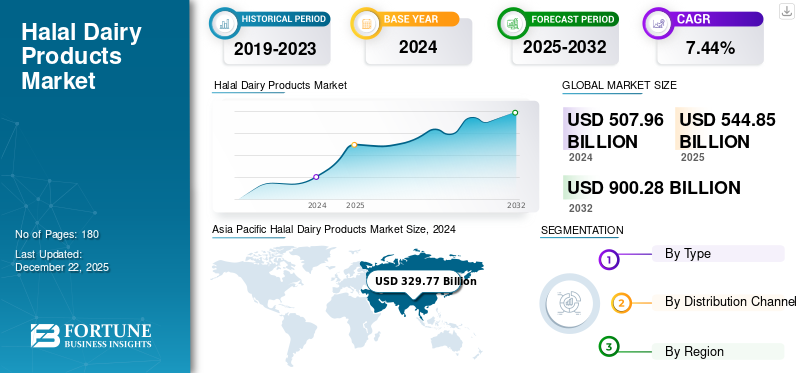
Download Free sample to learn more about this report.
Halal Dairy Products Industry Key Takeaways
 Global Market Size & Forecast
- 2025 Market Size: USD 544.85 billion
- 2026 Market Size: USD 584.69 billion
- 2034 Forecast Market Size: USD 1,042.42 billion
- CAGR: 7.5% from 2026–2034
 Market Share
- Asia Pacific dominated the halal dairy products market with a 21.59% share in 2025.
- The milk segment dominated the global market in 2025.
- The supermarkets/hypermarkets segment led the market, while the online retail segment is projected to register the fastest CAGR during the forecast period.
 Key Regional Highlights
North America
North America reached USD 20.26 billion in 2025 and is projected to expand to USD 21.54 billion in 2026.
Europe
Europe accounted for USD 46.91 billion in 2025 and is expected to grow to USD 49.95 billion in 2026.
Asia Pacific
Asia Pacific generated USD 354.8 billion in 2025 and is projected to reach USD 381.91 billion in 2026.
U.S.
The U.S. market is expected to witness steady growth, supported by rising demand for halal-certified dairy products and expanding retail availability.
Japan
The Japan market is anticipated to grow steadily, driven by increasing consumer awareness and demand for premium halal dairy products.
Read More

MARKET DYNAMICS
Market Driver
Rapid Growth in Muslim Population Escalates the Industry's Momentum
The increasing Muslim population worldwide is a key driver augmenting the market's potential. Halal dairy items are permissible for Muslims under Islamic law, as they are prepared using halal-certified ingredients. In accordance with religious beliefs, Muslims avoid the consumption of dairy items comprising pig fat, alcohol, gelatin, and others. This has led to strong demand for halal products amongst the Muslim community. Moreover, for the majority of Muslims, halal certification is essential to ensure that the dairy items they consume are pure and developed as per their religious beliefs. Apart from Muslim consumers, the non-Muslim population is also gravitating toward halal items to maintain a healthy lifestyle. Thus, such inclination necessitates food producers to introduce an extensive range of halal dairy items globally.
Market Restraints
Hurdles in Obtaining Halal Certification and Mislabeling Practices Limit Market Growth
One of the pivotal challenges faced by halal dairy producers is the difficulty of obtaining a halal certificate. The halal certification process can be lengthy, requiring comprehensive paperwork and numerous checks and audits. Moreover, the certification fees can be a significant financial burden, particularly for medium and small-sized enterprises. Additionally, different certification bodies can have varying procedures and standards, resulting in confusion and making it challenging for companies to navigate the system effectively. These challenges collectively act as barriers, hindering the global halal dairy products market growth.
Another obstacle in the global industry is the rising fraudulent practices. Globally, a few manufacturers falsely label non-halal items as halal products. Moreover, some companies produce halal and non-halal products in the same facility, creating contamination risks. These issues compromise consumer safety and also pose serious ethical/legal challenges for businesses.
Market Opportunities
Utilization of Advanced Technology Presents Various Growth Chances
The increasing adoption of advanced technologies unlocks new growth opportunities in the global industry. In today's era, businesses should leverage emerging technologies to ensure the halal integrity of dairy items. For instance, Raman spectroscopy can be utilized to analyze the composition of dairy products, aiding in identifying ingredients, including non-halal additives. Moreover, polymerase chain reaction (PCR) and various DNA techniques can be employed to verify the origin of ingredients. Additionally, enzyme-linked immunosorbent assays can detect particular proteins and aid in identifying potential contaminants and other animal-sourced ingredients. Besides this, the Internet of Things (IoT) can be integrated to monitor product quality and environmental conditions, strengthening transparency and efficiency in the halal dairy products market.
Halal Dairy Products Market Trends
Surging Inclination Toward Ethical Consumerism is the Prominent Trend
Ethical consumerism is recognized as a substantial trend in the halal dairy industry. Consumers from non-Muslim and Muslim communities prioritize dairy items that align with sustainable and ethical practices. This shift indicates that consumer preferences now extend beyond regional permissible limits and consider factors such as animal welfare and sustainability. Moreover, ethical consumerism boosts businesses in the halal sector to go beyond basic halal requirements and integrate sustainable practices in their operations. Moreover, the rise of ethical activists and influencers improves the awareness of green consumerism. As a result, this ongoing trend fuels the growth potential of the halal dairy products sector.
Download Free sample to learn more about this report.
SEGMENTATION ANALYSIS
By Type
Milk Segment Leads the Market Due to Its Higher Nutritional Value
Based on type, the market is segmented into milk, butter, cheese, yoghurt, ice cream, and others. The milk segment dominated the market in 2024 as Halal-certified milk is free from harmful preservatives and additives than conventional milk, and is produced under the utmost hygienic conditions. This milk has higher nutritional value and offers transparency about the production process and origin of the finished item. Moreover, halal-certified dairy items boost customers' confidence, especially those searching for products that align with their religious values and beliefs.
Cheese emerged as the fastest-growing segment and is anticipated to soar at the same pace in the future. The growing demand for animal-based protein and the increasing availability of halal cheese propel the segment's growth.
By Distribution Channel
Supermarkets/Hypermarkets Segment Dominates Owing to Their Affordability
Based on distribution channel, the market is divided into supermarkets/hypermarkets, traditional retailers, online retail, and others. The supermarkets/hypermarkets led the global market. These channels are known for providing an array of halal dairy products, including milk, cheese, ice cream, and others, under one roof. Moreover, supermarkets provide a bulk purchasing option at lower prices. Additionally, compared to grocery stores, it offers freedom of selection of products and numerous promotional offers, further facilitating the industry's potential.
The online retail segment is likely to exhibit the highest CAGR during the forecast period. The convenience of ordering halal dairy products and the easy delivery/return option enhances the segment's potential. Moreover, the quick commerce channels are gaining traction owing to their fast delivery and lower prices of finished products.
Halal Dairy Products Market Regional Outlook
Based on region, the market is segmented into North America, Europe, Asia Pacific, South America, and the Middle East & Africa.
Asia Pacific
Asia Pacific Halal Dairy Products Market Size, 2025 (USD Billion)
To get more information on the regional analysis of this market, Download Free sample
In 2025, Asia Pacific held 21.59% of the global market, reaching a valuation of USD 354.8 billion, and is projected to grow to USD 381.91 billion in 2026. Asia Pacific held the largest halal dairy products market share, primarily backed by the largest Muslim population seeking halal products. Compared to other countries, Asian countries such as Indonesia and Malaysia have a major chunk of Muslim individuals, contributing to the consistent and notable demand for halal dairy items. Moreover, the strong government regulations promoting halal products boost consumer trust and support market expansion. Additionally, as the regional market economy soars, most Asians have improved disposable income to spend on premium halal items. Besides this, the expanding e-commerce channel in the region makes it easier for consumers to purchase an array of halal options. As a result, these factors are augmenting the halal dairy product sales across the region.
Middle East & Africa
Middle East & Africa contributed approximately USD 116.61 billion to the global market in 2025, accounting for 17.85% share, and is expected to reach USD 124.78 billion in 2026. The Middle East & Africa is ranked second in the global market. Similar to Asia Pacific, the Middle East & Africa also has a large Muslim population that places strong emphasis on halal dietary guidelines. Majority of the Muslims concentrate on production practices and choose items that are approved as per Islamic law. Moreover, halal food products align with the ongoing health & wellness trend, focusing on ethical sourcing, natural ingredients, and quality control. Additionally, the presence of established halal dairy items manufacturers and the ongoing expansion of retailer infrastructure in the region strengthen the industry's potential.
Europe
The Europe market was valued at USD 46.91 billion in 2025, capturing 21.40% of global revenue, and is estimated to reach USD 49.95 billion in 2026. Europe secured third position in the market and is witnessing a strong growth trajectory. In this region, Europeans are following veganism and are seeking premium quality products composed of natural/plant-based ingredients. Along with Muslims, non-muslin consumers are also searching for halal-certified products which align with principles of better animal welfare and clean eating. Moreover, the European Government aims to standardize halal certification procedures to enhance consumer trust and promote business. Additionally, rising product innovation and the adoption of advanced technology in halal dairy production are bolstering the market's growth. As a result, many European food producers are focusing on expanding their halal dairy products offerings across the region.
North America
North America accounted for USD 20.26 billion in 2025, representing 21.59% of the global market share, and is projected to reach USD 21.54 billion in 2026. North America holds a prominent position in the halal dairy sector worldwide. Major drivers in the region include increasing consumer demand for convenience and rapid innovation within the halal industry. In today's era, most Americans are inclined toward healthy snacking and seek nutritious and superior quality products. To lead a healthy lifestyle, consumers are increasingly incorporating halal-certified yoghurt, milk, and cheese in their daily diet. Moreover, the surging focus on ethical farming practices further fuels the acceptance of halal dairy edibles. Apart from Muslims, non-Muslim and health-conscious individuals rely on premium quality halal products to maintain their health.
The U.S. is the leading consumer in the regional market, followed by Canada and Mexico. The increasing focus on healthy eating habits and the presence of well-known halal companies, continue to accelerate market growth across North America.
South America
South America is at a nascent stage in the market and is projected to experience steady growth in the near term. The rising Muslim population and expanding food and beverages sector are key factors strengthening the industry's potential.
Latin America
The Latin America region captured 19.29% of the global market in 2025, generating USD 6.27 billion in revenue, and is projected to reach USD 6.52 billion in 2026.
COMPETITIVE LANDSCAPE
Key Industry Players
Market Players are Expanding their Product Offerings to Cater to Consumer Requirements
Key players in the global space include Lactalis, Almarai, Danone S.A., and others. These companies are concentrating on launching halal products to cater to both Muslim and non-Muslim consumers globally. By expanding their halal product portfolios, these firms aim to strengthen their market position.
List of Key Halal Dairy Products Companies Profiled
- Bel Brands (U.S.)
- Lactalis (France)
- TH Group (Vietnam)
- Koita (UAE)
- Kuber Group (India)
- Arla Foods Amba (Denmark)
- Danone S.A. (France)
- Almarai (Saudi Arabia)
- Kelava (Malaysia)
- Malaysia Milk Sdn Bhd (Malaysia)
KEY INDUSTRY DEVELOPMENTS
- December 2024: The Laughing Cow Cheese, a brand of Bel Brands, a U.S.-based cheese firm, announced the addition of the Halal certification mark from Indonesia's Halal Product Assurance Organizing Agency to its packaging.
- October 2022: The Public Investment Fund (PIF), a financial services enterprise in Saudi Arabia, launched the Halal Products Development company. Via this new company, the former financial services enterprise aims to improve halal production across Saudi Arabia.
- October 2022: Lactalis Canada, a dairy products corporation, unveiled its acquisition of Khaas, a Canadian halal company. Through this acquisition, the firm can fulfill the growing halal demand of Middle Eastern, North African, and South Asian consumers in Canada.
- September 2021: TH Group, a Vietnamese milk processing firm, participated in the Vietnam National Brands Week, an annual event held in Singapore. The enterprise showcased its TH true MILK HILO, TH true Yogurt, and TH true MILK Organic, which are high-quality and halal certified.
- January 2021: Koita, a UAE-based milk company, acquired halal certification for its plant in Italy. This certificate was received from the World Halal Authority, an Italian international halal certification body.
REPORT COVERAGE
The market research report includes quantitative and qualitative insights into the market. It also offers a detailed analysis of the market sizing and growth rate for all possible segments. Key insights in the report include an overview of related markets, a competitive landscape, recent industry developments such as mergers & acquisitions, the regulatory environment in critical countries, and current market trends.
Request for Customization to gain extensive market insights.
Report Scope & Segmentation
|
ATTRIBUTE |
DETAILS |
|
Study Period |
2021-2034 |
|
Base Year |
2025 |
|
Estimated Year |
2026 |
|
Forecast Period |
2026-2034 |
|
Historical Period |
2021-2024 |
|
Unit |
Value (USD Billion) |
|
Growth Rate |
CAGR of 7.5% from 2026 to 2034 |
|
Segmentation |
By Type
|
|
By Distribution Channel
|
|
|
By Region
|
Frequently Asked Questions
Fortune Business Insights says that the global market size was valued at USD 544.85 billion in 2025.
The market is expected to grow at a CAGR of 7.5% during the forecast period.
By distribution channel, the supermarkets/hypermarkets segment led the market.
Rapid growth in the Muslim population is a key factor driving market growth.
Lactalis, Almarai, and Danone S.A. are a few of the top players in the market.
Asia Pacific held the highest share of the market.
Utilization of advanced technology to produce halal dairy products is a key opportunity.



- 2021-2034
- 2025
- 2021-2024
- 180
-
(Offer valid till 15th Oct 2026)
Get 30-60 hrs Free Customization
Expand Regional and Country Coverage, Segments Analysis, Company Profiles, Competitive Benchmarking, and End-user Insights.




















Related Reports
-
US +1 833 909 2966 ( Toll Free )
-
Get In Touch With Us