Hazelnut Market Size, Share & Industry Analysis, By Type (Raw and Processed), By Nature (Conventional and Organic), By Application (Food & Beverage, Personal Care & Cosmetics, Nutraceuticals, and Others), and Regional Forecast, 2026-2034
 Download Free Sample
(Offer valid till 30th Sep 2026)

Hazelnut Market Size and Future Outlook
 Listen to Audio Version
The global hazelnut market size was valued at USD 10.21 billion in 2025 and is projected to grow from USD 11.08 billion in 2026 to USD 21.69 billion by 2034, exhibiting a CAGR of 8.76% during the forecast period. Europe dominated the global hazelnut market with a market share of 46.82% in 2025.
Hazelnuts are edible nuts known for their versatility, flavor, and nutritional profile across non-food and food applications. They are commonly consumed in both processed and raw forms, and are recognized as an essential ingredient in various high-value food categories, specifically in bakery and confectionery items. Globally, these tree nuts are mainly cultivated in temperate climates with moderate rainfall and mild winters. Nutritionally, it is a rich source of protein, monounsaturated fats, and antioxidants. A few of the commercial forms include roasted and shelled hazelnuts. With regards to end-use, it can be extensively utilized in snacks, cereals, chocolate, and desserts. The growing consumer preference for hazelnut spread and improved awareness of the long-term benefits of hazelnuts are pivotal drivers of the market.
Companies such as Olam International, Besana Group, and DURAK FINDIK are key players in this market. New product launches are a pivotal strategy adopted by key market players to improve their position.
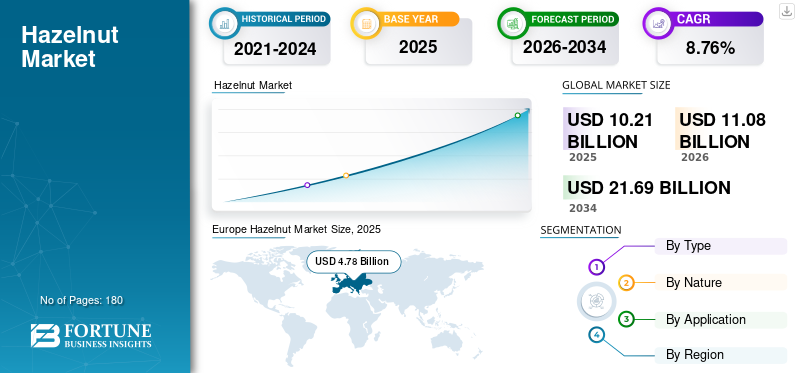
Download Free sample to learn more about this report.
Hazelnut Market Key Takeaways
 Market Size & Forecast
- 2025 Market Size: USD 10.21 billion
- 2026 Market Size: USD 11.08 billion
- 2034 Forecast Market Size: USD 21.69 billion
- CAGR: 8.76% from 2026–2034
 Market Share
- Europe dominated the hazelnut market with a 46.82% share in 2025.
- The raw segment is projected to expand at a CAGR of 7.64% during the forecast period.
- The organic segment is projected to witness strong growth at a CAGR of 11.17% over the forecast period.
 Key Regional Highlights
Europe
Europe led the global market with a valuation of USD 4.78 billion in 2025, supported by rising gifting trends and growth in the nutraceuticals industry.
Asia Pacific
Asia Pacific was the second-largest regional market, reaching USD 2.42 billion in 2025, driven by increasing consumption across emerging economies.
North America
North America ranked third globally with a market value of USD 1.79 billion in 2025, supported by strong demand for hazelnut-based food products.
U.S.
The U.S. hazelnut market was valued at USD 1.46 billion in 2025, accounting for approximately 14.32% of global market revenue.
Japan
Japan's hazelnut market reached USD 0.50 billion in 2025, representing approximately 4.91% of global market sales.
Read More

HAZELNUT MARKET TRENDS
Growing Use of Hazelnuts in Beauty Products is the Current Trend
The increasing utilization of hazelnut in cosmetic formulations is an emerging trend, although it remains niche as compared to food-based applications. In the skincare industry, hazelnut oil is gaining huge traction owing to its natural vitamin E, high content of linoleic and oleic acids, and light texture. These attributes make it ideal for massage oils, moisturizers, hair conditioning products, and serums, especially those positioned as clean-label and natural. Moreover, it helps tighten skin and prevent clogged pores and breakouts. Additionally, the anti-inflammatory properties of hazelnut oil minimize redness and soothe the skin. Along with skin health, hazelnut oil adds shine and repairs split ends, owing to its essential Vitamin E and fatty acids content. Seeing these advantages, producers in the market are aiming to launch new hazelnut-infused skincare products for consumers.
Download Free sample to learn more about this report.
MARKET DYNAMICS
MARKET DRIVERS
Surging Demand for Plant-based/Natural Ingredients Bolsters Market Potential
The rising shift toward plant-centric ingredients is a major driver strengthening the industry’s momentum. Today, individuals are looking for products perceived as naturally sourced and minimally processed. Hazelnuts fit well with this preference due to their plant-derived benefits and high consumer familiarity. In beverage and food applications, these nuts are utilized to support the trend toward clean-label items, where producers look for substitutes to replace artificial texturizers, flavors, and fats. The increasing prevalence of flexitarian and plant-based lifestyles is another factor that promotes the use of tree nuts. To fulfil the rising demand of health-conscious consumers, producers are incorporating nuts into dairy alternatives and plant-centric spreads as sources of natural flavor and fat.
MARKET RESTRAINTS
High Dependence on a Few Regions for Hazelnut and Tough Competition from Alternative Nuts Impede Market Potential
One of the pivotal hurdles in the market is the strong dependence on certain regions. Globally, the market is primarily concentrated in Turkey, which accounts for a major share of production, followed by a few countries such as Georgia, Italy, and the U.S. This heavy reliance on a limited number of regions makes global supply vulnerable to labor shortages, adverse weather events, and political instability. Any production shortfalls, especially in major origins, can hamper global supply and lead to price fluctuations, creating challenges for food companies, processors, and confectionery producers that rely on stable hazelnut availability.
Intense competition from alternative nuts is another key challenge in the industry. The hazelnut industry faces tough competition from nut-based ingredients, such as cashews, peanuts, and almonds. These alternatives are mostly economical and widely available, which hampers the global hazelnut market growth.
MARKET OPPORTUNITIES
Technological Advancements in Nuts Sector Create Growth Chances
The utilization of advanced technologies in the nuts industry opens several growth opportunities. To enhance orchard productivity, hazelnut producers are adopting precision agriculture technologies. Tools such as drone-based crop monitoring, soil moisture sensors, and satellite imagery allow growers to enhance nutrient application and irrigation. To strengthen post-harvest quality management, producers are also adopting modern shelling and sorting technologies to minimize losses and assure consistent kernel quality. Moreover, technological advancements in orchard design and harvesting equipment reduce the labor intensity of hazelnut farming. Additionally, a few processors are aiming to invest in advanced testing technologies, digital traceability systems, and real-time quality monitoring to comply with international food safety regulations.
Hazelnut Market Segmentation Analysis
By Type
Processed Category Dominated Market Owing to Its Prolonged Shelf Life
Based on the type, the market is segmented into processed and raw.
The processed segment led the global market in 2025. Compared to raw hazelnuts, processed hazelnuts are widely available in application-ready formats such as butters, oils, flour, and spreads. This format has higher usage in industrial food applications as it reduces additional steps at the factory level. Moreover, the hazelnuts that undergo processing have minimal risk of contamination, spoilage, and mold growth, improving their stability and shelf life. Additionally, processed ingredients offer functional benefits such as enhanced emulsification and smoother texture, which bolster the segment’s potential.
The raw segment is projected to grow at a CAGR of 7.64% over the forecast period.
By Nature
Conventional Segment Led Market Due to Cost-Effectiveness
Depending on the nature, the market is divided into conventional and organic.
In 2025, the conventional segment led the global industry. The conventional cultivation of hazelnuts allows the utilization of nutrient management and modern crop protection practices, which result in stable output. This category of hazelnuts doesn’t need organic certification or frequent audits, minimizing the logistics burden. Moreover, regular production systems offer effective tools to manage crop stress and pest attacks, especially under adverse climatic conditions. Additionally, it has high acceptance across almost all end-use sectors, including snacks, bakery, and confectionery.
The organic segment is projected to grow at a high CAGR of 11.17% over the forecast period.
By Application
To know how our report can help streamline your business, Speak to Analyst
Food & Beverage Led Market Due to High Usage of Nuts in Culinary Preparation
Based on application, the market is segmented into food & beverage, personal care & cosmetics, nutraceuticals, and others.
The food & beverage segment dominated the global market in 2025. In this sector, hazelnuts are widely used in the preparation of bakery goods, spreads, and snacks, and also offer various functional advantages, such as enhancing visual appeal and texture. Moreover, it is used in product innovation, thereby fueling demand for hazelnuts. Additionally, these nuts play a substantial role in gifting and seasonal categories, especially during holidays, which generate high demand. Thus, such instances boost the segment’s momentum.
The personal care & cosmetics segment is projected to grow at a high CAGR of 13.40% over the forecast period.
Hazelnut Market Regional Outlook
By geography, the market is categorized into Europe, North America, Asia Pacific, South America, and the Middle East & Africa.
Europe
Europe Hazelnut Market Size, 2025 (USD Billion)
To get more information on the regional analysis of this market, Download Free sample
Europe dominates the hazelnut market share and reached USD 4.78 billion by 2025. It is expected to record a growth rate of 8.55% in the coming years. The growing gifting trend and the expanding nutraceuticals industry propel regional growth.
Germany Hazelnut Market
The Germany market in 2025 was valued at around USD 1.20 billion, representing roughly 11.80% of the global market revenues.
U.K. Hazelnut Market
The U.K. market was valued at USD 0.79 billion in 2025, equivalent to around 7.71% of the global market sales.
Asia Pacific
Asia Pacific was valued at USD 2.42 billion in 2025 and is the second leading region. In the region, India and China accounted for USD 0.29 billion and USD 0.81 billion, respectively, in 2025.
India Hazelnut Market
The India market in 2025 was valued at around USD 0.29 billion, accounting for roughly 2.86% of the global market revenues.
The rising inclination toward plant-centric ingredients and the surging trend of functional cosmetics are driving factors in the regional market.
China Hazelnut Market
China's market is projected to be one of the largest worldwide, with revenues valued at around USD 0.81 billion in 2025, representing roughly 7.92% of the global market sales.
Japan Hazelnut Market
The Japan market in 2025 was valued at USD 0.50 billion, accounting for approximately 4.91% the global market revenues.
North America
The market in North America was valued at USD 1.79 billion in 2025 and secured the third position in the global market. The market in North America is expected to grow due to the increasing use of hazelnut meal in animal feed and the growing demand for supplements. Moreover, the rising incidence of lifestyle-related ailments and the increasing production of hazelnuts are other key factors bolstering regional growth.
U.S. Hazelnut Market:
Given North America’s strong contribution and the U.S. dominance in the region, the U.S. market was valued at USD 1.46 billion in 2025, accounting for roughly 14.32% of global hazelnut sales.
South America and Middle East & Africa
The South America and Middle East & Africa regions are expected to witness moderate growth in this market space during the forecast period. The South America market was valued at USD 0.74 billion in 2025 and secured the third position. The increasing demand for high quality hazelnuts and the strong e-commerce penetration are anticipated to drive demand for hazelnuts. The Middle East & Africa market was valued at USD 0.47 billion in 2025.
South Africa Hazelnut Market
The South Africa market was valued at USD 0.14 billion in 2025, representing roughly 1.36% of global hazelnut revenues.
COMPETITIVE LANDSCAPE
Key Industry Players
New Product Launches Help Firms to Improve Their Market Positions
The market is fragmented, with intense competition among players in this segment. In this market, the key companies primarily use new product launches as their main strategy. Through this approach, players can meet rising consumer demands and enhance their brand image.
LIST OF KEY HAZELNUT COMPANIES PROFILED
- Chelmer Foods Ltd. (U.K.)
- Besana Group (Italy)
- DURAK FINDIK (Turkey)
- Balsu Gıda Sanayi ve Ticaret A.S. (Turkey)
- Oregon Hazelnuts (U.S.)
- Olam International (Singapore)
- Olstan (Turkey)
- Cargill, Incorporated (U.S.)
- Kanegrade (U.K.)
- Gürsoy tarımsal ürünler gıda (Turkey)
KEY INDUSTRY DEVELOPMENTS
- December 2025: Barista, a coffee chain in India, unveiled a festive café menu created with hazelnuts. The chain's limited-edition menu includes hazelnut chocolate tart, a dry latte, and a crunchy frappe.
- November 2024: Turkish Hazelnut Exporters Association released the news of its collaboration with Reliance Retail, an Indian retail firm. Via this partnership, the consumers residing in Maharashtra, Delhi, Punjab, and Gujarat can purchase these nuts.
- October 2024: Haldiram’s, a fast-food restaurant chain in India, partnered with Turkish Hazelnut Exporters Associations to launch eight hazelnut-based sweets. The new products launched include Turkish hazelnut bites, dates, katli, and others.
- August 2024: Turkish Hazelnut Exporters Association announced the launch of Turkish hazelnuts in India. This unveiling was held at the Turkish embassy in New Delhi, in collaboration with the Nuts and Dry Fruits Council of India.
- April 2023: Apis, an Indian food manufacturer, revealed a new hazelnut chocolate spread that can be used with pancakes, shakes, waffles, and smoothies.
REPORT COVERAGE
Request for Customization to gain extensive market insights.
Report Scope & Segmentation
|
ATTRIBUTE |
DETAILS |
|
Study Period |
2021-2034 |
|
Base Year |
2025 |
|
Estimated Year |
2026 |
|
Forecast Period |
2026-2034 |
|
Historical Period |
2021-2024 |
|
Growth Rate |
CAGR of 8.76% from 2026 to 2034 |
|
Unit |
Value (USD Billion) |
|
Segmentation |
By Type, Nature, Application, and Region |
|
By Type |
· Processed · Raw |
|
By Nature |
· Conventional · Organic |
|
By Application |
· Food & Beverage · Personal Care & Cosmetics · Nutraceuticals · Others |
|
By Region |
North America (By Type, Nature, Application, and Country) o U.S. (By Nature) o Canada (By Nature) o Mexico (By Nature) Europe (By Type, Nature, Application, and Country) o Germany (By Nature) o U.K. (By Nature) o Spain (By Nature) o France (By Nature) o Italy (By Nature) o Rest of Europe (By Nature) Asia Pacific (By Type, Nature, Application, and Country) o China (By Nature) o India (By Nature) o Australia (By Nature) o Japan (By Nature) o South Korea (By Nature) o Rest of the Asia Pacific (By Nature) South America (By Type, Nature, Application, and Country) o Brazil (By Nature) o Argentina (By Nature) o Rest of South America (By Nature) Middle East & Africa (By Type, Nature, Application, and Country) o South Africa (By Nature) o UAE (By Nature) o Rest of Middle East & Africa (By Nature) |
Frequently Asked Questions
Fortune Business Insights says that the global market value stood at USD 10.21 billion in 2025 and is projected to reach USD 21.69 billion by 2034.
In 2026, the market value stood at USD 5.18 billion.
The market is expected to exhibit a CAGR of 8.76% during the forecast period of 2026-2034.
By nature, the conventional segment led the global market in 2025.
Surging demand for plant-based/natural ingredients bolsters the market potential.
Olam International, Besana Group, DURAK FINDIK, and Gürsoy tarımsal ürünler gıda are among the key players in the market.
Europe held the largest market share in 2025.
The growing use of hazelnuts in beauty products is the current trend.



- 2021-2034
- 2025
- 2021-2024
- 180
-
(Offer valid till 30th Sep 2026)
Get 30-60 hrs Free Customization
Expand Regional and Country Coverage, Segments Analysis, Company Profiles, Competitive Benchmarking, and End-user Insights.




















Related Reports
-
US +1 833 909 2966 ( Toll Free )
-
Get In Touch With Us