 Download Free Sample



Get a Quote
Receive a tailored pricing based on your needs.
- Choose license type
- Multiple user options
- Custom scope & coverage
- Fast turnaround
"Designing Growth Strategies is in our DNA"
 Listen to Audio Version
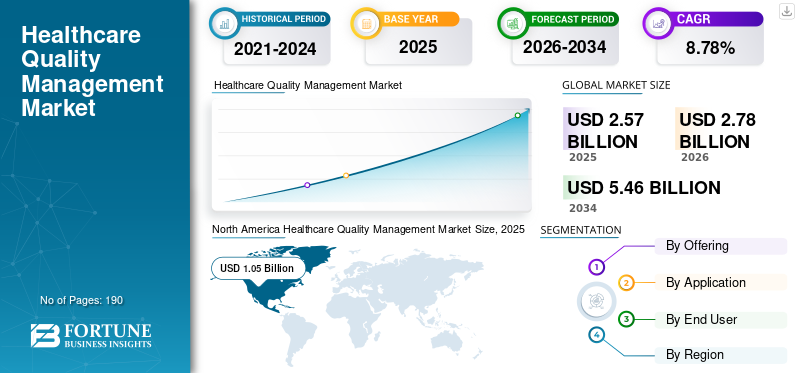
The global healthcare quality management market size was valued at USD 2.57 billion in 2025 and is projected to grow from USD 2.78 billion in 2026 to USD 5.46 billion by 2034, exhibiting a CAGR of 8.78% during the forecast period. North America dominated the global healthcare quality management market with a market share of 40.9% in 2025.
The healthcare quality management solutions enable healthcare providers, healthcare payers and life‑science organizations to manage quality initiatives, regulatory compliance, incident reporting, mortality/morbidity reviews, and performance analytics. These solutions include various aspects focused on quality KPIs to maintain the quality of healthcare. The market is primarily driven by increasing focus on patient safety and value-based care, stringent regulatory standards, and integration of AI/ML for predictive risk scoring.
The market comprises of various key industry players, such as RLDatix, Symplr, Veradigm LLC, and others who are focusing on innovative service offerings to support the rising demand.
Download Free sample to learn more about this report.
 Market Size & Forecast
 Market Share
 Key Regional Highlights
North America
North America maintained its leading position with a market value of USD 1.05 billion in 2025, driven by strong adoption of quality management and patient safety solutions.
Europe
Europe is projected to reach USD 0.81 billion by 2026, growing at a CAGR of 7.89% during the forecast period.
Asia Pacific
Asia Pacific is expected to reach USD 0.59 billion in 2026, securing its position as the third-largest regional market.
U.S.
The market is estimated at approximately USD 1.04 billion in 2026, accounting for around 37.2% of global market revenue.
Japan
The market is estimated at around USD 0.11 billion in 2026, supported by ongoing investments in healthcare quality improvement and digital healthcare infrastructure.
Read More

Shift to Cloud, SaaS Delivery, and Mobile Incident Capture is a Prominent Trend Observed in Market
In recent years, the global market is witnessing a shift towards cloud/SaaS delivery and mobile-first incident capture. The demand for easier upgrades, faster rollouts, and real-time visibility across multi-site networks is increasing among healthcare providers. This has resulted in growing adoption of cloud based solutions owing to advantages such as reduced infrastructure burden and faster workflows. On the other hand, mobile capture improves reporting rates by letting frontline staff submit events at the point of care which helps reduce under-reporting and speeds follow-up actions. These factors are supporting the overall global healthcare quality management market growth.
Download Free sample to learn more about this report.
Increasing Focus on Patient Safety and Value‑Based Care is Propelling Market Growth
The increasing focus on patient safety and value‑based care is a prominent driving factor for the healthcare quality management market growth. The healthcare payers and providers are focusing on patient safety and value-based care through purpose-built software for incident capture, RCA/CAPA, audits, analytics, and performance reporting. This is owing to the accountability of these organizations for measurable outcomes, avoidable harm, and standardized safety practices. Additionally, in value-based contracts, preventing complications, readmissions, and adverse events directly impacts reimbursement, so organizations invest in systems that identify risk early and close quality gaps. All these factors cumulatively drive the overall market growth.
Cybersecurity and Privacy Risks to Limit the Service Adoption
Healthcare quality management platforms handle sensitive patient as well as staff data and are increasingly cloud-based. Thus, the healthcare sector is a major target for cyber attacks, resulting in data security concerns among the patients. In addition, compliance with stringent security requirements increase compliance effort and cost for vendors and buyers. This results in limiting the market growth to certain extent.
Integration of AI/ML to Offer Market Growth Opportunities
Integration of AI/ML signify a lucrative market growth opportunity. In recent years, the market is witnessing a growing role of AI/ML in incident management and safety improvement. AI and machine-learning models can help prioritize high-severity events, identify hidden risk patterns, and flag emerging safety issues earlier than traditional rule-based systems. Owing to this, healthcare providers are adopting these tools in their workflows. This has created growth opportunities for operating players to fulfill market demands.
Workforce Shortages and Change Fatigue to Hamper the Market Growth
Persistent staffing shortages in both clinical and back-office limit the time available for training, incident follow-up, and process redesign. This results in reducing implementation success and delaying expansion to new modules/sites.
High Demand for Cloud-Based Solutions to Propel the Growth of Software Segment
Based on the offering, the market is divided into software and services.
The software segment is expected to account for the largest global healthcare quality management market share. The dominance of the segment is primarily attributed to the increasing demand for cloud-based solutions and adoption to optimize workflows. In addition, advantages offered by software such as effectiveness, scalability across multi-site health systems, and others also support the segment growth. Moreover, new product launches by operating players are also aimed at propelling the segmental revenue generation.
The services segment is anticipated to rise with a CAGR of 7.39% over the forecast period.
To know how our report can help streamline your business, Speak to Analyst
High Adoption Rate of Patient Safety & Adverse Event Management by Healthcare Providers Have Kept Them in the Leading Position
Based on application, the market is categorized into patient safety & adverse event management, risk & compliance management, clinical quality & outcomes improvement, regulatory & value-based program reporting, document management, training management, patient experience & satisfaction management, and others.
The patient safety & adverse event management dominated the global market in 2025. These are foundational applications which support the leading share of the segment. Almost every hospital with healthcare quality management has risk registers, incident reporting, and compliance workflows. Also, the high patient volume in hospitals and care providers also boosts the demand for solutions for patient safety & adverse event management. Furthermore, the segment is set to hold 23.1% share in 2026.
In addition, regulatory & value-based program reporting segment is projected to grow at a CAGR of 10.77% during the study period.
High Adoption by Hospitals Supported the Leading Position of Healthcare Providers
Based on end user, the market is segmented into healthcare payers, healthcare providers, and others.
The healthcare providers segment captured the dominating position in the global market. This was primarily driven by the increasing demand for quality management in these settings, expansion of telehealth and virtual care needing quality oversight, and integration of AI/analytics into clinical quality and safety tools. Furthermore, the segment is set to hold 82.1% share in 2026.
In addition, healthcare payers are projected to grow at a CAGR of 11.97% during the study period.
By geography, the market is categorized into Europe, Asia Pacific, North America, Latin America, and the Middle East & Africa.
North America Healthcare Quality Management Market Size, 2025 (USD Billion) To get more information on the regional analysis of this market, Download Free sample
North America held the leading position in 2024, with a revenue of USD 0.96 billion, and also maintained its dominance in 2025, with USD 1.05 billion. Prominent factors supporting regional dominance include higher EHR integration, stringent regulatory accreditation, and willingness to invest in patient safety programs. The U.S. in particular, has a robust infrastructure that serves large healthcare systems, payers, and government healthcare programs in the country.
The U.S. market dominated the North American market and is approximated to be around USD 1.04 billion in 2026, accounting for roughly 37.2% of global market.
Europe is anticipated to witness a growth rate of 7.89% in the coming years, becoming the second highest among all regions. The region would reach a valuation of USD 0.81 billion by 2026. Strong regulatory frameworks and structured national patient‑safety initiatives along with growth in centralized reporting platforms are driving the European market growth.
The U.K. market in 2026 is estimated to be around USD 0.16 billion, representing roughly 5.9% of global revenues.
Germany’s market is projected to reach approximately USD 0.18 billion in 2026, equivalent to around 6.5% of global sales.
Asia Pacific regional market is projected to be valued at USD 0.59 billion in 2026 and secure the position of the third-largest region in the market. In the region. Notable investments in China, India and other countries of the region are hubs for analytics and QMS rollouts which has majorly driven the regional market growth.
The Japan market in 2026 is estimated at around USD 0.11 billion, accounting for roughly 3.9% of global healthcare IT consulting revenues.
Increasing digitalization in healthcare systems in Japan has driven the market growth in the country.
China’s market is projected to be one of the significant markets across the globe, with 2026 revenues estimated around USD 0.18 billion, representing roughly 6.4% of global sales.
The India market in 2026 is estimated to be around USD 0.11 billion, accounting for roughly 4.8% of global revenues.
The Latin America and Middle East & Africa regions are expected to witness slower growth in this market space during the forecast period. The Latin America market is set to reach a valuation of USD 0.13 billion in 2026. Selective large‑scale procurements tied to new hospitals and accreditation drives the market growth in these regions.
The Saudi Arabia market is projected to reach around USD 0.05 billion in 2026, representing roughly 1.8% of global revenues.
Growing Digital Transformation Initiatives by Leading Firms to Strengthen their Market Positions
The global healthcare quality management market represents a moderately consolidated structure. The market consists of key players such as RLDatix, Symplr, and Veradigm LLC capturing dominating positions. Their leadership is reinforced by continuous investments in cloud-based platforms, data analytics, AI-driven quality improvement, and system integration services, which are critical for modernizing quality and safety operations across complex healthcare environments.
Other key players in the market include Radar Healthcare Inc., Riskonnect, Ideagen, and others. Service portfolio expansion, healthcare-focused consulting, and digital transformation support are some of the initiatives undertaken by these companies to broaden their global footprints during the forecast period.
Request for Customization to gain extensive market insights.
|
ATTRIBUTE |
DETAILS |
|
Study Period |
2019-2034 |
|
Base Year |
2025 |
|
Estimated Year |
2026 |
|
Forecast Period |
2026-2034 |
|
Historical Period |
2019-2024 |
|
Growth Rate |
CAGR of 8.78% from 2026-2034 |
|
Unit |
Value (USD Billion) |
|
Segmentation |
By Offering, Application, End User, and Region |
|
By Offering |
· Software · Services |
|
By Application |
· Patient Safety & Adverse Event Management · Risk & Compliance Management · Clinical Quality & Outcomes Improvement · Regulatory & Value-Based Program Reporting · Document Management · Training Management · Patient Experience & Satisfaction Management · Others |
|
By End User |
· Healthcare Providers o Hospitals & ASCs o Post-Acute & Long-Term Care Facilities o Others · Healthcare Payers · Others |
|
By Region |
· North America (By Offering, Application, End User, and Country) o U.S. o Canada · Europe (By Offering, Application, End User, and Country/Sub-region) o Germany o U.K. o France o Spain o Italy o Scandinavia o Rest of Europe · Asia Pacific (By Offering, Application, End User, and Country/Sub-region) o China o Japan o India o Australia o Southeast Asia o Rest of Asia Pacific · Latin America (By Offering, Application, End User, and Country/Sub-region) o Brazil o Mexico o Rest of Latin America · Middle East & Africa (By Offering, Application, End User, and Country/Sub-region) o GCC o South Africa o Rest of Middle East & Africa |
According to Fortune Business Insights, the global market value stood at USD 2.57 billion in 2025 and is projected to reach USD 5.46 billion by 2034.
In 2025, the market value in North America stood at USD 1.05 billion.
The market is expected to exhibit a CAGR of 8.78% during the forecast period.
By application, the patient safety & adverse event management segment is expected to lead the market.
Increasing focus on patient safety and value‑based care is driving market expansion.
RLDatix, Symplr, and Veradigm LLC are the major players in the global market.
North America dominated the market in 2025.

Get 30-60 hrs Free Customization
Expand Regional and Country Coverage, Segments Analysis, Company Profiles, Competitive Benchmarking, and End-user Insights.













.webp)






Related Reports
Get In Touch With Us
US +1 833 909 2966 ( Toll Free )
Receive a tailored pricing based on your needs.
Discuss your questions with our industry experts.
Have questions? Get quick answers before you purchase.

