Hearing Amplifiers Market Size, Share & Industry Analysis, By Product Type (Behind-the-ear, In-the-ear), By Sales Channel (Online Retail Sales, Offline Retail Sales) and Regional Forecast, 2026-2034
 Download Free Sample
Hearing Amplifiers Market Overview
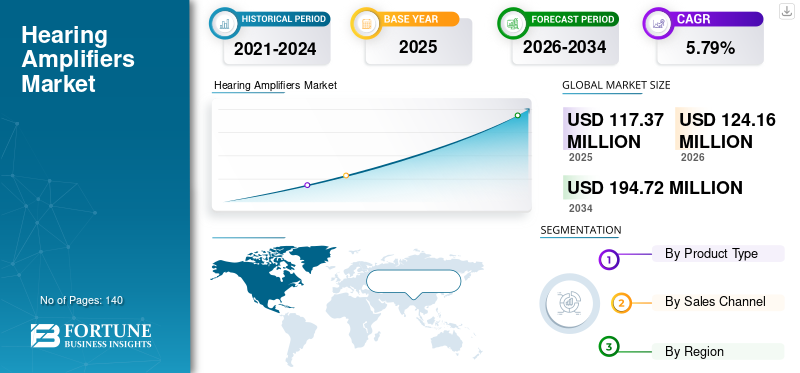
The hearing amplifiers market size was valued at USD 117.37 million in 2025. The market is projected to grow from USD 124.16 million in 2026 to USD 194.72 million by 2034, exhibiting a CAGR of 5.79% during the forecast period.

The hearing amplifiers market is witnessing strong expansion due to the increasing prevalence of hearing impairment among aging populations and growing awareness regarding affordable hearing support devices. Hearing amplifiers are widely adopted by consumers seeking cost-effective alternatives to conventional hearing aids for mild to moderate hearing challenges. Continuous advancements in digital sound processing, wireless connectivity, rechargeable batteries, and noise-reduction technologies are improving product performance and user experience. The hearing amplifiers market report highlights rising consumer preference for over-the-counter hearing enhancement devices, supported by expanding retail distribution channels and online sales platforms. Manufacturers are focusing on compact designs, personalized sound amplification, and user-friendly controls to strengthen market positioning and increase customer adoption across both developed and emerging economies.
The United States represents one of the most influential markets for hearing amplifiers due to a large aging population, increasing awareness of hearing wellness, and growing demand for accessible hearing support solutions. Consumers are increasingly seeking affordable hearing amplification products that can be purchased without extensive clinical procedures. Retail pharmacies, specialty healthcare stores, and e-commerce channels continue to support product availability across the country.
Technological innovation remains a key growth factor in the U.S. hearing amplifiers market analysis. Manufacturers are integrating Bluetooth connectivity, smartphone compatibility, adaptive noise filtering, and rechargeable battery systems into their devices. Rising healthcare awareness campaigns and greater acceptance of hearing enhancement products among younger adults experiencing noise-induced hearing issues are further strengthening market demand.
Download Free sample to learn more about this report.
Hearing Amplifiers Market Key Takeaways
 Global Market Size & Forecast
- 2025 Market Size: USD 117.37 Million
- 2026 Market Size: USD 124.16 Million
- 2034 Forecast Market Size: USD 194.72 Million
- CAGR: 5.79% from 2026-2034
 Market Share
- North America dominated with a revenue share of 38% in 2025.
- Behind-the-ear hearing amplifiers accounted for approximately 61% of the market share.
- Offline retail sales held approximately 66% of the market share.
 Key Regional Highlights
North America
North America led the market with a 38% regional share in 2025.
Asia-Pacific
Asia-Pacific accounted for 24% of the global hearing amplifiers market, supported by increasing demand for hearing support devices.
Europe
Europe represented 31% of the market, driven by established healthcare and retail infrastructure.
U.S.
Strong demand for hearing amplifiers supported by an aging population and increasing awareness of hearing support solutions.
Japan
Accounted for 29% of the Asia-Pacific hearing amplifiers market.
Read More

Hearing Amplifiers Market Latest Trends
The hearing amplifiers market trends indicate significant movement toward smart and digitally enabled hearing solutions. Consumers increasingly prefer compact devices equipped with wireless connectivity, AI-supported sound adjustment, and personalized listening settings. Bluetooth-enabled hearing amplifiers are becoming highly popular because they allow users to connect directly with smartphones, televisions, and communication devices. The integration of mobile applications for volume control and sound customization is transforming the user experience and creating new opportunities for manufacturers.
Download Free sample to learn more about this report.
Another notable trend in the hearing amplifiers industry report is the growing popularity of rechargeable hearing amplifiers. Consumers are shifting away from disposable batteries due to convenience and sustainability concerns. Manufacturers are also focusing on discreet product designs that resemble consumer electronics rather than traditional hearing devices. Online retail channels continue to gain traction as consumers seek convenient purchasing options and product comparisons. Additionally, advancements in digital signal processing are improving speech clarity in noisy environments, making hearing amplifiers more attractive to a broader consumer base. These developments are strengthening overall hearing amplifiers market growth and creating competitive opportunities across global markets.
Hearing Amplifiers Market Dynamics
DRIVER
Increasing Prevalence of Age-Related and Noise-Induced Hearing Loss
The primary driver supporting hearing amplifiers market growth is the rising incidence of hearing impairment among elderly and adult populations. Global demographic changes have resulted in a substantial increase in the number of individuals experiencing age-related hearing challenges. At the same time, prolonged exposure to loud music, industrial environments, and urban noise pollution has contributed to hearing difficulties among younger consumers. These factors are increasing demand for affordable hearing support devices that can improve communication and daily living experiences.
The hearing amplifiers market research report indicates that many consumers seek cost-effective alternatives to conventional hearing aids due to affordability concerns and accessibility limitations. Hearing amplifiers provide immediate assistance for mild to moderate hearing issues and are available through multiple distribution channels. Growing awareness campaigns focused on hearing health, coupled with technological improvements in sound amplification, continue to support market expansion. Enhanced product quality, ease of use, and improved aesthetics are also encouraging wider consumer adoption across various age groups.
RESTRAINT
Competition from Prescription Hearing Aids and Advanced Hearing Technologies
A major restraint affecting the hearing amplifiers market is intense competition from prescription hearing aids and sophisticated hearing assistance technologies. Medical-grade hearing aids often offer advanced customization, professional fitting services, and clinical support that hearing amplifiers may not fully provide. Consumers with severe hearing impairment frequently prefer specialized hearing aids that are designed to address complex hearing conditions.
Another challenge involves consumer confusion regarding the differences between hearing amplifiers and hearing aids. Some users may have unrealistic expectations regarding device performance, leading to dissatisfaction and product returns. Regulatory requirements in certain regions can also affect product distribution and marketing activities. The hearing amplifiers industry analysis suggests that manufacturers must continuously educate consumers about appropriate product applications and benefits. Limited insurance coverage and varying regulatory classifications across countries can further impact market penetration, particularly in healthcare-focused purchasing environments where professional recommendations influence buying decisions.
OPPORTUNITY
Expansion of Online Retail Platforms and Direct-To-Consumer Sales
One of the most promising opportunities in the hearing amplifiers market outlook is the rapid expansion of e-commerce and direct-to-consumer distribution models. Online platforms enable manufacturers to reach wider customer bases while reducing dependence on traditional retail networks. Consumers increasingly prefer researching product specifications, reading reviews, and comparing prices through digital channels before making purchasing decisions.
The hearing amplifiers market opportunities are further enhanced by the growing adoption of telehealth and remote hearing assessment services. Manufacturers can provide virtual consultations, online support, and personalized product recommendations to improve customer engagement. Emerging markets present additional opportunities due to rising healthcare awareness and improving internet accessibility. Product innovation focused on affordability, comfort, and smartphone integration can help companies attract first-time users. Expanding partnerships with pharmacies, wellness retailers, and healthcare providers also creates avenues for broader market reach and long-term customer retention.
CHALLENGE
Maintaining Product Differentiation in a Competitive Marketplace
The hearing amplifiers market faces ongoing challenges related to product differentiation and competitive pricing pressures. Numerous manufacturers offer similar features, making it difficult for brands to establish unique market identities. As competition intensifies, companies must balance affordability with technological innovation to maintain profitability and market relevance.
Consumer expectations are also evolving rapidly. Users increasingly demand advanced noise cancellation, wireless connectivity, ergonomic design, and long battery life at competitive price points. The hearing amplifiers market forecast indicates that companies investing in research and development will be better positioned to address changing customer preferences. However, maintaining quality standards while controlling production costs remains a significant challenge. Regulatory compliance, product reliability, and customer service excellence are becoming critical factors influencing purchasing decisions and long-term brand loyalty.
Hearing Amplifiers Market Segmentation
By Product Type
To know how our report can help streamline your business, Speak to Analyst
Behind-the-ear hearing amplifiers account for approximately 61% of the global hearing amplifiers market share. These devices remain the preferred option due to their durability, higher amplification capabilities, and ease of handling. BTE devices are suitable for a wide range of users and provide consistent performance across different listening environments. Their larger form factor allows manufacturers to integrate advanced features such as rechargeable batteries, Bluetooth connectivity, and enhanced noise-reduction systems. The hearing amplifiers market insights reveal that BTE products are particularly popular among elderly consumers who prioritize comfort and operational simplicity. Healthcare retailers and audiology-focused distributors often recommend these devices because of their reliability and maintenance convenience. Continuous innovation in design and miniaturization is helping manufacturers attract younger consumers while maintaining strong demand across traditional user segments.
In-the-ear hearing amplifiers represent nearly 39% of the hearing amplifiers market size and continue to gain popularity among consumers seeking discreet hearing enhancement solutions. These devices fit directly within the ear structure, offering improved aesthetics and greater user confidence in social settings. Their compact design appeals particularly to working professionals and active individuals who prefer less visible hearing support products. The hearing amplifiers market analysis indicates growing demand for ITE devices featuring digital sound processing, feedback reduction technology, and customized fit options. Manufacturers are investing in ergonomic designs that improve comfort during extended use. Although ITE products may offer slightly lower amplification capacity compared to BTE models, their discreet appearance and convenience continue to drive market adoption. Increasing consumer preference for wearable technology is expected to further strengthen demand for this product category.
By Sales Channel
Online retail sales account for approximately 34% of the hearing amplifiers market share and continue to expand due to increasing digital purchasing behavior. Consumers appreciate the convenience of comparing product specifications, reading customer reviews, and accessing competitive pricing through online platforms. Direct-to-consumer sales models are enabling manufacturers to reach broader audiences while reducing distribution costs. The hearing amplifiers market report highlights that online channels are particularly attractive to younger consumers and tech-savvy buyers seeking immediate product information. Manufacturers are leveraging digital marketing strategies, virtual consultations, and personalized recommendations to improve customer engagement. Subscription-based accessories and remote support services are also contributing to channel growth. Enhanced logistics networks and secure payment systems continue to strengthen confidence in online hearing amplifier purchases.
Offline retail sales hold approximately 66% of the hearing amplifiers market share, maintaining leadership due to consumer preference for in-person product demonstrations and professional guidance. Pharmacies, medical equipment stores, specialty hearing centers, and consumer electronics retailers remain important distribution points for hearing amplifiers. The hearing amplifiers industry report indicates that many consumers value hands-on product evaluation before purchase. Retail staff can provide usage instructions, product comparisons, and immediate assistance that enhance the buying experience. Offline channels also support trust-building among older consumers who may be less comfortable with online purchasing processes. Retail partnerships, promotional campaigns, and product trial opportunities continue to strengthen the importance of physical distribution networks within the market.
Hearing Amplifiers Market Regional Outlook
North America
North America Hearing Amplifiers Market Share, 2025 (%)
To get more information on the regional analysis of this market, Download Free sample
North America holds approximately 38% of the global hearing amplifiers market share. The region benefits from advanced healthcare infrastructure, strong consumer awareness, and widespread adoption of hearing wellness products. The United States remains the dominant contributor due to a large elderly population and growing demand for affordable hearing support devices. Retail availability and favorable consumer acceptance continue to strengthen market expansion throughout the region.
Manufacturers operating in North America focus heavily on innovation, including wireless connectivity, AI-supported sound optimization, and rechargeable product designs. Rising awareness regarding hearing health among younger demographics affected by noise exposure is also supporting demand. Strong distribution networks and ongoing product development activities position North America as a leading region within the hearing amplifiers market outlook.
Europe
Europe accounts for approximately 31% of the global hearing amplifiers market share. The region benefits from aging populations, increasing healthcare awareness, and strong adoption of hearing support technologies. Consumers across Europe demonstrate growing interest in affordable alternatives to traditional hearing aids, supporting demand for hearing amplifiers through both retail and online channels.
The hearing amplifiers market research report identifies Germany, the United Kingdom, France, and Italy as major contributors to regional growth. Manufacturers continue investing in product innovation, ergonomic designs, and enhanced sound quality to meet evolving consumer expectations. Growing emphasis on preventive healthcare and active aging initiatives further supports market development throughout Europe.
Germany Hearing Amplifiers Market
Germany represents approximately 27% of the European hearing amplifiers market. The country benefits from a highly developed healthcare system, strong consumer purchasing power, and increasing awareness of hearing health management. German consumers place significant importance on product quality, technological reliability, and long-term performance, encouraging manufacturers to introduce advanced hearing amplification solutions.
The hearing amplifiers market analysis for Germany highlights growing adoption of rechargeable devices, wireless connectivity features, and personalized sound adjustment capabilities. Retail pharmacies and specialty hearing centers play important roles in product distribution. An expanding elderly population and increasing attention to hearing wellness continue to create favorable conditions for market expansion across the country.
United Kingdom Hearing Amplifiers Market
The United Kingdom contributes approximately 22% of the European hearing amplifiers market. Rising awareness of hearing difficulties among aging adults and increasing interest in affordable hearing support products are driving demand throughout the country. Consumers are actively exploring alternatives that offer convenience, accessibility, and enhanced listening performance.
The hearing amplifiers industry analysis indicates that online retail channels are gaining considerable popularity in the United Kingdom. Digital purchasing platforms provide extensive product comparisons and consumer reviews, influencing buying decisions. Manufacturers are responding by introducing compact, user-friendly devices designed to meet the preferences of modern consumers. Expanding awareness initiatives and improved accessibility continue to support market growth.
Asia-Pacific
Asia-Pacific holds approximately 24% of the global hearing amplifiers market share and represents one of the most dynamic regions for future development. Rapid population aging, increasing healthcare awareness, and expanding middle-class populations are creating strong demand for hearing enhancement solutions. Countries such as China, Japan, South Korea, and India are contributing significantly to regional market expansion.
The hearing amplifiers market forecast indicates substantial opportunities for manufacturers offering affordable and technologically advanced products. E-commerce adoption, improving healthcare access, and rising consumer education regarding hearing health are supporting demand across urban and semi-urban markets. Local manufacturing capabilities and competitive pricing strategies further strengthen regional growth prospects.
Japan Hearing Amplifiers Market
Japan accounts for approximately 29% of the Asia-Pacific hearing amplifiers market. The country has one of the world's oldest populations, creating sustained demand for hearing support technologies. Japanese consumers prioritize high-quality products featuring precision engineering, durability, and advanced functionality.
The hearing amplifiers market insights for Japan reveal growing interest in compact devices equipped with digital signal processing and intelligent noise management features. Manufacturers are focusing on comfort, aesthetics, and ease of operation to address consumer preferences. Strong healthcare awareness and widespread acceptance of assistive technologies continue to support long-term market development.
China Hearing Amplifiers Market
China represents approximately 36% of the Asia-Pacific hearing amplifiers market. The country's large population base, improving healthcare awareness, and expanding consumer electronics sector are contributing to rising demand for hearing amplifiers. Urbanization and increasing disposable incomes are encouraging consumers to invest in hearing enhancement solutions.
The hearing amplifiers market report highlights strong growth in online retail sales across China, supported by extensive digital commerce infrastructure. Domestic manufacturers are introducing competitively priced products with advanced features to meet growing consumer demand. Increased awareness regarding hearing wellness and accessibility improvements are creating favorable market conditions throughout the country.
Rest of World
The Rest of World region accounts for approximately 7% of the global hearing amplifiers market share. Markets in Latin America, the Middle East, and Africa are gradually expanding due to increasing healthcare awareness and improving access to hearing support technologies. Consumers in these regions are becoming more informed about hearing wellness and available treatment options.
The hearing amplifiers market opportunities within these regions are supported by growing retail networks, healthcare investments, and digital commerce adoption. Manufacturers are introducing affordable product portfolios tailored to local purchasing capabilities. Awareness campaigns and educational initiatives are expected to improve product adoption rates and support long-term market development.
List of Top Hearing Amplifiers Companies
- Beurer GmbH
- Etymotic Research, Inc.
- Innerscope Hearing Technologies, Inc.
- Sound World Solutions
- Huizhou Jinghao Electronics Co. Ltd.
- Foshan Vohom Technology Co., Ltd.
- Medca Hearing
Hearing Amplifiers Market Top Two Companies by Market Share
- Huizhou Jinghao Electronics Co. Ltd. – 14%
- Beurer GmbH – 11%
Hearing Amplifiers Market Investment Analysis and Opportunities
The hearing amplifiers market is attracting substantial investment due to rising demand for accessible hearing enhancement solutions and ongoing technological innovation. Investors are increasingly focusing on companies developing rechargeable devices, wireless connectivity features, and AI-powered sound optimization technologies. Product differentiation through digital platforms and personalized listening experiences is becoming a key investment area within the industry.
The hearing amplifiers market opportunities are particularly strong in emerging economies where hearing care awareness is increasing and healthcare accessibility continues to improve. Expansion of online retail infrastructure presents additional growth potential for manufacturers and distributors. Strategic investments in research and development, supply chain optimization, and direct-to-consumer marketing models are expected to strengthen competitive positioning. Partnerships between hearing technology firms, healthcare providers, and retail distributors are also creating opportunities for market expansion and customer acquisition.
Hearing Amplifiers Market New Product Development
Innovation remains a central focus within the hearing amplifiers market as manufacturers seek to improve performance, comfort, and user satisfaction. New product development efforts are emphasizing digital signal processing, adaptive noise filtering, and intelligent sound amplification technologies that enhance speech clarity in complex listening environments. Rechargeable battery systems are becoming standard features across many product categories.
Manufacturers are also introducing hearing amplifiers with smartphone connectivity, mobile application controls, and personalized sound profiles. Compact designs and lightweight materials are improving wearability while addressing consumer demand for discreet devices. Advanced microphones, directional sound technology, and machine-learning capabilities are helping create more responsive hearing enhancement solutions. These innovations are strengthening product value propositions and supporting continued hearing amplifiers market growth.
Hearing Amplifiers Market Five Recent Developments (2023-2025)
- Beurer GmbH expanded its hearing amplifier portfolio with enhanced digital sound processing features in 2023.
- Innerscope Hearing Technologies increased direct-to-consumer distribution initiatives through expanded online sales channels in 2023.
- Huizhou Jinghao Electronics introduced upgraded rechargeable hearing amplifiers featuring improved battery performance in 2024.
- Sound World Solutions expanded Bluetooth-enabled hearing amplification offerings designed for smartphone integration in 2024.
- Medca Hearing launched compact ergonomic hearing amplifier models focused on improved comfort and daily usability in 2025.
Report Coverage of Hearing Amplifiers Market
The hearing amplifiers market report provides detailed analysis of industry structure, market trends, growth drivers, restraints, opportunities, and competitive dynamics. The report evaluates product innovation, distribution channel developments, consumer purchasing behavior, and regional performance across major global markets. It offers extensive segmentation analysis covering product types and sales channels while identifying key factors influencing market expansion.
Request for Customization to gain extensive market insights.
The hearing amplifiers market research report also examines strategic initiatives undertaken by leading companies, including product development, distribution expansion, and technological advancements. Regional assessments provide insights into demand patterns, market penetration, and emerging growth opportunities. The report is designed to support manufacturers, investors, distributors, and industry stakeholders seeking comprehensive understanding of current industry conditions and future market prospects.
Frequently Asked Questions
Fortune Business Insights says that the global market value stood at USD 117.37 million in 2025 and is projected to reach USD 194.72 million by 2034.
The market is expected to exhibit a CAGR of 5.79% during the forecast period of 2026-2034.
Behind-the-ear (BTE) hearing amplifiers were the leading product type, accounting for approximately 61% of the market, due to their durability, higher amplification capabilities, and ease of handling.
Key players include Beurer GmbH, Etymotic Research, Inc., Innerscope Hearing Technologies, Inc., Sound World Solutions, Huizhou Jinghao Electronics Co. Ltd., and Foshan Vohom Technology Co., Ltd.
Major trends include increasing adoption of Bluetooth-connected, AI-supported, and personalized hearing amplifiers and growing demand for rechargeable, compact devices and online retail purchasing. North America leads regionally with approximately 38% market share.



- 2021-2034
- 2025
- 2021-2024
- 140
-

(Offer valid till 30th Sep 2026)
Get 30-60 hrs Free Customization
Expand Regional and Country Coverage, Segments Analysis, Company Profiles, Competitive Benchmarking, and End-user Insights.













.webp)






-
US +1 833 909 2966 ( Toll Free )
-
Get In Touch With Us