Heavy Construction Equipment Market Size, Share & Industry Analysis, By Machinery, By Application, By Propulsion, By Power Output, By Engine Capacity, By End Use, and Regional Forecast, 2026-2034
 Download Free Sample
Heavy Construction Equipment Market Overview
The Heavy Construction Equipment market size was valued at USD 229.84 billion in 2025. The market is projected to grow from USD 242.00 billion in 2026 to USD 365.45 billion by 2034, exhibiting a CAGR of 5.29 % during the forecast period. The market in Asia Pacific dominated with a revenue share of 37% in 2025.

The Heavy Construction Equipment Market includes excavators, loaders, bulldozers, graders, cranes, haulers, compactors, and other high-capacity machinery used for excavation, earthmoving, material handling, lifting, roadbuilding, mining, and large infrastructure projects. Demand is influenced by infrastructure development, urban expansion, industrial construction, mining activity, replacement of aging fleets, and increasing equipment productivity requirements. Manufacturers are integrating telematics, automation, machine-control systems, fuel-efficient powertrains, electric drives, and remote monitoring into heavy machinery. The Heavy Construction Equipment Market Analysis increasingly focuses on equipment utilization, total cost of ownership, operator productivity, safety, emissions performance, connected services, and aftermarket support rather than equipment acquisition alone.
The USA Heavy Construction Equipment Market is supported by transportation infrastructure projects, commercial construction, utility development, residential construction, mining, energy projects, and fleet replacement. Demand is particularly strong for excavators, wheel loaders, dozers, graders, articulated trucks, and lifting equipment capable of handling large-scale projects.
Infrastructure investment is encouraging contractors to modernize fleets, while labor shortages are increasing interest in automation, machine control, remote diagnostics, and equipment capable of delivering higher productivity with fewer operators. The USA market is also becoming an important testing ground for electric and hybrid construction machinery, particularly where contractors operate in urban areas with stricter emissions and noise requirements.
Download Free sample to learn more about this report.
Automotive Sunroof Control Unit Market Key Takeaways
 Global Market Size & Forecast
- 2025 Market Size: USD 229.84 Billion
- 2026 Market Size: USD 241.99 Billion
- 2034 Forecast Market Size: USD 365.45 Billion
- CAGR: 5.29% from 2026-2034
 Market Share
- The market in Asia-Pacific dominated with a revenue share of 37% in 2025.
- Excavators led the market with a share of approximately 29%.
- Infrastructure Construction accounted for approximately 32% of the market.
 Key Regional Highlights
Asia Pacific
Asia-Pacific held the largest market share at 37%, supported by ongoing infrastructure and construction activities.
North America
North America accounted for 24% of the market, driven by construction and infrastructure development.
Europe
Europe held a 22% share, with Germany representing 24% of the region’s market.
United Kingdom
The U.K. accounted for 16% of Europe’s market, supported by construction and infrastructure projects.
Japan
Japan represented 18% of Asia-Pacific’s market, reflecting continued demand for heavy construction equipment.
Read More

Heavy Construction Equipment Market Latest Trends
Electrification is one of the most important Heavy Construction Equipment Market Trends. Manufacturers are expanding battery-electric excavators, wheel loaders, compact construction machines, hybrid cranes, and electric material-handling equipment. Larger machines remain more difficult to electrify because of battery weight, charging infrastructure, operating hours, and high energy requirements, but progress is moving gradually into heavier equipment categories.
Automation and connected machinery are also transforming the industry. Telematics platforms can monitor equipment location, operating hours, fuel consumption, maintenance requirements, idle time, and machine health. Advanced machine-control systems can improve grading, excavation accuracy, and material movement while reducing unnecessary rework.
Download Free sample to learn more about this report.
Artificial intelligence is increasingly being incorporated into fleet management and predictive maintenance. Construction companies can use machine-generated data to identify abnormal operating patterns and schedule service before failures interrupt projects.
Another major trend is the development of low-emission diesel engines, alternative fuels, hybrid systems, and battery-electric platforms. Volvo CE, for example, expanded its electric portfolio in 2024 with additional machines and charging solutions, including an electric wheeled excavator.
Manufacturers are also shifting toward solutions rather than individual machines. Equipment-as-a-service models, fleet-management platforms, financing packages, maintenance contracts, autonomous operation, and integrated project solutions are becoming more relevant to B2B buyers.
Heavy Construction Equipment Market Dynamics
DRIVER
Rising infrastructure development and large-scale construction activity.
Infrastructure modernization is a primary driver of the Heavy Construction Equipment Market. Governments and private developers are investing in highways, bridges, railways, airports, ports, tunnels, water systems, utilities, renewable-energy facilities, industrial parks, and urban development. These projects require high-capacity excavators, bulldozers, graders, loaders, cranes, articulated haulers, and specialized equipment.
Urbanization is another important demand factor. Growing cities require new housing, commercial buildings, roads, drainage systems, mass-transit infrastructure, and utility networks. Heavy machinery allows contractors to complete excavation and material-handling activities at substantially higher productivity levels than manual methods.
Replacement demand also supports market growth. Older machines generally require more maintenance, consume more fuel, and may provide fewer digital capabilities than newer equipment. Fleet owners increasingly evaluate purchases according to fuel efficiency, uptime, operator productivity, safety, and lifetime operating cost.
The expansion of mining and quarrying further contributes to demand. Large excavators, wheel loaders, haul trucks, graders, drilling equipment, and dozers are essential for extracting and transporting minerals and construction materials.
Infrastructure programs in North America are also supporting equipment demand. Caterpillar has highlighted continuing construction demand associated with government-related infrastructure investment in North America.
RESTRAINT
High acquisition costs and expensive equipment ownership.
The substantial purchase price of heavy construction equipment remains a major restraint, particularly for small and medium-sized contractors. Excavators, cranes, articulated haulers, large wheel loaders, and dozers require significant capital investment, while financing costs can influence purchasing decisions.
Ownership costs extend beyond the initial equipment purchase. Contractors must account for fuel, lubricants, tires, replacement components, scheduled maintenance, unscheduled repairs, transportation, insurance, storage, and operator training. Machines used intermittently may not generate sufficient utilization to justify new-equipment acquisition.
Supply-chain disruptions can also affect equipment availability. Heavy machinery depends on engines, hydraulic components, electronic controls, transmissions, steel structures, tires, batteries, sensors, and specialized components. Delays in any of these areas can affect production schedules.
Electrification introduces additional cost considerations. Battery-electric machinery may require charging equipment, electrical upgrades, battery management systems, and workforce training. Contractors operating in remote locations can face additional challenges because charging infrastructure may not be readily available.
Used equipment can therefore remain attractive. Contractors seeking to control capital expenditures may purchase refurbished or pre-owned machines, particularly where equipment is required for shorter projects. This creates competition between new machinery and secondary-market equipment.
OPPORTUNITY
Growth of intelligent, electric, automated, and connected construction equipment.
The transition toward smart construction creates significant opportunities for equipment manufacturers and technology suppliers. Connected machinery can provide contractors with real-time information on utilization, location, fuel consumption, maintenance status, operating conditions, and productivity.
Automation represents another major opportunity. Semi-autonomous and autonomous excavators, dozers, haul trucks, and compactors can potentially reduce dependence on operator availability while improving consistency and safety. Autonomous equipment is especially attractive for mining, quarrying, large earthmoving operations, and repetitive construction tasks.
Electrification provides opportunities across multiple machine categories. Battery-electric excavators, loaders, and compact machines can help contractors meet emissions targets in urban environments, indoor construction, tunnels, and low-noise projects. Hybrid systems can provide an intermediate pathway for applications where full battery operation is not yet practical.
Alternative fuels also create opportunities. Renewable diesel and hydrogen-based power systems are being investigated for heavy equipment where battery-electric operation may be difficult.
Digital services offer recurring commercial opportunities for manufacturers. Fleet-management software, remote diagnostics, predictive maintenance, operator analytics, machine-control subscriptions, and digital financing solutions can expand relationships with customers beyond equipment sales.
Emerging markets represent another opportunity. Infrastructure development in India, Southeast Asia, Africa, Latin America, and the Middle East is increasing demand for earthmoving and roadbuilding machinery.
CHALLENGE
Balancing productivity, emissions reduction, operating range, and equipment cost.
Heavy construction equipment manufacturers face a complex technology transition. Customers want higher productivity and longer operating hours, but they also increasingly demand lower emissions, reduced fuel consumption, improved safety, and lower operating costs.
Electrification is particularly challenging for heavy machines. Large equipment requires substantial energy, and batteries can add weight while reducing available payload. Charging times and site-level electrical infrastructure can also affect machine utilization.
Another challenge is the shortage of skilled operators and technicians. Modern equipment increasingly includes sophisticated electronic controls, telematics, machine-control systems, and high-voltage electrical components. Contractors therefore need employees with different technical skills than those required for conventional diesel equipment.
Construction sites are also highly variable. A machine designed for urban utility work may not be suitable for mining, quarrying, or large infrastructure projects. Manufacturers must offer broad product ranges while controlling development and production complexity.
Global regulatory differences create another challenge. Emission requirements, safety standards, fuel specifications, road regulations, and environmental policies vary by market. Equipment manufacturers must customize products without losing manufacturing efficiency.
Heavy Construction Equipment Market Segmentation
By Machinery
Excavators hold the leading position among heavy construction machinery, with a market share of approximately 29%. Excavators are widely used for excavation, trenching, demolition, foundation preparation, material handling, mining, quarrying, and utility construction. Crawler excavators are preferred for large-scale earthmoving because of their stability and high digging capability, while wheeled excavators are suitable for urban projects requiring frequent movement between locations. Manufacturers are increasingly incorporating telematics, automated machine control, fuel-efficient hydraulic systems, remote diagnostics, and alternative powertrains. Rising infrastructure development and replacement of aging machinery are supporting demand for modern excavators. The Heavy Construction Equipment Market Analysis indicates that versatility, productivity, operating efficiency, attachment compatibility, and maintenance requirements remain important factors influencing equipment selection among contractors and fleet operators.
Loaders account for approximately 18% of the Heavy Construction Equipment Market. Wheel loaders are extensively used for moving soil, aggregates, construction materials, waste, and minerals. Their ability to load trucks, stockpile materials, clear construction sites, and transport materials across short distances makes them essential for infrastructure, quarrying, mining, and commercial construction. Manufacturers are improving loader efficiency through optimized hydraulic systems, improved operator cabins, automated controls, payload monitoring, and telematics. Electric wheel loaders are also gaining attention for urban construction and indoor applications where lower noise and emissions are desirable. The Heavy Construction Equipment Market Trends indicate that contractors increasingly evaluate loaders according to fuel consumption, bucket capacity, cycle time, operator comfort, maintenance accessibility, and total operating cost.
Bulldozers and graders represent approximately 16% of market demand and are essential for earthmoving, land preparation, road construction, leveling, slope development, and finishing operations. Bulldozers provide high pushing force and are frequently used to move large quantities of soil and construction materials. Motor graders provide greater precision for road surfaces, drainage slopes, and final grading activities. Modern machines increasingly incorporate GPS positioning, automated blade control, machine-control systems, and telematics to improve accuracy and reduce rework. Demand is supported by highway construction, mining, land development, and infrastructure modernization. The Heavy Construction Equipment Market Research Report highlights that productivity, durability, operator visibility, precision control, fuel efficiency, and machine uptime are major purchasing considerations for contractors and government infrastructure operators.
Haulers and dump trucks represent approximately 14% of the market and are primarily used for transporting soil, rocks, aggregates, minerals, construction waste, and other bulk materials. Articulated dump trucks provide flexibility on uneven terrain, while rigid haul trucks are preferred for high-volume mining and quarry operations. Connected technologies allow operators and fleet managers to monitor payload, fuel consumption, cycle times, location, and maintenance requirements. Manufacturers are also developing battery-electric and alternative-power haulage solutions for selected applications. The Heavy Construction Equipment Market Outlook indicates that demand will remain closely connected with mining, large infrastructure projects, quarrying, and major earthmoving operations. Payload optimization and equipment availability remain important factors affecting fleet productivity.
Cranes and lifting equipment account for approximately 13% of the market and are widely used in commercial construction, industrial facilities, infrastructure projects, ports, energy projects, and heavy manufacturing. Mobile cranes, crawler cranes, tower cranes, and rough-terrain cranes serve different lifting requirements. Manufacturers are introducing improved safety systems, remote monitoring, load-management technology, operator-assistance systems, and hybrid or electric solutions. Increasing construction of high-rise buildings, bridges, renewable-energy installations, and industrial facilities supports equipment demand. The Heavy Construction Equipment Industry Analysis shows that lifting capacity, mobility, setup time, operating safety, fuel efficiency, and digital monitoring are important factors for contractors when selecting cranes and related heavy lifting machinery.
By Application
Infrastructure Construction represents approximately 32% of the market and is a major application area for heavy construction equipment. Highway development, bridges, railways, airports, tunnels, ports, water systems, utility networks, and urban infrastructure projects require extensive use of excavators, loaders, bulldozers, graders, cranes, compactors, and hauling equipment. Large infrastructure projects often involve substantial excavation and material movement, creating strong demand for high-capacity machinery. Contractors are increasingly adopting GPS-based machine control, telematics, automated grading, and fleet-management systems to improve productivity and project accuracy. The Heavy Construction Equipment Market Report indicates that infrastructure modernization, public construction programs, urban expansion, and transportation upgrades will continue influencing equipment procurement decisions.
Building and Commercial Construction accounts for approximately 26% of the market and includes residential developments, commercial buildings, industrial facilities, warehouses, hospitals, educational institutions, and mixed-use projects. Excavators, loaders, cranes, compactors, telehandlers, and other machinery are commonly deployed throughout site preparation and structural construction activities. Urban projects increasingly require compact and maneuverable equipment because construction sites can have limited operating space. Low-emission and electric machinery is gaining interest in locations where noise and emissions restrictions are important. The Heavy Construction Equipment Market Growth is also supported by renovation and redevelopment projects that require specialized equipment for demolition, excavation, material handling, and site preparation.
Mining and Quarrying contributes approximately 23% of the market and requires heavy-duty machinery capable of operating continuously in demanding environments. Large excavators, wheel loaders, haul trucks, dozers, graders, drilling equipment, and other specialized machines are used for extraction, loading, transportation, and site preparation. Equipment productivity and availability are particularly important because unexpected downtime can significantly affect mining operations. Mining companies are increasingly adopting automation, remote operation, payload monitoring, predictive maintenance, and autonomous haulage systems. The Heavy Construction Equipment Market Insights show that equipment manufacturers are focusing on longer operating life, improved fuel efficiency, stronger components, advanced monitoring, and alternative power technologies for mining applications.
Oil, Gas, Energy and Other Industrial Applications account for approximately 19% of market demand. Heavy construction equipment is used for pipelines, power plants, renewable-energy projects, refineries, industrial facilities, ports, and large-scale energy infrastructure. Excavators are important for trenching and site preparation, while cranes support lifting and installation activities. Renewable-energy projects are creating additional requirements for cranes, loaders, graders, and transportation equipment. The Heavy Construction Equipment Market Opportunities in this segment are linked to energy infrastructure modernization, utility expansion, industrial development, and renewable-energy investment. Equipment suppliers are focusing on durable machines capable of operating efficiently across difficult terrain and demanding project conditions.
To know how our report can help streamline your business, Speak to Analyst
By Propulsion
Diesel propulsion represents approximately 78% of the Heavy Construction Equipment Market and continues to dominate heavy-duty applications because diesel engines provide high power density, long operating ranges, rapid refueling, and established service infrastructure. Excavators, dozers, loaders, haul trucks, graders, and cranes continue to rely heavily on advanced diesel engines. Manufacturers are improving combustion efficiency, hydraulic integration, emissions control, and electronic engine management. At the same time, electric and hybrid machinery is expanding, particularly in urban and medium-duty applications. The Heavy Construction Equipment Market Forecast indicates that propulsion diversification will remain an important industry trend as manufacturers respond to emissions requirements and customer demand for lower operating costs.
By Power Output
Medium-power equipment between 100 and 300 horsepower represents approximately 39% of market demand. This category serves a broad range of construction, infrastructure, roadbuilding, agricultural construction, quarrying, and utility applications. Machines in this range offer a balance between operating capability, mobility, fuel consumption, and equipment size. Contractors often select medium-power machinery because it can perform multiple tasks without the operating requirements associated with extremely large equipment. Manufacturers are improving productivity through electronically controlled engines, efficient hydraulic systems, automated functions, and connected monitoring. The Heavy Construction Equipment Market Analysis indicates that demand for this category remains supported by general construction and infrastructure projects.
By Engine Capacity
Engines between 5 and 10 liters account for approximately 43% of the market. This capacity range is widely used across excavators, loaders, dozers, graders, and other heavy machinery requiring substantial power without the very high fuel consumption associated with the largest engines. Manufacturers are using turbocharging, advanced fuel injection, electronic controls, improved cooling systems, and hydraulic optimization to achieve higher productivity. Engine manufacturers are also developing solutions compatible with alternative fuels and hybrid systems. The Heavy Construction Equipment Industry Report indicates that engine efficiency, reliability, serviceability, emissions compliance, and operating cost are major considerations for equipment manufacturers and fleet operators.
By End Use
Construction contractors represent approximately 48% of market demand and remain the largest end-user group. Contractors purchase or rent excavators, loaders, graders, dozers, cranes, compactors, and hauling equipment according to project requirements. Equipment selection is increasingly based on productivity, fuel consumption, maintenance requirements, availability, financing, operator comfort, and resale value. Rental companies are also becoming important partners for contractors that need temporary access to specialized machinery. The Heavy Construction Equipment Market Trends show growing interest in telematics because contractors can monitor utilization and maintenance across multiple machines. Digital fleet management can also help reduce idle time and improve equipment scheduling.
By Region
Asia-Pacific represents approximately 37% of the Heavy Construction Equipment Market and remains the leading regional market. Strong construction activity, infrastructure development, urbanization, mining, industrial expansion, and large-scale transportation projects support demand. China, India, Japan, South Korea, Australia, and Southeast Asia contribute significantly to regional equipment consumption. The region is also home to several major equipment manufacturers that are expanding electric, hybrid, autonomous, and connected machinery portfolios. The Heavy Construction Equipment Market Outlook indicates that infrastructure investment, urban development, mining projects, and equipment replacement will remain important drivers of regional demand.
Heavy Construction Equipment Market Regional Outlook
North America
North America is a major market 24% for heavy construction machinery, supported by infrastructure modernization, commercial construction, residential development, mining, energy projects, and equipment replacement. The United States dominates regional demand because of its extensive road, bridge, utility, industrial, and construction activity.
Contractors increasingly evaluate machines according to total cost of ownership. Fuel efficiency, equipment uptime, service coverage, resale value, telematics, and operator productivity are important purchasing criteria. Fleet management is becoming more sophisticated as contractors use machine data to reduce idle time and schedule preventive maintenance.
Electric and hybrid equipment is gaining traction in urban construction and applications where noise and emissions are important. Volvo CE has been testing and expanding electric equipment in North America, including the EC230 Electric excavator.
Europe
Europe has a mature construction equipment market 22% characterized by strict emissions requirements, advanced infrastructure, technology adoption, and strong demand for efficient machinery. Germany, the United Kingdom, France, Italy, and the Nordic countries are important equipment markets.
Electrification is a major focus. European construction companies operating in cities are increasingly interested in low-noise and zero-tailpipe-emission machines. Manufacturers are developing electric excavators, wheel loaders, compactors, and other equipment suited to urban projects.
Europe also has strong demand for digital construction solutions. Machine-control technology, telematics, automated grading, remote diagnostics, and fleet optimization are increasingly integrated into equipment procurement decisions.
Germany Heavy Construction Equipment Market
approximately 24% of Europe's market Germany is one of Europe's largest construction equipment markets because of its industrial base, infrastructure requirements, construction activity, and advanced machinery manufacturing ecosystem. Demand spans excavators, wheel loaders, cranes, roadbuilding machinery, material-handling equipment, and specialized industrial machines.
German contractors increasingly emphasize machine efficiency, reliability, operator safety, and environmental performance. Urban construction is supporting demand for electric machinery, particularly where noise and emissions restrictions influence equipment selection.
Germany also serves as an important development and demonstration center for advanced construction technologies. Manufacturers use the country to introduce autonomous systems, electric equipment, connected machinery, and next-generation machine-control technologies.
United Kingdom Heavy Construction Equipment Market
approximately 16% of Europe's marketThe United Kingdom market is supported by road upgrades, rail projects, commercial construction, housing development, utilities, energy infrastructure, and environmental projects. Excavators, loaders, compactors, cranes, and roadbuilding equipment represent major demand categories.
Fleet rental is particularly relevant because contractors can access equipment without committing large amounts of capital. This makes machine availability, maintenance support, reliability, and telematics important factors for rental companies.
Low-emission equipment is also becoming increasingly relevant in urban construction. Electric excavators and loaders can support projects where noise and emissions restrictions limit conventional diesel equipment.
Asia-Pacific
Asia Pacific Heavy Construction Equipment Market Share, 2025 (%)
To get more information on the regional analysis of this market, Download Free sample
Asia-Pacific is the largest regional market 37% because of its extensive construction activity, urbanization, infrastructure development, mining, and large equipment manufacturing base. China accounts for a substantial portion of regional demand, while India, Japan, South Korea, Australia, and Southeast Asia provide additional opportunities.
China has a particularly large domestic equipment ecosystem. XCMG, SANY, and other manufacturers are expanding electric, hybrid, autonomous, and digitally connected equipment. At bauma CHINA 2024, XCMG presented more than 100 machines across multiple categories and highlighted electric loaders, electric graders, hybrid cranes, and intelligent mining solutions.
India is emerging as a major construction equipment market because of highways, railways, airports, industrial corridors, urban infrastructure, mining, and housing development. Demand is strongest for excavators, backhoe loaders, wheel loaders, cranes, and roadbuilding equipment.
Japan Heavy Construction Equipment Market
approximately 18% of Asia-Pacific's market Japan has a technologically advanced heavy equipment industry and strong demand for highly efficient, reliable, and digitally integrated machinery. The market includes excavators, loaders, cranes, roadbuilding equipment, and specialized machinery.
Japan's aging workforce has increased interest in automation and remote operation. Manufacturers are investing in machine-control technologies, autonomous construction systems, and digital fleet management.
Infrastructure maintenance is another important demand source. Japan requires continuous repair and upgrading of roads, bridges, tunnels, utilities, and other infrastructure, supporting replacement demand even when new construction cycles fluctuate.
China Heavy Construction Equipment Market
approximately 49% of Asia-Pacific's market China is the largest country-level market in Asia-Pacific. Extensive infrastructure development, urban construction, mining, industrial investment, and large-scale construction machinery manufacturing support equipment demand.
Chinese manufacturers are rapidly expanding their global presence while investing heavily in intelligent and new-energy machinery. XCMG displayed electric loaders, hybrid excavators, electric graders, and intelligent equipment at bauma CHINA 2024. SANY also unveiled 51 new products at the same event, including electric excavators and mining machinery.
China is also an important market for autonomous mining and construction systems. Manufacturers are integrating sensors, connectivity, AI-based control, remote operation, and fleet-management technologies into heavy equipment.
Rest of World
Rest of World includes Latin America, the Middle East, and Africa. 17%These regions provide strong opportunities because of mining, oil and gas, infrastructure construction, urbanization, renewable-energy development, and industrial expansion.
Latin America is particularly important for mining and construction. Brazil, Chile, Peru, Mexico, Colombia, and Argentina require heavy excavators, loaders, haul trucks, dozers, graders, and drilling equipment for mining and infrastructure.
The Middle East is experiencing significant demand for heavy construction equipment because of urban megaprojects, transportation infrastructure, tourism developments, airports, ports, energy projects, and industrial facilities. High-capacity cranes, excavators, loaders, graders, and haulers are widely used.
Africa presents opportunities in mining, roads, ports, energy infrastructure, housing, and commercial development. Equipment suppliers must consider challenging operating environments, limited service infrastructure, financing constraints, and transportation requirements. Durable machinery with strong aftermarket support can therefore provide a competitive advantage.
List of Top Heavy Construction Equipment Companies
- Caterpillar
- Komatsu Ltd.
- AB Volvo
- Hitachi Construction Machinery Co., Ltd.
- Deere & Company
- CNH Industrial N.V.
- LIEBHERR
- Kobelco Construction Machinery Co., Ltd.
- SANY
- XCMG GROUP
Top Two Companies by Indicative Market Share
- Caterpillar: approximately 12.8%
- Komatsu Ltd.: approximately 9.4%
Investment Analysis and Opportunities
Investment in the Heavy Construction Equipment Market is increasingly shifting toward electrification, autonomous operation, machine connectivity, predictive maintenance, and energy-efficient powertrains. Companies developing high-capacity electric machinery can benefit as contractors and mining companies seek lower-emission equipment.
Technology partnerships represent another investment opportunity. Sensors, artificial intelligence, machine-control platforms, fleet-management software, batteries, charging systems, and remote-operation technologies are becoming increasingly important components of equipment ecosystems.
Aftermarket services provide attractive opportunities because construction machinery requires continuous maintenance throughout its operating life. Parts distribution, equipment refurbishment, predictive maintenance, remote diagnostics, financing, rental, and service contracts can create additional value beyond the original equipment transaction.
Emerging markets offer further investment potential. India, Southeast Asia, Latin America, Africa, and the Middle East are increasing infrastructure spending and expanding construction capacity. Manufacturers with localized production, strong dealer networks, financing options, and parts availability can establish stronger positions in these markets.
Mining automation is another major opportunity. Autonomous haulage, remote equipment operation, and intelligent fleet management can improve safety and productivity at large mining sites.
New Product Development
Heavy construction equipment product development is increasingly focused on electrification, automation, connected systems, energy efficiency, and operator assistance. Volvo CE's 2024 product program included modernized excavators with electro-hydraulic technology, additional electric machines, and charging solutions.
XCMG has introduced multiple electric and hybrid products, including electric loaders, electric mining graders, hybrid cranes, and hybrid mining excavators. Its 2024 product demonstrations also emphasized unmanned mining and road-construction solutions.
SANY is developing electric construction equipment, intelligent machinery, mining solutions, and automated equipment. At bauma CHINA 2024, the company introduced 51 new products covering several equipment categories.
Machine intelligence is becoming a central product-development theme. New equipment increasingly combines cameras, sensors, GNSS positioning, telematics, onboard diagnostics, digital displays, automated controls, and cloud connectivity.
Manufacturers are also developing modular platforms that can support multiple powertrains. This approach allows conventional diesel, hybrid, and electric variants to share common components while reducing engineering complexity.
Five Recent Developments (2023-2025)
- Volvo CE expanded its electric equipment portfolio in 2024, introducing the EWR150 Electric wheeled excavator and additional electric wheel loaders alongside expanded charging solutions.
- XCMG introduced multiple green and intelligent construction products in 2024, including a large pure-electric loader, pure-electric mining grader, hybrid crane, hybrid mining excavator, and electric drilling equipment.
- SANY launched 51 new products at bauma CHINA 2024, including electric excavators, electric forklifts, aerial work platforms, and mining machinery, reinforcing its focus on intelligent and sustainable equipment.
- XCMG expanded electric equipment for European markets in 2024, delivering customized XE19E electric excavators to Germany for applications affected by increasingly stringent urban emissions requirements.
- XCMG announced new-energy equipment expansion in 2024, reporting development across electric excavators, hydrogen-powered mining trucks, hybrid cranes, and other alternative-power product lines as part of its green machinery strategy
Report Coverage of Heavy Construction Equipment Market
The Heavy Construction Equipment Market Report covers major equipment categories, applications, propulsion systems, power-output classes, engine capacities, end-use industries, regional markets, competitive participants, investment priorities, and technological developments. The Heavy Construction Equipment Market Research Report focuses on excavators, loaders, bulldozers, graders, haulers, cranes, compactors, and specialized machinery.
The Heavy Construction Equipment Industry Report examines construction, infrastructure, mining, quarrying, energy, industrial, and other major end-use applications. It also evaluates how equipment purchasing decisions are influenced by productivity, operating cost, equipment availability, safety, financing, service support, fuel efficiency, emissions, and resale value.
The Heavy Construction Equipment Market Analysis includes key Heavy Construction Equipment Market Trends such as electrification, automation, telematics, artificial intelligence, machine control, predictive maintenance, autonomous operation, alternative fuels, and digital fleet management.
From a B2B perspective, the Heavy Construction Equipment Market Insights are relevant to equipment manufacturers, construction contractors, rental companies, mining companies, infrastructure developers, government agencies, distributors, dealers, component suppliers, technology providers, investors, and fleet managers.
Request for Customization to gain extensive market insights.
The Heavy Construction Equipment Market Outlook also considers regional differences in infrastructure development, construction cycles, mining investment, regulatory requirements, financing conditions, equipment replacement, and technological adoption. The Heavy Construction Equipment Market Opportunities are particularly significant in intelligent machinery, electric equipment, connected services, autonomous mining, aftermarket support, rental fleets, and emerging infrastructure markets.
Frequently Asked Questions
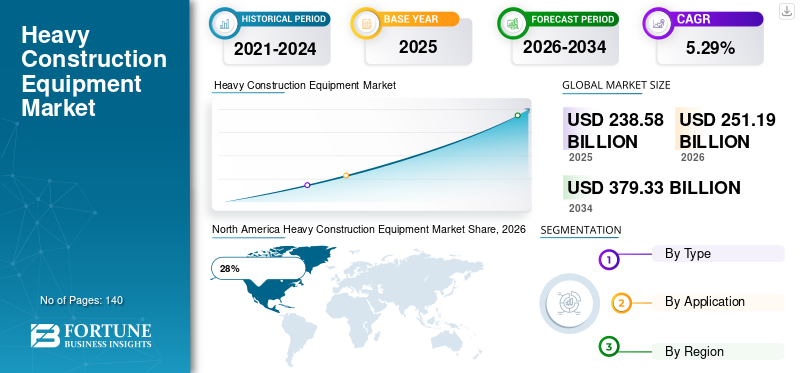
Fortune Business Insights says that the global market value stood at USD 238.58 billion in 2025 and is projected to reach USD 379.33 billion by 2034.
The market is expected to exhibit a CAGR of 5.29% during the forecast period of 2026-2034.
Infrastructure Construction was the leading type segment, accounting for approximately 32% share,Highway development, bridges, railways, airports, tunnels, ports, water systems, utility networks, and urban infrastructure projects require extensive use of excavators, loaders, bulldozers, graders, cranes, compactors, and hauling equipment.
Key players include Caterpillar, Komatsu Ltd., AB Volvo, Hitachi Construction Machinery Co., Ltd., Deere & Company, and CNH Industrial N.V.
Major trends include growing adoption of electric and hybrid-powered machinery, autonomous equipment, and telematics-integrated fleet management, alongside AI-enabled monitoring and predictive maintenance. Asia-Pacific led the market with a 37% share in 2025, supported by infrastructure and construction activity.


- 2021-2034
- 2025
- 2021-2024
- 140
-

(Offer valid till 15th Oct 2026)
Get 30-60 hrs Free Customization
Expand Regional and Country Coverage, Segments Analysis, Company Profiles, Competitive Benchmarking, and End-user Insights.















-
US +1 833 909 2966 ( Toll Free )
-
Get In Touch With Us