 Download Free Sample



Get a Quote
Receive a tailored pricing based on your needs.
- Choose license type
- Multiple user options
- Custom scope & coverage
- Fast turnaround
"Designing Growth Strategies is in our DNA"
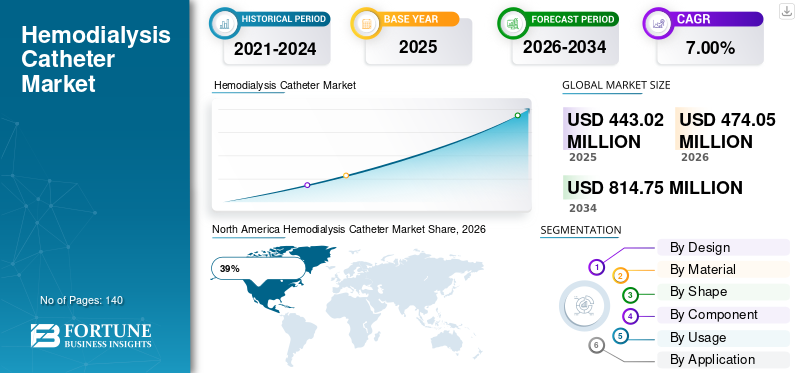
The global hemodialysis catheter market size was valued at USD 443.02 million in 2025. The market is projected to grow from USD 474.05 million in 2026 to USD 814.75 million by 2034, exhibiting a CAGR of 7.00% during the forecast period.

The hemodialysis catheter market is a critical segment of the renal care industry, supporting vascular access requirements for patients undergoing hemodialysis treatment. Hemodialysis catheters are widely utilized in both acute and chronic kidney disease management, particularly when immediate vascular access is required. Increasing prevalence of end-stage renal disease, rising incidence of diabetes and hypertension, and growing demand for dialysis services continue driving market expansion. Healthcare providers increasingly adopt advanced catheter technologies designed to improve blood flow performance, reduce infection risks, and enhance patient safety. The hemodialysis catheter market report highlights ongoing product innovation, expanding dialysis infrastructure, and growing emphasis on long-term vascular access management.
The United States accounts for approximately 42% market share in the global hemodialysis catheter market. The country benefits from a well-established dialysis network, advanced healthcare infrastructure, and a large population requiring renal replacement therapy. Increasing prevalence of chronic kidney disease and end-stage renal disease continues driving demand for vascular access devices. Healthcare providers are increasingly adopting advanced catheter designs that minimize complications and improve treatment efficiency. Strong reimbursement systems, ongoing investments in renal care services, and continuous product innovation further support market growth. The USA hemodialysis catheter market outlook remains favorable due to rising dialysis patient volumes and technological advancements.
Download Free sample to learn more about this report.
 Global Market Size & Forecast
 Market Share
 Key Regional Highlights
North America
North America held the largest regional share at 42.5% in 2025.
Europe
Europe accounted for 28% of the global market, supported by established diagnostic infrastructure.
Asia-Pacific
Asia-Pacific represented 22% of the global market, driven by expanding healthcare access and diagnostic adoption.
U.S
The U.S. is a major market supported by advanced diagnostic infrastructure and growing demand for STI testing.
Japan
Japan accounted for 18% of the Asia-Pacific market, supported by established healthcare services and diagnostic capabilities.
Read More

The hemodialysis catheter market trends indicate growing adoption of antimicrobial and antithrombogenic catheter technologies designed to reduce infection rates and improve clinical outcomes. Manufacturers are increasingly focusing on catheter materials and coatings that minimize complications associated with long-term vascular access. These innovations are helping healthcare providers improve patient safety and treatment effectiveness.
Download Free sample to learn more about this report.
Another significant trend within the hemodialysis catheter market analysis landscape is the increasing preference for tunneled catheters in chronic dialysis applications. Tunneled devices offer improved stability and lower infection risk compared to traditional temporary access solutions. Healthcare facilities continue investing in advanced vascular access management programs aimed at reducing hospitalization and catheter-related complications.
Rising Prevalence of Chronic Kidney Disease and End-Stage Renal Disease
The primary driver of the hemodialysis catheter market growth is the increasing prevalence of chronic kidney disease and end-stage renal disease worldwide. Rising rates of diabetes, hypertension, obesity, and aging populations have significantly increased the number of patients requiring dialysis treatment. Hemodialysis catheters remain essential for establishing vascular access, particularly in emergency situations and during the transition to permanent access solutions. Healthcare systems continue expanding dialysis capacity to meet growing patient demand. Increasing awareness regarding kidney disease diagnosis and treatment further supports market growth. These factors collectively contribute to sustained expansion within the Hemodialysis Catheter Industry Analysis landscape.
Catheter-Related Complications and Infection Risks
A major restraint affecting the hemodialysis catheter market is the risk of catheter-related complications, including bloodstream infections, thrombosis, and vascular damage. Despite technological advancements, long-term catheter use remains associated with clinical challenges that may impact patient outcomes. Healthcare providers continue emphasizing infection prevention protocols and alternative vascular access methods whenever possible. Regulatory scrutiny regarding device safety and performance also influences product development timelines. These factors can limit adoption rates and increase clinical management requirements, creating challenges for manufacturers operating within the market.
Development of Advanced Antimicrobial Catheter Technologies
A significant opportunity within the hemodialysis catheter market opportunities landscape is the development of advanced antimicrobial and biocompatible catheter technologies. Manufacturers are investing in innovative coatings, materials, and catheter designs that reduce infection rates and improve long-term performance. Growing demand for safer vascular access solutions is creating opportunities for product differentiation and market expansion. Emerging healthcare markets are also investing in dialysis infrastructure and renal care services, providing additional growth potential. These developments support continued innovation and commercial opportunities throughout the hemodialysis catheter market forecast environment.
Stringent Regulatory Requirements and Reimbursement Pressures
One of the primary challenges facing the hemodialysis catheter market is navigating complex regulatory requirements while maintaining product affordability. Manufacturers must comply with strict clinical testing, quality assurance, and post-market surveillance standards. Healthcare providers also face reimbursement pressures that influence purchasing decisions and technology adoption. Product recalls, supply chain disruptions, and evolving regulatory expectations can create operational challenges. Balancing innovation with cost-effectiveness remains a critical concern for industry participants. These factors continue influencing competitive dynamics within the hemodialysis catheter market insights landscape.
Single lumen catheters account for approximately 18% market share in the hemodialysis catheter market. These devices are primarily utilized in specialized clinical situations requiring single-channel vascular access. Single lumen designs offer procedural simplicity and are commonly used for temporary access requirements. Although less common in routine hemodialysis applications, they remain important in selected patient populations and emergency care settings. Healthcare providers value their ease of insertion and reduced structural complexity. Continued demand for temporary vascular access solutions supports segment stability. Advancements in catheter materials and manufacturing quality continue contributing to clinical performance improvements.
Double lumen catheters hold approximately 57% market share within the hemodialysis catheter market and represent the leading product category. These catheters allow simultaneous blood withdrawal and return during dialysis treatment, making them highly efficient and widely adopted across healthcare settings. Hospitals and dialysis centers prefer double lumen designs because they support reliable blood flow rates and treatment effectiveness. Manufacturers continue improving lumen geometry, catheter flexibility, and antimicrobial protection features. Growing dialysis patient populations and increasing demand for dependable vascular access solutions continue strengthening the segment’s leadership position within the hemodialysis catheter market outlook.
Triple lumen catheters account for approximately 25% market share in the hemodialysis catheter market. These devices provide additional access channels that support multiple clinical functions beyond dialysis treatment alone. Healthcare professionals utilize triple lumen catheters in complex patient management situations requiring simultaneous medication administration, monitoring, or additional therapeutic interventions. The versatility of these devices contributes to their growing adoption in intensive care and specialized treatment environments. Ongoing innovation in catheter design and performance characteristics supports continued segment development. Triple lumen solutions remain important for healthcare providers managing critically ill renal patients.
To know how our report can help streamline your business, Speak to Analyst
Polyurethane accounts for approximately 54% market share in the hemodialysis catheter market and remains the most widely utilized material due to its excellent balance of flexibility, strength, and durability. Healthcare providers prefer polyurethane catheters because they can withstand repeated dialysis procedures while maintaining structural integrity and reliable blood flow performance. The material offers resistance to kinking and supports efficient vascular access during both short-term and long-term treatments. Manufacturers continue improving polyurethane formulations to enhance biocompatibility and reduce complication risks. Increasing demand for durable vascular access solutions and growing dialysis patient populations continue supporting segment growth. Advanced polyurethane catheter technologies also contribute to improved patient comfort and treatment reliability, reinforcing their dominant position within the hemodialysis catheter market.
Straight catheters account for approximately 45% market share in the hemodialysis catheter market and remain one of the most commonly used catheter configurations across hospitals and dialysis centers. These catheters are preferred for their simple design, ease of insertion, and broad compatibility with different patient anatomies. Healthcare professionals frequently utilize straight catheters in both temporary and long-term vascular access procedures due to their predictable clinical performance. The segment benefits from widespread availability and established clinical familiarity among nephrologists and vascular access specialists. Manufacturers continue enhancing material quality and blood flow characteristics to improve treatment efficiency.
Curved catheters hold approximately 32% market share within the hemodialysis catheter market and are increasingly utilized to improve catheter positioning and patient comfort. The curved design helps reduce tension at the insertion site while supporting stable catheter placement during long-term dialysis treatment. Healthcare providers often prefer curved catheters for patients requiring extended vascular access because they may reduce mechanical complications and improve overall treatment experience. Manufacturers are focusing on advanced designs that optimize blood flow performance while minimizing the risk of displacement. Growing emphasis on patient-centered care and long-term vascular access management continues supporting adoption.
Pre-curved catheters account for approximately 23% market share in the hemodialysis catheter market and represent a specialized category designed to improve anatomical alignment and procedural efficiency. These catheters are manufactured with predetermined curvature that facilitates accurate placement and enhances stability following insertion. Healthcare providers increasingly utilize pre-curved configurations in complex clinical cases where precise positioning is essential for optimal dialysis performance. The design helps reduce the need for catheter manipulation during placement procedures, contributing to improved patient outcomes.
Catheter tubing accounts for approximately 52% market share within the hemodialysis catheter market by component and forms the primary structure responsible for blood transport during dialysis procedures. Manufacturers focus on developing tubing materials that provide flexibility, durability, and resistance to kinking while maintaining optimal blood flow performance. The increasing prevalence of chronic kidney disease and rising dialysis procedure volumes continue supporting demand for high-quality catheter tubing. Advanced material technologies are helping improve biocompatibility and reduce treatment-related complications. Healthcare providers prioritize reliable tubing systems because they directly influence treatment efficiency and patient safety. Continuous product innovation and improvements in catheter design further contribute to segment expansion across hospitals, dialysis centers, and specialized renal care facilities.
Temporary hemodialysis catheters account for approximately 38% market share in the hemodialysis catheter market and are primarily utilized in emergency situations requiring immediate vascular access. These catheters are commonly used for acute kidney injury cases, urgent dialysis procedures, and short-term treatment requirements. Healthcare providers value temporary catheters because they can be inserted quickly and provide immediate access for life-saving interventions. Growing numbers of emergency renal care cases continue supporting segment demand. Manufacturers focus on improving insertion efficiency, blood flow performance, and infection prevention characteristics. The increasing prevalence of acute renal complications and expanding critical care services contribute significantly to segment growth.
Acute hemodialysis applications account for approximately 34% market share in the hemodialysis catheter market and involve the treatment of patients experiencing sudden kidney failure or severe metabolic disturbances. Hospitals and intensive care units frequently perform acute dialysis procedures that require immediate and reliable vascular access. Catheters used in acute settings must support rapid treatment initiation and efficient blood flow performance. Increasing hospitalization rates and growing numbers of critically ill patients continue supporting segment demand. Healthcare providers focus on solutions that improve procedural efficiency and patient outcomes. The critical role of acute dialysis in emergency renal care contributes to sustained market growth.
Hospitals account for approximately 44% market share in the hemodialysis catheter market and remain the largest end-use segment. These facilities perform a substantial number of dialysis procedures while managing complex renal care cases requiring specialized vascular access solutions. Hospitals provide both acute and chronic dialysis services, creating consistent demand for advanced catheter technologies. Increasing patient volumes and ongoing investments in healthcare infrastructure continue supporting market expansion. Healthcare providers prioritize products that improve treatment efficiency, infection prevention, and patient safety. The growing burden of kidney disease worldwide further strengthens demand within hospital settings.
North America Hemodialysis Catheter Market Share, 2026 (%)
To get more information on the regional analysis of this market, Download Free sample
North America accounts for approximately 39% market share in the global hemodialysis catheter market and remains the largest regional contributor due to its advanced healthcare infrastructure and extensive dialysis treatment network. The region has a large population suffering from chronic kidney disease, diabetes, and hypertension, all of which contribute to increasing demand for hemodialysis procedures. Healthcare providers are actively adopting advanced catheter technologies that improve blood flow performance and reduce infection risks. The United States represents the largest share of regional demand because of its high dialysis patient population and strong reimbursement framework. Canada also contributes significantly through ongoing healthcare modernization efforts and investments in renal care services. Growing awareness regarding vascular access management supports product adoption. Continuous clinical research and medical device innovation further strengthen market growth. Expansion of dialysis centers and outpatient treatment facilities continues supporting demand. These factors collectively reinforce North America's leadership in the hemodialysis catheter market.
Europe holds approximately 28% market share in the global hemodialysis catheter market and remains a significant regional market supported by strong healthcare systems and advanced renal care services. The growing prevalence of chronic kidney disease and an increasing elderly population continue driving demand for dialysis access products. Healthcare providers across Europe prioritize patient safety, infection prevention, and long-term vascular access reliability. Hospitals and dialysis centers are increasingly utilizing advanced catheter technologies that improve treatment efficiency and minimize complications. Government investments in healthcare infrastructure and dialysis treatment capacity continue supporting market expansion. Growing awareness regarding kidney disease diagnosis and management also contributes to increased treatment rates. Medical device manufacturers continue introducing innovative catheter designs tailored to clinical needs. Strong reimbursement systems and regulatory standards support broad adoption. These factors continue strengthening Europe's position within the hemodialysis catheter market outlook.
Germany accounts for approximately 27% market share within the European hemodialysis catheter market and represents one of the most important markets in the region. The country benefits from a highly developed healthcare infrastructure and extensive dialysis treatment network. Rising numbers of patients suffering from chronic kidney disease continue supporting demand for vascular access devices. Healthcare providers increasingly adopt advanced hemodialysis catheters featuring enhanced safety and infection prevention characteristics. Germany’s strong medical technology sector contributes to continuous product innovation and clinical advancement. Investments in renal care modernization and patient-centered treatment approaches further strengthen market development. Growing awareness regarding dialysis treatment quality supports demand for high-performance catheter solutions. The presence of specialized nephrology centers also contributes to market growth. These factors support the expansion of the Germany hemodialysis catheter market.
The United Kingdom represents approximately 19% market share within the European hemodialysis catheter market and continues to demonstrate steady growth. Increasing prevalence of kidney disease and growing demand for dialysis treatment services are major market drivers. Healthcare providers are focusing on advanced vascular access technologies that improve patient outcomes and reduce treatment-related complications. The country benefits from ongoing healthcare modernization programs and increasing investments in renal care infrastructure. Hospitals and dialysis centers continue expanding treatment capabilities to accommodate rising patient numbers. Growing emphasis on infection prevention and quality improvement initiatives supports adoption of advanced catheter products. Strong clinical expertise and established treatment protocols further contribute to market development. These trends continue strengthening the United Kingdom hemodialysis catheter market growth environment.
Asia-Pacific accounts for approximately 24% market share in the global hemodialysis catheter market and remains one of the fastest-growing regions. Rapid healthcare infrastructure development and increasing healthcare expenditure continue supporting market expansion. Rising prevalence of diabetes, hypertension, and chronic kidney disease has significantly increased demand for dialysis treatment services. Governments across the region are investing heavily in healthcare modernization and chronic disease management programs. Countries such as China, Japan, India, and South Korea are expanding dialysis center networks and improving access to renal care services. Manufacturers continue introducing advanced catheter technologies tailored to local clinical requirements. Growing awareness regarding kidney health and early disease diagnosis further contributes to market growth. Increasing adoption of outpatient dialysis services supports demand. These factors position Asia-Pacific as a major growth center within the hemodialysis catheter market forecast landscape.
Japan accounts for approximately 23% market share within the Asia-Pacific hemodialysis catheter market and benefits from one of the world’s most advanced renal care systems. The country has a large dialysis patient population requiring long-term vascular access solutions. Healthcare providers prioritize high-quality catheter technologies that improve patient safety, treatment effectiveness, and long-term reliability. Strong healthcare infrastructure and extensive clinical expertise contribute to widespread adoption of advanced dialysis products. Continuous investment in medical innovation and renal care research further supports market development. The aging population also contributes to increasing demand for dialysis treatment. Hospitals and specialized renal care centers continue expanding access to advanced vascular access technologies. These factors strengthen Japan’s role within the hemodialysis catheter market insights landscape.
China represents approximately 31% market share within the Asia-Pacific hemodialysis catheter market, making it the largest regional contributor. Rapid expansion of healthcare infrastructure and increasing access to dialysis services continue supporting market growth. Rising prevalence of chronic kidney disease, diabetes, and hypertension has significantly increased demand for hemodialysis treatment. Government healthcare reforms and investments in medical facilities contribute positively to market development. Domestic and international manufacturers are expanding production capabilities and strengthening distribution networks throughout the country. Growing awareness regarding kidney disease management and improved diagnostic capabilities support treatment adoption. Expansion of dialysis centers in urban and rural areas further strengthens demand. These factors position China as a key growth engine within the hemodialysis catheter market analysis environment.
The Rest of World region accounts for approximately 9% market share in the global hemodialysis catheter market and includes Latin America, the Middle East, and Africa. These regions are experiencing increasing demand for dialysis treatment due to growing chronic disease burdens and improving healthcare access. Governments and healthcare providers are investing in dialysis infrastructure and renal care services to address rising patient needs. Adoption of advanced catheter technologies is gradually increasing as healthcare systems modernize. International manufacturers continue expanding regional distribution networks and improving product availability. Growing awareness regarding kidney disease diagnosis and treatment contributes to higher dialysis utilization rates. Private healthcare investments are also supporting market development. Although market penetration remains lower than in developed regions, significant long-term opportunities exist. These factors support continued expansion within the Rest of World hemodialysis catheter market.
The hemodialysis catheter market presents substantial investment opportunities due to the growing global burden of chronic kidney disease and increasing demand for dialysis treatment. Investors continue focusing on companies developing advanced vascular access technologies that improve patient outcomes while reducing infection and thrombosis risks. Antimicrobial catheter coatings, biocompatible materials, and innovative blood flow optimization technologies are attracting significant attention.
Healthcare providers are expanding dialysis infrastructure to accommodate rising patient populations, creating opportunities for manufacturers and technology developers. Emerging economies represent attractive investment destinations due to increasing healthcare expenditure and expanding access to renal care services. Companies that offer differentiated products focused on safety, performance, and long-term reliability are well positioned for growth.
Innovation within the hemodialysis catheter market is focused on improving patient safety, reducing complications, and enhancing treatment efficiency. Manufacturers continue developing antimicrobial-coated catheters that minimize infection risks associated with long-term vascular access. Advanced biomaterials designed to improve biocompatibility and reduce thrombosis rates are also gaining attention.
Product development efforts increasingly emphasize blood flow optimization through enhanced lumen configurations and catheter tip designs. These innovations support more effective dialysis treatment while reducing recirculation and access-related complications. Manufacturers are also introducing catheters with improved flexibility and insertion characteristics to enhance clinical usability.
The hemodialysis catheter market report provides comprehensive analysis of market dynamics, segmentation trends, regional performance, and competitive developments. The report evaluates key growth drivers including rising prevalence of chronic kidney disease, expanding dialysis patient populations, and increasing demand for advanced vascular access solutions. Market restraints, opportunities, and challenges influencing industry performance are examined in detail.
Request for Customization to gain extensive market insights.
The report includes segmentation analysis by type, material, shape, component, usage, application, and end use. Product categories such as single lumen, double lumen, and triple lumen catheters are evaluated alongside material and design innovations. Regional coverage spans North America, Europe, Asia-Pacific, and Rest of World markets, providing insight into demand patterns and growth opportunities.
Fortune Business Insights says that the global market value stood at USD 443.02 million in 2025 and is projected to reach USD 814.75 million by 2034.
The market is expected to exhibit a CAGR of 7.00% during the forecast period of 2026-2034.
Double lumen catheters were the leading design segment with approximately 57% market share, as they enable simultaneous blood withdrawal and return during dialysis and support reliable treatment efficiency.
Key players include BD, Teleflex Incorporated, Mozarc Medical Holding LLC., Medical Components, Inc., Merit Medical Systems, and Medtronic.
Major trends include growing adoption of antimicrobial and antithrombogenic catheter technologies and increasing preference for tunneled catheters in chronic dialysis. North America leads regionally with approximately 39% market share.


(Offer valid till 15th Nov 2026)
Get 30-60 hrs Free Customization
Expand Regional and Country Coverage, Segments Analysis, Company Profiles, Competitive Benchmarking, and End-user Insights.













.webp)






Get In Touch With Us
US +1 833 909 2966 ( Toll Free )
Receive a tailored pricing based on your needs.
Discuss your questions with our industry experts.
Have questions? Get quick answers before you purchase.

