Hemodialysis Vascular Grafts Market Size, Share & Industry Analysis, By Raw Material (Polyester, Polyurethane, Polyurethane, Biological Materials), and Regional Forecast, 2026-2034
 Download Free Sample
Hemodialysis Vascular Grafts Market Overview
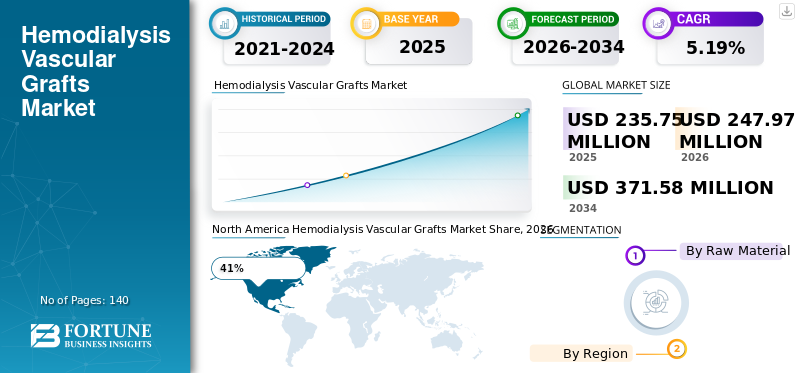
The global Hemodialysis vascular grafts market size was valued at USD 235.75 billion in 2025. The market is projected to grow from USD 247.97 billion in 2026 to USD 371.58 billion by 2034, exhibiting a CAGR of 5.19% during the forecast period.

The Hemodialysis vascular grafts market is an essential segment of the renal care and vascular access industry, supporting patients who require long-term hemodialysis treatment. Vascular grafts are widely used when native arteriovenous fistulas are not suitable due to poor vessel quality or other clinical limitations. Growing prevalence of chronic kidney disease, end-stage renal disease, diabetes, and hypertension continues to increase demand for reliable vascular access solutions. Manufacturers are focusing on improving graft durability, infection resistance, and patency rates. The Hemodialysis vascular grafts market report highlights continuous innovation in synthetic and biological graft technologies, supporting improved patient outcomes and long-term dialysis efficiency.
The United States represents the largest market for hemodialysis vascular grafts in North America due to its significant dialysis patient population and advanced healthcare infrastructure. More than half a million patients receive maintenance dialysis treatment annually, creating substantial demand for dependable vascular access products. Hospitals, dialysis centers, and vascular surgery facilities continue to adopt advanced graft technologies designed to reduce thrombosis and infection risks. The presence of leading medical device manufacturers and specialized renal care providers supports ongoing product development and commercialization. The USA remains a key contributor to Hemodialysis vascular grafts market analysis through strong clinical research, reimbursement support, and widespread adoption of innovative vascular access solutions.
Download Free sample to learn more about this report.
Hemodialysis Vascular Grafts Market Key Takeaways
 Global Market Size & Forecast
- 2025 Market Size: USD 235.75 Billion
- 2026 Market Size: USD 247.97 Billion
- 2034 Forecast Market Size: USD 371.58 Billion
- CAGR: 5.19% from 2026-2034
 Market Share
- The market in North America dominated with a revenue share of 41% in 2025.
- Polyester vascular grafts dominated by raw material with a market share of approximately 39%.
- Polyurethane vascular grafts accounted for a market share of approximately 34%.
 Key Regional Highlights
North America
North America led the market with a 41% share, supported by advanced healthcare infrastructure and strong demand for dialysis treatments.
Europe
Europe accounted for 27% of the market, driven by established renal care facilities and increasing demand for vascular access solutions.
Asia-Pacific
Asia-Pacific held a 24% share, supported by expanding healthcare infrastructure and rising prevalence of kidney diseases.
U.S
The U.S. remains a key market, supported by advanced dialysis infrastructure and strong adoption of vascular access technologies.
Japan
Japan accounted for approximately 22% of the Asia-Pacific market, supported by advanced renal care facilities and established dialysis services.
Read More

Hemodialysis Vascular Grafts Market Latest Trends
The Hemodialysis vascular grafts market is experiencing significant technological advancements focused on improving long-term vascular access performance. One of the most notable trends is the development of early-cannulation grafts that allow dialysis treatment to begin sooner after implantation. These products help reduce dependence on central venous catheters and improve patient care efficiency. Another important trend involves the increasing use of biologically engineered graft materials that promote better tissue integration and lower complication rates. Manufacturers are investing in advanced biomaterial research to enhance graft patency and minimize infection risks. Hybrid graft designs that combine synthetic durability with biological compatibility are gaining attention among vascular specialists.
Download Free sample to learn more about this report.
The market is also witnessing increased adoption of antimicrobial technologies integrated into graft structures to address access-related infections. Digital patient monitoring systems and predictive analytics are supporting better management of vascular access complications. Healthcare providers are increasingly focusing on personalized treatment approaches that match graft selection with individual patient characteristics. Hemodialysis vascular grafts market trends further indicate growing collaboration between device manufacturers and dialysis providers to improve treatment outcomes and reduce hospitalization rates. These innovations continue to strengthen Hemodialysis vascular grafts market growth and long-term clinical adoption.
Hemodialysis Vascular Grafts Market Dynamics
DRIVER
Rising Prevalence of Chronic Kidney Disease and End-Stage Renal Disease
The increasing prevalence of chronic kidney disease and end-stage renal disease remains the primary driver of Hemodialysis vascular grafts market growth. Aging populations, rising diabetes rates, and increasing hypertension prevalence continue to expand the global dialysis patient base. Many patients require vascular graft implantation when native fistulas are unsuitable or fail to mature adequately. Healthcare systems are investing in dialysis infrastructure to address growing treatment demand, creating additional opportunities for graft manufacturers. Hospitals and dialysis centers increasingly seek reliable vascular access products that provide long-term functionality and minimize complications. This growing patient population continues to support sustained demand for advanced hemodialysis vascular graft technologies across developed and emerging healthcare markets.
RESTRAINT
Preference for Arteriovenous Fistulas Over Grafts
A major restraint affecting the Hemodialysis vascular grafts market is the clinical preference for arteriovenous fistulas whenever suitable patient anatomy allows. Fistulas are often associated with longer access survival and lower infection rates compared with grafts. Clinical guidelines frequently recommend fistulas as the preferred vascular access option for dialysis patients. As a result, vascular grafts are commonly reserved for patients with inadequate vascular structures or previous fistula failure. This treatment hierarchy can limit overall graft utilization. Additionally, physician efforts to improve fistula maturation rates and expand fistula use may reduce potential demand for graft-based solutions in certain healthcare environments.
OPPORTUNITY
Development of Next-Generation Bioengineered Vascular Grafts
The emergence of bioengineered vascular graft technologies presents significant opportunities for market participants. Researchers and manufacturers are focusing on tissue-engineered grafts designed to improve biocompatibility, reduce inflammatory responses, and enhance long-term patency. These advanced products aim to overcome limitations associated with conventional synthetic materials while providing durable vascular access. Growing investment in regenerative medicine and biomaterials research is accelerating innovation within the sector. Healthcare providers increasingly seek solutions that reduce intervention frequency and improve patient quality of life. As clinical evidence supporting bioengineered graft performance expands, adoption opportunities are expected to increase across dialysis centers and vascular surgery facilities worldwide.
CHALLENGE
High Incidence of Access-Related Complications
One of the most significant challenges facing the Hemodialysis vascular grafts market is the ongoing risk of access-related complications. Thrombosis, infection, stenosis, and graft failure remain common concerns that can affect patient outcomes and increase healthcare costs. Frequent interventions may be required to maintain graft functionality, creating additional clinical burdens. Manufacturers must continually invest in research and development to address these issues through improved materials and device designs. Regulatory requirements for safety and performance validation further increase development complexity. Achieving long-term graft durability while maintaining affordability remains a critical challenge for both manufacturers and healthcare providers.
Hemodialysis Vascular Grafts Market Segmentation
By Raw Material
Polyester vascular grafts account for approximately 39% of the global Hemodialysis vascular grafts market share. These grafts are widely recognized for their mechanical strength, durability, and long history of clinical use. Polyester materials provide reliable structural support and are commonly utilized in patients requiring durable vascular access for long-term dialysis treatment. Manufacturers continue to improve graft construction techniques to enhance flexibility and reduce complications. Hospitals and vascular surgeons value polyester grafts for their established performance record and broad availability. The segment benefits from continued demand in mature healthcare markets where proven clinical outcomes remain an important purchasing consideration.
Polyurethane vascular grafts hold approximately 34% of the Hemodialysis vascular grafts market share. These grafts are valued for their flexibility, elasticity, and favorable handling characteristics during implantation procedures. Polyurethane materials can provide improved patient comfort and facilitate easier surgical placement compared with some traditional alternatives. Manufacturers continue developing advanced polyurethane formulations designed to improve biocompatibility and long-term access performance. Healthcare providers increasingly utilize polyurethane grafts in patients requiring reliable vascular access with enhanced flexibility. Growing awareness of material innovations and increasing demand for improved dialysis outcomes continue to support this segment's market position.
Biological material-based vascular grafts account for approximately 27% of the global Hemodialysis vascular grafts market share. These products are designed to promote tissue integration and improve compatibility with the patient's vascular system. Biological graft technologies are attracting increasing attention due to their potential to reduce inflammatory responses and improve long-term patency. Research initiatives focused on regenerative medicine and tissue engineering continue to expand opportunities within this segment. Healthcare providers are evaluating biological materials as alternatives to conventional synthetic options, particularly for complex patient populations. Continued innovation and growing clinical evidence supporting biological graft performance are expected to strengthen adoption across advanced renal care facilities.
To know how our report can help streamline your business, Speak to Analyst
Hemodialysis Vascular Grafts Market Regional Outlook
North America Hemodialysis Vascular Grafts Market Share, 2026 (%)
To get more information on the regional analysis of this market, Download Free sample
North America
North America dominates the Hemodialysis vascular grafts market with approximately 41% of global market share. The region benefits from a large population of patients undergoing maintenance hemodialysis and a highly developed healthcare infrastructure. The United States accounts for the majority of regional demand due to the significant burden of chronic kidney disease, diabetes, and hypertension. Hospitals and dialysis centers increasingly utilize advanced vascular graft products to improve long-term access reliability and reduce complications. Continuous technological innovation and strong physician awareness contribute to widespread adoption of synthetic and biologically enhanced grafts. Favorable reimbursement frameworks and access to specialized vascular surgery services further support market expansion. Manufacturers actively invest in research programs focused on improving graft patency, reducing infection risks, and enhancing patient outcomes. The region also benefits from strong clinical trial activity and early adoption of new vascular access technologies. North America remains a leading contributor to Hemodialysis vascular grafts market growth and Hemodialysis vascular grafts market insights.
Europe
Europe accounts for approximately 27% of the global Hemodialysis vascular grafts market share and represents a mature healthcare market with extensive dialysis treatment networks. Rising prevalence of renal disorders and aging populations continue to drive demand for durable vascular access solutions. Countries throughout Europe maintain well-established nephrology and vascular surgery programs that support widespread use of hemodialysis grafts. Healthcare providers increasingly focus on reducing catheter dependence and improving long-term dialysis access outcomes through advanced graft technologies. Biological materials and next-generation polyurethane grafts are gaining acceptance because of their improved clinical performance. Regional manufacturers and healthcare institutions actively collaborate on product development and vascular access research initiatives. Regulatory standards emphasizing patient safety and device quality encourage innovation across the market. Increasing investments in chronic disease management programs further contribute to market development. Europe continues to play a significant role in Hemodialysis vascular grafts market analysis through clinical innovation and expanding renal care services.
Germany Hemodialysis Vascular Grafts Market
Germany represents approximately 29% of the European Hemodialysis vascular grafts market and remains one of the region's most important healthcare markets. The country has a large dialysis patient population supported by advanced renal care infrastructure and specialized vascular surgery centers. Growing prevalence of chronic kidney disease and diabetes continues to generate demand for vascular access procedures. German healthcare providers prioritize high-quality graft technologies that offer long-term durability and reduced intervention rates. Strong medical device manufacturing capabilities and extensive clinical research activities contribute to ongoing innovation. The country's focus on advanced treatment protocols and patient-centered care supports steady adoption of next-generation vascular graft products across hospitals and dialysis centers.
United Kingdom Hemodialysis Vascular Grafts Market
The United Kingdom accounts for approximately 18% of the European Hemodialysis vascular grafts market. Demand is driven by increasing rates of chronic kidney disease, expanding dialysis treatment services, and growing awareness of vascular access optimization. Hospitals and renal care providers emphasize long-term access management to improve treatment continuity and patient outcomes. Adoption of advanced graft materials is increasing as healthcare organizations seek solutions that reduce complications and maintenance procedures. Academic institutions and healthcare providers actively participate in vascular access research and clinical evaluations. Continued investments in nephrology services and healthcare modernization support market development. The United Kingdom remains an important contributor to Hemodialysis vascular grafts market forecast and industry advancement.
Asia-Pacific
Asia-Pacific holds approximately 24% of the global Hemodialysis vascular grafts market share and is emerging as a major growth region for vascular access products. Increasing prevalence of chronic kidney disease, expanding healthcare infrastructure, and rising dialysis patient populations are driving demand throughout the region. Countries across Asia-Pacific are investing heavily in dialysis facilities and specialized nephrology services to address growing healthcare needs. The adoption of vascular graft technologies is increasing as healthcare providers focus on improving dialysis access reliability and reducing treatment interruptions. Local manufacturers are strengthening production capabilities while international companies continue expanding their regional presence. Government healthcare initiatives aimed at improving access to renal care further support market expansion. Growing physician awareness and advances in vascular surgery techniques are encouraging broader utilization of innovative graft products. Asia-Pacific remains a key area for Hemodialysis vascular grafts market Opportunities and future industry development.
Japan Hemodialysis Vascular Grafts Market
Japan contributes approximately 22% of the Asia-Pacific Hemodialysis vascular grafts market. The country has one of the world's most advanced dialysis care systems and a substantial population receiving long-term hemodialysis treatment. Healthcare providers place strong emphasis on maintaining reliable vascular access and minimizing complications. Advanced medical technology infrastructure supports widespread adoption of high-performance graft products. Research institutions and manufacturers continue collaborating to develop innovative vascular access solutions. The country's aging population contributes to sustained demand for renal replacement therapies and associated vascular graft technologies. High standards of clinical care and technological innovation continue to strengthen Japan's position within the regional market.
China Hemodialysis Vascular Grafts Market
China accounts for approximately 31% of the Asia-Pacific Hemodialysis vascular grafts market and represents the largest country-level market in the region. Rapid expansion of healthcare infrastructure and growing access to dialysis services are major factors supporting market growth. Increasing prevalence of diabetes, hypertension, and chronic kidney disease continues to expand the dialysis patient population. Hospitals and renal care centers are investing in advanced vascular access technologies to improve treatment quality and patient outcomes. Domestic manufacturers are expanding production capabilities while international companies increase market penetration. Government healthcare reforms and investments in chronic disease management programs further support adoption of vascular graft solutions. China remains a significant contributor to Hemodialysis vascular grafts market size and regional expansion.
Rest of World
The Rest of World region accounts for approximately 8% of the global Hemodialysis vascular grafts market share and includes Latin America, the Middle East, and Africa. Demand is supported by improving healthcare infrastructure, increasing availability of dialysis treatment, and growing awareness of chronic kidney disease management. Urban healthcare centers are increasingly adopting advanced vascular graft products to improve dialysis access outcomes. Government healthcare investments and international support programs are helping expand renal care services across developing regions. Synthetic grafts remain widely used due to affordability and accessibility advantages, while biological graft adoption is gradually increasing in advanced treatment centers. Training initiatives for vascular surgeons and nephrologists are improving procedural capabilities and access management practices. As healthcare systems continue to evolve, the Rest of World region is expected to generate additional opportunities for manufacturers participating in the Hemodialysis vascular grafts market.
List of Top Hemodialysis Vascular Grafts Companies
- W. L. Gore & Associates, Inc.
- C. R. Bard, Inc.
- Vascudyne, Inc.
- LeMaitre
- Getinge AB
- VASCULAR GENESIS
- InnAVasc Medical, Inc.
- CryoLife, Inc.
- Merit Medical Systems
- BIOVIC Sdn Bhd
Top two companies with the highest market share
- W. L. Gore & Associates, Inc. — estimated 24% market share.
- Becton, Dickinson and Company / C. R. Bard legacy — estimated 19% market share.
Investment Analysis and Opportunities
Investment interest in the Hemodialysis vascular grafts market is strongest in platforms that improve cannulation speed, reduce infection exposure, and extend functional graft life. Early-cannulation products are especially attractive because they help reduce central venous catheter dependence, which remains a major cost and complication driver in dialysis access care. Gore’s ACUSEAL materials emphasize earlier catheter removal or avoidance, while BD’s Covera franchise focuses on access maintenance and stenosis management within the dialysis circuit. That combination supports a market environment where buyers reward clinical utility, workflow efficiency, and measurable outcome improvement.
Longer-term opportunity sits in biologic and bioengineered grafts. Vascudyne’s research library shows active work on a first-in-human biological regenerative vascular conduit for hemodialysis access, which signals continued investor interest in tissue-based solutions that may improve integration and durability. InnAVasc is also pursuing a differentiated graft design with protective cannulation backplates and immediate-use positioning, which addresses needle injury and access handling concerns. LeMaitre’s Artegraft remains important in biologic access because it is positioned for hemodialysis conduit use and has gained broader commercial momentum. For investors, the most attractive assets are products that can combine hospital acceptance, procedural simplicity, and strong evidence in catheter-dependent populations.
New Product Development
New product development in the Hemodialysis vascular grafts market is being shaped by three priorities: earlier use after implantation, better resistance to infection and puncture damage, and improved handling for surgeons and dialysis staff. Gore’s ACUSEAL graft is built around early cannulation and a tri-layer construction designed to support quicker use after surgery. That feature is strategically important because it can lower catheter exposure and improve treatment continuity. BD’s Covera platform adds development depth on the access-maintenance side, with a product family used in stenotic lesions of AV access circuits.
Biologic innovation is also advancing. LeMaitre’s Artegraft collagen vascular graft is positioned as a hemodialysis conduit with a flexible, compliant biological matrix, while Getinge’s Flixene graft uses a three-layer ePTFE design and is marketed for AV access graft applications. InnAVasc adds another design direction by integrating backplates intended to reduce needle puncture risk in vulnerable graft areas, and Vascudyne is working on regenerative tissue conduits for hemodialysis access. Collectively, these programs show that the next wave of product development is not just about durability; it is about making grafts safer to puncture, easier to cannulate, and more compatible with long-term renal care workflows.
Recent Developments (2023-2025)
- In 2023, BD released an annual clinical update for Covera, reporting ongoing follow-up in its AV access evidence program and reinforcing the product’s use in venous outflow stenosis treatment.
- In 2024, Vascudyne listed a first-in-human evaluation of a biological regenerative vascular conduit for hemodialysis access in its research library, signaling an active regenerative graft pipeline.
- In 2024, LeMaitre’s Artegraft documentation continued to position the collagen vascular graft as a conduit for hemodialysis access, supporting broader commercial adoption in dialysis-access practice.
- In 2025, LeMaitre reported that Artegraft growth accelerated because of an international launch, showing expanded geographic commercialization for the biologic graft platform.
- In 2025, BD highlighted Covera clinical data and case-based access maintenance at an industry event page, showing continued manufacturer emphasis on evidence-driven access maintenance.
Report Coverage
This Hemodialysis vascular grafts market report covers the complete market structure across product type, application, geography, competitive landscape, investment activity, innovation, and recent manufacturer developments. The coverage includes polyester, polyurethane, and biological graft categories, along with their use across hospitals, dialysis centers, and specialty vascular access settings. It also examines regional behavior across North America, Europe, Asia-Pacific, and Rest of World, with country-level emphasis on the United States, Germany, the United Kingdom, Japan, and China.
Request for Customization to gain extensive market insights.
The competitive section highlights the role of major manufacturers such as Gore, BD, LeMaitre, Getinge, Merit, InnAVasc, and Vascudyne, alongside emerging innovators working on regenerative access solutions. The report is structured for B2B readers seeking Hemodialysis vascular grafts market analysis, Hemodialysis vascular grafts market research report, Hemodialysis Vascular Grafts Industry report, Hemodialysis vascular grafts market trends, Hemodialysis vascular grafts market Outlook, Hemodialysis vascular grafts market share, and Hemodialysis vascular grafts market opportunities.
Frequently Asked Questions
Fortune Business Insights says that the global market value stood at USD 1.05 billion in 2025 and is projected to reach USD 1.67 billion by 2034.
The market is expected to exhibit a CAGR of 5.34% during the forecast period of 2026-2034.
Expanded Polytetrafluoroethylene (ePTFE) grafts led the material segment with approximately 64% market share, owing to their proven durability, biocompatibility, and widespread clinical use.
Key players include W. L. Gore & Associates, Inc., BD, Getinge AB, LeMaitre Vascular, Inc., Merit Medical Systems, Inc., and Vascular Graft Solutions Ltd.
Major trends include increasing adoption of bioengineered vascular grafts and growing demand for infection-resistant and low-thrombogenic graft materials. North America dominated the market with a 42% share.



- 2021-2034
- 2025
- 2021-2024
- 140
-

(Offer valid till 15th Oct 2026)
Get 30-60 hrs Free Customization
Expand Regional and Country Coverage, Segments Analysis, Company Profiles, Competitive Benchmarking, and End-user Insights.













.webp)






-
US +1 833 909 2966 ( Toll Free )
-
Get In Touch With Us