 Download Free Sample



Get a Quote
Receive a tailored pricing based on your needs.
- Choose license type
- Multiple user options
- Custom scope & coverage
- Fast turnaround
"Designing Growth Strategies is in our DNA"
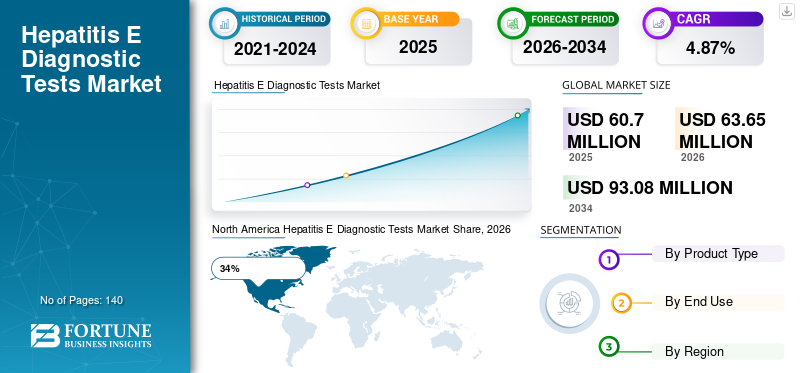
The global hepatitis E diagnostic tests market size was valued at USD 60.70 Million in 2025. The market is projected to grow from USD 63.65 Million in 2026 to USD 93.08 Million by 2034, exhibiting a CAGR of 4.87% during the forecast period.

The hepatitis E diagnostic tests market is witnessing strong expansion due to increasing awareness regarding viral hepatitis screening, rising cases of waterborne infections, and growing emphasis on early infectious disease detection across healthcare systems. The demand for Hepatitis E diagnostic testing is increasing among hospitals, blood banks, diagnostic laboratories, and public health institutions because of the need for accurate and rapid diagnosis. The hepatitis E diagnostic tests market Report highlights increasing adoption of ELISA HEV IgM tests and rapid diagnostics technologies in emerging and developed healthcare sectors. Rising investments in infectious disease monitoring, stronger surveillance programs, and advancements in molecular diagnostics are improving accessibility and operational efficiency in the Hepatitis E Diagnostic Tests Industry Analysis.
In the United States, the hepatitis E diagnostic tests market is growing steadily due to increasing awareness of zoonotic infections, imported hepatitis cases, and advanced laboratory infrastructure. Healthcare providers in the country are increasingly adopting advanced serological and molecular diagnostic methods to improve screening accuracy and patient management. Public health agencies are promoting routine viral hepatitis testing in high-risk populations, contributing to wider market penetration. Academic institutions and biotechnology companies are also investing in research activities associated with hepatitis diagnostics. The USA hepatitis E diagnostic tests market Research Report indicates that specialized laboratories and hospital networks are increasingly integrating rapid diagnostic technologies to support faster clinical decisions and improve disease surveillance capabilities.
Download Free sample to learn more about this report.
 Global Market Size & Forecast
 Market Share
 Key Regional Highlights
North America
North America led the market with a 34% regional share, supported by advanced diagnostic infrastructure.
Asia-Pacific
Asia-Pacific accounted for 31% of the global market, driven by increasing diagnostic needs.
Europe
Europe held a significant 29% share, supported by healthcare infrastructure and hepatitis screening.
U.S.
Demand is supported by advanced laboratory infrastructure and increasing infectious disease testing.
Japan
Market growth is supported by advanced diagnostic facilities and public health screening initiatives.
Read More

The hepatitis E diagnostic tests market is experiencing significant transformation due to the increasing integration of automated diagnostic platforms and advanced immunoassay technologies. Diagnostic manufacturers are focusing on improving sensitivity and specificity in HEV antibody detection systems to minimize false-positive outcomes. Automation in laboratory workflows is helping healthcare facilities process larger sample volumes while reducing turnaround times. The growing adoption of portable rapid diagnostic devices in rural and underserved regions is also reshaping the hepatitis E diagnostic tests market Outlook. These trends are improving patient accessibility and accelerating infectious disease diagnosis globally.
Download Free sample to learn more about this report.
Another important trend influencing the hepatitis E diagnostic tests market Analysis is the increasing use of multiplex diagnostic solutions capable of identifying multiple hepatitis strains simultaneously. Healthcare providers are emphasizing point-of-care testing solutions to strengthen outbreak monitoring and emergency response systems. Artificial intelligence-supported laboratory analytics and digital healthcare integration are also enhancing data interpretation and patient tracking capabilities. Demand for decentralized testing infrastructure is increasing among blood banks and emergency healthcare providers. The Hepatitis E Diagnostic Tests Industry Report further highlights strategic collaborations between biotechnology firms and healthcare institutions to develop faster and more cost-effective diagnostic products for large-scale infectious disease screening programs.
Rising Prevalence of Viral Hepatitis Infections and Increasing Disease Surveillance Initiatives
The increasing prevalence of hepatitis-related infections across developing and developed economies is a major driver supporting the growth of the hepatitis E diagnostic tests market. Governments and healthcare organizations are implementing stronger disease surveillance programs to reduce transmission risks and improve outbreak management capabilities. Increased awareness campaigns regarding waterborne and foodborne viral infections are encouraging earlier diagnosis and routine hepatitis screening. Hospitals and diagnostic laboratories are adopting advanced ELISA and rapid diagnostic technologies to enhance testing accuracy and reduce clinical delays.
The hepatitis E diagnostic tests market Growth is also supported by expanding healthcare infrastructure and improved laboratory accessibility in emerging countries. Rising international travel and migration patterns are increasing concerns related to infectious disease transmission, thereby strengthening demand for hepatitis screening solutions. Public health authorities are promoting early diagnosis initiatives among vulnerable populations, including pregnant women and immunocompromised individuals. These factors are significantly improving the adoption rate of hepatitis E diagnostic technologies across healthcare facilities and diagnostic centers globally.
Limited Awareness and Inconsistent Diagnostic Accessibility In Low-Income Regions
One of the major restraints affecting the hepatitis E diagnostic tests market is the limited awareness regarding hepatitis E infections in economically weaker regions. Many low-income countries continue to face shortages of laboratory infrastructure, trained healthcare professionals, and advanced diagnostic technologies. In several rural areas, infectious diseases remain underdiagnosed because of inadequate healthcare accessibility and insufficient testing programs. This restricts the penetration of advanced Hepatitis E diagnostic solutions in underserved regions.
The high operational costs associated with sophisticated molecular diagnostic systems also limit adoption among small healthcare facilities and community clinics. Inconsistent reimbursement policies and low healthcare spending in developing economies create additional barriers for manufacturers and diagnostic providers. Some healthcare institutions continue to rely on conventional testing methods with lower diagnostic accuracy due to budget constraints. These limitations reduce the pace of technological adoption and create challenges for companies attempting to expand their hepatitis E diagnostic tests market Share in price-sensitive healthcare markets.
Expansion of Point-Of-Care Testing And Emerging Market Healthcare Investments
The increasing demand for decentralized healthcare services is creating strong opportunities in the hepatitis E diagnostic tests market. Point-of-care diagnostic technologies are gaining popularity because they provide rapid results, portability, and operational convenience in remote healthcare environments. Governments in emerging economies are increasing investments in infectious disease monitoring infrastructure, creating favorable opportunities for diagnostic manufacturers. The expansion of mobile healthcare services and rural screening programs is further strengthening market demand.
The hepatitis E diagnostic tests market Opportunities are also expanding because biotechnology companies are developing affordable rapid diagnostic kits suitable for resource-limited settings. Rising partnerships between healthcare organizations and diagnostic manufacturers are improving product accessibility in developing countries. Growing awareness regarding preventive healthcare and early disease detection is encouraging hospitals and blood banks to invest in high-performance hepatitis screening systems. Increased funding for infectious disease research and technological innovation is expected to support long-term expansion of the Hepatitis E Diagnostic Tests Industry Analysis globally.
Diagnostic Complexity and Variability In Testing Accuracy Standards
The hepatitis E diagnostic tests market faces significant challenges associated with variability in diagnostic accuracy and testing standardization. Different diagnostic platforms may produce inconsistent results depending on antibody response timing, viral genotype variations, and patient immune conditions. This creates operational difficulties for healthcare providers attempting to ensure reliable diagnosis across diverse patient populations. False-negative and false-positive outcomes continue to impact clinical decision-making in some cases.
Another challenge involves the regulatory approval process for new diagnostic technologies, which can delay commercialization timelines for manufacturers. Maintaining compliance with international quality standards requires continuous investment in research, validation, and laboratory certifications. Healthcare institutions also face challenges integrating advanced diagnostic systems into existing workflows without increasing operational complexity. The hepatitis E diagnostic tests market Forecast indicates that companies must continue improving assay sensitivity, affordability, and operational efficiency to overcome these market barriers and strengthen customer confidence in diagnostic reliability.
ELISA HEV IgM tests account for nearly 63% of the hepatitis E diagnostic tests market share due to their high diagnostic sensitivity and widespread adoption across hospital laboratories and reference diagnostic centers. These tests are extensively used for detecting acute hepatitis E infections because they enable efficient antibody identification during early infection stages. The growing preference for automated immunoassay platforms is further supporting the expansion of ELISA-based diagnostic systems. Healthcare facilities favor ELISA HEV IgM tests because they can process large sample volumes efficiently while maintaining reliable analytical performance. The hepatitis E diagnostic tests market Research Report highlights increasing demand for ELISA technologies in blood banks, research institutions, and public health laboratories. Manufacturers are continuously improving assay precision and reagent stability to support faster laboratory workflows.
Rapid diagnostics tests represent approximately 37% of the hepatitis E diagnostic tests market share due to increasing demand for portable and fast-result diagnostic technologies. These tests are gaining strong popularity in rural healthcare facilities, emergency medical settings, and outbreak response programs because they deliver results within a short period. The growing need for decentralized diagnostic infrastructure is accelerating adoption among community healthcare providers and mobile medical units. The Hepatitis E Diagnostic Tests Industry Report indicates that rapid diagnostic kits are increasingly utilized in developing countries where laboratory infrastructure remains limited. Manufacturers are focusing on improving affordability, portability, and operational simplicity to support broader adoption.
To know how our report can help streamline your business, Speak to Analyst
Hospitals account for nearly 58% of the hepatitis E diagnostic tests market share because they serve as primary centers for infectious disease diagnosis and treatment. Large hospital networks are increasingly investing in advanced laboratory systems capable of performing high-volume hepatitis screening procedures. The rising number of hospital admissions associated with liver disorders and infectious diseases is strengthening the demand for accurate Hepatitis E diagnostic technologies. The hepatitis E diagnostic tests market Insights show that hospitals are integrating automated immunoassay analyzers and molecular diagnostic platforms to improve testing efficiency and patient outcomes. Increasing awareness regarding early diagnosis and preventive healthcare is encouraging hospitals to expand viral hepatitis screening programs. Emergency departments and infectious disease units are also utilizing rapid diagnostic technologies to accelerate treatment decisions. Growing healthcare expenditures and modernization of hospital laboratory infrastructure are expected to continue supporting the expansion of hepatitis diagnostic testing services in clinical settings worldwide.
Blood banks hold approximately 42% of the hepatitis E diagnostic tests market share due to increasing emphasis on blood safety and donor screening protocols. Blood transfusion centers are adopting advanced hepatitis screening technologies to minimize transmission risks and strengthen regulatory compliance. The increasing number of blood donations globally is driving the need for efficient and reliable hepatitis testing systems. The hepatitis E diagnostic tests market Trends indicate that blood banks are investing in high-throughput screening technologies capable of processing large donor sample volumes with improved accuracy. Public health authorities are implementing stricter infectious disease monitoring guidelines, encouraging blood banks to upgrade diagnostic capabilities. Increasing collaborations between diagnostic manufacturers and blood collection organizations are improving access to innovative screening technologies. Automated ELISA systems and rapid screening kits are widely used in blood banks to enhance operational efficiency and ensure safe blood supply management across healthcare systems.
North America Hepatitis E Diagnostic Tests Market Share, 2025 (%)
To get more information on the regional analysis of this market, Download Free sample
North America holds approximately 34% of the hepatitis E diagnostic tests market share due to advanced healthcare infrastructure, high diagnostic awareness, and strong infectious disease monitoring systems. The region benefits from widespread adoption of advanced laboratory technologies and increasing investments in viral hepatitis research programs. Healthcare providers across the United States and Canada are increasingly implementing rapid diagnostic systems and automated immunoassay platforms to improve testing accuracy and clinical workflow efficiency. The hepatitis E diagnostic tests market Analysis for North America indicates growing demand for decentralized testing solutions and improved outbreak surveillance capabilities. Public health organizations are promoting routine hepatitis screening among high-risk populations and blood donors. The presence of major biotechnology companies and advanced healthcare institutions is further strengthening regional market growth. Research initiatives focused on infectious disease prevention and laboratory innovation continue to support expansion opportunities within the North American Hepatitis E diagnostic testing industry.
Europe accounts for nearly 29% of the hepatitis E diagnostic tests market share because of increasing awareness regarding zoonotic infections and strong public healthcare systems. The region has experienced growing emphasis on food safety monitoring and viral hepatitis screening due to rising concerns regarding imported infections and cross-border disease transmission. Diagnostic laboratories and healthcare providers are increasingly adopting automated testing technologies to improve diagnostic precision and laboratory efficiency. The hepatitis E diagnostic tests market Forecast for Europe highlights expanding investments in infectious disease surveillance and preventive healthcare initiatives. Governments across the region are strengthening blood safety regulations and laboratory quality standards, encouraging broader adoption of advanced hepatitis diagnostic solutions. Academic research institutions are also contributing to technological innovation through collaborations with biotechnology companies. Rising demand for rapid and portable diagnostic systems is supporting further expansion across hospital laboratories and public health facilities in Europe.
Germany represents nearly 27% of the Europe hepatitis E diagnostic tests market due to its advanced diagnostic infrastructure and strong infectious disease research capabilities. Healthcare providers in Germany are increasingly emphasizing early hepatitis detection and laboratory automation to improve patient management efficiency. The country has a well-developed network of hospitals, clinical laboratories, and blood screening centers that support widespread adoption of advanced diagnostic systems. The Germany Hepatitis E Diagnostic Tests Industry Analysis indicates growing investments in biotechnology research and molecular diagnostic innovation. Diagnostic manufacturers are collaborating with healthcare institutions to improve assay sensitivity and testing reliability. Rising awareness regarding zoonotic hepatitis transmission and foodborne infections is encouraging healthcare providers to expand screening activities. Public health agencies are also promoting preventive healthcare strategies and disease monitoring programs to strengthen infectious disease control measures within the country.
The United Kingdom accounts for approximately 22% of the Europe hepatitis E diagnostic tests market due to increasing demand for infectious disease surveillance and modern diagnostic technologies. Healthcare institutions in the country are expanding hepatitis screening programs to improve outbreak preparedness and public health safety. Diagnostic laboratories are increasingly adopting automated immunoassay systems and rapid testing technologies to improve operational efficiency. The United Kingdom hepatitis E diagnostic tests market Report highlights increasing collaborations between research organizations and biotechnology companies to develop innovative hepatitis screening products. Public health initiatives aimed at improving blood safety and early disease detection are contributing to stronger market demand. Hospitals and blood banks are investing in high-performance diagnostic solutions to support faster clinical decisions and regulatory compliance. Growing healthcare digitization and laboratory modernization are further supporting the expansion of the hepatitis diagnostic testing market across the United Kingdom.
Asia-Pacific holds nearly 31% of the hepatitis E diagnostic tests market share because of rising hepatitis infection prevalence, improving healthcare infrastructure, and increasing investments in diagnostic technologies. Countries across the region are strengthening infectious disease surveillance systems to address public health challenges associated with waterborne and foodborne infections. Growing awareness regarding preventive healthcare is encouraging broader adoption of hepatitis screening programs. The hepatitis E diagnostic tests market Size in Asia-Pacific is also supported by expanding hospital networks and increasing healthcare expenditure in emerging economies. Governments are investing in laboratory modernization and rural healthcare accessibility to improve disease detection capabilities. The growing demand for rapid diagnostic kits and portable testing systems is particularly strong in densely populated countries. Biotechnology companies are focusing on affordable diagnostic product development to address the large patient population and expanding healthcare requirements across the Asia-Pacific region.
Japan represents approximately 19% of the Asia-Pacific hepatitis E diagnostic tests market due to its advanced healthcare system and strong focus on laboratory precision. Healthcare institutions in Japan are increasingly utilizing automated immunoassay analyzers and advanced molecular diagnostics to improve hepatitis detection efficiency. The country’s emphasis on technological innovation and quality healthcare services is supporting the expansion of sophisticated diagnostic solutions. The Japan hepatitis E diagnostic tests market Research Report indicates growing awareness regarding foodborne hepatitis transmission and preventive screening practices. Research institutions and biotechnology companies are actively investing in assay development and diagnostic automation technologies. Hospitals and diagnostic laboratories are focusing on reducing turnaround times while maintaining high testing accuracy. Increasing elderly population healthcare needs and advanced disease monitoring systems are contributing to continued market growth across Japan’s infectious disease diagnostics sector.
China accounts for nearly 38% of the Asia-Pacific hepatitis E diagnostic tests market because of its large population base and increasing government focus on infectious disease management. Rapid urbanization and rising healthcare investments are encouraging the expansion of hospital laboratory infrastructure and diagnostic accessibility. Public health authorities are strengthening viral hepatitis screening initiatives to improve outbreak control and patient management capabilities. The China hepatitis E diagnostic tests market Outlook highlights increasing domestic production of affordable diagnostic kits and expanding adoption of rapid testing technologies. Biotechnology companies in China are focusing on large-scale manufacturing and research activities to strengthen competitive positioning in infectious disease diagnostics. Hospitals and blood banks are investing in high-throughput screening technologies to manage increasing testing volumes efficiently. The country’s healthcare modernization programs and rising awareness regarding early diagnosis are expected to continue supporting strong market expansion.
The Rest of World region accounts for approximately 6% of the hepatitis E diagnostic tests market share due to growing healthcare investments and increasing awareness regarding infectious disease diagnosis. Countries in Latin America, the Middle East, and Africa are gradually improving laboratory infrastructure and expanding access to diagnostic services. International healthcare organizations are supporting disease surveillance programs aimed at reducing hepatitis transmission risks. The hepatitis E diagnostic tests market Opportunities within these regions are expanding because governments are increasing investments in public healthcare systems and rural diagnostic accessibility. Blood banks and hospitals are adopting rapid testing technologies to improve disease screening efficiency. Rising collaborations between global diagnostic manufacturers and regional healthcare providers are improving technology transfer and product availability. Increasing awareness campaigns regarding viral hepatitis prevention and waterborne disease management are also contributing to the steady growth of the Hepatitis E diagnostic testing industry across developing healthcare markets.
The hepatitis E diagnostic tests market is attracting increasing investments due to growing concerns regarding infectious disease preparedness and global healthcare security. Governments and private healthcare organizations are allocating funding toward laboratory modernization, rapid testing infrastructure, and disease surveillance systems. Biotechnology companies are investing heavily in research activities focused on improving assay sensitivity, automation, and testing speed. Expansion of diagnostic manufacturing facilities in emerging economies is also creating favorable investment opportunities for market participants.
The hepatitis E diagnostic tests market Opportunities are further strengthened by rising demand for affordable point-of-care testing technologies in rural and underserved healthcare settings. Venture capital investments in molecular diagnostics and portable healthcare technologies are increasing globally. Public-private partnerships are supporting innovation in infectious disease monitoring and outbreak response systems. Growing international healthcare collaborations and rising demand for blood screening technologies are expected to create additional opportunities for diagnostic manufacturers and healthcare technology providers within the Hepatitis E diagnostic testing industry.
The hepatitis E diagnostic tests market is witnessing continuous product innovation focused on improving diagnostic efficiency and operational convenience. Manufacturers are developing advanced rapid diagnostic kits capable of delivering accurate results within shorter timeframes. Automated immunoassay systems with enhanced throughput capacity are being introduced to support large-scale screening requirements in hospitals and blood banks. Companies are also focusing on multiplex diagnostic platforms capable of detecting multiple hepatitis strains simultaneously.
The hepatitis E diagnostic tests market Trends indicate increasing adoption of portable diagnostic devices suitable for decentralized healthcare environments. Biotechnology firms are integrating digital healthcare technologies and artificial intelligence-supported analytics into diagnostic workflows to improve result interpretation and patient monitoring. Innovations in reagent stability and assay precision are helping laboratories achieve higher operational consistency. Manufacturers are also emphasizing user-friendly testing systems that require minimal technical expertise, improving accessibility in resource-limited healthcare settings and expanding global market penetration.
The hepatitis E diagnostic tests market Report provides detailed analysis of diagnostic technologies, healthcare applications, competitive landscape, and regional market developments associated with hepatitis E screening solutions. The report covers major testing technologies including ELISA HEV IgM tests and rapid diagnostic systems while evaluating their adoption across hospitals, blood banks, and diagnostic laboratories. It also examines technological advancements, healthcare infrastructure developments, and evolving disease surveillance strategies influencing market expansion.
Request for Customization to gain extensive market insights.
The Hepatitis E Diagnostic Tests Industry Analysis further evaluates investment activities, product innovation trends, competitive positioning, and emerging growth opportunities within the global diagnostic sector. Regional insights include detailed evaluation of North America, Europe, Asia-Pacific, and Rest of World healthcare markets. The report also examines regulatory developments, healthcare modernization initiatives, and infectious disease prevention programs affecting diagnostic demand patterns. Competitive analysis includes major manufacturers, technological developments, and strategic collaborations shaping the future of the Hepatitis E diagnostic testing industry.
Fortune Business Insights says that the global market value stood at USD 60.70 million in 2025 and is projected to reach USD 93.08 million by 2034.
The market is expected to exhibit a CAGR of 0.04% during the forecast period of 2026-2034.
ELISA HEV IgM tests was the leading product type, accounting for nearly 63% of the market, owing to its high diagnostic sensitivity and widespread laboratory adoption.
Key players include Wantai BioPharm, MP Biomedicals LLP, PerkinElmer, Inc., Dia.Pro Diagnostic Bioprobes srl, ELITechGroup, and F. Hoffmann-La Roche Ltd.
Major trends include increasing adoption of automated diagnostic platforms and advanced immunoassay technologies, along with growing use of portable rapid diagnostic devices in rural and underserved regions. North America leads with a 34% market share.


(Offer valid till 31st Oct 2026)
Get 30-60 hrs Free Customization
Expand Regional and Country Coverage, Segments Analysis, Company Profiles, Competitive Benchmarking, and End-user Insights.













.webp)






Get In Touch With Us
US +1 833 909 2966 ( Toll Free )
Receive a tailored pricing based on your needs.
Discuss your questions with our industry experts.
Have questions? Get quick answers before you purchase.

