Herbal Beverage Market Size, Share & Industry Analysis, By Product Type (Herbal Tea, RTD Herbal Drinks, Herbal Concentrates, and Others), By Herb Type (Ginger, Chamomile, Peppermint, Hibiscus, and Others), By Nature (Conventional and Organic), By Distribution Channel (Supermarkets/Hypermarkets, Convenience Stores, Specialty Stores, and Online Retail), and Regional Forecast, 2026-2034
 Download Free Sample
(Offer valid till 30th Sep 2026)

Herbal Beverage Market Size and Future Outlook
 Listen to Audio Version
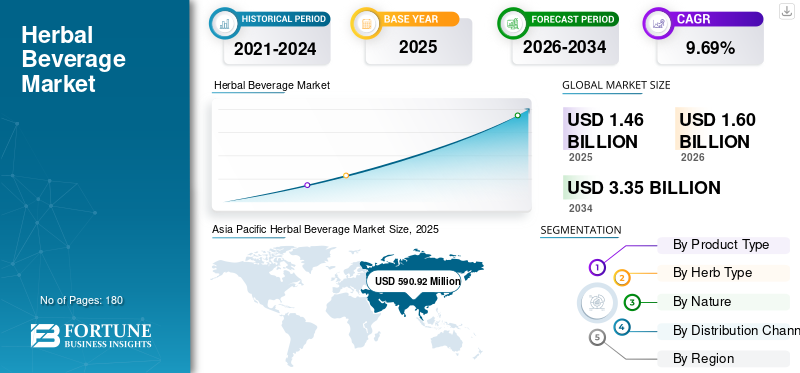
The global herbal beverage market size was valued at USD 1,462.27 million in 2025. The market is projected to grow from USD 1,601.47 million in 2026 to USD 3,355.64 million by 2034, exhibiting a CAGR of 9.69% during the forecast period. Asia Pacific dominated the herbal beverage market with a market share of 40.41% in 2025.
Herbal beverages are drinks prepared by extracting, infusing, and blending plant-sourced components other than tea leaves. They are typically made using roots, herbs, spices, and flowers, and are mostly consumed for flavor and refreshment. Unlike regular coffee or tea, this drink is free of caffeine and is positioned as a wellness or natural beverage. A few of the popular herbal drinks include peppermint tea, chamomile tea, hibiscus tea, and herbal tonics. Moreover, this product caters to a wide consumer base, including younger urban consumers seeking premium options and health-conscious individuals.
Companies such as Nestle S.A., Unilever Plc, and Associated British Foods plc are prominent players in the market. New product offerings are a pivotal strategy adopted by key players to improve their position.
Download Free sample to learn more about this report.
HERBAL BEVERAGE MARKET Key Takeaways
 Global Market Size & Forecast
- 2025 Market Size: USD 1,462.27 million
- 2026 Market Size: USD 1,601.47 million
- 2034 Forecast Market Size: USD 3,355.64 million
- CAGR: 9.69% from 2026–2034
 Market Share
- Asia Pacific dominated the herbal beverage market with a market share of 40.41% in 2025.
- The hibiscus segment is projected to grow at a high CAGR of 15.25% over the forecast period.
- The organic segment is projected to grow at a CAGR of 11.33% over the forecast period.
 Key Regional Highlights
Asia Pacific
The region led the global market with a valuation of USD 590.92 million in 2025, supported by rising demand for immune-support beverages and ready-to-drink herbal teas.
Europe
The market reached USD 396.98 million in 2025 and is expanding at a 9.21% CAGR, driven by growing consumer preference for plant-based and organic beverages.
North America
The regional market was valued at USD 285.52 million in 2025, benefiting from strong demand for herbal-infused drinks and increasing health awareness.
U.S.
The market was valued at approximately USD 221.06 million in 2025, representing around 15.12% of global revenue, supported by robust consumer demand for functional herbal beverages.
Japan
The market reached approximately USD 96.34 million in 2025, accounting for about 6.59% of global revenue, driven by growing interest in natural and wellness-focused beverage products.
Read More

HERBAL BEVERAGE MARKET TRENDS
Growing Inclination toward Herbal Infusions beyond Tea Format is the Ongoing Trend
The increasing shift toward herbal infusions beyond tea format represents changing consumer trends, with herbal ingredients highly used in functional blends/sparkling drinks. This expansion is mainly fueled by the aim to improve the convenience of drinks, appealing to a wide consumer base that may not prefer brewed or hot tea. By incorporating herbs into familiar beverages, brands can position them for various consumption occasions (refreshment or hydration), rather than confining them to traditional uses. Moreover, this trend bolsters the prospects for product innovation, as herbs can be easily blended with natural flavors and fruits to develop new products. After witnessing these benefits, companies in the global space are introducing more herbal infusions to captivate consumers.
MARKET DYNAMICS
MARKET DRIVERS
Download Free sample to learn more about this report.
Increasing Health & Wellness Awareness Propels the Consumption of Herbal Drinks
The surging health & wellness awareness is a key driver of demand for herbal beverages. Today, most health focused individuals are prioritizing items that support lifestyle balance and well-being. Consumers are increasingly moving away from highly processed and sugary drinks toward beverages perceived as more beneficial and natural, such as herbal drinks. This product fits well into daily routines and is known to support hydration and digestion. Along with this, it also minimizes the risk of chronic health ailments and improves cardiovascular and immune health. Moreover, this trend is specifically strong among younger, urban consumers who are influenced by clean-label preferences and wellness trends. As a result, these advantages boost sales of herbal drinks worldwide.
MARKET RESTRAINTS
Limited Education Gaps and Consumer Awareness Impede the Market’s Potential
One of the pivotal obstacles in the market is restricted consumer awareness. Globally, the majority of the population is familiar with only a confined set of well-known ingredients, such as ginger or chamomile, while a broader array of botanicals (such as moringa and ashwagandha) has comparatively minimal awareness among everyday consumers. This lack of familiarity makes it challenging for individuals to understand the importance, usage, and purpose of herbal drinks. This difficulty is further exacerbated by cultural and regional variations in herbal knowledge, where components are commonly recognized in one market but may have lower awareness in another. Further, requiring players to invest their efforts in targeted consumer education. As a result, the aforementioned factors hinder the global herbal beverage market share.
MARKET OPPORTUNITIES
Technological Advancements in the Beverage Industry Create Growth Opportunities
The incorporation of advanced technologies in the herbal drinks industry opens various growth opportunities. To preserve active components, the producers are adopting advanced extraction methods such as supercritical fluid extraction and cold extraction. Microencapsulation technology is another popular method for masking unpleasant flavors while enhancing stability against oxidation and heat. Moreover, minimal processing technologies are being explored by companies to retain natural color and aroma compounds. Additionally, clarification technologies are widely utilized in the herbal beverages sector, as most herbal extracts contain fibers and residues that can affect the overall texture and appearance. Besides this, firms are focusing on natural preservation methods to prolong the shelf life of end products.
Segmentation Analysis
By Product Type
Herbal Tea Segment Dominated the Market Due to Strong Cultural Acceptance
Based on product type, the market is divided into herbal tea, RTD herbal drinks, herbal concentrates, and others.
The herbal tea segment led the market in 2025. Compared with RTD and herbal syrups, tea is widely consumed at the household level and holds traditional significance across the Middle East, Asia, and Europe. Most herbal teas are available in loose tea leaves and tea bag formats, which have a prolonged shelf life, minimizing spoilage risk. Moreover, this product is accessible and has minimal transportation and packaging costs, unlike RTD drinks. Along with this, ease of new product innovation and strong alignment with wellness trends further bolster the global herbal beverage market growth.
The RTD herbal drinks segment is projected to grow at a high CAGR of 11.64% over the forecast period.
By Herb Type
Ginger Segment Leads in the Market Owing to High Consumer Familiarity
Based on herb type, the market is divided into ginger, chamomile, peppermint, hibiscus, and others.
The ginger segment led the global market in 2025. Compared to other herbs, ginger is widely used and recognized in the Middle East, Asia, and the European market. This ingredient is used in tonics, traditional remedies, and the preparation of wellness shots. Ginger has better appeal in both modern and traditional wellness and has improved efficacy. Moreover, it blends easily with mint, lemon, honey, and hibiscus, and can be used in both cold and hot beverages. Thus, such factors contribute to the growth.
The hibiscus segment is projected to grow at a high CAGR of 15.25% over the forecast period.
By Nature
Conventional Category Dominated in the Industry Due to Lower Pricing
Depending on the nature, the market is distributed into conventional and organic.
In 2025, the conventional segment led the global market. Conventional beverages are typically affordable as they are not subjected to the stringent cultivation and certification standards associated with organic items. Compared with organic products, regular drinks are easier to produce, particularly due to greater herb availability and a stronger supply chain infrastructure. Moreover, conventional herbs are less expensive to source and well-suited to mass-market demand.
The organic segment is projected to grow at a CAGR of 11.33% over the forecast period.
By Distribution Channel
To know how our report can help streamline your business, Speak to Analyst
Supermarkets/Hypermarkets Segment Led the Market Due to Strong Consumer Footfall
Based on distribution channel, the market is distributed into supermarkets/hypermarkets, convenience stores, specialty stores, and online retail.
The supermarkets/hypermarkets segment leads the global market in 2025. They offer an array of formats, flavors, and herbal drink categories that appeal to a broad consumer base. This retail outlet features dedicated large shelves for herbal beverages, improving brand visibility. Moreover, it supports bundled offers, product launches, and promotional campaigns, which increase the likelihood of higher consumption. Additionally, supermarkets mostly operate in both semi-urban and urban markets, enhancing market penetration and accessibility.
The online retail segment is projected to grow at a high CAGR of 12.77% over the forecast period.
Herbal Beverage Market Regional Outlook
By region, the market is categorized into Europe, North America, Asia Pacific, South America, and the Middle East & Africa.
Asia Pacific
Asia Pacific Herbal Beverage Market Size, 2025 (USD Million)
To get more information on the regional analysis of this market, Download Free sample
The Asia Pacific region dominated the market, reaching a valuation of USD 590.92 million in 2025. The increasing use of herbal drinks for immune support and the surging demand for ready to drink cold herbal teas are propelling the region's potential.
India Herbal Beverage Market
The Indian market size in 2025 was valued at around USD 110.97 million, accounting for roughly 7.59% of the global revenues.
China Herbal Beverage Market
China's market is projected to be one of the largest worldwide, with revenues recorded at around USD 198.40 million in 2025, accounting for roughly 13.57% of the global market sales.
Japan Herbal Beverage Market
The Japan market size in 2025 was valued at around USD 96.34 million, accounting for approximately 6.59% of the global revenues.
Europe
Europe reached USD 396.98 million in 2025, with a growth rate of 9.21% over the forecast period, and secured the second position in the market. The rising shift toward plant based foods/organic products and the growing number of health conscious consumers are boosting the regional potential.
Germany Herbal Beverage Market
The Germany market in 2025 was valued at around USD 101.58 million, representing roughly 6.95% of the global revenues.
U.K. Herbal Beverage Market
The U.K. market reached approximately USD 74.12 million in 2025, equivalent to around 5.07% of the global sales.
North America
The North America region reached a valuation of USD 285.52 million in 2025. The market in North America is expected to grow due to high demand for herbal infused beverages and the increasing prevalence of chronic ailments.
U.S. Herbal Beverage Market:
Based on North America's strong contribution and the U.S. dominance within the region, the U.S. market was approximated at around USD 221.06 million in 2025, accounting for roughly 15.12% of global sales.
South America and the Middle East & Africa
South America and the Middle East & Africa regions are expected to witness moderate growth in this market space during the forecast period. The South America market reached a valuation of USD 109.48 million in 2025. The growing preference for immunity boosting products and robust e-commerce platforms is expected to drive demand. The Middle East & Africa market reached USD 79.36 million in 2025. The surging demand for caffeine-free alternatives and increasing health consciousness is predicted to boost market’s momentum.
South Africa Herbal Beverage Market
The South African market reached around USD 37.34 million in 2025, representing roughly 2.55% of global revenues.
COMPETITIVE LANDSCAPE
Key Industry Players
New Product Innovation Strengthens Market Visibility and Improves Brand Competitiveness
The herbal beverage industry is moderately fragmented, which comprises a mix of regional herbal specialists and prominent beverage enterprises such as Nestle S.A., Unilever Plc, and Associated British Foods plc. All these firms compete via product innovation, clean-label positioning, and distribution networks. Moreover, players should seek collaborations or partnerships to expand their market reach. Additionally, companies can try to enter into acquisitions which can further strengthen their growth.
LIST OF KEY HERBAL BEVERAGE COMPANIES PROFILED
- Nestle S.A. (Switzerland)
- Unilever PLC (U.K.)
- The Hain Celestial Group, Inc. (U.S.)
- Tata Consumer Products Ltd. (India)
- Traditional Medicinals (U.S.)
- Associated British Foods plc (U.K.)
- Dilmah Tea (Sri Lanka)
- East West Tea Company LLC (U.S.)
- Bigelow Tea Company (U.S.)
- Numi Organic Tea (U.S.)
KEY INDUSTRY DEVELOPMENTS
- April 2026: Himchanmaru, a South Korean manufacturer of health extracts, unveiled a premium Ssanghwa Tea, which is a Korean herbal medicinal drink. This beverage is easily accessible in 1-liter packages and can be purchased from duty-free shops at Incheon International Airport in South Korea.
- August 2025: Twinings, a premium tea brand of Associated British Foods, a multinational food enterprise in the U.K., introduced their first herbal tea instant beverage. This drink is specifically targeted for Gen Z and millennials and is available in two flavors.
- March 2023: Bridge Goodness Pvt Ltd, a private enterprise in India, announced the launch of the brand “FromBhutan,” offering herbal tea variants for Indian consumers.
- November 2022: Netsurf Network, an Indian health supplements producer, revealed a line of new herbal green teas. This beverage aims to meet the needs of health-conscious individuals seeking chemical-free products.
- March 2022: Tera Food & Beverage Co., Ltd., a Thai functional drinks firm, released two RTD herbal-based functional beverages through its brand, “QminC.”
REPORT COVERAGE
The global market report provides an in-depth study of the market size & forecast by all the market segments. The global market forecast analysis includes details on the market dynamics and global market trends expected to drive the market during the forecast period. The global herbal beverage market analysis offers information on the technological advancements, new product launches, key industry developments, and details on partnerships, mergers & acquisitions. The industry forecast also encompasses a detailed competitive landscape with information on the market segmentation, market share, and profiles of key operating players.
Request for Customization to gain extensive market insights.
Report Scope & Segmentation
| ATTRIBUTE | DETAILS |
| Study Period | 2021-2034 |
| Base Year | 2025 |
| Estimated Year | 2026 |
| Forecast Period | 2026-2034 |
| Historical Period | 2021-2024 |
| Growth Rate | CAGR of 9.69% from 2026-2034 |
| Unit | Value (USD Million) |
| Segmentation | By Product Type, Herb Type, Nature, Distribution Channel, and Region |
| By Product Type |
|
| By Herb Type |
|
| By Nature |
|
| By Distribution Channel |
|
| By Region |
|
Frequently Asked Questions
Fortune Business Insights says that the global market value stood at USD 1,462.27 million in 2025 and is projected to reach USD 3,355.64 million by 2034.
In 2025, the market value stood at USD 590.92 million.
The market is expected to exhibit a CAGR of 9.69% during the forecast period.
By nature, the conventional segment led the global market in 2025.
Increasing health & wellness awareness propels the consumption of herbal drinks.
Nestle S.A., Unilever Plc, and Associated British Foods plc are among the key players in the market.
Asia Pacific held the largest market share in 2025.
Growing Inclination toward herbal infusions beyond tea format is the ongoing market trend.



- 2021-2034
- 2025
- 2021-2024
- 180
-
(Offer valid till 30th Sep 2026)
Get 30-60 hrs Free Customization
Expand Regional and Country Coverage, Segments Analysis, Company Profiles, Competitive Benchmarking, and End-user Insights.




















Related Reports
-
US +1 833 909 2966 ( Toll Free )
-
Get In Touch With Us