 Download Free Sample



Get a Quote
Receive a tailored pricing based on your needs.
- Choose license type
- Multiple user options
- Custom scope & coverage
- Fast turnaround
"Designing Growth Strategies is in our DNA"
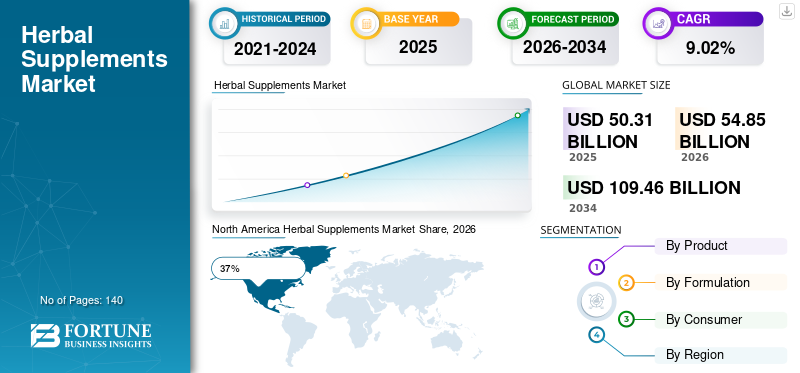
The global herbal supplements market size was valued at USD 50.31 billion in 2025. The market is projected to grow from USD 54.85 billion in 2026 to USD 109.46 billion by 2034, exhibiting a CAGR of 9.02% during the forecast period.

The herbal supplements market is experiencing strong global expansion due to increasing consumer preference for plant-based wellness products, preventive healthcare solutions, and natural nutritional ingredients. Herbal supplements are widely used to support immunity, digestion, stress management, cardiovascular health, cognitive function, and energy enhancement. The market includes capsules, powders, tablets, gummies, and liquid extracts derived from botanical ingredients such as moringa, turmeric, ashwagandha, ginseng, ginger, and echinacea. The herbal supplements market Report highlights growing demand from nutraceutical manufacturers, pharmacies, wellness retailers, and online distribution channels. Rising awareness regarding holistic healthcare and clean-label nutrition products is significantly supporting herbal supplements market Growth globally.
The USA herbal supplements market is witnessing strong demand due to increasing health consciousness, preventive wellness trends, and expanding dietary supplement consumption among adults and aging populations. Consumers in the United States are increasingly purchasing herbal formulations for immunity support, sleep management, joint health, and stress reduction. Retail pharmacies, e-commerce platforms, fitness nutrition stores, and healthcare practitioners continue to promote herbal wellness products across the country. The herbal supplements market Analysis for the USA also highlights increasing interest in organic ingredients, vegan formulations, non-GMO certifications, and scientifically validated botanical extracts. Continuous innovation in functional nutrition products remains a major growth factor across the American herbal supplements industry.
Download Free sample to learn more about this report.
 Global Market size & Forecast
 Market Share
 Key Regional Highlights
North America
North America held the largest regional share at 37%, supported by rising wellness and supplement demand.
Europe
Europe accounted for 29% of the market, driven by growing consumer interest in natural health products.
Asia-Pacific
Asia-Pacific represented 26% of the market, supported by traditional herbal medicine and increasing health awareness.
U.S.
Demand is supported by growing consumer preference for natural and plant-based wellness products.
Japan
Japan accounted for 21% of the Asia-Pacific market, supported by strong demand for herbal and functional wellness products.
Read More

The herbal supplements market trends indicate increasing demand for clean-label, organic, and plant-based nutritional products across global consumer markets. Health-conscious consumers are actively seeking herbal supplements containing natural botanical extracts without synthetic additives, artificial preservatives, or chemical ingredients. Adaptogenic herbs such as ashwagandha, ginseng, and rhodiola are becoming highly popular because of growing consumer interest in stress management and mental wellness solutions. Functional herbal blends targeting immunity, digestion, and sleep support are also gaining significant market attention.
Download Free sample to learn more about this report.
Another important trend shaping the herbal supplements market outlook is the growing use of personalized nutrition and digital wellness platforms. Manufacturers are increasingly introducing customized herbal supplement formulations based on age, gender, lifestyle, and health conditions. The herbal supplements market Research Report highlights rising investments in sustainable sourcing, eco-friendly packaging, and transparent ingredient traceability systems. E-commerce channels are expanding rapidly as consumers increasingly prefer direct-to-consumer supplement purchases. Companies are also integrating scientific validation and clinical testing into product development strategies to strengthen consumer trust and improve brand differentiation within the highly competitive herbal supplements industry.
Rising Consumer Preference for Preventive Healthcare Solutions
The increasing global focus on preventive healthcare is one of the strongest drivers supporting herbal supplements market Growth. Consumers are actively adopting natural wellness products to improve immunity, digestive health, energy levels, and overall physical well-being. Growing awareness regarding lifestyle disorders, stress-related conditions, and nutritional deficiencies has significantly increased demand for herbal supplements containing botanical extracts and plant-derived nutrients. Consumers are increasingly preferring herbal products because they are perceived as safer and more compatible with long-term wellness goals compared to synthetic alternatives.
The herbal supplements market insights indicate strong demand across adult consumers, fitness enthusiasts, elderly populations, and working professionals seeking natural health optimization products. Healthcare practitioners and wellness experts are increasingly recommending herbal formulations for stress management, sleep improvement, and immune support. The growing popularity of ayurvedic and traditional medicinal ingredients is also contributing to rising market demand. Expansion of digital wellness platforms, social media health awareness campaigns, and online supplement retailing is further accelerating the global herbal supplements market forecast and strengthening long-term industry growth opportunities.
Regulatory Inconsistencies and Product Quality Concerns
One of the major restraints affecting the herbal supplements market size is the lack of standardized global regulations regarding product safety, labeling, and ingredient validation. Herbal supplement manufacturers often operate under different regional compliance requirements, creating inconsistencies in quality control and product transparency. Concerns related to adulteration, contamination, inaccurate ingredient labeling, and unverified health claims continue to affect consumer confidence in some product categories.
The herbal supplements market Analysis also highlights challenges associated with limited scientific validation for certain botanical ingredients and formulations. Consumers increasingly demand clinically supported health benefits and transparent sourcing information before purchasing herbal products. Smaller manufacturers may face operational difficulties in maintaining quality assurance standards, third-party testing, and regulatory compliance across international markets. Supply chain inconsistencies for raw herbal ingredients can also affect production stability and product consistency. These factors continue to create barriers for market expansion and brand credibility within the global herbal supplements industry.
Expansion of Personalized Nutrition and Functional Wellness Products
The rapid growth of personalized nutrition and functional wellness solutions presents major opportunities for the herbal supplements market opportunities segment. Consumers are increasingly seeking customized herbal formulations tailored to specific health goals including immunity enhancement, cognitive support, digestive wellness, sports nutrition, and stress reduction. Advances in health analytics, wellness applications, and digital nutrition platforms are encouraging manufacturers to develop targeted supplement solutions based on individual lifestyle preferences and health requirements.
The herbal supplements market Research Report highlights growing opportunities in vegan supplements, organic formulations, and adaptogenic herbal blends. Manufacturers are investing heavily in innovative delivery formats including gummies, effervescent tablets, herbal beverages, and dissolvable powders to improve consumer convenience and product accessibility. Expansion of e-commerce distribution channels and direct-to-consumer business models is further increasing market penetration globally. Growing demand for herbal products among younger consumers and aging populations continues to create substantial long-term commercial opportunities across the herbal supplements industry.
Supply Chain Instability and Raw Material Sourcing Difficulties
One of the key challenges influencing the herbal supplements market outlook is the instability associated with sourcing high-quality herbal raw materials. Many botanical ingredients depend heavily on climate conditions, agricultural productivity, seasonal harvesting, and geographic availability. Environmental changes, supply disruptions, and inconsistent cultivation practices can significantly affect raw material quality and product manufacturing timelines.
The herbal supplements market Report also identifies increasing challenges related to counterfeit products, sustainability concerns, and rising competition among supplement manufacturers. Businesses must ensure ingredient authenticity, traceability, and ethical sourcing practices to maintain consumer trust and regulatory compliance. Maintaining consistent potency and quality across large-scale production batches can also be technically demanding for manufacturers handling multiple botanical ingredients. Furthermore, rapidly changing consumer preferences and intense market competition require continuous innovation in product formulations, branding strategies, and distribution networks, increasing operational pressure across the herbal supplements industry.
Moringa accounts for approximately 18% of the herbal supplements market Share due to increasing global demand for nutrient-rich plant-based wellness ingredients. Moringa supplements are widely consumed because of their high concentration of antioxidants, vitamins, minerals, amino acids, and anti-inflammatory compounds. Consumers increasingly use moringa-based products to support immunity, energy enhancement, digestive wellness, and metabolic health. The ingredient is highly popular within functional nutrition, ayurvedic healthcare, and sports wellness categories because of its natural nutritional profile and plant-based positioning.
The herbal supplements market Research Report highlights growing commercial demand for moringa powders, capsules, tablets, and herbal beverage formulations across health-conscious consumer groups. Manufacturers are focusing on organic cultivation practices and sustainable ingredient sourcing to strengthen brand positioning and product quality. Moringa-based supplements are also gaining popularity among vegan consumers and fitness-focused populations seeking clean-label nutrition products. Increasing scientific research regarding antioxidant activity and nutritional benefits is further supporting long-term growth opportunities for moringa within the global herbal supplements industry.
To know how our report can help streamline your business, Speak to Analyst
Tablets represent approximately 46% of the herbal supplements market Share due to their convenience, long shelf life, dosage accuracy, and cost-effective manufacturing process. Consumers widely prefer tablet-based herbal supplements because they are easy to store, transport, and consume within daily wellness routines. Herbal tablet formulations commonly include ingredients such as turmeric, ashwagandha, moringa, ginseng, garlic, and ginger designed to support immunity, joint health, cardiovascular wellness, and stress management.
The herbal supplements market Analysis indicates increasing demand for sugar-free, vegan, and extended-release tablet formulations among health-conscious consumers. Manufacturers are introducing advanced coating technologies and combination herbal blends to improve absorption efficiency and consumer convenience. Tablet-based herbal supplements are highly distributed through pharmacies, supermarkets, online retail channels, and wellness stores globally. Continuous innovation in botanical extraction processes and nutraceutical formulation strategies is expected to strengthen tablet segment growth within the global herbal supplements market.
account for nearly 39% of the herbal supplements market Share because of their superior absorption capabilities, ingredient protection, and consumer-friendly format. Herbal capsules are widely used for delivering concentrated botanical extracts and standardized herbal compounds while maintaining product potency and ingredient stability. Consumers often prefer capsule-based supplements because they are easier to swallow and provide faster digestion compared to conventional tablets.
The herbal supplements market insights reveal rising demand for plant-based capsules, gelatin-free formulations, and organic herbal blends targeting immunity support, cognitive wellness, sleep improvement, and sports nutrition. Manufacturers are increasingly introducing dual-action capsule technologies and delayed-release formulations to improve ingredient delivery efficiency. Capsule-based herbal supplements are especially popular within premium wellness categories and personalized nutrition products. Growth in online wellness retailing and direct-to-consumer supplement brands continues to strengthen the global capsules segment within the herbal supplements industry.
Pregnant women account for approximately 14% of the herbal supplements market Share due to increasing awareness regarding prenatal nutrition, immunity support, and natural wellness management during pregnancy. Herbal supplements targeted toward pregnant women commonly include ingredients such as ginger, raspberry leaf, moringa, chamomile, and iron-rich botanical extracts designed to support digestion, reduce nausea, improve nutritional intake, and maintain overall maternal wellness. Consumers increasingly prefer plant-based prenatal supplements because of growing concerns regarding synthetic additives and artificial ingredients in conventional healthcare products.
The herbal supplements market Report highlights rising demand for clean-label prenatal supplements containing organic ingredients, non-GMO certifications, and physician-recommended formulations. Manufacturers are focusing on developing herbal products with improved safety standards, clinically evaluated ingredients, and convenient dosage formats including capsules, powders, and herbal teas. Retail pharmacies, maternity wellness stores, and online healthcare platforms remain major distribution channels for pregnancy-focused herbal supplements. Increasing health awareness among expecting mothers and growing preference for holistic prenatal care continue to strengthen demand within this consumer segment
North America Herbal Supplements Market Share, 2026 (%)
To get more information on the regional analysis of this market, Download Free sample
North America accounts for approximately 37% of the global herbal supplements market Share due to strong consumer awareness regarding preventive healthcare, nutritional wellness, and plant-based supplementation. Consumers across the United States and Canada increasingly purchase herbal supplements for immunity support, stress reduction, digestive wellness, and healthy aging applications. Retail pharmacies, health food stores, fitness nutrition outlets, and e-commerce platforms remain major distribution channels across the region.
The herbal supplements market forecast for North America highlights rising demand for organic, non-GMO, vegan, and clean-label herbal products. Manufacturers are investing heavily in scientific validation, sustainable sourcing practices, and innovative supplement formulations to improve consumer trust and market competitiveness. Functional nutrition trends and increasing healthcare expenditure related to wellness products continue to support long-term expansion of the herbal supplements industry across North America.
Europe represents approximately 29% of the global herbal supplements market Share because of strong consumer preference for botanical wellness products and traditional herbal medicine practices. Countries including Germany, France, Italy, and the United Kingdom are witnessing growing demand for herbal formulations supporting digestive health, immunity, cardiovascular wellness, and cognitive function. European consumers are increasingly prioritizing organic certification, ingredient traceability, and sustainable production standards while purchasing herbal supplements.
The Herbal Supplements Industry Report highlights increasing investments in plant-based nutrition innovation, herbal extraction technologies, and eco-friendly supplement packaging throughout Europe. Regulatory focus on product safety and ingredient transparency is encouraging manufacturers to improve quality assurance practices and clinical validation efforts. Growth in vegan lifestyles and preventive healthcare awareness continues to strengthen the European herbal supplements market.
Germany contributes approximately 24% of the European herbal supplements market Share due to its well-established natural healthcare culture and strong consumer preference for botanical wellness products. German consumers widely use herbal supplements for digestive health, immune support, stress management, and healthy aging applications. Pharmacies, wellness retailers, and healthcare practitioners continue to play an important role in promoting herbal supplement consumption across the country.
The Germany herbal supplements market Analysis highlights rising demand for organic herbal formulations, scientifically validated botanical ingredients, and plant-based nutritional products. Manufacturers are increasingly focusing on sustainable sourcing, advanced extraction technologies, and clean-label product development to strengthen consumer confidence. Growing awareness regarding preventive wellness and holistic healthcare solutions is expected to support long-term growth within the German herbal supplements industry.
The United Kingdom accounts for approximately 18% of the European herbal supplements market Share because of increasing consumer awareness regarding preventive wellness and nutritional supplementation. British consumers are increasingly adopting herbal supplements containing turmeric, ashwagandha, moringa, and elderberry for immunity support, stress reduction, and overall health maintenance. Online retailing and digital wellness platforms are significantly influencing purchasing behavior across the country.
The United Kingdom herbal supplements market trends indicate rising demand for vegan supplements, personalized nutrition products, and eco-friendly packaging solutions. Consumers are actively seeking herbal formulations supported by scientific research and transparent ingredient labeling. Manufacturers are expanding product innovation strategies focused on gummies, herbal beverages, and convenient supplement formats to improve market penetration and customer engagement within the UK herbal supplements industry.
Asia-Pacific accounts for approximately 26% of the global herbal supplements market Share and remains one of the fastest-growing regional segments because of strong traditional medicine practices and expanding health-conscious populations. Countries including China, Japan, India, and South Korea continue to witness rising demand for herbal wellness products, ayurvedic formulations, and botanical nutritional supplements. Consumers increasingly prefer natural healthcare solutions that support immunity, digestion, energy enhancement, and stress management.
The herbal supplements market opportunities within Asia-Pacific are expanding rapidly due to increasing disposable income, urbanization, and digital wellness awareness. E-commerce expansion and mobile health applications are also supporting herbal supplement accessibility throughout the region. Manufacturers are investing heavily in herbal ingredient cultivation, nutraceutical innovation, and personalized nutrition products to strengthen regional market presence and long-term growth opportunities.
Japan contributes approximately 21% of the Asia-Pacific herbal supplements market Share because of increasing focus on healthy aging, preventive healthcare, and functional nutrition products. Japanese consumers widely use herbal supplements containing green tea extracts, turmeric, garlic, and botanical antioxidants to support cardiovascular wellness, cognitive health, and metabolic balance. Aging population trends continue to strengthen demand for daily nutritional supplementation.
The Japan herbal supplements market Research Report highlights rising interest in scientifically validated herbal formulations and premium wellness products. Manufacturers are increasingly developing convenient supplement formats including powders, capsules, and functional beverages designed for busy urban consumers. Demand for clean-label ingredients, sustainable sourcing practices, and advanced nutraceutical innovation remains strong within the Japanese herbal supplements industry.
China accounts for approximately 43% of the Asia-Pacific herbal supplements market Share due to the country’s extensive traditional herbal medicine culture and rapidly growing wellness industry. Chinese consumers strongly prefer botanical products derived from traditional medicinal herbs including ginseng, goji berry, ginger, and astragalus for immunity enhancement and energy support. Rising middle-class populations and increasing healthcare awareness continue to accelerate herbal supplement consumption.
The China herbal supplements market insights indicate growing investments in herbal extraction technologies, e-commerce distribution infrastructure, and premium wellness product development. Manufacturers are increasingly combining traditional medicinal ingredients with modern nutraceutical research to improve product effectiveness and consumer appeal. Expansion of digital retailing and preventive healthcare awareness continues to support long-term growth within the Chinese herbal supplements market.
Rest of World accounts for approximately 8% of the global herbal supplements market Share due to increasing wellness awareness and growing demand for plant-based nutritional products across Latin America, the Middle East, and Africa. Consumers within these regions are increasingly adopting herbal supplements for immunity enhancement, digestive support, energy improvement, and general wellness maintenance. Expansion of urban healthcare infrastructure and online supplement retailing is improving product accessibility.
The herbal supplements market opportunities within emerging economies continue to strengthen as manufacturers expand distribution networks and introduce affordable herbal wellness products. Rising interest in natural healthcare, traditional medicinal practices, and functional nutrition continues to support market penetration. Increasing availability of imported herbal supplements and expansion of regional nutraceutical manufacturing capabilities are expected to accelerate future market growth across Rest of World regions.
The herbal supplements market opportunities segment is attracting strong investment from nutraceutical manufacturers, wellness brands, agricultural producers, and healthcare investors focused on plant-based nutrition products. Companies are increasingly investing in sustainable herbal cultivation, advanced extraction technologies, and personalized nutrition solutions to strengthen market competitiveness. Expansion of organic farming practices and botanical ingredient processing facilities continues to support long-term supply chain development across the herbal supplements industry.
The herbal supplements market Research Report highlights growing commercial opportunities in vegan supplements, immunity-support formulations, and functional wellness products targeting aging populations and fitness-focused consumers. Investors are increasingly supporting direct-to-consumer supplement brands, digital wellness platforms, and AI-enabled nutrition personalization technologies. Expansion of e-commerce infrastructure and rising consumer awareness regarding preventive healthcare are expected to create substantial future opportunities across the global herbal supplements market.
Innovation remains a major competitive factor within the herbal supplements market Growth as manufacturers continuously introduce advanced botanical formulations and functional wellness products. Companies are increasingly developing sugar-free gummies, plant-based capsules, herbal beverages, dissolvable powders, and personalized nutrition kits designed to improve consumer convenience and product accessibility. Adaptogenic herbs and immunity-support blends remain among the most innovative product categories within the market.
The herbal supplements market trends also indicate rising investment in clinical validation, bioavailability enhancement technologies, and eco-friendly packaging systems. Manufacturers are focusing on organic certification, non-GMO ingredients, and sustainable sourcing practices to strengthen product differentiation and brand credibility. Integration of herbal extracts with sports nutrition, cognitive wellness, and beauty-from-within formulations is creating new commercial opportunities across the global herbal supplements industry.
The herbal supplements market Report provides comprehensive analysis of product categories, ingredient trends, competitive landscape, regional demand patterns, and emerging business opportunities across the global nutraceutical industry. The report evaluates herbal supplement applications including immunity support, digestive wellness, cognitive health, sports nutrition, and healthy aging while analyzing tablet, capsule, powder, and liquid supplement formats. Market coverage also includes distribution channels, consumer behavior patterns, and botanical ingredient innovation trends shaping industry expansion.
Request for Customization to gain extensive market insights.
The herbal supplements market Analysis further examines regulatory developments, sustainability initiatives, supply chain challenges, investment activities, and technological advancements influencing market growth. Regional evaluation includes North America, Europe, Asia-Pacific, and Rest of World along with detailed country-level insights for the United States, Germany, the United Kingdom, Japan, and China. The report additionally evaluates product development strategies, e-commerce expansion, personalized nutrition trends, and competitive positioning across the global herbal supplements industry.
Fortune Business Insights says that the global market value stood at USD 50.31 billion in 2025 and is projected to reach USD 109.46 billion by 2034.
The market is expected to exhibit a CAGR of 9.02% during the forecast period of 2026-2034.
Tablets were the leading formulation segment, accounting for approximately 46% of the market, driven by their convenience, dosage accuracy, long shelf life, and cost-effective manufacturing.
Key players include Herbalife, Nature’s Bounty, Jarrow Formulas, Inc., Solgar, Inc., Gaia Herbs, and NOW Foods.
Key trends include rising demand for clean-label, organic, and plant-based products and growing popularity of adaptogenic herbs and personalized nutrition. North America leads regionally with approximately 37% market share.


(Offer valid till 31st Oct 2026)
Get 30-60 hrs Free Customization
Expand Regional and Country Coverage, Segments Analysis, Company Profiles, Competitive Benchmarking, and End-user Insights.













.webp)






Get In Touch With Us
US +1 833 909 2966 ( Toll Free )
Receive a tailored pricing based on your needs.
Discuss your questions with our industry experts.
Have questions? Get quick answers before you purchase.

