High-Bandwidth Memory and Advanced Memory Market Size, Share & Industry Analysis, By Memory Type (High-Bandwidth Memory, Advanced DRAM, Advanced NAND Flash, and Emerging Non-Volatile Memory), By Product (Memory Chips, Memory Modules, Solid-State Drives, and Embedded Memory Solutions), By Application (AI and ML, High-Performance Computing, Data Centers and Cloud Infrastructure, Consumer Electronics, and Others), and Regional Forecast, 2026–2034
 Download Free Sample
HIGH-BANDWIDTH MEMORY AND ADVANCED MEMORY MARKET SIZE AND FUTURE OUTLOOK
 Listen to Audio Version
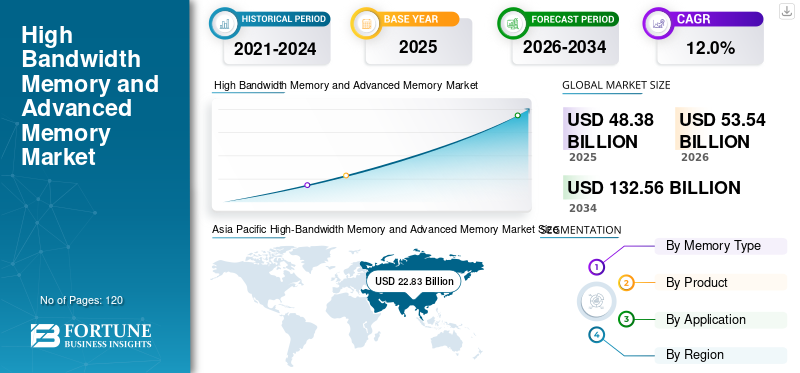
The high-bandwidth memory and advanced memory market size was valued at USD 48.38 billion in 2025. The market is projected to grow from USD 53.54 billion in 2026 to USD 132.56 billion by 2034, exhibiting a CAGR of 12.0% during the forecast period. Asia Pacific dominated the high bandwidth memory and advanced memory market with a market share of 47.19% in 2025.
High-bandwidth memory and advanced memory refers to the market for future-oriented memory technologies, including HBM, advanced DRAM, cadvanced NAND flash, and advanced non-volatile memories that promise high bandwidth, fast data transmission, low latency, and efficient power consumption. Various types of memories are applied in systems used for AI applications, data centers, supercomputing, consumer electronics, automotive electronics, and edge computing. The market is growing rapidly, owing to the increasing pace of development of applications in AI and machine learning, which lead to the demand for high speed, large capacity, and energy-efficient memory to perform fast data processing in GPUs, AI accelerators, and cloud data centers.
Furthermore, key market players, such as SK Hynix Inc., Samsung Electronics Co., Ltd., Micron Technology, Inc., KIOXIA Corporation, and SanDisk Corporation operating in the market, are focusing on capacity expansion, advanced packaging partnerships, and next-generation HBM/DRAM/NAND product development to strengthen their position in AI accelerators, data centers, high-performance computing, and advanced consumer electronics applications.
Download Free sample to learn more about this report.
IMPACT OF GENERATIVE AI
Expansion of Generative AI Infrastructure is Accelerating Demand for High-Bandwidth and Advanced Memory Solutions
Generative AI will increase the demand for high-bandwidth and advanced memory as the usage of large language models, multimodal artificial intelligence, and AI inference workloads implies faster data communication between the processor and memory. With the development of modern artificial intelligence models, both GPUs and AI accelerators require more capacity of HBM, higher bandwidth, and lower power consumption in order to ease the bottlenecks in memory usage in training and inference. Also, the demand for advanced DRAM, memory modules, and enterprise-level NAND used for AI servers, cloud, and high-performance data centers is growing. Therefore, memory manufacturers are altering their plans and investments and are also focused on HBM3E, HBM4, DDR5, LPDDR5X as well as memory optimized for AI. For instance,
- In September 2025, SK Hynix announced that it had completed development and prepared mass production of HBM4, describing it as a next-generation memory product for ultra-high-performance AI applications.
HIGH-BANDWIDTH MEMORY AND ADVANCED MEMORY MARKET TRENDS
Increasing Demand for Enterprise SSDs and Advanced NAND Flash Are Emerging Market Trends
The rise in demand for enterprise SSDs and sophisticated NAND flash memory is largely driven by the need for ultra-high-speed storage with increased capacity, decreased latency, and improved power efficiency resulting from the requirements of AI data centers for processing large training data sets and executing AI algorithms. Despite the fact that HBM and advanced DRAM offer high computing speed, the usage of enterprise SSDs made with advanced 3D NAND technology is indispensable for feeding data to AI servers and facilitating cloud storage. The transition toward PCIe Gen5 and Gen6 technologies, high-capacity QLC NAND, and advanced 3D NAND accounts for the improved throughput of storage processors, which allows data centers to save space and energy. In addition, the impact of this shift on the strategy of NAND suppliers in the implementation of AI technologies is increasing as storage performance becomes an important determinant of the total efficiency of GPU clusters. For instance,
- In July 2025, Micron launched a portfolio of data center SSDs built on its G9 NAND platform, including the Micron 9650 SSD, described as the world’s first PCIe Gen6 data center SSD, and the 6600 ION SSD, a 122TB E3.S data center SSD designed to increase storage density.
MARKET DYNAMICS
MARKET DRIVERS
Download Free sample to learn more about this report.
Growth of Hyperscale Data Centers and Cloud Infrastructure Drives Market Growth
The boom in hyperscale data centers and cloud services contributes to shaping the market since the requirements of cloud companies include data storage and memory that operate with speed, which is needed for various processes of AI training, inference, analysis, and loads that are complicated performance-wise. Modern memory technologies, such as HBM, DDR5, LPDDR5X, CXL memory, and SSD for business purposes, lead to increased efficiency of servers and lower latency and become more environmentally friendly in the large cloud storage sectors. The trend is caused by the increased establishment of data centers based on AI clusters which leads to sharp growth of the demand for both high-capacity and High-Bandwidth Memory (HBM). For instance,
- In July 2025, Micron launched a new portfolio of data center SSDs built for AI workloads, including the Micron 9650, PCIe Gen6 SSD, and the 6600 ION 122TB E3.S SSD. This launch supports hyperscale and cloud data centers in adopting advanced NAND-based SSDs to improve storage density and performance for AI infrastructure.
These factors collaboratively boost high-bandwidth memory and advanced memory market growth.
|
Rank |
Market Drivers |
Overall Impact Rank |
CAGR Contribution (2026-2034) |
Impact 2026-2028 |
Impact 2029-2031 |
Impact 2032-2034 |
|
1 |
Rapid expansion of generative AI, AI training, and inference workloads increasing demand for HBM and advanced DRAM |
High |
+6.2% |
High |
High |
High |
|
2 |
Surging hyperscale data centers and cloud infrastructure requiring high-speed memory and enterprise SSDs |
High |
+5.0% |
High |
High |
High |
|
3 |
Increasing deployment of GPUs, AI accelerators, and high-performance computing systems |
High |
+4.2% |
High |
Medium |
Medium-High |
|
4 |
Rising adoption of DDR5, LPDDR5X, GDDR7, and next-generation DRAM across servers, AI PCs, gaming, and premium electronics |
Medium-High |
+3.0% |
Medium-High |
High |
High |
|
5 |
Expansion of advanced NAND flash and enterprise SSD adoption for AI data pipelines, cloud storage, and real-time analytics |
Medium |
+2.1% |
Medium |
Medium-High |
Medium-High |
|
6 |
Others (Growing use of advanced memory in automotive electronics, edge AI, industrial systems, and telecom infrastructure, etc.) |
Medium-Low |
+0.6% |
Medium |
Medium |
Medium |
|
|
Total Positive Growth Contribution |
|
+15.5% |
|
|
|
MARKET RESTRAINTS
High Production and Development Cost May Hinder Market Growth
Elevated costs related to manufacturing and development are one of the most significant limitations that the market face. This is majorly due to the fact that technologies such as HBM, advanced DRAM, and new generations of non-volatile memory have to do with sophisticated circuit design and precise manufacturing. The HBM manufacturing process uses multi-layer memory chips, via through silicon, interposer, and advanced packaging, which leads to higher costs of production than traditional memory. Companies also require considerable investments to set up R&D, equipment, production, testing, yield improvement and capacity expansion.
|
Rank |
Market Restraints |
Overall Impact Rank |
Negative CAGR Contribution (2026-2034) |
Impact 2026-2028 |
Impact 2029-2031 |
Impact 2032-2034 |
|
1 |
Surging production and development cost |
High |
-0.5% |
High |
High |
Medium |
|
2 |
Complex advanced packaging requirements |
High |
-0.8% |
High |
Medium-High |
Medium |
|
3 |
Supply-demand imbalance and capacity constraints |
Medium |
-1.0% |
High |
Medium |
Medium |
|
4 |
Others (Thermal and power management challenges, Premium pricing limiting adoption, and compatibility issues, etc.) |
Medium-Low |
-1.2% |
Medium |
Medium-Low |
Medium-Low |
|
|
Total Negative Growth Impact |
|
-3.5% |
|
|
|
MARKET OPPORTUNITIES
Increasing Growth of CXL-based Memory Expansion Creates New Opportunities for Market Growth
CXL memory expansion is expected to become a big opportunity for the market growth, as AI servers, cloud data centers, and high-performance computing memory systems are in search of big memory capacity without having to depend only on costly onboard DRAM. CXL can make it possible to pool and expand memory by connecting the CPU, accelerators, and memory modules with a high-speed low-latency interface and assist data-center administrators in maximizing the efficiency of storage devices and technologies. This also helps in cutting costs and adequately meeting the demands of memory-intensive processes such as generative AI, in-memory databases, analytical systems, and virtualizations. For instance,
- In September 2025, Marvell announced that its Structera CXL memory-expansion controllers and near-memory compute accelerators completed interoperability testing with DDR4 and DDR5 memory solutions from Micron, Samsung Electronics, and SK Hynix.
Segmentation Analysis
By Memory Type
Expansion of DDR5 and LPDDR5X Adoption Drives Advanced DRAM Segment Leadership
Based on the memory type, the market is divided into high-bandwidth memory, advanced DRAM, advanced NAND flash, and emerging non-volatile memory.
Advanced DRAM captured the largest market share in 2025. This is owing to the extensive use of DDR5, LPDDR5/LPDDR5X, and GDDR6/GDDR7 in devices such as servers, AI PCs, smartphones, gaming GPUs, and data centers; compared to other types of DRAM. HBM was limitedly used in certain AI accelerators and HPC platforms. The increasing server DRAM adoption also contributed to this segment growth and according to TrendForce, the share of DDR5 in server DRAM bit shipments increased from 40% in 2024 to 60%-65% in 2025.
Emerging non-volatile memory is anticipated to grow at the highest CAGR of 18.5% over the forecast period. This is owing to technologies, such as MRAM, ReRAM, PCM, and FeRAM, are increasingly used in edge devices and AI, automotive electronics, industrial systems, and low power computing applications where access speed, data preservation, total endurance, and energy efficiency are of utmost importance.
By Product
Growing Demand for High-Performance Memory Chips Drives Segment Dominance
Based on the product, the market is categorized into memory chips, memory modules, solid-state drives, and embedded memory solutions.
Memory chips accounted for the largest market share in 2025 and is anticipated to grow at the highest CAGR of 13.4% during the forecast period. This is owing to HBM, next-gen DRAM, and NAND chips were produced mainly and utilized at the chip level in AI accelerators, graphic processing units, data servers, mobile handsets, and embedded platforms. Their widespread adoption for AI-based applications and data center devices also boosts segment’s dominance.
Memory modules is anticipated to grow at a moderate CAGR of 11.3% over the forecast period. DDR5, CXL-based memory modules, and high-capacity server modules gain adoption in data centers and enterprise systems, but their growth remains slower than memory chips due to higher cost, longer qualification cycles, and stronger concentration in server-focused applications.
By Application
To know how our report can help streamline your business, Speak to Analyst
Higher Implementation of Advanced AI Servers Drives Data Center Segment Dominance
Based on the application, the market is classified into AI and ML, high-performance computing, data centers and cloud infrastructure, consumer electronics, and others (automotive, edge computing, etc.).
Data centers and cloud infrastructure are expected to witness a dominating market share in 2025. This is owing to the higher implementation of advanced AI servers, GPUs, enterprise SSDs, and high-speed memory systems. The various cloud service providers opted for the implementation of HBM and advanced NAND and DRAM solutions for enhanced performance.
AI and ML is anticipated to grow at a moderate CAGR of 15.9% during the forecast period. This is owing to generative AI, large language models, AI training, and inference workloads require HBM, advanced DRAM, and high-performance NAND to support faster data movement, higher bandwidth, lower latency, and improved accelerator efficiency.
High-Bandwidth Memory and Advanced Memory Market Regional Outlook
By geography, the market is categorized into North America, South America, Europe, Middle East & Africa, and Asia Pacific.
Asia Pacific
Asia Pacific High-Bandwidth Memory and Advanced Memory Market Size, 2025 (USD Billion)
To get more information on the regional analysis of this market, Download Free sample
Asia Pacific accounted for the largest high-bandwidth memory and advanced memory market share in 2024, valuing at USD 20.77 billion, and also maintained the leading share in 2025, with USD 22.83 billion. The market in the Asia Pacific is expected to increase, owing to the significant presence of memory manufacturing, semiconductor assembly and electronics manufacturing, and the supply chains for AI hardware in nations such as South Korea, Taiwan, China, and Japan. Asia Pacific has strong memory companies including Samsung, SK Hynix, KIOXIA, and YMTC as well as a huge demand for consumer electronics, data centers, cloud networks, and AI accelerator manufacturing. For instance,
- In May 2025, Japan-based KIOXIA Corporation announced the CM9 Series enterprise NVMe SSD, built with its 8th-generation BiCS FLASH 3D flash memory. This supports the region’s leadership in the market.
China High-Bandwidth Memory and Advanced Memory Market
China’s market is projected to be one of the largest worldwide, with 2026 revenues estimated at around USD 6.09 billion, representing roughly 11.4% of global sales. The country’s growth is driven by rapid AI server deployment, cloud infrastructure expansion, strong consumer electronics manufacturing, and domestic memory development by players such as YMTC and CXMT, as the country continues to strengthen its semiconductor self-reliance and advanced memory supply chain.
To know how our report can help streamline your business, Speak to Analyst
Japan High-Bandwidth Memory and Advanced Memory Market
The Japan market in 2026 is estimated at around USD 4.77 billion, accounting for roughly 8.9% of global revenues.
India High-Bandwidth Memory and Advanced Memory Market
The India market in 2026 is estimated at around USD 3.18 billion, accounting for roughly 5.9% of global revenues.
North America
North America is estimated to reach USD 15.42 billion in 2026 and secure the position of the second-largest region in the market. This is owing to strong demand for high-end memory products from hyperscale AI data centers, cloud service providers, GPU clusters, and high-performance computing systems. The region also benefits from U.S. initiatives aimed at enhancing advanced memory production facilities and solidifying semiconductor supply chain led by Micron's huge investments in Idaho, New York, and Virginia.
U.S. High-Bandwidth Memory and Advanced Memory Market
Based on North America’s significant contribution, the U.S. market can be analytically approximated at around USD 12.37 billion in 2026, accounting for roughly 23.1% of global market sales.
Europe
Europe is projected to grow at a CAGR of 10.7% in the coming years, and reach a valuation of USD 8.93 billion by 2026. The region is seeing an increase in demand for advanced memory technologies due to the growing use of it in AI data centers, cloud infrastructure systems, high-performance computing, automotive electronics, and wireless automation throughout countries such as Germany, the U.K., France, Benelux, and the Nordic regions. In addition, Europe has a strong R&D base as well as equipment ecosystem for semiconductors with companies that promote its development. For instance,
- In February 2026, The European Union inaugurated the NanoIC pilot line, the largest of five semiconductor pilot lines funded under the European Chips Act to boost next‑generation chip production, including advanced packaging and high‑performance integration technologies for AI and autonomous systems.
U.K. High-Bandwidth Memory and Advanced Memory Market
The U.K. market in 2026 is estimated at around USD 1.55 billion, representing roughly 2.9% of global revenues.
Germany High-Bandwidth Memory and Advanced Memory Market
Germany’s market is projected to reach approximately USD 1.99 billion in 2026, equivalent to around 3.7% of global high sales.
South America
South America is expected to witness moderate growth in this market space during the forecast period. The South America market is set to reach a valuation of USD 1.63 billion in 2026. The market growth in South America is driven by expanding cloud adoption, data center modernization, telecom upgrades, and rising enterprise demand for advanced storage and memory solutions, especially in Brazil, where AI, banking, retail, and digital infrastructure investments are increasing. In South America, Brazil is set to reach a value of USD 0.77 billion in 2026.
Middle East & Africa
The Middle East & Africa region is estimated to reach USD 2.35 billion in 2026 and expected to grow at a prominent rate in the coming years. Increasing investments in AI data centers, sovereign cloud infrastructure, smart city initiatives, and digital transformation efforts are driving the growth of the market in GCC countries, Israel, South Africa, and Turkey. The region is on a growth trajectory from a smaller size base as demand for HBM, advanced DRAM, and enterprise SSD is on the rise as the cloud industry, telecom operators, and government expand high-performance processing and AI-supported infrastructure. In the Middle East & Africa, the GCC is set to reach a value of USD 0.79 billion in 2026.
COMPETITIVE LANDSCAPE
Key Industry Players
Focus on Expanding HBM Capacity and Advanced Memory Portfolios by Key Players to Propel Market Competition
The high-bandwidth memory and advanced memory market holds a semi-consolidated structure, with prominent players such as SK Hynix Inc., Samsung Electronics Co., Ltd., Micron Technology, Inc., KIOXIA Corporation, and SanDisk Corporation holding significant positions. These companies are investing heavily in HBM3E, HBM4, advanced DRAM, 3D NAND flash, enterprise SSDs, and CXL-based memory solutions to address rising demand from AI accelerators, hyperscale data centers, high-performance computing, and cloud infrastructure.
Other notable players in the market are strengthening their advanced memory portfolios through product innovation, capacity expansion, and system-level integration capabilities. These enable faster data processing, higher bandwidth, lower latency, and improved power efficiency across AI servers, premium consumer electronics, automotive systems, networking infrastructure, and edge computing applications.
LIST OF KEY HIGH-BANDWIDTH MEMORY AND ADVANCED MEMORY COMPANIES PROFILED
- SK Hynix Inc. (South Korea)
- Samsung Electronics Co., Ltd. (South Korea)
- Micron Technology, Inc. (U.S.)
- KIOXIA Corporation (Japan)
- SanDisk Corporation (AMD) (U.S.)
- Yangtze Memory Technologies Co., Ltd. (China)
- Nanya Technology Corporation (Taiwan)
- Winbond Electronics Corporation (Taiwan)
- Macronix International Co., Ltd. (Taiwan)
- Everspin Technologies, Inc. (U.S.)
KEY INDUSTRY DEVELOPMENTS
- February 2026: Samsung began mass production and commercial shipment of its HBM4 products, offering higher speed and bandwidth for next-generation AI data centers. This supports the adoption of advanced HBM solutions in AI computing, hyperscale cloud, and high-performance memory applications.
- December 2025: Winbond launched its 8Gb DDR4 DRAM built on advanced 16nm process technology for industrial and embedded applications. This strengthens Winbond’s advanced DRAM portfolio for servers, networking equipment.
- August 2025: Macronix introduced ArmorBoot MX76, a secure NOR flash memory designed for AI, IoT, automotive electronics, and other demanding applications. This supports Macronix’s advanced non-volatile memory portfolio for secure boot and high-reliability embedded memory use cases.
- August 2025: SanDisk showcased its UltraQLC platform with a high-capacity 256TB NVMe enterprise SSD for AI-driven and data-intensive workloads. This supports advanced NAND flash adoption in AI data lakes, hyperscale cloud, and enterprise storage memory.
- June 2025: Micron shipped HBM4 36GB 12-high samples to key customers for next-generation AI platforms. This expands Micron’s advanced HBM portfolio for AI training, inference, and cloud acceleration workloads.
- March 2025: Everspin expanded its high-reliability MRAM portfolio with PERSYST EM064LX HR and EM128LX HR STT-MRAM devices for automotive-grade applications. This supports persistent, high-speed memory adoption across aerospace, automotive, defense, and industrial environments.
- October 2024: KIOXIA introduced the XD8 Series PCIe 5.0 NVMe EDSFF E1.S SSDs for cloud and hyperscale environments. This launch strengthens advanced NAND and enterprise SSD adoption across cloud, data center, and AI infrastructure applications.
REPORT COVERAGE
The high-bandwidth memory and advanced memory market analysis includes a comprehensive study of the market size & forecast by all the market segments included in the report. It includes details on the market dynamics and market trends expected to drive the market over the forecast period. It provides information on key aspects, including an overview of technological advancements, pipeline candidates, the regulatory environment, and product launches. Additionally, it details partnerships, mergers & acquisitions, as well as key industry developments and prevalence by key regions. The global market research report also provides a detailed competitive landscape with information on the market share and profiles of key operating players.
Request for Customization to gain extensive market insights.
Report Scope & Segmentation
| ATTRIBUTE | DETAILS |
| Study Period | 2021-2034 |
| Base Year | 2025 |
| Estimated Year | 2026 |
| Forecast Period | 2026-2034 |
| Historical Period | 2021-2024 |
| Growth Rate | CAGR of 12.0% from 2026-2034 |
| Unit | Value (USD Billion) |
| Segmentation | By Memory Type, Product, Application, and Region |
| By Memory Type |
|
| By Product |
|
| By Application |
|
| By Region |
|
Frequently Asked Questions
According to Fortune Business Insights, the global market value stood at USD 48.38 billion in 2025 and is projected to reach USD 132.56 billion by 2034.
The market is growing at a CAGR of 12.0% during 2026-2034.
In 2025, the Asia Pacific market value stood at USD 22.83 billion.
By application, data centers and cloud infrastructure segment is expected to lead the market.
Growth of hyperscale data centers and cloud infrastructure drives market growth.
SK Hynix Inc., Samsung Electronics Co., Ltd., Micron Technology, Inc., KIOXIA Corporation, and SanDisk Corporation are the major players in the global market.
Asia Pacific dominated the market in 2025.


- 2021-2034
- 2025
- 2021-2024
- 120
Get 30-60 hrs Free Customization
Expand Regional and Country Coverage, Segments Analysis, Company Profiles, Competitive Benchmarking, and End-user Insights.




















-
US +1 833 909 2966 ( Toll Free )
-
Get In Touch With Us