High Frequency Trading Market Size, Share & Industry Analysis, By Product (Market Making, Others), By Deployment (Cloud, On-premise), By End Use (Investment Banks, Hedge Funds, Personal Investors) and Regional Forecast, 2026-2034
 Download Free Sample
High Frequency Trading Market Overview
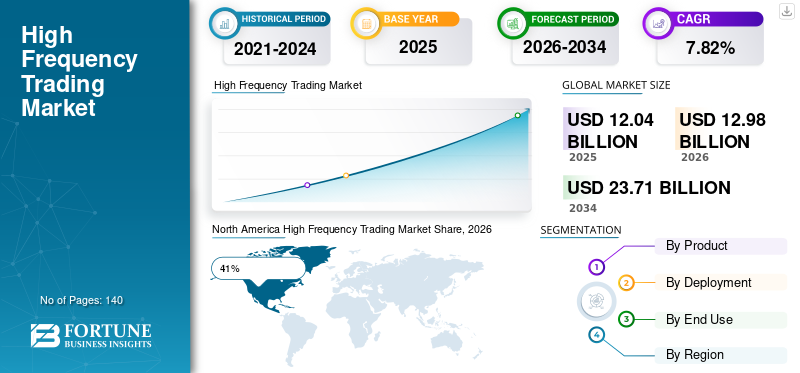
The global high frequency trading market size was valued at USD 12.04 billion in 2025. The market is projected to grow from USD 12.98 billion in 2026 to USD 23.70 billion by 2034, exhibiting a CAGR of 7.82 % during the forecast period. The market in North America dominated with a revenue share of 41% in 2025.

The high frequency trading market is experiencing substantial transformation due to rising adoption of algorithmic trading systems, ultra-low latency infrastructure, and automated financial analytics platforms. Financial institutions are investing heavily in advanced trading engines capable of processing millions of orders within microseconds. The demand for optimized execution strategies, predictive analytics, and real-time risk monitoring is strengthening high frequency trading market Growth across global capital markets. Exchanges are enhancing co-location services and fiber-optic networks to support faster transaction processing. Increasing digitization of financial services, growing electronic equity trading volumes, and expansion of quantitative investment strategies are accelerating high frequency trading market Trends among institutional participants worldwide.
The United States accounts for 41% share of the high frequency trading market due to strong electronic trading infrastructure and advanced capital market ecosystems. More than 70 equity exchanges and alternative trading systems operate across the country, creating strong demand for low-latency trading technologies. Large investment banks and hedge funds continue to deploy AI-powered trading algorithms to improve execution efficiency and reduce transaction delays. The presence of advanced data centers, high-speed communication networks, and sophisticated regulatory oversight supports high frequency trading market Analysis across the USA. Institutional investors are increasingly utilizing predictive analytics and machine learning models to optimize high-speed trade execution in equities, derivatives, and foreign exchange markets.
Download Free sample to learn more about this report.
High Frequency Trading Market Key Takeaways
 Global Market Size & Forecast
- 2025 Market Size: USD 12.04 Billion
- 2026 Market Size: USD 12.98 Billion
- 2034 Forecast Market Size: USD 23.70 Billion
- CAGR: 7.82% from 2026-2034
 Market Share
- North America dominated with a 41% regional market share in 2025.
- Market making held the largest product share at 61%.
- Cloud deployment accounted for the largest share at 54%.
 Key Regional Highlights
North America
North America held the largest regional share at 41%, supported by advanced financial markets and algorithmic trading adoption.
Europe
Europe accounted for 27% of the market, driven by growing electronic trading activity.
Asia-Pacific
Asia-Pacific represented 24% of the market, supported by increasing digital trading and financial technology adoption.
U.S.
Demand is supported by strong adoption of algorithmic trading and advanced financial technologies.
Japan
Japan accounted for 34% of the Asia-Pacific market, supported by electronic trading and automated execution systems.
Read More

High Frequency Trading Market Latest Trends
The high frequency trading market is witnessing rapid technological advancements driven by artificial intelligence integration, machine learning adoption, and quantum computing experimentation in financial trading operations. Financial firms are increasingly deploying predictive trading algorithms capable of analyzing large volumes of market data within milliseconds. The use of cloud-based analytics platforms is improving scalability and operational flexibility for trading institutions. Demand for low-latency communication networks and high-speed data transmission systems is strengthening high frequency trading market Opportunities across developed economies.
Download Free sample to learn more about this report.
Financial exchanges are modernizing trading architecture with FPGA acceleration and advanced co-location services to reduce execution time. More than 58% of institutional firms are integrating AI-enabled trade surveillance systems to detect anomalies and improve compliance management. Cross-asset trading strategies are expanding rapidly due to increased market connectivity and electronic transaction volumes. The High Frequency trading Industry Analysis also reflects growing investment in cybersecurity systems as financial firms attempt to protect sensitive trading infrastructure from cyber threats.
High Frequency Trading Market Dynamics
DRIVER
Rising Adoption of Algorithmic and Ai-Powered trading Systems.
The growing implementation of artificial intelligence and automated trading algorithms is significantly accelerating high frequency trading market Growth across global financial markets. Financial institutions are increasingly adopting machine learning technologies capable of processing extensive trading data in real time. More than 64% of institutional investors rely on algorithmic execution strategies to improve transaction efficiency and minimize market impact during high-volume trades. Increasing electronic trading volumes in equities, commodities, and derivatives are supporting investments in low-latency infrastructure and advanced trading engines. Financial exchanges are also investing in ultra-fast connectivity systems to attract institutional trading participants. Proprietary trading firms are deploying predictive analytics platforms that improve trade accuracy and execution speed. High-performance computing technologies enable firms to process millions of orders within seconds, supporting greater liquidity across capital markets.
RESTRAINT
Increasing Regulatory Scrutiny and Compliance Requirements.
The high frequency trading market faces significant restraints due to rising regulatory oversight across major financial markets. Regulatory authorities are introducing stricter compliance frameworks to monitor algorithmic trading activities and reduce market manipulation risks. Financial firms are required to maintain extensive audit trails, transaction monitoring systems, and real-time reporting infrastructure, increasing operational complexity and compliance expenditure. More than 47 countries have introduced advanced surveillance measures targeting high-speed trading activities across stock exchanges and derivatives markets. trading firms are investing heavily in compliance analytics and cybersecurity solutions to align with evolving market regulations. Stringent reporting obligations can reduce operational flexibility and delay implementation of new trading algorithms. Concerns regarding flash crashes, market volatility, and unfair trading advantages continue to influence public and regulatory sentiment.
OPPORTUNITY
Expansion of Digital Asset and Cross-Border Electronic trading.
The expansion of digital asset markets and international electronic trading platforms is creating strong high frequency trading market Opportunities for technology providers and institutional investors. Cryptocurrency exchanges and decentralized finance ecosystems are increasing demand for automated trading infrastructure capable of executing high-speed transactions across multiple digital asset classes. More than 52% of institutional digital asset traders utilize algorithmic execution platforms to manage volatility and optimize trading efficiency. Cross-border capital market integration is further driving investments in multi-asset trading technologies and predictive analytics systems. Financial institutions are developing AI-based strategies to analyze international trading patterns and macroeconomic indicators. Emerging economies are modernizing electronic exchange infrastructure to attract global institutional participation. Increasing adoption of cloud-based data analytics and real-time trading intelligence platforms is supporting high frequency trading market Insights across foreign exchange and commodities trading environments.
CHALLENGE
Rising Infrastructure and Cybersecurity Complexity.
The high frequency trading market faces operational challenges associated with maintaining sophisticated low-latency infrastructure and cybersecurity protection systems. Financial trading firms require high-performance servers, fiber-optic communication networks, and advanced co-location facilities to sustain competitive execution speeds. Continuous infrastructure upgrades significantly increase operational expenditure and technical management complexity for market participants. Cybersecurity risks are becoming increasingly severe due to rising digitalization of trading operations and interconnected financial systems. More than 43% of institutional trading firms reported increased cyberattack attempts targeting sensitive market data and automated trading infrastructure. trading disruptions caused by technical failures or security breaches can create substantial financial losses and reputational damage. Firms are investing in AI-driven threat detection systems and encryption technologies to strengthen operational resilience.
High Frequency Trading Market Segmentation
By Product
Market making holds 61% share of the high frequency trading market due to extensive utilization by institutional trading firms and liquidity providers. Market makers continuously execute high-speed buy and sell orders to maintain efficient pricing across equities, derivatives, and foreign exchange markets. Advanced algorithmic trading systems help firms minimize bid-ask spreads and improve liquidity conditions during volatile trading sessions. More than 75 trading venues globally rely heavily on automated market-making technologies to maintain transaction stability and execution efficiency. The increasing integration of artificial intelligence and predictive analytics platforms is improving trade execution precision among market-making firms.
Other trading strategies account for 39% share of the high frequency trading market and include arbitrage trading, statistical trading, and event-driven execution models. Proprietary trading firms are increasingly utilizing machine learning algorithms to identify pricing inefficiencies and execute cross-asset trading opportunities. These strategies are widely adopted across commodities, digital assets, and derivatives markets where price movements occur rapidly. Advanced predictive analytics systems are enabling firms to process macroeconomic indicators, news sentiment, and market volatility in real time. Hedge funds and quantitative trading institutions are investing in automated portfolio balancing and execution platforms to optimize transaction efficiency.
To know how our report can help streamline your business, Speak to Analyst
By Deployment
Cloud deployment represents 54% share of the high frequency trading market due to increasing adoption of scalable computing infrastructure and remote analytics capabilities. Financial institutions are utilizing cloud-based trading environments to process large trading datasets and improve execution flexibility. Cloud platforms support rapid integration of machine learning algorithms, predictive analytics, and real-time monitoring systems across multi-asset trading operations. The growing need for operational scalability and reduced infrastructure management costs is accelerating cloud adoption among investment firms. More than 62% of quantitative trading firms are implementing hybrid cloud architectures to improve trading efficiency and optimize latency management.
On-premise deployment accounts for 46% share of the high frequency trading market because many financial institutions prioritize direct infrastructure control and ultra-low latency execution environments. Large investment banks and proprietary trading firms continue to maintain dedicated data centers located near financial exchanges to reduce communication delays during high-frequency trading operations. On-premise infrastructure enables firms to customize hardware acceleration systems, high-speed processors, and direct network routing technologies for optimized execution performance. Institutions handling sensitive financial transactions prefer localized infrastructure for stronger data security and compliance management.
By End Use
Investment banks hold 44% share of the high frequency trading market due to large-scale adoption of algorithmic execution systems and quantitative trading platforms. Major banking institutions utilize automated trading technologies to improve liquidity management, execute high-volume trades, and reduce transaction inefficiencies across equities and derivatives markets. Advanced predictive analytics tools enable investment banks to process extensive market data in milliseconds and optimize institutional order execution. Electronic trading expansion and increasing cross-border capital flows are supporting investments in AI-driven trading systems among banking institutions. More than 68 international banking organizations utilize automated trade surveillance systems to monitor compliance and reduce operational risks.
Hedge funds account for 37% share of the high frequency trading market because quantitative investment strategies increasingly rely on high-speed algorithmic execution systems. Hedge funds deploy advanced machine learning models and predictive analytics platforms to identify arbitrage opportunities and manage market volatility efficiently. Institutional investors are allocating larger portions of portfolios toward AI-driven trading strategies capable of processing global financial data rapidly. Hedge funds also utilize automated risk management tools to optimize portfolio exposure and improve transaction accuracy. The expansion of digital asset trading and electronic derivatives markets is creating additional opportunities for quantitative hedge fund operations.
Personal investors represent 19% share of the high frequency trading market as retail participation in electronic trading platforms continues to expand. Online brokerage platforms are increasingly providing retail traders with access to algorithmic execution tools, AI-based analytics, and automated portfolio management systems. Mobile trading applications and cloud-based financial platforms are improving accessibility for individual investors interested in quantitative trading strategies. Retail traders are increasingly utilizing predictive analytics and automated execution systems to manage equities, cryptocurrencies, and exchange-traded products. The availability of low-cost trading software and educational resources is encouraging broader adoption of algorithmic trading tools among personal investors.
High Frequency Trading Market Regional Outlook
North America
North America High Frequency Trading Market Share, 2026 (%)
To get more information on the regional analysis of this market, Download Free sample
North America dominates the high frequency trading market with 41% market share due to strong adoption of algorithmic trading infrastructure and advanced electronic exchange systems. The region processes millions of high-speed transactions daily across equities, commodities, and derivatives platforms. The United States leads regional demand because of extensive institutional trading activity and large-scale deployment of AI-powered execution technologies. Major stock exchanges continue investing in ultra-low latency connectivity and co-location facilities to support proprietary trading firms. More than 82% of institutional transactions in the region are executed through automated trading systems. Canada is also expanding quantitative trading adoption across financial institutions and hedge funds. Financial companies are deploying predictive analytics platforms to improve liquidity management and execution efficiency. Demand for FPGA acceleration systems and high-performance servers continues to rise among market participants.
Europe
Europe holds 27% share of the high frequency trading market supported by sophisticated financial institutions and highly regulated electronic trading ecosystems. The region continues to strengthen automated trading infrastructure through investments in low-latency communication systems and AI-driven analytics technologies. Financial centers including London, Frankfurt, and Paris remain major hubs for algorithmic trading activities across equities and derivatives markets. More than 63 institutional firms in Europe are actively deploying machine learning models for predictive trade execution and portfolio optimization. European stock exchanges are modernizing co-location services and expanding digital transaction processing capabilities. Hedge funds and investment banks are increasingly implementing automated market-making solutions to improve liquidity management. Financial institutions are also focusing heavily on compliance monitoring technologies and cybersecurity integration. Cloud-based analytics platforms are gaining rapid adoption due to operational scalability and real-time processing capabilities.
Germany High Frequency Trading Market
Germany accounts for 31% share within the European high frequency trading market due to advanced financial infrastructure and strong institutional technology adoption. Frankfurt serves as one of the leading electronic trading centers supporting large-scale algorithmic execution across equities and derivatives markets. German financial institutions are heavily investing in AI-powered analytics systems and predictive trading platforms to improve operational efficiency. More than 48 institutional firms in the country utilize automated surveillance technologies for compliance monitoring and risk management. Demand for low-latency communication systems and FPGA-enabled servers continues to increase among trading participants. Financial exchanges are modernizing transaction processing infrastructure to support high-speed electronic trading environments. Cloud-based analytics adoption is also expanding rapidly across banking and investment organizations. Germany benefits from strong industrial digitization and advanced data center ecosystems supporting real-time market intelligence.
United Kingdom High Frequency Trading Market
The United Kingdom holds 29% share within the European high frequency trading market due to strong institutional investment activity and advanced electronic trading networks. London remains one of the largest global financial centers supporting high-volume algorithmic trading operations. Investment banks and proprietary trading firms continue deploying machine learning algorithms for predictive execution and liquidity optimization. More than 71% of equity transactions across major UK exchanges involve automated trading systems. Financial institutions are investing significantly in cloud-based analytics infrastructure and ultra-low latency communication technologies. The country is witnessing increasing demand for AI-driven trade surveillance and cybersecurity protection systems. Hedge funds are expanding quantitative investment strategies across derivatives and foreign exchange markets. Co-location facilities and high-performance computing infrastructure continue to attract institutional market participants.
Asia-Pacific
Asia-Pacific represents 24% share of the high frequency trading market due to rapid digitalization of financial systems and modernization of electronic exchanges. Countries across the region are investing heavily in AI-enabled trading infrastructure, low-latency communication systems, and cloud-based analytics platforms. Japan, China, Singapore, and Australia are emerging as major centers for quantitative trading operations. More than 57 institutional firms in the region utilize predictive analytics and machine learning technologies for automated trade execution. Growing foreign investment participation and expanding derivatives trading volumes are accelerating regional market development. Financial exchanges are modernizing transaction processing systems to support high-frequency electronic trading environments. Cryptocurrency exchanges and digital asset trading platforms are also increasing demand for automated execution solutions. Institutional investors are prioritizing scalable cloud-based infrastructure and advanced cybersecurity technologies.
Japan High Frequency Trading Market
Japan accounts for 34% share within the Asia-Pacific high frequency trading market due to sophisticated financial technology infrastructure and strong institutional trading activity. Tokyo remains a major hub for electronic equities, derivatives, and foreign exchange trading operations. Japanese trading firms are investing heavily in FPGA-enabled computing systems and AI-driven predictive analytics platforms. More than 67 financial institutions in the country utilize automated execution technologies to improve transaction efficiency and reduce latency. Financial exchanges continue upgrading communication networks and co-location services to support ultra-fast trade processing. Demand for machine learning algorithms and real-time risk management systems is increasing rapidly among investment firms. Cloud-based analytics solutions are also gaining popularity because of scalability and operational flexibility advantages. Institutional investors are expanding quantitative trading strategies across multiple financial asset classes.
China High Frequency Trading Market
China holds 6% share within the Asia-Pacific high frequency trading market supported by rapid financial digitization and growing adoption of electronic trading systems. Chinese financial institutions are investing heavily in AI-powered trading infrastructure and cloud-based analytics platforms to improve execution efficiency. Domestic exchanges are modernizing transaction processing systems and high-speed connectivity infrastructure to support increasing trading volumes. More than 49 algorithmic trading firms in China are implementing machine learning technologies for predictive market analysis and liquidity management. Institutional participation in quantitative investment strategies continues expanding across equities and commodities markets. Government-backed fintech innovation programs are encouraging modernization of electronic financial ecosystems. Demand for automated surveillance technologies and cybersecurity systems is also increasing among financial institutions. Cryptocurrency trading activity and digital asset innovation are contributing additional market opportunities across China.
Rest of World
Rest of World accounts for 8% share of the high frequency trading market due to increasing modernization of electronic financial infrastructure across emerging economies. Countries in Latin America, the Middle East, and Africa are investing in digital trading platforms and advanced transaction processing systems to improve market efficiency. More than 36 regional exchanges are implementing automated surveillance technologies and cloud-based analytics platforms to support secure electronic trading operations. Institutional investors are increasingly utilizing algorithmic execution systems to improve liquidity management and optimize transaction performance. Governments are supporting fintech innovation and digital banking initiatives to strengthen financial market accessibility. Demand for AI-driven predictive analytics and automated risk management technologies is steadily increasing across emerging financial ecosystems. Electronic foreign exchange and derivatives trading volumes continue expanding throughout developing markets. Financial firms are also investing in cybersecurity protection systems to reduce operational risks and maintain infrastructure stability.
List of Top High Frequency Trading Companies
- Optiver
- IMC
- DRW Holdings, LLC
- Citadel Securities
- Hudson River trading LLC
- Jane Street Group, LLC
- VIRTU Financial Inc.
- Flow Traders
- Two Sigma Investments, LP.
- Tower Research Capital LLC
Top Two Companies with Highest Market Share
- Citadel Securities – 18% market share
- Jane Street Group, LLC – 14% market share
Investment Analysis and Opportunities
The high frequency trading market is attracting significant investments due to increasing demand for ultra-low latency infrastructure, AI-powered execution systems, and predictive analytics technologies. Financial institutions are prioritizing investments in high-performance computing environments capable of processing millions of transactions within microseconds. More than 59% of institutional firms are increasing capital allocation toward automated trading platforms and cloud-based analytics systems.
Investment opportunities are expanding across digital asset trading, machine learning integration, and cross-border electronic exchange infrastructure. Proprietary trading firms are deploying advanced FPGA acceleration technologies to improve execution speed and transaction efficiency. Venture capital investments in fintech startups specializing in algorithmic trading analytics are also increasing rapidly.
New Product Development
Innovation within the high frequency trading market is accelerating as financial technology companies develop advanced AI-powered execution systems and predictive analytics platforms. trading firms are introducing machine learning algorithms capable of identifying market inefficiencies and executing complex trades within milliseconds. More than 54% of institutional investors are integrating AI-enabled trade optimization systems to improve execution accuracy and liquidity management.
Cloud-native trading infrastructure is becoming increasingly popular due to scalability advantages and operational flexibility. Financial software providers are launching real-time analytics dashboards equipped with automated risk monitoring and predictive forecasting tools. FPGA-based acceleration systems are also being developed to reduce transaction latency and improve data processing efficiency.
Five Recent Developments (2023-2025)
- Citadel Securities expanded AI-powered execution analytics infrastructure in 2024 to improve liquidity optimization across global equities markets.
- Jane Street Group introduced advanced machine learning trading algorithms in 2023 for enhanced predictive market analysis and cross-asset execution.
- VIRTU Financial Inc. upgraded ultra-low latency communication systems in 2025 to support increasing institutional trading volumes.
- IMC expanded cloud-based quantitative trading infrastructure in 2024 to improve real-time analytics and operational scalability.
- Flow Traders launched advanced cryptocurrency market-making solutions in 2025 to strengthen digital asset trading capabilities.
Report Coverage of high frequency Trading market
The high frequency trading market Report provides detailed analysis of technological advancements, trading infrastructure modernization, and institutional investment strategies across global electronic financial markets. The report evaluates market dynamics including drivers, restraints, opportunities, and operational challenges influencing industry development. It includes extensive analysis of algorithmic trading adoption, AI integration, predictive analytics technologies, and low-latency communication systems.
Request for Customization to gain extensive market insights.
The report covers segmentation analysis by type, deployment model, and end-user category, highlighting market share distribution and operational trends across investment banks, hedge funds, and retail trading participants. Regional evaluation focuses on North America, Europe, Asia-Pacific, and emerging financial markets, identifying key infrastructure investments and institutional participation trends.
Frequently Asked Questions
Fortune Business Insights says that the global market value stood at USD 12.04 billion in 2025 and is projected to reach USD 23.70 billion by 2034.
The market is expected to exhibit a CAGR of 7.82% during the forecast period of 2026-2034.
Market Making was the leading product segment, holding a 61% share, driven by extensive use among institutional trading firms and liquidity providers.
Key players include Optiver, IMC, DRW Holdings, LLC, Citadel Securities, Hudson River Trading LLC, and Jane Street Group, LLC.
Major trends include increasing AI and machine learning adoption and growing use of cloud-based analytics and low-latency trading infrastructure. North America leads with a 41% market share, supported by advanced electronic trading infrastructure.



- 2021-2034
- 2025
- 2021-2024
- 140
-

(Offer valid till 15th Sep 2026)
Get 30-60 hrs Free Customization
Expand Regional and Country Coverage, Segments Analysis, Company Profiles, Competitive Benchmarking, and End-user Insights.












-
US +1 833 909 2966 ( Toll Free )
-
Get In Touch With Us