Home Insurance Market Size, Share & Industry Analysis, By Coverage Type (Dwelling Coverage, Personal Property Coverage, Liability Protection, and Others), By Distribution Channel (Direct to Consumer, Agent and Broker Channel, Bancassurance/Financial Partners, and Others), and Regional Forecast, 2026-2034
 Download Free Sample
KEY MARKET INSIGHTS
 Listen to Audio Version
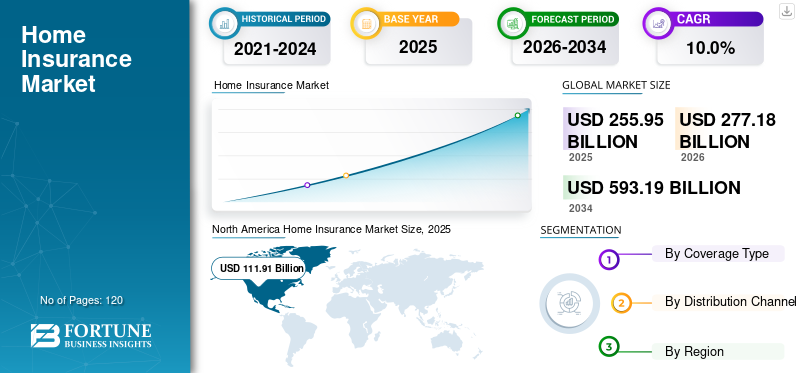
The global home insurance market size was valued at USD 255.95 billion in 2025 and is projected to grow from USD 277.18 billion in 2026 to USD 593.19 billion by 2034, exhibiting a CAGR of 10.0% during the forecast period. North America dominated the global market with a market share of 43.72% in 2025.
The market is witnessing steady growth, supported by rising homeownership rates, increasing property values, and heightened awareness of financial protection against natural disasters and unforeseen risks. Homeowners are placing greater emphasis on comprehensive coverage that safeguards assets, contents, and liability, while insurers are responding with customizable policies, digital underwriting, and usage based pricing models. The growing frequency of climate related events and regulatory focus on risk mitigation are further strengthening demand across both developed and emerging economies.
- For instance, in 2025, several major insurers across North America and parts of Asia Pacific reported a strong increase of around 70% to 90% in new home insurance policy issuance, driven by higher residential construction activity and mandatory insurance requirements tied to home loans.
Furthermore, several industry players such as State Farm Group, Allstate Corporation, USAA Insurance Group, Liberty Mutual Insurance, and Farmers Insurance Group are focusing on increasing their digital distribution channels, improving risk assessment through advanced analytics, and offering customized home insurance products tailored to evolving customer needs.
Download Free sample to learn more about this report.
Home Insurance MARKET KEY TAKEAWAYS
 Market Size & Forecast
- 2025 Market Size: USD 255.95 billion
- 2026 Market Size: USD 277.18 billion
- 2034 Forecast Market Size: USD 593.19 billion
- CAGR: 10.0% from 2026–2034
 Market Share
- North America dominated the home insurance market with a 43.72% share in 2025.
- The dwelling coverage segment held the largest market share in 2025.
- The agent and broker channel accounted for the largest market share in 2025.
 Key Regional Highlights
North American
North America reached USD 111.91 billion in 2025, driven by high homeownership rates and increasing climate-related risks.
Europe
Europe reached USD 65.80 billion in 2025, supported by strong regulatory frameworks and rising demand for comprehensive property protection.
Asia Pacific
Asia Pacific reached USD 49.40 billion in 2025, driven by growing residential property values and expanding insurance adoption.
U.S.
The market was valued at approximately USD 99.77 billion in 2025, accounting for around 39.0% of global home insurance revenues.
Japan
The market reached approximately USD 10.86 billion in 2025, supported by rising reconstruction costs and increasing adoption of digital insurance platforms.
Read More

HOME INSURANCE MARKET TRENDS
Rising Demand for Customized Coverage is a Prominent Trend Observed in Market
Homeowners increasingly seek policies aligned with their specific property characteristics, risk exposure, and financial priorities. Insurers are responding by offering modular coverage options, flexible deductibles, and add ons such as protection for high value assets, home offices, and rental portions of residences. Customers also expect greater transparency and control over policy features, enabling them to balance premium costs with coverage depth. This shift is further supported by advanced data analytics, which allow insurers to design personalized plans based on location, lifestyle, and claims history. As a result, customized coverage is becoming a key differentiator for insurers aiming to improve customer satisfaction and retention.
- For instance, in February 2025, as per the industry survey average home and contents insurance premiums in Australia rose about 16%, with several major providers hiking prices due to inflation and weather-related risk.
Download Free sample to learn more about this report.
MARKET DYNAMICS
MARKET DRIVERS
Growing Frequency of Natural Disasters and Climate Related Risks Propelling Adoption for Home Insurance
Events such as floods, hurricanes, wildfires, and severe storms are causing higher levels of property damage, increasing financial vulnerability for homeowners. As rebuilding and repair costs continue to rise, homeowners are recognizing the importance of insurance coverage to protect against unexpected losses. Insurers are also updating risk assessment models to account for region specific climate exposure, which is influencing coverage structures and pricing. This heightened risk environment is strengthening the role of home insurance as a critical tool for financial resilience and long term asset protection.
- For instance, in December 2025, a Swiss Re Institute industry report highlighted that insured losses from natural catastrophes exceeded USD 100 billion globally for the sixth consecutive year, driven largely by floods, storms, and wildfires.
MARKET RESTRAINTS
Increasing Claim Costs due to Inflation in Construction Materials and Labor Restricting Market Growth
Rising prices of raw materials such as cement, steel, and timber, along with higher labor wages, have sharply increased repair and rebuilding expenses after property damage. As a result, insurers are facing higher claim payouts, which puts pressure on profitability. To offset these costs, insurance providers are raising premiums or tightening coverage terms, making policies less affordable for some homeowners.
This situation can lead to lower policy renewals and reduced adoption, particularly in cost sensitive segments. Consequently, inflation related claim pressures are acting as a key restraint on overall market expansion.
MARKET OPPORTUNITIES
Integration of Smart Home and IoT Devices to Offer Market Growth Opportunities
Integration of smart home and IoT devices is creating significant growth opportunities in the home insurance industry by enabling proactive risk prevention and improved loss management. Devices such as smart smoke detectors, water leak sensors, security cameras, and connected thermostats help detect potential hazards in real time and reduce the severity of damage. Insurers are increasingly offering premium discounts and customized coverage to homeowners who adopt these technologies. Data collected from IoT devices also allows insurers to refine risk assessment and pricing models with greater accuracy. This shift supports lower claim frequency and faster claims resolution. Additionally, partnerships between insurers and smart home technology providers are expanding value added services. As adoption of connected homes increases, IoT integration is expected to strengthen customer engagement and long term market growth.
Segmentation Analysis
By Coverage Type
Rising Need for Protecting Physical Structure of Residential Properties to Propel Segmental Growth
Based on the coverage type, the market is divided into dwelling coverage, personal property coverage, liability protection, and others.
Dwelling coverage accounted for the largest home insurance market share due to its essential role in protecting the physical structure of residential properties against risks such as fire, natural disasters, and accidental damage. Rising property values and increasing construction costs have further reinforced the importance of adequate dwelling coverage among homeowners.
- For instance, in 2025, multiple homeowner insurance surveys across North America and Europe indicated that over two thirds of policyholders prioritized higher dwelling coverage limits when renewing policies, reflecting concerns over rising rebuilding costs and increased exposure to weather related damage.
Liability protection is anticipated to rise with a CAGR of 14.6% over the forecast period driven by growing awareness of personal legal risks and increasing incidents of third party injury and property damage claims.
By Distribution Channel
To know how our report can help streamline your business, Speak to Analyst
Rising Personalized Advisory Support by Agents and Broker to Boost Segment Growth
Based on distribution channel, the market is segmented into direct to consumer, agent and broker channel, bancassurance/financial partners, and others.
In 2025, the agent and broker channel dominated the global market. It is owing to the personalized advisory support they provide and their ability to guide customers through complex policy structures. Many homeowners continue to rely on agents and brokers for tailored coverage recommendations, risk assessment, and claims assistance. Their strong local presence and long term customer relationships also enhance trust and policy retention.
Direct to consumer is projected to grow at a CAGR of 13.3% over the forecast period due to the rapid adoption of digital insurance platforms and increasing preference for online policy purchasing and management.
Home Insurance Market Regional Outlook
By region, the market is categorized into Europe, North America, Asia Pacific, South America, and the Middle East & Africa.
North America
North America Home Insurance Market Size, 2025 (USD Billion) To get more information on the regional analysis of this market, Download Free sample
North America held the dominant share in 2024, valuing at USD 103.19 billion, and also maintained the leading share in 2025, with USD 111.91 billion. The North America market growth is driven by high homeownership rates, rising property values, and strong awareness of financial risk protection. Increasing frequency of climate related events such as hurricanes, wildfires, and floods is further accelerating insurance adoption across the region.
U.S Home Insurance Market
Based on North America’s strong contribution and the U.S. dominance within the region, the U.S. market can be analytically approximated at around USD 99.77 billion in 2025, accounting for roughly 39.0% of global home insurance sales.
Europe
Europe is projected to record a growth rate of 8.8% in the coming years, which is the second highest among all regions, and reach a valuation of USD 65.80 billion by 2025. The Europe home insurance market growth is driven by increasing residential property values, strong regulatory frameworks, and high awareness of property and liability protection among homeowners. Rising exposure to climate related risks such as floods and storms is encouraging wider adoption of comprehensive coverage.
U.K Home Insurance Market
The U.K. market in 2025 is estimated at around USD 14.32 billion, representing roughly 6.0% of global home insurance revenues.
Germany Home Insurance Market
Germany’s market is projected to reach approximately USD 13.26 billion in 2025, equivalent to around 5.0% of global Home Insurance sales.
Asia Pacific
Asia Pacific is estimated to reach USD 49.40 billion in 2025 and secure the position of the third-largest region in the market. In the region, India and China are both estimated to reach USD 10.51 billion and USD 12.46 billion, respectively in 2025.
Japan Home Insurance Market
The Japan market in 2025 is estimated at around USD 10.86 billion, accounting for roughly 4.0% of global Home Insurance revenues. This growth is attributed to rising renovation and reconstruction costs that encourage homeowners to opt for higher coverage limits. In addition, increasing adoption of digital insurance platforms and insurer focus on tailored disaster protection products are contributing to steady market growth.
China Home Insurance Market
China’s market is projected to be one of the largest worldwide, with 2025 revenues estimated at around USD 12.46 billion, representing roughly 5% of global home insurance sales.
India Home Insurance Market
The India market for home insurance in 2025 is estimated at around USD 10.51 billion, accounting for roughly 4% of global home insurance revenues.
South America and Middle East & Africa
The South America and the Middle East & Africa regions are expected to witness moderate growth in this market space during the forecast period. The South America market is set to reach a valuation of USD 15.91 billion in 2025. T supported by rising urbanization, expanding middle class populations, and increasing homeownership rates. In Middle East & Africa, rapid infrastructure development and higher awareness of property protection against natural disasters and fire risks are driving demand. In the Middle East & Africa, the GCC is set to reach a value of USD 5.87 billion in 2025.
COMPETITIVE LANDSCAPE
Key Industry Players
Focus on Integrating Digital Platforms and Automation by Key Players to Propel Market Progress
Key players in the market are increasingly investing in digital platforms and automation to streamline operations, improve customer engagement, and accelerate policy servicing across underwriting and claims functions. Insurers are adopting AI‑driven tools such as automated pricing engines, conversational digital assistants, and cloud‑based policy management systems to reduce manual tasks, improve speed and accuracy, and provide a more seamless digital experience for policyholders.
Additionally, new insurtech solutions for orchestrating end‑to‑end insurance processes are gaining traction, enabling faster claims processing and more efficient policy lifecycle management. These technology advancements are helping insurers respond to evolving customer expectations for faster digital service and personalized coverage options, supporting overall market growth
LIST OF KEY HOME INSURANCE COMPANIES PROFILED
- State Farm Group (U.S.)
- Allstate Corporation (U.S.)
- USAA Insurance Group (U.S.)
- Liberty Mutual Insurance (U.S.)
- Farmers Insurance Group (U.S.)
- American Family Insurance (U.S.)
- The Travelers Companies (U.S.)
- Chubb Ltd (Switzerland)
- Nationwide Mutual Insurance Company (U.S.)
- Auto‑Owners Insurance (U.S.)
- Allianz SE (Germany)
- AXA S.A. (France)
- Zurich Insurance Group (Switzerland)
- Aviva (U.K.)
- Other Companies
KEY INDUSTRY DEVELOPMENTS
- December 2025: Prestige Underwriting and insurtech partnered to deliver non-standard home insurance through Urban Jungle’s digital platform. Urban Jungle has launched under the “Select by Urban Jungle” brand, a move that will enable Urban Jungle’s customers with non-standard home insurance needs.
- December 2025: Ageas and Saga launched 20-year affinity insurance partnership to offer compelling home propositions for over‑50s customers.
- August 2025: SiriusPoint Ltd. Announced a new strategic partnership with Arden Insurance Services LLC, a commercial property managing general underwriter (MGU) in the United States.
- June 2025: Porch Group, Inc., homeowner’s insurance company announced a renewed partnership with Goosehead Insurance. The renewed partnership with Goosehead represents help in re-activate agency partnerships and further extending its distribution channels.
- May 2025: SBI General Insurance, India’s general insurance providers launched SBI General Flexi Home Insurance. This will help in meeting the evolving protection needs of homeowners and renters across India.
REPORT COVERAGE
Request for Customization to gain extensive market insights.
Report Scope & Segmentation
|
ATTRIBUTE |
DETAILS |
|
Study Period |
2021-2034 |
|
Base Year |
2025 |
|
Estimated Year |
2026 |
|
Forecast Period |
2026-2034 |
|
Historical Period |
2021-2024 |
|
Growth Rate |
CAGR of 10.0% from 2026-2034 |
|
Unit |
Value (USD Billion) |
|
Segmentation |
By Coverage Type, Distribution Channel, and Region |
|
By Coverage Type |
· Dwelling Coverage · Personal Property Coverage · Liability Protection · Others |
|
By Distribution Channel |
· Direct to Consumer · Agent and Broker Channel · Bancassurance/Financial Partners · Others |
|
By Region |
· North America (By Coverage Type, By Distribution Channel, and Country) o U.S. o Canada o Mexico · Europe ( By Coverage Type, By Distribution Channel, and Country) o Germany o U.K. o France o Spain o Italy o Russia o Benelux o Nordics o Rest of Europe · Asia Pacific (By Coverage Type, By Distribution Channel, and Country) o China o Japan o India o South Korea o ASEAN o Oceania o Rest of Asia Pacific · South America (By Coverage Type, By Distribution Channel, and Country) o Brazil o Argentina o Rest of Latin America · Middle East & Africa (By Coverage Type, By Distribution Channel, and Country) o Turkey o Israel o GCC o South Africa o North Africa o Rest of the Middle East & Africa |
Frequently Asked Questions
According to Fortune Business Insights, the global market value stood at USD 255.95 billion in 2025 and is projected to reach USD 593.19 billion by 2034.
In 2025 the market value stood at USD 111.91 billion.
The market is expected to exhibit a CAGR of 10.0% during the forecast period.
By distribution channel, the agent and broker channel is expected to lead the market.
The rising demand for customized coverage is a prominent trend observed in the market.
State Farm Group, Allstate Corporation, USAA Insurance Group, Liberty Mutual Insurance, and Farmers Insurance Group are the major players in the global market.
North America dominated the market in 2025.



- 2021-2034
- 2025
- 2021-2024
- 120
Get 30-60 hrs Free Customization
Expand Regional and Country Coverage, Segments Analysis, Company Profiles, Competitive Benchmarking, and End-user Insights.












-
US +1 833 909 2966 ( Toll Free )
-
Get In Touch With Us