Hospital Acquired Infection Control Market Size, Share & Industry Analysis, By Type (Equipment, Services, Consumables), By End Use (Hospitals & ICUs, Ambulatory Surgical and Diagnostic Centers), By Region, and Regional Forecast, 2026-2034
 Download Free Sample
Hospital Acquired Infection Control Market Overview
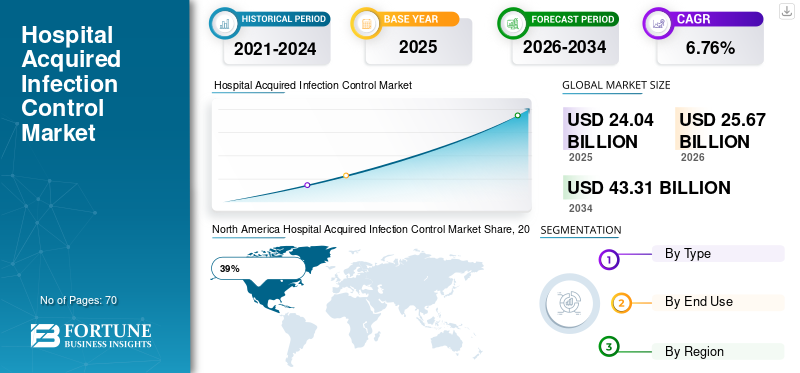
The hospital acquired infection control market size was valued at USD 22.88 billion in 2025 and is projected to grow from USD 24.44 billion in 2026 to USD 41.34 billion by 2034, exhibiting a CAGR of 6.79 % during the forecast period.

The hospital acquired infection control market covers products, equipment, consumables, and specialized services designed to prevent, monitor, and control infections acquired within healthcare environments. The market includes sterilization systems, disinfectors, endoscope reprocessors, infection surveillance solutions, antimicrobial products, protective barriers, and related services. Demand is supported by rising surgical volumes, increasing use of invasive medical devices, antimicrobial resistance concerns, and stronger hospital hygiene requirements. Healthcare providers are moving toward automated sterilization, low-temperature processing, touchless disinfection, digital surveillance, and integrated infection prevention programs. The hospital acquired infection control market Report therefore focuses on technologies that improve patient safety, operational efficiency, contamination control, and compliance.
The U.S. hospital acquired infection control market is supported by advanced hospital infrastructure, extensive surgical activity, sophisticated intensive care facilities, and strong emphasis on infection prevention. Hospitals are adopting automated sterilization systems, ultraviolet disinfection, hydrogen peroxide technologies, antimicrobial barriers, sterilization monitoring, and digital surveillance platforms. Demand is particularly strong in operating rooms, intensive care units, central sterile services departments, and ambulatory surgical centers. U.S. healthcare organizations are also increasing investments in infection prevention training and real-time compliance monitoring. The hospital acquired infection control market Analysis for the USA highlights increasing demand for integrated technologies capable of improving sterilization reliability while reducing manual processing and contamination risks.
Download Free sample to learn more about this report.
Hospital Acquired Infection Control Market Key Takeaways
 Global Market Size & Forecast
- 2025 Market Size: USD 22.88 Billion
- 2026 Market Size: USD 24.44 Billion
- 2034 Forecast Market Size: USD 41.34 Billion
- CAGR: 6.79% from 2026–2034
 Market Share
- The market in North America dominated with a 39% share in 2025.
- Equipment dominated the type segment with a 38% market share.
- Hospitals & ICUs dominated the end-use segment with a 72% market share.
 Key Regional Highlights
Asia Pacific
The market in Asia-Pacific accounted for a 24% share, driven by expanding healthcare infrastructure and rising patient volumes.
North America
The market in North America dominated with a 39% share in 2025, driven by advanced healthcare infrastructure and infection prevention investments.
Europe
The market in Europe accounted for a 27% share, supported by stringent infection control standards and hospital modernization.
United Kingdom
The market in the UK accounted for 24% of Europe’s market, supported by healthcare modernization and infection prevention measures.
Japan
The market in Japan accounted for 31% of Asia-Pacific’s market, driven by advanced healthcare systems and infection control adoption.
Read More

Hospital Acquired Infection Control Market Latest Trends
The hospital acquired infection control market trends are increasingly centered on automation, digital monitoring, low-temperature sterilization, and environmentally responsible infection prevention. Hospitals are deploying robotic and ultraviolet-C disinfection systems to treat patient rooms, operating rooms, isolation areas, and other high-risk environments. Hydrogen peroxide vapor and gas-plasma sterilization are gaining attention for heat-sensitive surgical instruments and advanced endoscopic devices.
Another important trend is the integration of infection surveillance with hospital information systems. Digital platforms can centralize infection-related information, track compliance, identify unusual patterns, and support faster intervention. Sensor-based hand hygiene monitoring and automated reporting are also becoming more relevant for large healthcare networks.
The hospital acquired infection control market Insights indicate growing demand for consumables with improved barrier performance, antimicrobial properties, and sustainability characteristics. Hospitals are also seeking sterilization equipment that reduces water consumption, chemical exposure, processing time, and energy requirements. Manufacturers are responding with connected sterilizers, rapid biological indicators, automated washer-disinfectors, and specialized reprocessing systems.
Download Free sample to learn more about this report.
Hospital Acquired Infection Control Market Dynamics
Drivers
Rising Prevalence of Healthcare-Associated Infections and Increasing Surgical Procedures
The growing need to prevent healthcare-associated infections is a primary driver of the hospital acquired infection control market Growth. Hospitals manage increasingly complex patients requiring surgery, catheterization, mechanical ventilation, dialysis, endoscopy, and other invasive interventions. These procedures create multiple opportunities for microorganisms to enter vulnerable patients, increasing the importance of sterilization, environmental cleaning, personal protection, and infection surveillance.
The aging population and rising prevalence of chronic diseases are also expanding hospital utilization. Patients with weakened immune systems frequently require longer treatment and more intensive medical intervention, creating additional infection prevention requirements. Healthcare providers are consequently strengthening infection control programs across operating rooms, intensive care units, emergency departments, and sterile processing departments.
The emergence of antimicrobial-resistant organisms is another important market driver. Hospitals require more sophisticated monitoring and environmental controls to reduce transmission between patients and healthcare workers. Automated disinfection, sterilization validation, antimicrobial surfaces, and single-use consumables are increasingly incorporated into comprehensive infection prevention strategies.
The hospital acquired infection control market Forecast is also supported by investments in hospital infrastructure. New hospitals and upgraded medical facilities increasingly incorporate dedicated sterile processing departments, improved ventilation, advanced disinfection equipment, and digital infection monitoring capabilities. These developments create sustained procurement opportunities for equipment manufacturers, consumable suppliers, and specialized service providers.
Restraints
High Implementation and Maintenance Costs of Advanced Infection Control Technologies
High acquisition and operating costs can restrict adoption of sophisticated infection control systems, particularly among smaller hospitals and healthcare facilities with limited capital budgets. Advanced sterilizers, automated washer-disinfectors, robotic disinfection equipment, monitoring platforms, and low-temperature systems require substantial initial investment and continuing maintenance.
Healthcare providers must also consider staff training, equipment validation, service contracts, consumable requirements, facility modifications, and technology integration costs. For facilities operating older infrastructure, installation of modern sterilization systems may require electrical, ventilation, plumbing, or workflow changes.
Another restraint is the complexity of maintaining consistent infection prevention practices. Purchasing advanced equipment alone does not eliminate infection risks. Healthcare workers must follow correct cleaning, disinfection, sterilization, storage, and handling procedures. Inconsistent compliance can reduce the effectiveness of expensive systems.
Budget pressure can also encourage hospitals to prioritize essential medical equipment over infection control upgrades. Emerging markets may experience additional challenges because access to advanced sterilization technologies, trained personnel, maintenance services, and specialized consumables can be limited. These conditions may slow the adoption of sophisticated solutions even when infection prevention requirements are increasing.
Market Opportunities
Expansion of Automated, Digital, and Low-Temperature Infection Control Solutions
Automation represents a significant hospital acquired infection control market Opportunity. Healthcare facilities increasingly seek technologies that reduce manual intervention while improving consistency, traceability, and processing speed. Automated sterilizers, washer-disinfectors, robotic room disinfection, smart monitoring systems, and digital compliance platforms can improve workflow efficiency.
Low-temperature sterilization is another attractive opportunity because modern hospitals increasingly use heat-sensitive instruments, flexible endoscopes, robotic surgical instruments, and sophisticated minimally invasive devices. Manufacturers are developing vaporized hydrogen peroxide and other technologies that can process delicate instruments without the high temperatures associated with conventional steam sterilization.
Digital infection surveillance offers another growth opportunity. Hospitals can use connected systems to centralize information from sterilization equipment, environmental monitoring, hand hygiene systems, and patient-care workflows. Advanced analytics can help infection prevention teams identify patterns and prioritize interventions.
Emerging healthcare markets also offer significant opportunities. New hospitals, ambulatory surgical centers, diagnostic facilities, and specialty clinics require infection control infrastructure from the beginning. Suppliers capable of offering complete solutions combining equipment, consumables, validation, training, and maintenance services can establish stronger B2B relationships.
Challenges
Maintaining Consistent Infection Prevention Compliance Across Complex Healthcare Environments
One of the major challenges in the Hospital Acquired Infection Control Industry is ensuring consistent adherence to infection prevention protocols. Hospitals involve thousands of daily interactions among patients, physicians, nurses, technicians, cleaning staff, and support personnel. Any weakness in hand hygiene, instrument processing, environmental cleaning, or protective procedures can create opportunities for infection transmission.
Healthcare facilities must also manage multiple infection risks simultaneously. Surgical site infections, bloodstream infections, catheter-associated infections, respiratory infections, and contamination associated with medical devices require different prevention approaches. This complexity increases the need for integrated infection control strategies.
Technology integration is another challenge. Modern hospitals operate numerous digital systems, and infection monitoring platforms may need to interact with clinical, laboratory, equipment, and administrative systems. Poor interoperability can limit the value of digital surveillance.
Sustainability is becoming an additional consideration. Hospitals consume large volumes of disinfectants, disposable protective equipment, sterilization packaging, and other products. Healthcare organizations increasingly seek infection control technologies that maintain high safety standards while reducing waste, water consumption, chemical use, and energy requirements.
Hospital Acquired Infection Control Market Segmentation
By Type
Equipment represents the largest product category in the hospital acquired infection control market, accounting for approximately 38% of the overall market in this analysis. The category includes sterilizers, washer-disinfectors, endoscope reprocessors, UV disinfection systems, microbial testing equipment, air treatment systems, and other specialized technologies.
Sterilization equipment remains central to healthcare infection prevention because surgical instruments must be reliably processed before reuse. Steam sterilizers continue to serve as a core technology, while low-temperature systems are increasingly important for heat-sensitive instruments. Washer-disinfectors are also gaining adoption because automated cleaning can improve consistency and reduce manual handling.
Hospitals are increasingly selecting equipment with digital connectivity, automated cycle monitoring, traceability, and data-reporting capabilities. These features allow sterile processing departments to document instrument processing and identify deviations more efficiently. Equipment manufacturers are also focusing on energy-efficient operation and reduced water consumption.
The equipment segment benefits from expansion of operating rooms, ambulatory surgical centers, and centralized sterile processing facilities. The hospital acquired infection control market research report identifies automation, low-temperature sterilization, connected equipment, and compact systems as major areas of opportunity. Demand is particularly strong where hospitals are upgrading older sterilization infrastructure or expanding surgical capacity.
Services account for approximately 29% of the hospital acquired infection control market. This segment includes sterilization validation, infection control consulting, equipment maintenance, environmental disinfection, training, compliance assessment, and outsourced infection prevention programs.
Healthcare facilities increasingly use specialized service providers because infection control requires technical expertise beyond equipment procurement. Sterilization validation ensures that equipment operates according to defined performance requirements, while preventive maintenance helps reduce unexpected equipment downtime.
Training services are also important. Staff must understand cleaning procedures, instrument handling, sterilization cycles, packaging requirements, environmental disinfection, and personal protection. Regular training can support compliance and reduce process errors.
Large hospital networks increasingly seek centralized infection control services that provide consistent protocols across multiple facilities. The hospital acquired infection control market Outlook therefore includes opportunities for companies offering integrated service models combining technology support, validation, education, monitoring, and maintenance.
Consumables represent approximately 33% of the market and generate recurring demand because hospitals continuously require products such as disinfectants, sterilization wraps, gloves, gowns, masks, wipes, chemical indicators, biological indicators, and protective barriers.
The consumables segment benefits from increasing patient admissions and surgical procedures. Sterilization monitoring products are particularly important because healthcare facilities need evidence that sterilization processes have operated correctly. Chemical and biological indicators help sterile processing departments verify cycle performance.
Hospitals are also seeking products that reduce cross-contamination and improve worker protection. Antimicrobial surfaces, advanced disinfectant formulations, single-use products, and specialized protective barriers are receiving increased attention.
Sustainability is influencing product development. Manufacturers are exploring recyclable packaging, lower-residue chemicals, biodegradable materials, and reduced-plastic designs. These innovations create new hospital acquired infection control market Opportunities while addressing environmental requirements.
To know how our report can help streamline your business, Speak to Analyst
By End Use
Hospitals and intensive care units account for approximately 72% of the hospital acquired infection control market. These facilities have the highest infection prevention requirements because they handle large patient volumes, invasive procedures, complex surgeries, critically ill patients, and prolonged hospital stays.
ICUs require particularly stringent environmental controls because patients may have weakened immune responses and multiple medical devices. Infection control programs commonly combine sterilization, environmental cleaning, hand hygiene, air management, antimicrobial products, protective equipment, and infection surveillance.
Operating rooms are another major demand center. Surgical instruments must undergo validated cleaning and sterilization before reuse, while surgical environments require controlled air quality and rigorous surface disinfection.
Hospitals are increasingly investing in integrated infection prevention platforms that combine equipment monitoring with infection surveillance. The hospital acquired infection control market Analysis indicates that large healthcare networks are particularly attractive customers because centralized systems can standardize infection prevention processes across multiple facilities.
Ambulatory surgical and diagnostic centers account for approximately 28% of the market. Growth in outpatient procedures is creating additional demand for compact sterilizers, automated instrument washers, endoscope reprocessors, disinfectants, protective products, and monitoring solutions.
These facilities require efficient instrument turnover because operating schedules often depend on rapid availability of sterile equipment. Compact, fast-cycle, and easy-to-operate systems are therefore increasingly attractive.
Diagnostic centers performing endoscopy and other invasive procedures also require reliable reprocessing systems. The increasing use of flexible endoscopes creates demand for specialized cleaning, high-level disinfection, sterilization, and monitoring solutions.
For B2B suppliers, ambulatory facilities represent an important hospital acquired infection control market Opportunity because many are upgrading their infection prevention infrastructure as procedure volumes increase.
Hospital Acquired Infection Control Market Regional Outlook
North America
North America Hospital Acquired Infection Control Market Share, 2025 (%)
To get more information on the regional analysis of this market, Download Free sample
North America represents the 39% largest regional market, supported by advanced healthcare infrastructure, strong infection prevention programs, and widespread use of sophisticated sterilization technologies. The United States accounts for the majority of regional demand, while Canada contributes through hospital modernization and infection prevention investments. Healthcare providers increasingly use automated sterilizers, low-temperature systems, digital monitoring, and advanced consumables. Hospitals are also prioritizing antimicrobial resistance management and infection surveillance. The regional hospital acquired infection control market Size is strongly influenced by replacement demand because healthcare facilities regularly upgrade aging sterilization equipment. Large hospital systems are adopting centralized monitoring and standardized infection prevention workflows. The region also has strong demand for validation services, maintenance programs, and specialized sterile processing solutions.
Europe
Europe maintains a significant position in 27% the hospital acquired infection control market due to established healthcare systems and strong emphasis on patient safety. Germany, the United Kingdom, France, Italy, and other major healthcare markets support demand for sterilization equipment, disinfectants, infection monitoring systems, and protective consumables. European hospitals are increasingly interested in energy-efficient sterilization and low-temperature technologies. Environmental sustainability is an important purchasing consideration, encouraging manufacturers to reduce water, chemical, and energy consumption. The regional market also benefits from hospital modernization and increasing outpatient surgery. Healthcare providers are adopting integrated infection control programs combining equipment, training, monitoring, and validation services. B2B procurement increasingly favors suppliers capable of providing complete infection prevention workflows rather than individual products.
Germany Hospital Acquired Infection Control Market
approximately 31% of Europe's market Germany is one of Europe's most important hospital acquired infection control market destinations, supported by its extensive hospital network, advanced medical technology infrastructure, and strong sterile processing requirements. Demand is concentrated in hospitals, surgical centers, specialty clinics, and central sterile supply departments. German healthcare providers emphasize equipment reliability, validation, traceability, and operational efficiency. Automated washer-disinfectors, steam sterilizers, low-temperature systems, and monitoring products are important procurement categories. Manufacturers are increasingly emphasizing resource-efficient equipment because hospitals seek to reduce water and energy consumption. Germany also offers opportunities for infection control service providers, particularly in maintenance, validation, staff training, and equipment lifecycle management.
United Kingdom Hospital Acquired Infection Control Market
approximately 24% of Europe's market The United Kingdom has a strong market for infection prevention equipment and consumables, supported by extensive public and private healthcare infrastructure. Hospitals continue to invest in sterilization, disinfection, environmental hygiene, and infection surveillance. Demand is particularly strong in surgical departments and sterile processing environments. The UK market increasingly favors technologies that improve traceability and process documentation. Automated monitoring systems and digital reporting can help healthcare organizations maintain consistent infection prevention procedures across multiple facilities. Sustainability is also becoming more important, encouraging procurement teams to consider water-efficient sterilizers, lower-chemical disinfection processes, and environmentally responsible consumables.
Asia-Pacific
Asia-Pacific is a rapidly developing hospital acquired infection control market 24% because healthcare infrastructure is expanding across China, Japan, India, South Korea, Australia, and Southeast Asia. Rising hospital capacity and increased surgical activity are creating demand for sterilizers, disinfectors, consumables, and infection monitoring solutions. Developed markets such as Japan and Australia emphasize advanced infection prevention technologies, while emerging markets are investing in fundamental sterilization infrastructure. Manufacturers are increasingly developing scalable and compact equipment for facilities with varying levels of infrastructure. The regional market also benefits from increasing awareness of healthcare-associated infections and growing adoption of international infection prevention practices.
Japan Hospital Acquired Infection Control Market
approximately 31% of Asia-Pacific's market Japan is a major Asia-Pacific market characterized by advanced healthcare infrastructure, aging demographics, and strong demand for reliable medical equipment. Hospitals require sophisticated sterilization and disinfection systems for surgical instruments, endoscopes, and other reusable devices. Automation is particularly relevant because healthcare providers seek efficient workflows and technologies that reduce manual workload. Japan also has significant opportunities for compact equipment, low-temperature sterilization, advanced monitoring systems, and highly reliable consumables. The Hospital Acquired Infection Control Industry Analysis indicates that technology suppliers emphasizing precision, traceability, durability, and ease of operation are well positioned within the Japanese market.
China Hospital Acquired Infection Control Market
approximately 35% of Asia-Pacific's market China represents a major hospital acquired infection control market within Asia-Pacific due to its large healthcare system, expanding hospital infrastructure, and increasing demand for modern medical technologies. Hospitals are upgrading sterilization departments and adopting automated equipment to support growing procedure volumes. Large tertiary hospitals are significant buyers of advanced sterilizers, washer-disinfectors, endoscope reprocessors, and infection monitoring systems. Demand is also expanding outside major metropolitan areas as healthcare infrastructure improves. Local manufacturing and technology partnerships are increasingly important as hospitals seek cost-effective solutions suited to domestic operating environments.
Rest of World
Rest of World includes Latin America, 10% the Middle East, and Africa, where infection control requirements are creating long-term opportunities for suppliers of sterilization equipment, consumables, and services. Healthcare infrastructure development is a major market factor, particularly in countries investing in new hospitals and surgical facilities. Demand often begins with essential sterilization and disinfection equipment before progressing toward automated and digitally connected solutions. Private healthcare expansion is another important contributor, especially in major urban centers. Suppliers that provide installation, training, maintenance, and technical support alongside equipment can address infrastructure limitations and improve customer adoption. Portable sterilization systems, compact equipment, basic monitoring technologies, and cost-efficient consumables represent important hospital acquired infection control market Opportunities in developing healthcare environments.
List of Top Hospital Acquired Infection Control Companies
- 3M
- Belimed Inc.
- O&M Halyards
- Getinge
- ASP (Advanced Sterilization Products Services, Inc.)
- Sterigenics U.S., LLC - A Sotera Health Company
- MMM Group
- Midmark Corporation
- STERIS
- W&H
Top Two Companies By Estimated Market Share
- STERIS: approximately 9%
- Getinge: approximately 8%
Investment Analysis and Opportunities
Investment activity in the hospital acquired infection control market is increasingly concentrated on automation, low-temperature sterilization, digital monitoring, and specialized reprocessing. Healthcare providers want technologies that improve infection prevention without creating excessive workflow complexity. This creates opportunities for manufacturers developing equipment with automated loading, cycle verification, remote diagnostics, and digital documentation.
Low-temperature sterilization is particularly attractive because minimally invasive surgery and robotic procedures are increasing the use of instruments that cannot withstand conventional high-temperature processing. Investment in vaporized hydrogen peroxide systems, advanced biological indicators, and specialized endoscope reprocessing can therefore address an expanding technology requirement.
Emerging healthcare markets provide another investment opportunity. New hospitals and ambulatory facilities require complete infection prevention infrastructure, creating demand for equipment suppliers, consumable manufacturers, maintenance companies, and training providers. Strategic partnerships with healthcare organizations can help manufacturers establish recurring B2B relationships.
Sustainability is also attracting investment. Products that reduce water consumption, chemical exposure, energy requirements, and disposable waste can help healthcare organizations meet environmental objectives while maintaining patient safety.
New Product Development
New product development in the hospital acquired infection control market is increasingly focused on faster processing, automation, digital connectivity, and improved sustainability. Manufacturers are developing low-temperature sterilizers for heat-sensitive surgical instruments and endoscopes. In 2024, Getinge introduced the Poladus 150 vaporized hydrogen peroxide low-temperature sterilizer for heat-sensitive instruments, designed to operate at temperatures up to 55°C and incorporate cross-contamination barrier technology.
ASP has also expanded its sterilization monitoring portfolio. Its 2024 ULTRA GI cycle for the STERRAD 100NX system addressed terminal sterilization of compatible duodenoscopes, while subsequent developments included faster biological indicator technologies.
Another major development direction involves connected sterilization equipment. New systems increasingly capture cycle information automatically and provide digital records for sterile processing departments. This supports traceability and helps healthcare organizations identify process deviations.
Manufacturers are also developing environmentally oriented products, including systems designed to reduce water and energy consumption. The combination of infection prevention performance, automation, data connectivity, and sustainability is shaping the next generation of hospital infection control technologies.
Five Recent Developments (2023-2025)
- 2023 – ASP expanded its steam sterilization monitoring portfolio with BIOTRACE biological indicators, Auto Read Steam Readers, VERISURE chemical indicator strips, and SEALSURE steam indicator tape.
- 2024 – Getinge introduced Poladus 150, a vaporized hydrogen peroxide low-temperature sterilizer designed for heat-sensitive surgical instruments.
- 2024 – ASP introduced the ULTRA GI Cycle for its STERRAD 100NX Sterilizer with ALLClear Technology for compatible duodenoscope terminal sterilization.
- 2024 – Midmark launched next-generation M11 and M9 steam sterilizers, focusing on durability, workflow usability, and sterilization performance.
- 2025 – ASP expanded rapid biological indicator technology, including BIOTRACE Instant Read Steam Biological Indicator and rapid-read VH2O2 biological indicator systems.
Report Coverage of Hospital Acquired Infection Control Market
The hospital acquired infection control market Report covers the principal technologies, products, services, end-use environments, competitive developments, regional markets, and investment opportunities associated with healthcare-associated infection prevention. The analysis includes equipment such as sterilizers, washer-disinfectors, endoscope reprocessors, and other specialized infection control systems.
The report also examines services covering validation, maintenance, training, environmental disinfection, and infection surveillance, together with recurring consumables such as disinfectants, sterilization indicators, protective equipment, wraps, wipes, and antimicrobial products.
Request for Customization to gain extensive market insights.
By end use, the hospital acquired infection control market research report evaluates hospitals and intensive care units as well as ambulatory surgical and diagnostic centers. Regional analysis covers North America, Europe, Germany, the United Kingdom, Asia-Pacific, Japan, China, and Rest of World.
The Hospital Acquired Infection Control Industry Report further evaluates market drivers, restraints, opportunities, and challenges, alongside technology development, procurement priorities, competitive positioning, and emerging B2B opportunities. Particular attention is given to automated sterilization, low-temperature processing, digital surveillance, sustainability, rapid monitoring, and advanced consumables.
Frequently Asked Questions
According to Fortune Business Insights says that the global market value stood at USD 22.88 billion in 2025 and is projected to reach USD 41.34 billion by 2034.
The market is expected to exhibit a CAGR of 6.79% during the forecast period of 2026-2034.
Hospitals and intensive care units led the market with nearly 72% share, driven by high patient volumes, critical care procedures, and elevated infection risks.
Key players include 3M, Belimed Inc., O&M Halyards, Getinge, ASP (Advanced Sterilization Products Services, Inc.), and Sterigenics U.S., LLC - A Sotera Health Company.
Key trends include the growing adoption of automated sterilization and robotic disinfection systems and increasing use of AI-powered/cloud-based infection monitoring platforms. North America dominated with approximately 39% market share.



- 2021-2034
- 2025
- 2021-2024
- 70
-

(Offer valid till 15th Oct 2026)
Get 30-60 hrs Free Customization
Expand Regional and Country Coverage, Segments Analysis, Company Profiles, Competitive Benchmarking, and End-user Insights.













.webp)






-
US +1 833 909 2966 ( Toll Free )
-
Get In Touch With Us