Hot Drinks Packaging Market Size, Share & Industry Analysis, By Material (Plastic, Glass, Paper), By Product (Coffee, Tea), By Region (North America, Europe, APAC, Latin America, MEA), and Regional Forecast, 2026-2034
 Download Free Sample

Hot Drinks Packaging Market Overview
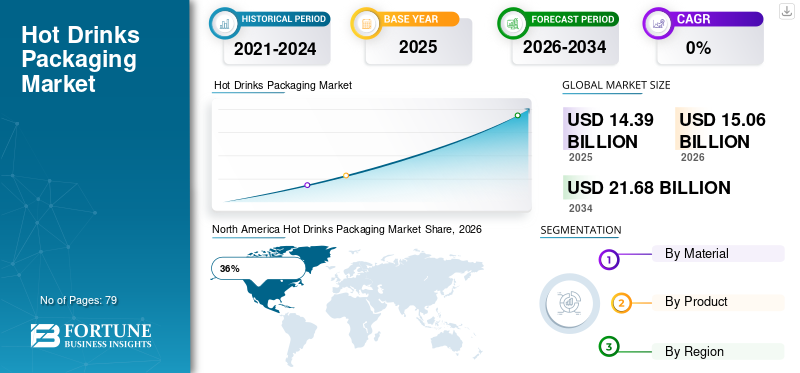
The hot drinks packaging market size was valued at USD 13.95 billion in 2025. The market is projected to grow from USD 14.60 billion in 2026 to USD 21.05 billion by 2034, exhibiting a CAGR of 4.68% during the forecast period. The market in Asia-Pacific dominated with a revenue share of 36.4% in 2025.

The hot drinks packaging market covers packaging formats designed for coffee, tea, hot chocolate, and other heated beverages across retail, foodservice, hospitality, vending, and on-the-go channels. The industry includes paper cups, plastic containers, glass jars, metal cans, pouches, sachets, cartons, lids, closures, and protective secondary packaging. Packaging manufacturers are increasingly balancing heat resistance, leakage prevention, product freshness, portability, branding, recyclability, and production efficiency. Paper remains a major material because of its suitability for disposable cups and fiber-based formats, while flexible packaging is gaining attention for coffee and tea products requiring strong oxygen and moisture barriers. The hot drinks packaging market Analysis also reflects increasing adoption of lightweight and resource-efficient structures.
The USA hot drinks packaging market is supported by high coffee consumption, an established café and foodservice ecosystem, specialty beverage demand, and widespread takeaway consumption. Packaging requirements vary from paper cups and insulated containers for foodservice to high-barrier pouches, cans, jars, and single-serve formats for packaged coffee and tea. Specialty coffee has encouraged brands to use packaging that communicates premium positioning while protecting aroma and freshness.
Sustainability is becoming a major purchasing consideration for American beverage companies, retailers, and packaging converters. Recyclable polypropylene containers, fiber-based cups, lightweight structures, compostable alternatives, and improved barrier technologies are receiving greater attention. The USA hot drinks packaging market also benefits from e-commerce, direct-to-consumer beverage brands, convenience retail, and premium ready-to-drink beverage formats.
Download Free sample to learn more about this report.
Hot Drinks Packaging Market KEY TAKEAWAYS
 Global Market Size & Forecast
- 2025 Market Size: USD 13.95 billion
- 2026 Market Size: USD 14.60 billion
- 2034 Forecast Market Size: USD 21.05 billion
- CAGR: 4.68% from 2026–2034
 Market Share
- Asia-Pacific dominated the hot drinks packaging market with a 36.4% share.
- Paper held the leading position among material categories with approximately 46.5% share in 2024.
- Coffee was the leading product application with approximately 53.4% share in 2024.
 Key Regional Highlights
Asia Pacific
Asia Pacific 36.4% share, driven by high tea consumption, rising coffee demand, and expanding modern retail.
North America
North America 22% share, driven by established coffee chains, foodservice, and sustainability-focused packaging.
Europe
Europe 27.5% share, supported by strong tea and coffee consumption and sustainable packaging demand.
U.K.
United Kingdom 19% of Europe’s market, driven by café culture, takeaway beverages, and sustainable packaging.
Japan
Japan 28% of Asia-Pacific’s market, supported by advanced packaging technology and demand for functional packaging.
Read More

hot drinks packaging market Latest Trends
Sustainability is one of the most visible hot drinks packaging market Trends. Beverage brands are moving toward recyclable paperboard, mono-material flexible packaging, lighter structures, recycled content, and renewable-fiber solutions. Packaging suppliers are simultaneously working to maintain heat resistance, seal integrity, barrier performance, print quality, and compatibility with automated filling and converting equipment.
Another important trend is the expansion of single-serve and portion-controlled packaging. Coffee pods, instant coffee sachets, tea sachets, stick packs, and compact pouches are increasingly relevant to consumers seeking convenience. High-barrier structures are particularly important for protecting coffee aroma and flavor against oxygen, moisture, and light.
Premiumization is also influencing packaging design. Specialty coffee, premium tea, organic blends, functional beverages, and gift-oriented products increasingly use distinctive graphics, textured finishes, metallic effects, rigid containers, and resealable closures. At the foodservice level, double-wall cups, insulated sleeves, secure lids, and spill-resistant designs are becoming important differentiators.
Digital printing and smart packaging are creating additional opportunities. Short-run digital printing allows beverage producers to introduce seasonal designs, localized campaigns, promotional packaging, and limited editions without the same tooling requirements associated with traditional printing. QR codes and connected packaging can support traceability, product information, consumer engagement, and authenticity initiatives.
Download Free sample to learn more about this report.
hot drinks packaging market Dynamics
DRIVER
Rising consumption of coffee, tea, specialty beverages, and convenient single-serve products.
The expanding consumption of coffee and tea across household, workplace, hospitality, café, vending, and foodservice environments is a fundamental driver for the hot drinks packaging market. Packaging demand is closely connected with beverage consumption patterns because each channel requires different protection, handling, and presentation characteristics. Coffee brands need packaging that protects volatile aromas and prevents oxygen-related deterioration, while tea products require protection against moisture, odors, light, and contamination.
The expansion of specialty coffee has strengthened demand for premium pouches, tins, jars, capsules, sachets, and branded takeaway cups. Consumers increasingly purchase whole-bean coffee, ground coffee, instant coffee, specialty blends, herbal tea, premium loose-leaf tea, and functional hot beverages. Each product format creates packaging requirements around barrier protection, resealing, portion control, shelf presentation, and transportation.
Single-serve consumption is another important factor. Stick packs, sachets, pods, and individually wrapped products simplify preparation and support consumption in offices, hotels, travel environments, and households. Foodservice businesses also require cups and lids capable of handling high temperatures while maintaining structural integrity.
The growth of cafés and quick-service beverage outlets has further increased demand for disposable and reusable hot drink packaging. Double-wall paper cups, sleeves, sip-through lids, insulated containers, and customized printed formats allow operators to combine functionality with brand visibility. These developments collectively support hot drinks packaging market Growth across retail and commercial channels.
RESTRAINT
Material costs, recycling limitations, and performance constraints of sustainable packaging.
The transition toward sustainable packaging creates significant technical and commercial restraints for the hot drinks packaging market. Hot beverage packaging must withstand elevated temperatures, moisture, pressure, handling, and transportation. Replacing conventional structures with recyclable or compostable alternatives can therefore require substantial material engineering and testing.
Paper-based packaging, for example, needs an effective barrier to prevent liquid penetration and edge wicking. Flexible coffee packaging requires high resistance to oxygen and moisture, while some traditional high-barrier structures use combinations of polymers, adhesives, coatings, or aluminum that can complicate recycling. Designing a package that is simultaneously recyclable, lightweight, heat resistant, mechanically strong, and commercially affordable remains difficult.
Infrastructure differences also affect packaging choices. A package may be technically recyclable but may not be accepted by collection or sorting systems in every market. This creates uncertainty for beverage manufacturers seeking consistent packaging strategies across countries.
Raw material volatility can also affect procurement decisions. Paperboard, polymers, resins, aluminum, coatings, adhesives, inks, and specialty barrier materials can experience changing costs and availability. Packaging companies must maintain stable supply while meeting customer requirements for sustainability and performance.
For small and medium-sized beverage companies, transitioning packaging formats may require new machinery, tooling, testing, certifications, and supply-chain adjustments. These investments can delay adoption of advanced packaging solutions and restrain the pace of transformation in price-sensitive market segments.
OPPORTUNITY
Development of recyclable, fiber-based, lightweight, and high-barrier packaging solutions.
The strongest opportunities in the hot drinks packaging market are emerging from the intersection of sustainability, convenience, and performance. Beverage producers increasingly require packaging that reduces material usage without compromising product protection. This is creating demand for lightweight paperboard, optimized plastic structures, mono-material pouches, fiber-based cups, recyclable lids, and advanced barrier coatings.
Fiber-based packaging represents a particularly attractive opportunity. Paperboard can provide stiffness, printability, renewable content, and efficient conversion for cups and containers. Suppliers are improving coatings and barrier systems to make paper-based packaging more suitable for hot liquids and moisture-sensitive products.
Flexible packaging also provides substantial opportunities. Mono-polymer structures can potentially simplify recycling compared with multilayer alternatives, while high-performance coatings can provide oxygen, moisture, and light barriers. Recyclable coffee pouches and tea packaging can help brands respond to retailer sustainability requirements without sacrificing shelf life.
Digital customization is another opportunity. Small beverage brands increasingly need short production runs, seasonal packaging, promotional campaigns, and localized designs. Digital printing can support these requirements while reducing the need for extensive tooling.
Emerging markets offer additional opportunities as packaged coffee and tea consumption expands. Urbanization, modern retail, café development, e-commerce, and premium beverage consumption are encouraging manufacturers to introduce more sophisticated packaging. India, China, Southeast Asia, Latin America, and parts of the Middle East provide attractive markets for affordable, convenient, and sustainable hot beverage packaging.
CHALLENGE
Balancing sustainability, food safety, thermal performance, recyclability, and cost.
The central challenge for the hot drinks packaging market is developing packaging that satisfies several competing requirements at the same time. Hot beverages place greater demands on packaging than many ambient products. Containers must tolerate heat, maintain shape, prevent leakage, protect consumers from burns, and remain functional during transportation and consumption.
Sustainable alternatives introduce additional engineering challenges. Fiber-based structures require effective barriers against liquids and steam. Compostable materials must perform reliably under real-world conditions while remaining compliant with applicable food-contact requirements. Recyclable flexible packaging needs sufficient barrier performance without relying on difficult-to-separate material combinations.
Another challenge involves consumer behavior. Recycling outcomes depend not only on package design but also on collection, sorting, and disposal practices. Clear labeling and improved consumer education can help, but inconsistent waste infrastructure continues to complicate circular packaging strategies.
Packaging manufacturers must also manage the expectations of beverage brands. Customers want premium graphics, low material consumption, reliable production speeds, strong seals, convenient opening, and competitive costs. Achieving all these requirements simultaneously requires investment in material science, converting technology, quality control, and process optimization.
Supply-chain complexity is another challenge. Global beverage companies often want standardized packaging platforms across multiple markets, but local recycling rules, material availability, food-contact requirements, and consumer preferences can differ substantially. Packaging suppliers therefore need flexible manufacturing capabilities and region-specific technical expertise.
hot drinks packaging market Segmentation
By Material
Paper holds the leading position among major material categories, accounting for approximately 46.5% of the market based on widely reported 2024 industry estimates. Paper is extensively used for hot beverage cups, sleeves, cartons, folding packs, sachets, secondary packaging, and specialty containers. Its strong printability enables beverage companies to use packaging as a branding surface, while its lightweight characteristics support efficient transportation and handling.
The main innovation focus is improving paper performance for direct contact with hot beverages. Cupstock needs to resist leakage, maintain stiffness, and minimize edge wicking. New barrier coatings and optimized fiber structures are therefore becoming important. Recyclable and renewable paperboard solutions are particularly attractive to café operators and beverage manufacturers seeking to reduce dependence on conventional plastic structures.
Paper also supports premiumization. High-quality printing, embossing, matte finishes, textured surfaces, and customized graphics can differentiate specialty coffee and tea products. In retail packaging, paper-based cartons and secondary packaging can reduce plastic use while maintaining shelf visibility.
Plastic remains important because of its versatility, durability, sealing performance, lightweight properties, and ability to support complex packaging geometries. Plastic is used in cups, lids, pouches, bottles, containers, sachets, closures, and protective components. Polypropylene and polyethylene are particularly relevant for applications requiring heat resistance and flexible processing.
The market is increasingly focused on reducing plastic complexity rather than eliminating all plastic. Mono-material structures, recycled content, lightweighting, and recyclable formats are gaining attention. For hot beverage packaging, plastic can provide excellent moisture barriers and strong seals, making it useful for instant coffee, tea blends, and specialty drink powders.
Innovative plastic designs can also improve consumer convenience. Resealable pouches, easy-open sachets, lightweight cups, and durable lids allow beverage manufacturers to combine functionality with material efficiency. However, recyclability and end-of-life infrastructure remain major considerations for plastic packaging strategies.
Glass is associated with premium coffee, specialty beverages, instant coffee, tea products, concentrates, and reusable packaging. Its non-porous nature provides strong product protection and does not easily retain odors or flavors. Glass containers can also communicate quality and premium positioning, making them attractive for higher-value beverage brands.
Glass is particularly relevant where product visibility is important. Transparent jars allow consumers to see coffee granules, tea blends, or beverage concentrates before purchase. Glass can also be reused or recycled through established collection systems in several markets.
However, weight and breakage can limit its suitability for high-volume transportation and on-the-go applications. Packaging designers therefore need to balance premium appearance with logistics efficiency. Lightweight glass and optimized container shapes can help reduce transportation burdens while retaining the advantages of the material.
By Product
Coffee is the largest product application, representing approximately 53.4% of the market in 2024 according to industry estimates. The extensive range of coffee products creates demand for highly diverse packaging formats. Whole beans, ground coffee, instant coffee, capsules, pods, ready-to-drink coffee, and specialty blends each require different packaging characteristics.
Coffee is particularly sensitive to oxygen and moisture, making barrier performance essential. Pouches, vacuum packs, cans, jars, capsules, and sachets are used according to product type and distribution channel. Resealable closures are increasingly relevant for premium coffee because they allow consumers to preserve aroma after opening.
Specialty coffee is also influencing packaging design. Roasters use distinctive graphics, information panels, origin storytelling, roast details, and premium finishes to differentiate products. Smaller brands often require flexible minimum order quantities, creating opportunities for digital printing and modular packaging solutions.
Tea represents another major application and includes black tea, green tea, herbal tea, specialty blends, functional teas, instant tea, and ready-to-drink formats. Packaging requirements vary considerably depending on whether the product is sold as loose leaf, tea bags, sachets, tins, pouches, cartons, or liquid beverages.
Moisture control is especially important because exposure to humidity can reduce tea quality. Packaging must also protect delicate aromas and prevent external odors from entering the product. Premium tea brands frequently use rigid tins, decorated cartons, resealable pouches, and individually wrapped tea bags to create a stronger quality proposition.
Tea packaging is also increasingly influenced by sustainability. Paper-based tea packaging, recyclable structures, and reduced-plastic formats are being explored across retail channels. In emerging markets, affordable sachets and compact packs remain important, while developed markets show stronger demand for premium packaging, convenience features, and sustainability claims.
hot drinks packaging market Regional Outlook
North America
North America has a mature hot beverage packaging ecosystem supported by coffee chains, convenience stores, restaurants, offices, hospitality businesses, supermarkets, and e-commerce. 22% The United States is the principal market within the region, while Canada contributes through established coffee consumption and growing sustainability requirements.
Paper cups remain highly relevant in foodservice, but the competitive landscape is moving toward better-performing fiber-based systems, recyclable plastics, insulated structures, and improved lids. Packaging suppliers are also responding to demand for customized designs, smaller production runs, and seasonal branding.
The U.S. market is particularly influenced by specialty coffee. Premium coffee packaging increasingly incorporates high-barrier pouches, decorative cans, rigid containers, resealable closures, and differentiated printing. Packaging must protect product freshness while communicating origin, roasting profile, sustainability credentials, and brand identity.
Foodservice operators are also seeking packaging that improves spill resistance and user comfort. Double-wall cups, insulated designs, secure lids, and ergonomic structures help improve the takeaway experience. Meanwhile, recycling and waste-management requirements are encouraging companies to redesign packaging components that were previously difficult to recover.
Europe
Europe has a strong position in the hot drinks packaging market 27.5% because of established tea and coffee consumption and a high level of attention toward packaging sustainability. Germany, the United Kingdom, France, Italy, Spain, and the Netherlands represent important markets for coffee, tea, and foodservice packaging.
European packaging buyers increasingly assess recyclability, renewable material content, lightweighting, and supply-chain efficiency. Fiber-based cups and paperboard solutions are becoming increasingly important, while mono-material flexible packaging is being developed for coffee and tea products.
The region also has a strong premium beverage segment. Specialty coffee shops, premium tea brands, organic beverages, and functional drinks require packaging with strong visual appeal and reliable product protection. Digital printing enables smaller brands to create customized packaging without committing to extremely large production volumes.
Germany Hot Drinks Packaging Market
approximately 23% of Europe's market Germany is one of Europe's most important packaging markets, supported by sophisticated retail infrastructure, strong coffee consumption, sustainability awareness, and established packaging manufacturing capabilities. Coffee remains a major driver of packaging demand, ranging from ground coffee and whole beans to pods, capsules, and instant products.
German beverage companies increasingly prioritize packaging efficiency and recyclability. Paperboard cartons, recyclable pouches, reusable containers, and lightweight structures are gaining attention. Packaging suppliers must deliver reliable barriers, strong seals, and consistent performance on automated production lines.
Premium coffee and specialty tea also create demand for high-quality printing and differentiated packaging. Retailers and beverage brands increasingly expect packaging to communicate product information clearly while supporting sustainability goals. Germany's advanced recycling infrastructure further encourages packaging designers to consider end-of-life performance during product development.
United Kingdom Hot Drinks Packaging Market
approximately 19% of Europe's market The United Kingdom has a strong café culture and substantial demand for takeaway coffee, tea, instant beverages, and specialty hot drinks. The market supports a broad mix of paper cups, pouches, cartons, sachets, cans, jars, and flexible packaging.
Sustainability remains a key consideration for British foodservice and retail businesses. Packaging manufacturers are focusing on fiber-based materials, recyclable structures, reduced plastic usage, and lightweight designs. At the same time, packaging must remain practical for high-volume foodservice operations.
Tea remains an especially important application, while specialty coffee continues to support premium packaging demand. Resealable pouches, decorative cartons, single-serve formats, and customized takeaway cups provide opportunities for packaging suppliers targeting British beverage brands.
Asia-Pacific
Asia-Pacific Hot Drinks Packaging Market Share, 2025 (%)
To get more information on the regional analysis of this market, Download Free sample
Asia-Pacific is the largest regional market in the hot drinks packaging market. 36.4% The region combines enormous tea consumption with rapidly expanding coffee consumption, particularly in urban centers. China, Japan, India, South Korea, Australia, and Southeast Asia each contribute different consumption patterns and packaging requirements.
Flexible packaging is highly relevant because sachets, pouches, and compact packs provide affordability, convenience, portability, and strong product protection. At the same time, premium coffee shops and modern retail are increasing demand for attractive paper cups, specialty pouches, rigid containers, and sustainable packaging.
India is developing as an important market for packaged tea and coffee, supported by modern retail, e-commerce, premiumization, health-focused products, and portion-controlled packaging. China is experiencing continued demand for packaged tea alongside growing coffee consumption and urban café culture.
Japan Hot Drinks Packaging Market
approximately 28% of Asia-Pacific's market Japan has a sophisticated beverage packaging industry characterized by convenience, quality, functionality, and strong attention to design. Hot coffee and tea are sold through multiple channels, including retail stores, vending systems, cafés, offices, and foodservice environments.
Japanese consumers place strong value on convenient packaging, clean design, easy opening, portability, and reliable product protection. Metal cans, plastic containers, paper cups, cartons, and flexible packaging are used according to beverage format.
The market also provides opportunities for lightweight packaging and high-performance materials. Premium coffee and tea products increasingly use packaging with refined graphics and functional features. Packaging companies serving Japan must maintain high standards of manufacturing consistency and consumer usability.
China Hot Drinks Packaging Market
approximately 24% of Asia-Pacific's market China is a major hot beverage packaging market, with tea remaining a dominant category and coffee gaining importance in urban areas. Growing health awareness, premium tea consumption, café expansion, and modern retail are influencing packaging formats.
Flexible pouches, cartons, paper-based packaging, glass containers, and rigid plastic formats serve different beverage categories. Premium tea brands often use visually distinctive cartons, tins, and gift-oriented packaging, while mass-market products continue to rely heavily on affordable and convenient flexible formats.
Coffee packaging is becoming more sophisticated as specialty coffee consumption expands. Brands are adopting resealable pouches, high-barrier structures, single-serve packaging, and premium printed designs. E-commerce is also increasing the importance of packaging durability because products must withstand transportation and repeated handling.
Rest of World
The Rest of World category includes Latin America, the Middle East, and Africa. 14.1%These markets provide long-term opportunities for packaging manufacturers as beverage consumption patterns diversify and modern retail infrastructure develops.
Latin America has strong coffee and tea consumption and an important coffee-producing industry. Packaging requirements range from economical flexible packs to premium export-oriented containers. Local brands increasingly use packaging differentiation to compete in retail markets.
Middle Eastern markets have strong cultural connections with tea and coffee, supporting demand for premium tins, cartons, pouches, cups, and hospitality-oriented packaging. Gift packaging and premium presentation are especially relevant for high-end coffee and tea products.
Africa presents a diverse packaging environment. Flexible sachets and small packs are important because they support affordability and portion control. In urban markets, premium coffee shops and modern retailers are creating demand for higher-quality paper cups, pouches, jars, and cartons.
Packaging companies entering these markets need to consider local purchasing power, distribution conditions, climate, recycling infrastructure, and retail development. Heat and humidity can create additional product-protection requirements, increasing the importance of strong barrier materials and reliable closures.
List of Top Hot Drinks Packaging Companies
- Bemis Manufacturing Company
- Sonoco
- Mondi
- Amcor plc
- Crown
- Stora Enso
- Ball Corporation
- Graham Packaging
- O-I Glass
- Printpack
- Silgan Holdings Inc.
- Veritiv Corporation
- AptarGroup, Inc.
Indicative Top Company Market Share
- Amcor plc: approximately 8.5%
- Sonoco: approximately 7.2%
Investment Analysis and Opportunities
Investment opportunities in the hot drinks packaging market are increasingly concentrated around sustainable materials, high-barrier flexible packaging, lightweight paperboard, recyclable plastic, advanced closures, and automated manufacturing. Packaging companies that can combine material efficiency with reliable performance are well positioned to capture demand from global coffee and tea brands.
Fiber-based packaging represents an attractive investment area because beverage manufacturers are seeking alternatives to conventional plastic-heavy structures. Investments in coatings, barrier technologies, forming equipment, and recyclable cup systems can support product development while maintaining compatibility with high-speed production.
Flexible packaging is another important investment opportunity. Mono-material structures, recyclable pouches, resealable formats, and high-performance barrier films can address the requirements of coffee, tea, instant beverages, and powdered products.
Digital printing, automation, inspection systems, and intelligent production lines also offer investment potential. These technologies allow packaging manufacturers to improve quality, reduce waste, support shorter production runs, and respond faster to customized beverage packaging requirements.
Emerging markets offer additional opportunities for companies capable of providing affordable sustainable packaging. India, China, Southeast Asia, Latin America, and selected Middle Eastern markets are developing modern beverage ecosystems where packaging innovation can support premiumization and convenience.
New Product Development
New product development in the hot drinks packaging market is increasingly focused on reducing material consumption while preserving thermal and barrier performance. Paperboard cup manufacturers are developing thinner structures, improved coatings, and enhanced forming characteristics that allow cups to remain stiff and leak resistant.
Mono-material flexible packaging is another major innovation area. Coffee and tea manufacturers require packaging that protects aroma and flavor against oxygen, moisture, and light while being easier to process within recycling systems. Suppliers are therefore developing mono-PE and mono-PP structures, barrier-coated films, and paper-based high-barrier solutions.
Mondi has introduced paper and mono-material approaches for coffee and tea packaging, including solutions designed for high-barrier applications and existing packaging machinery. Its partnership with Paulig resulted in a printed mono-material structure for vacuum-packed coffee, replacing a traditional multilayer format.
Stora Enso continues developing paperboard solutions for beverage cups, emphasizing lightweight construction, stiffness, leak resistance, edge-wicking prevention, and efficient conversion. Its Cupforma range is designed for hot and cold beverage applications.
Amcor has also introduced recyclable polypropylene drink-cup technology incorporating rigidity features while reducing material weight compared with polystyrene formats.
Five Recent Developments (2023-2025)
- Mondi and Paulig introduced a recyclable mono-material vacuum packaging structure for ground coffee in 2024, replacing a conventional multilayer structure containing aluminum while maintaining barrier and product-protection requirements.
- Mondi and Meurer introduced a paper-based TrayWrap solution in 2024 for securing bundled coffee packages during transportation, replacing plastic shrink film in the application.
- Mondi showcased expanded sustainable coffee and tea packaging technologies in 2024, including mono-material and paper-based structures for coffee, tea, pods, capsules, and secondary packaging.
- Stora Enso advanced food and beverage packaging production capabilities in 2024, highlighting lightweight materials and more efficient production for renewable-fiber consumer packaging.
- Amcor introduced recyclable polypropylene drink cups in 2024, using its Bantam technology to improve durability and grip while reducing average cup weight compared with polystyrene alternatives.
Report Coverage of hot drinks packaging market
The hot drinks packaging market Report covers the major materials, product applications, geographic markets, competitive participants, market dynamics, emerging technologies, investment themes, and packaging innovations shaping the industry. The analysis focuses on packaging used for coffee, tea, and other hot beverages across retail, foodservice, hospitality, convenience, vending, and e-commerce channels.
The hot drinks packaging market Research Report evaluates paper, plastic, and glass packaging and considers their respective advantages in heat resistance, product protection, sustainability, branding, logistics, and consumer convenience. It also assesses coffee and tea as key product applications and examines regional differences across North America, Europe, Asia-Pacific, Latin America, the Middle East, and Africa.
The Hot Drinks Packaging Industry Report further considers trends including recyclable packaging, fiber-based materials, mono-material flexible packaging, lightweighting, premiumization, single-serve formats, resealable structures, smart packaging, digital printing, and high-barrier technologies.
From a B2B perspective, the hot drinks packaging market Insights are relevant to packaging manufacturers, beverage producers, converters, material suppliers, foodservice companies, retailers, distributors, investors, procurement teams, and technology providers. The Hot Drinks Packaging Industry Analysis also considers supplier capabilities, product development priorities, sustainability requirements, automation, supply-chain considerations, and competitive positioning.
The hot drinks packaging market Forecast perspective emphasizes packaging solutions capable of combining cost efficiency, food safety, convenience, sustainability, thermal performance, and brand differentiation. The hot drinks packaging market Opportunities are particularly relevant to companies developing recyclable cups, sustainable pouches, high-barrier paper, lightweight containers, advanced closures, and customized packaging platforms.
Request for Customization to gain extensive market insights.
Frequently Asked Questions
Fortune Business Insights says that the global market value stood at USD 13.95 billion in 2025 and is projected to reach USD 21.05 billion by 2034.
The market is expected to exhibit a CAGR of 4.68% during the forecast period of 2026-2034.
Paper was the leading material segment, accounting for approximately 46.5% of the market in 2024, supported by its printability and lightweight characteristics.
Key players include Bemis Manufacturing Company, Sonoco, Mondi, Amcor plc, Crown, and Stora Enso.
Major trends include the shift toward recyclable and renewable-fiber packaging and the expansion of single-serve and portion-controlled formats; Asia-Pacific led regionally with a 36.4% share.



- 2021-2034
- 2025
- 2021-2024
- 79
-

(Offer valid till 15th Dec 2026)
Get 30-60 hrs Free Customization
Expand Regional and Country Coverage, Segments Analysis, Company Profiles, Competitive Benchmarking, and End-user Insights.












-
US +1 833 909 2966 ( Toll Free )
-
Get In Touch With Us