Household Slicer Market Size, Share & Industry Analysis, By Product (Manual, Automatic), By Distribution Channel (Offline, Online), By Region, and Regional Forecast, 2026-2034
 Download Free Sample
Household Slicer Market Overview
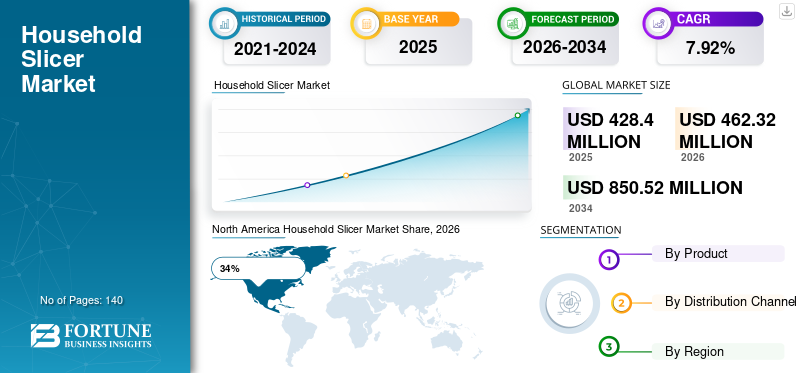
The household slicer market size was valued at USD 428.4 Million in 2025. The market is projected to grow from USD 462.32 Million in 2026 to USD 850.52 Million by 2034, exhibiting at a CAGR of 7.92% during the forecast period.

The household slicer market is evolving as consumers increasingly prioritize convenience, precision, and efficiency in home food preparation. Household slicers are widely used for cutting vegetables, fruits, meat, cheese, and bakery products into uniform slices, supporting modern cooking practices and meal presentation standards. The market is influenced by growing interest in home cooking, rising adoption of multifunctional kitchen appliances, and increasing awareness regarding food preparation efficiency. Manufacturers are focusing on ergonomic designs, enhanced safety mechanisms, stainless-steel blade systems, and compact product formats suitable for residential kitchens. The household slicer market report indicates that product innovation, smart kitchen integration, and expanding e-commerce penetration continue to shape long-term market development.
The United States represents one of the most established markets for household slicers due to widespread adoption of kitchen appliances and a strong culture of home-based meal preparation. Consumers increasingly seek appliances that reduce preparation time while maintaining food quality and presentation consistency. The popularity of healthy eating habits has encouraged the use of slicers for fresh vegetables, fruits, and homemade meal ingredients. The household slicer market analysis for the U.S. highlights increasing demand for automatic slicers equipped with safety locks, adjustable thickness controls, and easy-clean designs.
Retail chains, specialty kitchen appliance stores, and digital marketplaces continue to strengthen product accessibility across the country. The growing influence of cooking-focused content, culinary experimentation, and premium kitchen appliance ownership supports demand among households. Product manufacturers are introducing advanced blade technologies and compact countertop solutions to meet changing consumer preferences. As a result, the U.S. remains a major contributor to household slicer market growth and Household Slicer Industry Analysis.
Download Free sample to learn more about this report.
Household Slicer Market Key Takeaways
 Global Market Size & Forecast
- 2025 Market Size: USD 428.40 Million
- 2026 Market Size: USD 462.32 Million
- 2034 Forecast Market Size: USD 850.52 Million
- CAGR: 7.92% from 2026-2034
 Market Share
- The market in North America dominated with a revenue share of 34% in 2025.
- Automatic household slicers dominated by product with a market share of approximately 58%.
- Offline distribution channels dominated by distribution channel with a market share of approximately 61%.
 Key Regional Highlights
North America
North America led the market with a 34% share, supported by strong demand for convenient and efficient kitchen appliances.
Europe
Europe accounted for 31% of the market, driven by established household appliance markets and consumer preference for advanced kitchen products.
Asia-Pacific
Asia-Pacific held a 26% share, supported by rising urbanization and increasing adoption of modern kitchen appliances.
U.S
The U.S. remains a key market, supported by strong demand for convenient and technologically advanced kitchen appliances.
Japan
Japan accounted for approximately 24% of the Asia-Pacific market, supported by advanced household appliance adoption and demand for efficient food preparation solutions.
Read More

Household Slicer Market Latest Trends
The household slicer market trends reveal a significant shift toward technologically advanced and user-friendly products. Consumers increasingly prefer slicers featuring adjustable thickness settings, quick-release blade systems, and enhanced safety functions. Manufacturers are investing in durable stainless-steel components and lightweight materials to improve product lifespan and usability. Compact models designed for smaller kitchens are becoming highly popular among urban consumers.
Download Free sample to learn more about this report.
Another notable trend in the household slicer market research report is the integration of multifunctional capabilities. Many household slicers now combine slicing, shredding, julienne cutting, and grating functions within a single appliance. This trend aligns with consumer demand for space-saving kitchen solutions. Online sales channels continue to gain prominence due to wider product selection, competitive pricing, and convenient delivery services. Sustainable packaging initiatives and energy-efficient automatic slicers are also emerging as important market differentiators. The growing influence of digital product reviews and social media-based kitchen appliance recommendations is accelerating purchasing decisions, contributing significantly to household slicer market opportunities and household slicer market outlook.
Household Slicer Market Dynamics
DRIVER
Rising Demand for Convenient Home Food Preparation Solutions
The primary driver supporting household slicer market growth is the increasing consumer preference for efficient and time-saving food preparation methods. Modern households seek kitchen appliances that simplify cooking tasks while ensuring consistency and precision. Household slicers enable users to prepare vegetables, fruits, meats, and cheeses quickly, reducing manual effort and improving meal presentation quality.
The growing popularity of home cooking has further strengthened product adoption. Consumers are increasingly experimenting with restaurant-style recipes and gourmet meal preparation at home. Household slicers help achieve professional slicing results, making them attractive to both amateur cooks and culinary enthusiasts. Additionally, rising awareness of healthy eating habits has increased demand for fresh ingredients and homemade meals. Consumers preparing salads, sandwiches, and fresh food platters frequently rely on slicers for convenience and uniformity. Product manufacturers continue introducing improved blade technology, ergonomic designs, and enhanced safety features, reinforcing market expansion across residential segments. These factors collectively support positive household slicer market forecast and household slicer market insights.
RESTRAINT
Availability of Alternative Manual Kitchen Tools
One of the major restraints affecting the household slicer market is the widespread availability of low-cost alternatives such as knives, graters, peelers, and mandoline slicers. Many consumers continue using traditional kitchen tools because of familiarity, affordability, and ease of storage. In price-sensitive markets, purchasing a dedicated household slicer may be viewed as a non-essential expense.
Storage limitations also influence buying behavior. Compact kitchens, particularly in urban apartments, often lack sufficient countertop or cabinet space for specialized appliances. Additionally, concerns regarding blade maintenance and cleaning requirements may discourage potential buyers. Some consumers perceive automatic slicers as complex compared to conventional cutting methods. Safety concerns associated with sharp blades can further limit adoption among households with children or elderly users. While manufacturers continue addressing these issues through design improvements and safety mechanisms, alternative kitchen tools remain a notable challenge to household slicer market Share expansion.
OPPORTUNITY
Expansion of Online Retail and Smart Kitchen Ecosystems
The growing digital retail landscape presents significant household slicer market opportunities. E-commerce platforms provide manufacturers with access to broader customer bases while enabling detailed product comparisons and consumer reviews. Online channels facilitate the introduction of niche and premium household slicer products that may not be available through traditional retail networks.
The emergence of connected kitchens and smart home ecosystems further expands market potential. Consumers increasingly seek appliances that align with technology-driven lifestyles. Smart household slicers featuring digital controls, automated settings, and enhanced precision functionalities are attracting interest among tech-savvy buyers. Product personalization, subscription-based accessory sales, and direct-to-consumer distribution strategies are creating new revenue channels for manufacturers. Rising disposable incomes in developing economies and growing urbanization also provide opportunities for premium appliance adoption. These factors strengthen the long-term Household Slicer Industry Report outlook and support continued product innovation.
CHALLENGE
Rising Manufacturing and Supply Chain Costs
A major challenge facing the household slicer market involves increasing manufacturing costs associated with raw materials, electronic components, and precision-engineered blade systems. Stainless steel, motors, safety components, and packaging materials have experienced cost pressures that impact overall production economics.
Supply chain disruptions can further affect product availability and delivery timelines. Manufacturers operating across multiple international markets must manage logistics complexity, inventory fluctuations, and regulatory compliance requirements. Competitive pricing pressures add another layer of difficulty, particularly in markets where low-cost alternatives are readily available. Maintaining product quality while controlling costs remains a key strategic priority. Additionally, evolving safety standards and consumer expectations require continuous investment in research, testing, and product development. These challenges influence profitability and competitive positioning within the household slicer market analysis landscape.
Household Slicer Market Segmentation
By Product
Manual household slicers account for approximately 42% of the household slicer market Share. These products remain popular among consumers seeking affordable, lightweight, and portable food preparation solutions. Manual slicers require no electricity, making them suitable for small kitchens, outdoor use, and consumers prioritizing simplicity. Their popularity is particularly strong in emerging markets where affordability influences purchasing decisions.
Manufacturers continue improving manual slicers through ergonomic handles, enhanced blade durability, and compact storage designs. These products are widely used for slicing vegetables, fruits, and cheese. Demand is supported by consumers who value direct control over slicing thickness and cutting speed. The household slicer market research report identifies manual slicers as a stable segment due to lower ownership costs and straightforward maintenance requirements. Product innovation increasingly focuses on safety guards and multipurpose functionality to strengthen competitiveness against automatic alternatives.
Automatic household slicers represent nearly 58% of the household slicer market Share. These appliances appeal to consumers seeking speed, precision, and convenience. Equipped with electric motors, adjustable thickness controls, and advanced safety mechanisms, automatic slicers deliver consistent slicing results with minimal effort. Increasing urbanization and busy lifestyles continue to drive adoption.
Automatic slicers are particularly popular among consumers who frequently prepare large quantities of food or require professional-grade slicing consistency. Product manufacturers are introducing smart controls, enhanced blade technologies, and easy-clean systems to improve user experience. Premium models increasingly feature multifunctional capabilities that support slicing, shredding, and food preparation versatility. The household slicer market outlook indicates strong demand for automatic products due to ongoing technological advancements and rising consumer preference for efficient kitchen appliances. These factors contribute significantly to household slicer market growth across developed and developing regions.
To know how our report can help streamline your business, Speak to Analyst
By Distribution Channel
Offline distribution channels account for approximately 61% of the household slicer market Share. Specialty appliance retailers, department stores, supermarkets, and kitchen equipment outlets remain important purchasing destinations. Consumers often prefer physical stores when purchasing household slicers because they can examine product quality, compare features, and receive in-person demonstrations.
Retail sales personnel play a crucial role in influencing purchasing decisions, particularly for premium automatic slicers. Offline channels also support immediate product availability and after-sales service interactions. Promotional campaigns, seasonal discounts, and in-store displays contribute to customer engagement. The Household Slicer Industry Analysis suggests that offline channels continue to maintain a strong position despite the rapid growth of digital commerce. Manufacturers frequently collaborate with retail partners to expand visibility and strengthen brand recognition across target consumer segments.
Online channels represent around 39% of the household slicer market Share and continue gaining momentum. E-commerce platforms provide consumers with access to extensive product catalogs, competitive pricing, and detailed customer reviews. Online purchasing is particularly attractive to younger consumers and digitally connected households seeking convenience.
The household slicer market trends indicate that manufacturers increasingly prioritize direct-to-consumer sales strategies and digital marketing initiatives. Product comparison tools, video demonstrations, and influencer recommendations help consumers make informed purchasing decisions. Subscription-based accessory sales and personalized promotional campaigns further enhance online engagement. As digital commerce infrastructure expands globally, online distribution channels are expected to strengthen their position within the household slicer market forecast landscape.
Household Slicer Market Regional Outlook
North America Household Slicer Market Share, 2025 (%)
To get more information on the regional analysis of this market, Download Free sample
North America
North America accounts for approximately 34% of the global household slicer market Share. The region benefits from strong consumer purchasing power, widespread kitchen appliance adoption, and high demand for convenience-oriented household products. Consumers increasingly invest in premium kitchen equipment designed to improve food preparation efficiency and culinary experiences.
Growing interest in healthy eating, meal preparation, and home cooking supports demand across residential segments. Product innovation, strong retail networks, and expanding online distribution channels contribute to regional market development. Manufacturers continue introducing advanced automatic slicers featuring enhanced safety systems and multifunctional capabilities. The household slicer market research report identifies North America as a mature yet innovation-driven market where product differentiation remains a key competitive factor.
Germany Household Slicer Market
Germany accounts for approximately 28% of the European household slicer market. The country has a strong tradition of high-quality kitchen appliance adoption and precision-engineered household products. Consumers prioritize durability, safety, and operational efficiency when selecting food preparation equipment. Household slicers are widely used for bread, meat, cheese, and vegetable preparation.
German consumers increasingly favor automatic slicers equipped with energy-efficient motors and advanced blade technologies. Sustainability considerations also influence purchasing behavior, encouraging demand for long-lasting appliances. Retail appliance stores and specialized kitchen equipment distributors remain important sales channels. Manufacturers continue investing in premium product development to meet evolving consumer expectations and support household slicer market growth within Germany.
United Kingdom Household Slicer Market
The United Kingdom represents approximately 22% of the European household slicer market. Consumer interest in home cooking, meal planning, and kitchen modernization continues supporting market expansion. Household slicers are increasingly viewed as practical appliances that enhance food preparation convenience and consistency.
Online retail channels play a particularly important role in the United Kingdom, providing consumers with extensive product options and competitive pricing. Manufacturers focus on compact designs suited for urban households and smaller kitchen spaces. Growing awareness regarding healthy eating and homemade meal preparation further supports adoption. The household slicer market outlook for the United Kingdom remains positive due to continued innovation and changing consumer lifestyles.
Europe
Europe holds approximately 31% of the global household slicer market Share. The region benefits from a well-established kitchen appliance industry, high product awareness, and strong consumer demand for quality food preparation equipment. Household slicers are commonly used across residential kitchens for meat, cheese, bread, and vegetable preparation.
Manufacturers operating within Europe emphasize precision engineering, safety compliance, and sustainability. Consumers increasingly seek durable products that combine efficiency with multifunctional performance. Growing interest in gourmet cooking and premium kitchen experiences further supports market demand. The Household Slicer Industry Report highlights Europe as a major center for product innovation and technological advancement within the household appliance sector.
Asia-Pacific
Asia-Pacific accounts for approximately 26% of the global household slicer market Share. Rapid urbanization, expanding middle-class populations, and rising disposable incomes are contributing to increasing demand for household kitchen appliances. Consumers increasingly adopt modern food preparation tools to improve convenience and efficiency.
Digital retail expansion is playing a crucial role in regional market growth. Online platforms provide broader access to household slicers across metropolitan and secondary cities. Manufacturers are introducing affordable and compact products tailored to local consumer preferences. The household slicer market analysis indicates strong potential for future expansion as kitchen modernization trends continue across major Asia-Pacific economies.
Japan Household Slicer Market
Japan contributes approximately 24% of the Asia-Pacific household slicer market. The country's emphasis on precision, efficiency, and compact living environments influences product design and purchasing behavior. Consumers prefer household slicers that offer high performance while minimizing kitchen space requirements.
Technological innovation remains a defining characteristic of the Japanese market. Manufacturers focus on advanced blade systems, enhanced safety features, and energy-efficient operation. Demand is supported by consumers seeking consistent food preparation quality for traditional and modern cuisine. Premium automatic slicers are particularly attractive among households emphasizing convenience and culinary precision.
China Household Slicer Market
China represents approximately 38% of the Asia-Pacific household slicer market. Rapid urban development, increasing disposable income, and growing adoption of modern kitchen appliances continue driving demand. Consumers increasingly prioritize convenience-oriented products that support efficient meal preparation.
E-commerce platforms play a dominant role in product distribution, enabling manufacturers to reach a large customer base. Domestic and international brands compete through innovation, pricing strategies, and multifunctional product offerings. The household slicer market forecast for China remains favorable due to ongoing urbanization and expanding middle-class consumption patterns.
Rest of World
The Rest of World region accounts for approximately 9% of the global household slicer market Share. Demand is supported by improving living standards, expanding retail infrastructure, and growing awareness of modern kitchen appliances. Household slicers are increasingly adopted in urban households seeking efficient food preparation solutions.
Manufacturers are targeting emerging markets through affordable product offerings and localized distribution strategies. Digital commerce is improving product accessibility across previously underserved regions. The household slicer market opportunities within Rest of World markets are supported by demographic growth, rising household appliance penetration, and evolving consumer lifestyles.
List of Top Household Slicer Companies
- MHS Schneidetechnik GmbH
- Swedlinghaus Srl
- Foodmate
- Brunner Group
- HALLDE
- Bizerba SE & Co. KG
- Sirman S.p.A.
- Deville Technologies
- MAGURIT Gefrierschneider GmbH
- Weber Food Technology GmbH
Top Two Companies by Market Share
- Bizerba SE & Co. KG – 14%
- Weber Food Technology GmbH – 11%
Investment Analysis and Opportunities
Investment activity within the household slicer market is increasingly directed toward product innovation, automation technologies, and digital distribution infrastructure. Manufacturers are expanding production capabilities to address growing consumer demand for efficient kitchen appliances. Investment in advanced blade materials, motor systems, and ergonomic designs is supporting product differentiation across competitive markets.
Significant opportunities exist in emerging economies where urbanization and rising disposable incomes continue driving household appliance adoption. Online retail growth provides manufacturers with cost-effective market entry opportunities and direct consumer engagement capabilities. Premium household slicers featuring smart controls, multifunctional operation, and enhanced safety mechanisms present attractive investment prospects. Strategic partnerships with appliance retailers and digital marketplaces are expected to strengthen market penetration. Investors are also focusing on sustainable manufacturing practices and environmentally responsible packaging solutions, aligning with evolving consumer preferences and supporting long-term household slicer market growth.
New Product Development
Product development efforts within the household slicer market are centered on improving performance, safety, convenience, and multifunctionality. Manufacturers are introducing advanced blade technologies designed to maintain sharpness and deliver consistent slicing results across various food categories. Enhanced safety features, including blade guards and automatic shutoff systems, are becoming standard in new product launches.
Innovation is also focused on compact and space-saving designs suitable for urban kitchens. Automatic slicers increasingly incorporate digital controls, programmable settings, and simplified cleaning mechanisms. Multifunctional appliances capable of slicing, shredding, and grating are gaining popularity among consumers seeking versatile kitchen solutions. Manufacturers are further exploring energy-efficient motor technologies and recyclable materials to align with sustainability objectives. These developments contribute significantly to household slicer market trends and reinforce competitive differentiation within the industry.
Five Recent Developments (2023-2025)
- Bizerba expanded its advanced slicing technology portfolio with improved precision control systems for food slicing applications.
- Sirman introduced upgraded household slicing solutions featuring enhanced safety lock mechanisms and simplified maintenance designs.
- Weber Food Technology expanded automation-focused slicing innovations aimed at improving cutting consistency and operational efficiency.
- HALLDE introduced multifunctional food preparation equipment integrating slicing and processing capabilities in compact formats.
- MHS Schneidetechnik enhanced blade engineering technology to improve slicing accuracy and product durability across residential applications.
Report Coverage
The household slicer market report provides a comprehensive assessment of industry structure, competitive dynamics, product innovation trends, distribution channels, and regional developments. The report evaluates market drivers, restraints, opportunities, and challenges influencing business performance across global and regional markets. Detailed segmentation analysis covers product categories including manual and automatic household slicers as well as offline and online distribution channels.
Request for Customization to gain extensive market insights.
The study examines consumer purchasing behavior, technological advancements, manufacturing developments, and emerging investment trends. Regional analysis includes North America, Europe, Asia-Pacific, and Rest of World markets, along with detailed country-level assessments of major economies. Competitive landscape evaluation highlights key manufacturers, strategic initiatives, product innovation activities, and market positioning. The household slicer market research report also explores future opportunities associated with digital commerce expansion, smart kitchen integration, and premium appliance demand. These insights support strategic decision-making for manufacturers, distributors, investors, and other industry stakeholders.
Frequently Asked Questions
Fortune Business Insights says that the global market value stood at USD 428.4 million in 2025 and is projected to reach USD 850.52 million by 2034.
The market is expected to exhibit a CAGR of 7.92% during the forecast period of 2026-2034.
Automatic household slicers led the product segment with nearly 58% of the market share, driven by demand for speed, precision, convenience, and consistent slicing results.
Key players include MHS Schneidetechnik GmbH, Swedlinghaus Srl, Foodmate, Brunner Group, HALLDE, and Bizerba SE & Co. KG.
Major trends include technologically advanced, user-friendly slicers with adjustable settings and enhanced safety features, along with multifunctional slicing, shredding, julienne, and grating capabilities. North America led regionally with a 34% share.



- 2021-2034
- 2025
- 2021-2024
- 140
-

(Offer valid till 15th Oct 2026)
Get 30-60 hrs Free Customization
Expand Regional and Country Coverage, Segments Analysis, Company Profiles, Competitive Benchmarking, and End-user Insights.



















-
US +1 833 909 2966 ( Toll Free )
-
Get In Touch With Us