Hoverboard Market Size, Share & Industry Analysis, By Type (Single Wheel, Double Wheel), By Wheel Size, By Application (Recreational, Personal Mobility, Commercial), By Distribution Channel (Online, Offline), and Regional Forecast, 2026-2034
 Download Free Sample
Hoverboard Market Overview
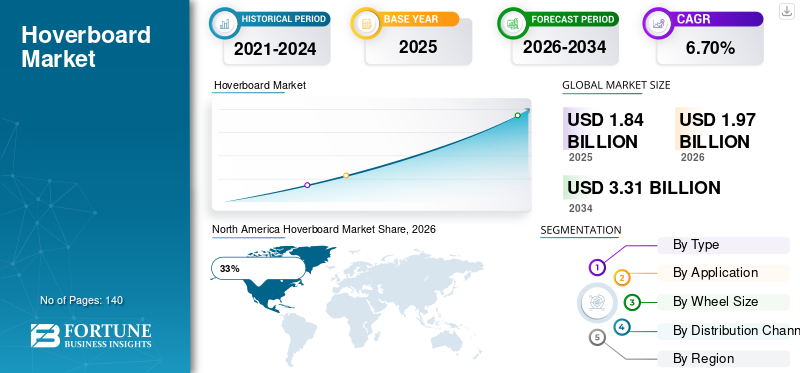
The global hoverboard market size was valued at USD 1.84 billion in 2025. The market is projected to grow from USD 1.97 billion in 2026 to USD 3.31 billion by 2034, exhibiting a CAGR of 6.70% during the forecast period.

The hoverboard market is experiencing strong growth due to increasing demand for electric personal mobility devices, smart transportation solutions, and recreational riding products. Hoverboards are gaining popularity among teenagers, urban commuters, and adventure enthusiasts because of compact design, battery-powered operation, and ease of mobility. The hoverboard market report highlights rising adoption across recreational parks, shopping complexes, educational campuses, and tourism activities. Technological advancements including Bluetooth connectivity, LED lighting, self-balancing systems, and enhanced lithium battery performance are improving consumer interest globally. The hoverboard indicates increasing investment in electric mobility infrastructure and growing demand for eco-friendly short-distance transportation alternatives across urban environments.
The United States hoverboard market is expanding steadily because of rising adoption of electric recreational vehicles and increasing interest in sustainable personal transportation devices. More than 61% of hoverboard purchases in the country are driven by consumers aged 12 years to 35 years seeking smart mobility and entertainment solutions. The Hoverboard Industry Report identifies strong demand during holiday seasons and increasing utilization in amusement parks, university campuses, and residential communities. Retailers across the United States are expanding product portfolios with advanced safety-certified hoverboards featuring smart balancing technologies and app-based controls. Rising urban congestion and growing awareness regarding electric mobility alternatives continue strengthening market demand across metropolitan regions.
Download Free sample to learn more about this report.
Hoverboard Market Key Takeaways
 Global Market Size & Forecast
- 2025 Market Size: USD 1.84 Billion
- 2026 Market Size: USD 1.97 Billion
- 2034 Forecast Market Size: USD 3.31 Billion
- CAGR: 6.70% from 2026-2034
 Market Share
- Asia-Pacific dominated with a 34% market share in 2025.
- Double-wheel hoverboards led by type with nearly 66% market share.
- Online distribution channels led with approximately 58% market share.
 Key Regional Highlights
Asia-Pacific
Asia-Pacific held the largest regional share at 34%.
North America
North America accounted for 33% of the global market.
Europe
Europe represented 26% of the global market.
U.S.
The U.S. is a major market, supported by growing demand for recreational and personal mobility hoverboards.
Japan
Japan accounted for 18% of the Asia-Pacific market, driven by increasing interest in compact electric mobility solutions.
Read More

Hoverboard Market Latest Trends
The hoverboard market trends indicate increasing integration of advanced technologies such as Bluetooth speakers, GPS tracking, mobile application controls, and intelligent self-balancing systems. Manufacturers are introducing hoverboards with larger battery capacities, improved wheel stability, and enhanced speed management systems to improve riding safety and user experience. Demand for rugged off-road hoverboards with durable tires and shock absorption systems is rising significantly among adventure enthusiasts and outdoor recreation users. The hoverboard market Research Report highlights increasing consumer preference for smart electric mobility devices with customizable LED lighting and voice-assisted controls.
Another major trend influencing the hoverboard market Outlook is the expansion of hoverboard-sharing services in tourist destinations, entertainment parks, and urban recreational centers. Businesses are increasingly utilizing hoverboards as rental mobility products for short-distance commuting and leisure activities. Manufacturers are also focusing on lightweight foldable designs to improve portability and convenience for urban consumers.
Download Free sample to learn more about this report.
Hoverboard Market Dynamics
DRIVER
Rising Demand for Eco-Friendly Personal Mobility Solutions
Growing consumer interest in electric transportation and sustainable mobility products is a major driver of the hoverboard market Growth. Urban consumers increasingly seek compact electric devices for short-distance commuting, recreational riding, and campus transportation. Hoverboards provide battery-powered transportation without fuel emissions, making them attractive alternatives for environmentally conscious users. The hoverboard indicates rising adoption among students, office workers, and teenagers seeking convenient mobility solutions in crowded urban environments. Government initiatives promoting electric mobility and green transportation technologies are further supporting market expansion. Manufacturers are introducing advanced self-balancing systems and safer battery technologies to improve consumer confidence. Increasing awareness regarding carbon emission reduction and urban traffic congestion continues strengthening demand for hoverboards globally.
RESTRAINT
Safety Concerns Related to Battery Performance and Accidents
Safety concerns associated with battery overheating, fire hazards, and rider injuries remain significant restraints in the hoverboard market. Earlier incidents involving unstable lithium batteries and poor-quality manufacturing negatively affected consumer confidence in several regions. The Hoverboard Industry Analysis highlights strict regulatory requirements regarding battery certifications, electrical safety standards, and rider protection measures. Parents and educational institutions often express concerns regarding accidents caused by high-speed riding and improper balancing techniques. Additionally, hoverboard usage restrictions in airports, shopping malls, and public transportation systems limit operational accessibility. Manufacturers are required to invest heavily in quality testing, battery management systems, and safety certification procedures to comply with evolving transportation and consumer safety regulations worldwide.
OPPORTUNITY
Expansion of Smart Recreational Mobility Products
The growing popularity of smart recreational devices and electric outdoor entertainment products presents major opportunities for the hoverboard market. Consumers increasingly seek technologically advanced mobility products integrated with mobile applications, entertainment features, and AI-assisted controls. The hoverboard market Opportunities are particularly strong in tourism, amusement parks, shopping complexes, and recreational rental businesses where electric mobility devices are used for leisure activities. Educational campuses and residential communities are also witnessing rising utilization of hoverboards for short-distance travel. Manufacturers are introducing customizable hoverboards with gaming-inspired designs, Bluetooth connectivity, and enhanced lighting systems to attract younger demographics. Expanding e-commerce channels and digital advertising campaigns are further improving product accessibility and consumer engagement across international markets.
CHALLENGE
Intense Competition From Alternative Electric Mobility Devices
The hoverboard market faces strong competition from electric scooters, electric skateboards, e-bikes, and self-balancing unicycles. Consumers increasingly compare battery life, safety, portability, and speed before purchasing electric mobility products. The hoverboard market Insights indicate that electric scooters are particularly preferred for urban commuting because of longer travel range and easier rider control. Price competition among manufacturers also affects profitability and product differentiation strategies. Smaller hoverboard companies face challenges associated with maintaining safety certifications, improving battery technology, and managing fluctuating raw material costs. Rapid technological changes and evolving consumer expectations require continuous innovation to maintain competitiveness within the growing electric mobility industry.
Hoverboard Market Segmentation
By Type
Single-wheel hoverboards account for approximately 34% market share within the type segment due to rising popularity among adventure enthusiasts and experienced riders. These devices provide greater maneuverability and off-road riding capabilities compared with traditional double-wheel models. The hoverboard highlights increasing demand for single-wheel models in outdoor sports, recreational racing, and urban adventure activities. Advanced gyroscopic balancing systems and rugged tire configurations improve riding precision and terrain adaptability. Consumers seeking high-performance electric mobility products increasingly prefer single-wheel hoverboards because of compact design and enhanced portability. Manufacturers are also introducing waterproof and shock-resistant models targeted toward outdoor recreation users.
Double-wheel hoverboards hold nearly 66% market share because of superior balance stability, beginner-friendly operation, and broader commercial adoption. These models are widely preferred by teenagers, casual riders, and first-time users because they offer safer riding experiences and easier maneuverability. The Hoverboard Industry Report indicates strong demand from recreational parks, educational campuses, and entertainment facilities utilizing double-wheel hoverboards for short-distance mobility. Manufacturers increasingly integrate Bluetooth speakers, LED lights, app-based controls, and battery monitoring systems into double-wheel products to improve consumer engagement. Off-road double-wheel hoverboards with larger wheel sizes are also gaining popularity among outdoor recreation users.
To know how our report can help streamline your business, Speak to Analyst
By Application
Recreational applications account for approximately 48% market share within the hoverboard market due to rising popularity among teenagers, children, and entertainment-focused consumers. Hoverboards are widely used in parks, residential communities, amusement centers, and outdoor leisure activities because they provide fun and interactive riding experiences. The hoverboard market Research Report identifies strong influence from social media trends, gaming culture, and youth entertainment activities supporting recreational product demand. Manufacturers increasingly launch colorful hoverboards featuring music systems, LED lighting, and themed designs to attract younger demographics. Seasonal demand during holidays and festivals further strengthens recreational hoverboard sales.
Personal mobility applications contribute approximately 32% market share due to increasing urban congestion and growing demand for compact transportation solutions. Consumers increasingly use hoverboards for short-distance commuting within campuses, residential complexes, and urban commercial areas. The hoverboard market Outlook indicates rising interest among students and office workers seeking convenient battery-powered transportation alternatives. Lightweight construction and self-balancing technologies improve ease of use and portability for daily commuting purposes. Smart city initiatives and increasing electric mobility awareness are also supporting adoption of hoverboards as micro-mobility solutions.
Commercial applications hold approximately 20% market share in the hoverboard market due to increasing use in tourism centers, shopping malls, amusement parks, and rental entertainment businesses. Companies operating recreational facilities increasingly utilize hoverboards as rentable electric mobility products for customer engagement and leisure experiences. The hoverboard market trends indicate growing utilization in hospitality properties, resort destinations, and guided city tour services. Businesses prefer hoverboards because of lower operational costs, compact storage requirements, and increasing popularity among younger tourists. Commercial operators are also investing in fleet management systems and battery monitoring technologies to improve service reliability.
By Distribution Channel
Online distribution channels account for approximately 58% market share because consumers increasingly prefer digital retail platforms for comparing features, pricing, and product reviews before purchasing hoverboards. E-commerce platforms provide broad product availability, promotional discounts, and convenient home delivery services that attract younger buyers. The hoverboard market Insights reveal that online channels are particularly effective for reaching tech-savvy consumers and urban demographics interested in smart mobility products. Manufacturers increasingly utilize digital advertising, influencer marketing, and social media campaigns to strengthen online sales performance. Virtual product demonstrations and app-based customer support services further improve consumer confidence and purchasing convenience.
Offline distribution channels represent approximately 42% market share due to strong consumer preference for physical product testing and in-store technical assistance before purchase. Electronic retail stores, mobility equipment outlets, and recreational product showrooms remain important sales channels for hoverboards globally. The hoverboard market Forecast highlights increasing collaboration between manufacturers and specialty retail chains to improve product visibility and customer engagement. Consumers often prefer offline purchases because they can evaluate balance stability, wheel performance, and build quality directly before buying. Retailers are also offering safety demonstrations and maintenance services to improve customer trust and long-term product satisfaction.
Hoverboard Market Regional Outlook
North America
North America Hoverboard Market Share, 2025 (%) To get more information on the regional analysis of this market, Download Free sample
North America accounts for approximately 33% market share within the hoverboard market because of increasing demand for electric recreational products and personal mobility solutions. The United States remains the dominant regional market supported by strong consumer spending on smart mobility devices and entertainment technologies. Educational campuses, amusement parks, and urban recreational centers increasingly utilize hoverboards for short-distance transportation and leisure activities. The hoverboard indicates strong demand among teenagers and young adults influenced by gaming culture and social media trends. Canada is also witnessing increasing hoverboard adoption due to growing awareness regarding eco-friendly transportation alternatives and battery-powered mobility products. Retailers across the region are introducing advanced hoverboards with larger wheels, safety certifications, and smart mobile application integration. Rising popularity of electric outdoor recreation and adventure sports continues strengthening regional market demand. Government focus on sustainable mobility solutions and increasing electric transportation awareness are further supporting hoverboard market Growth across North America.
Europe
Europe holds approximately 26% market share in the hoverboard market because of rising adoption of electric mobility products and growing consumer interest in sustainable transportation technologies. Countries including Germany, France, Italy, and the United Kingdom are witnessing increasing hoverboard utilization across urban recreational areas, campuses, and tourism facilities. The hoverboard market Research Report identifies strong demand for safety-certified hoverboards with enhanced battery efficiency and durable wheel systems. European consumers increasingly prefer compact electric mobility products for short-distance urban transportation and outdoor entertainment activities. Manufacturers are introducing advanced designs focused on rider safety, environmental sustainability, and improved portability. Tourism operators and recreational rental businesses are also expanding hoverboard services within urban sightseeing and leisure destinations. Regulatory focus on electrical safety standards and eco-friendly mobility solutions continues encouraging technological innovation across the European hoverboard market.
Germany Hoverboard Market
Germany contributes approximately 24% market share within the European hoverboard market because of rising demand for smart electric mobility products and environmentally friendly transportation solutions. Urban consumers increasingly utilize hoverboards for recreational riding and short-distance commuting purposes. The hoverboard market Insights indicate strong demand for safety-certified models with advanced battery management systems and durable wheel performance. German retailers are expanding premium hoverboard product lines featuring Bluetooth connectivity, LED displays, and intelligent speed control technologies. Adventure sports communities and outdoor recreational users are also contributing to increasing product adoption. Growing interest in sustainable urban mobility and electric transportation technologies continues strengthening hoverboard market expansion across Germany.
United Kingdom Hoverboard Market
The United Kingdom accounts for approximately 21% market share within the European hoverboard market due to increasing consumer interest in recreational electric mobility devices and urban transportation alternatives. Hoverboards are gaining popularity among teenagers, students, and entertainment-focused consumers across metropolitan cities. The hoverboard market Outlook highlights growing online sales supported by digital advertising campaigns and influencer-driven product promotions. Urban recreational parks and tourist attractions increasingly provide hoverboard rental services for leisure activities and guided tours. Manufacturers are introducing lightweight and foldable hoverboard models suitable for compact urban transportation. Rising electric mobility awareness and growing demand for battery-powered entertainment products continue supporting long-term market growth across the United Kingdom.
Asia-Pacific
Asia-Pacific dominates the hoverboard market with approximately 34% market share due to large-scale manufacturing capabilities, growing urbanization, and strong youth consumer demand for smart mobility devices. China, Japan, South Korea, and India represent major regional markets because of increasing adoption of electric transportation technologies and recreational mobility products. The hoverboard market trends indicate rising popularity of self-balancing scooters across shopping malls, educational campuses, and urban entertainment centers. China remains a major manufacturing hub for hoverboards because of strong electronics production infrastructure and cost-efficient battery manufacturing capabilities. Consumers throughout Asia-Pacific increasingly prefer compact electric mobility products integrated with advanced digital features and modern entertainment systems. E-commerce expansion and social media marketing campaigns continue strengthening product accessibility across regional markets. Rising disposable income and growing popularity of electric recreation activities further support long-term hoverboard market Growth throughout Asia-Pacific.
Japan Hoverboard Market
Japan contributes approximately 18% market share within the Asia-Pacific hoverboard market because of advanced consumer electronics adoption and strong demand for innovative mobility technologies. Japanese consumers increasingly seek compact electric transportation products for recreational riding and urban convenience. The hoverboard highlights growing popularity of hoverboards featuring intelligent balancing systems, compact designs, and advanced battery safety technologies. Entertainment facilities and technology-focused retail stores are expanding hoverboard product offerings targeted toward younger consumers and tourists. Manufacturers are emphasizing premium build quality, lightweight materials, and smart application connectivity to improve consumer experience. Growing interest in futuristic transportation devices and urban recreation continues supporting hoverboard market expansion across Japan.
China Hoverboard Market
China accounts for approximately 37% market share within the Asia-Pacific hoverboard market because of extensive electronics manufacturing infrastructure and strong domestic demand for electric mobility products. Major cities including Shenzhen, Beijing, and Shanghai are experiencing increasing utilization of hoverboards in recreational centers, residential communities, and entertainment venues. The hoverboard market Forecast identifies strong growth in online retail sales and export activities driven by cost-effective manufacturing capabilities. Chinese manufacturers continue investing in improved lithium battery technologies, safety systems, and intelligent mobility features to strengthen international competitiveness. Social media entertainment trends and youth-focused electric mobility culture continue driving strong domestic demand. Increasing investment in smart transportation products further accelerates hoverboard market penetration throughout China.
Rest of World
The Rest of World region holds approximately 7% market share within the hoverboard market with increasing demand across Latin America, the Middle East, and Africa. Brazil and the United Arab Emirates represent major growth markets because of rising consumer interest in electric recreational devices and tourism-focused mobility solutions. The Hoverboard Industry Analysis highlights growing adoption within shopping malls, recreational parks, and entertainment facilities across urban regions. Middle Eastern tourism operators increasingly utilize hoverboards for guided tours, luxury resort entertainment, and recreational customer experiences. Latin American consumers are also showing growing interest in affordable electric mobility devices for leisure and urban transportation purposes. International manufacturers are strengthening regional distribution partnerships to improve accessibility and product awareness. Rising digital commerce penetration and increasing youth demand for smart entertainment products continue supporting hoverboard market expansion across developing economies.
List of Top Hoverboard Companies
- Ninebot Inc.
- HaloBoard
- Segway Inc.
- TOMOLOO Technology Industrial Co. Ltd.
- SURFUS
- Hangzhou Chic Intelligent Technology Co.
- Shenzhen Rooder Technology Co. Ltd.
- JIALIKE Electronic Company Ltd.
- Airwheel Technology Co. Ltd.
- Razor USA LLC
Top Two Companies with Highest Market Share
- Segway Inc. – 19% market share
- Ninebot Inc. – 16% market share
Investment Analysis and Opportunities
Investment activity within the hoverboard market is increasing because of rising demand for electric recreational transportation and smart mobility products. Manufacturers are investing heavily in lithium battery innovation, intelligent balancing systems, and AI-assisted riding technologies to improve safety and performance. The hoverboard market Opportunities are particularly strong in tourism, educational campuses, entertainment parks, and urban mobility sectors where compact electric transportation products are gaining popularity.
Private investors and mobility technology companies are also supporting development of premium hoverboards featuring GPS tracking, smartphone integration, and advanced rider analytics. Expansion of e-commerce platforms and direct-to-consumer digital sales channels continues improving international product reach and brand visibility. Governments promoting electric transportation and eco-friendly mobility solutions are indirectly supporting hoverboard adoption among younger consumers and recreational users. Emerging markets across Asia-Pacific and Latin America are witnessing rising investment in electric mobility retail infrastructure and smart transportation technologies.
New Product Development
New product development within the hoverboard market is focused on advanced safety technologies, smart digital connectivity, and improved riding performance. Manufacturers are introducing hoverboards equipped with intelligent self-balancing systems, anti-slip footpads, GPS monitoring, and Bluetooth-enabled mobile applications. Rugged off-road hoverboards featuring shock absorption systems, waterproof designs, and larger wheel sizes are gaining popularity among adventure riders and outdoor recreation users.
The hoverboard market Research Report highlights increasing innovation in lithium battery efficiency, fast charging capabilities, and temperature management systems to improve rider safety and product reliability. Manufacturers are also developing lightweight foldable hoverboards designed for urban commuters seeking portable transportation solutions. Integration of LED lighting systems, voice control features, and entertainment-focused music speakers is attracting younger consumers and gaming enthusiasts. Premium brands are focusing on ergonomic design improvements and enhanced wheel traction for smoother riding experiences across multiple terrains.
Five Recent Developments (2023-2025)
- In 2023, major hoverboard manufacturers introduced enhanced battery safety technologies and certified lithium-ion protection systems.
- In 2023, electric mobility companies launched off-road hoverboards with rugged wheel designs and waterproof construction features.
- In 2024, manufacturers expanded Bluetooth-enabled hoverboards integrated with smartphone application controls and GPS tracking systems.
- In 2024, several brands introduced lightweight foldable hoverboards targeted toward urban commuting and campus transportation users.
- In 2025, hoverboard companies expanded international e-commerce partnerships to strengthen global product distribution and digital retail presence.
Report Coverage
The hoverboard market report provides comprehensive analysis of market trends, product innovation, competitive landscape, regional performance, and emerging business opportunities across the global electric mobility industry. The report evaluates changing consumer preferences regarding recreational mobility devices, urban transportation solutions, and smart battery-powered transportation products. It includes detailed segmentation analysis by wheel configuration, application category, and distribution channel to support strategic planning and commercial expansion initiatives.
Request for Customization to gain extensive market insights.
The hoverboard also examines technological advancements in self-balancing systems, lithium battery technologies, intelligent mobility controls, and safety certification standards. Regional analysis covers North America, Europe, Asia-Pacific, and Rest of World with insights regarding manufacturing activities, consumer behavior, and retail distribution trends. Competitive landscape evaluation highlights major manufacturers, product launch strategies, partnership activities, and investment expansion within the electric mobility sector. The report further assesses emerging opportunities associated with tourism mobility services, recreational entertainment industries, and sustainable transportation initiatives supporting long-term hoverboard market Growth.
Frequently Asked Questions
Fortune Business Insights says that the global market value stood at USD 1.84 billion in 2025 and is projected to reach USD 3.31 billion by 2034.
The market is expected to exhibit a CAGR of 6.70% during the forecast period of 2026-2034.
Double-wheel hoverboards led the type segment with nearly 66% market share, supported by superior balance stability, beginner-friendly operation, and broader commercial adoption.
Key players include Ninebot Inc., HaloBoard, Segway Inc., TOMOLOO Technology Industrial Co. Ltd., SURFUS, and Hangzhou Chic Intelligent Technology Co.
Major trends include the integration of Bluetooth, GPS, mobile-app controls, and intelligent self-balancing systems, along with rising demand for off-road and smart hoverboards. Asia-Pacific leads regionally with approximately 34% market share.



- 2021-2034
- 2025
- 2021-2024
- 140
-

(Offer valid till 15th Sep 2026)
Get 30-60 hrs Free Customization
Expand Regional and Country Coverage, Segments Analysis, Company Profiles, Competitive Benchmarking, and End-user Insights.














-
US +1 833 909 2966 ( Toll Free )
-
Get In Touch With Us