HR Analytics Market Size, Share & Industry Analysis, By Component (Solutions, and Services), Deployment Mode (On-Premise, and Cloud), Organization Size (Large Enterprises, and Small and Medium Enterprises), Application (Talent Acquisition and Onboarding, Workforce Planning and Optimization, and More), End-User Industry (IT and Telecom, Retail and Consumer Goods, Manufacturing, and More), and Regional Forecast, 2026-2034
 Download Free Sample
HR Analytics Market Overview
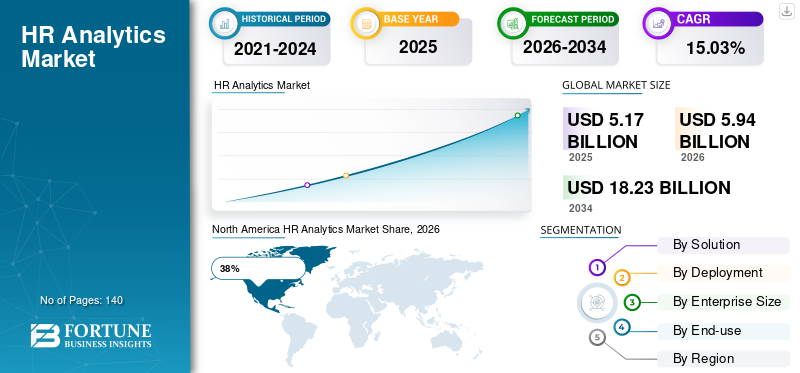
The HR analytics market size was valued at USD 4.75 billion in 2025. The market is projected to grow from USD 5.38 billion in 2026 to USD 14.54 billion by 2034, exhibiting a CAGR of 13.22% during the forecast period.

The HR Analytics Market is expanding as organizations increasingly use workforce data to improve hiring, retention, productivity, employee engagement, compensation, performance, and workforce planning. HR analytics platforms combine data from human capital management systems, payroll, recruitment, learning, performance management, employee surveys, attendance, and operational systems to generate actionable workforce insights. The HR Analytics Market Analysis increasingly emphasizes predictive and prescriptive analytics rather than basic reporting. Artificial intelligence, machine learning, natural language interfaces, skills intelligence, workforce forecasting, and automated dashboards are reshaping how HR departments support business decisions. Demand is particularly strong among organizations seeking measurable workforce outcomes, stronger talent strategies, improved resource allocation, and faster responses to changing labor conditions.
The USA HR Analytics Market is characterized by strong adoption of cloud-based human capital technologies, workforce intelligence platforms, AI-enabled decision support, and employee data analytics. Large enterprises across technology, financial services, healthcare, retail, manufacturing, professional services, and logistics are using HR analytics to understand workforce behavior and align talent decisions with business objectives. Demand is increasingly shifting from static HR reporting toward predictive insights covering attrition risk, hiring efficiency, skills gaps, workforce capacity, compensation, and employee experience.
The USA HR Analytics Market Outlook is also being shaped by widespread enterprise AI adoption. HR leaders are evaluating AI-assisted analytics, conversational workforce insights, automated reporting, and skills-based workforce planning. Organizations are simultaneously placing greater emphasis on data governance, privacy, transparency, bias monitoring, and responsible use of employee information. These factors create substantial HR Analytics Market Opportunities for analytics providers capable of integrating workforce data with broader financial and operational information.
Download Free sample to learn more about this report.
Key Takeaways
Market Size & Growth
- Global market size 2025: USD 4.75 Billion
- Global market size 2034: USD 14.54 Billion
- CAGR (2025–2034): 13.22%
Market Share – Regionals
- North America: 34%
- Europe: 27%
- Asia-Pacific: 29%
- Rest of World: 10%
Country-Level Shares
- Germany:31% of Europe’s market
- United Kingdom: 24% of Europe’s market
- Japan: 29% of Asia-Pacific market
- China: 38% of Asia-Pacific market
HR Analytics Market Latest Trends
A prominent HR Analytics Market Trend is the integration of generative AI and conversational interfaces into workforce analytics. Instead of requiring HR professionals and managers to navigate multiple dashboards, newer platforms allow users to ask workforce questions in natural language and receive summarized insights. This approach makes analytics accessible to business managers who may not possess advanced data-analysis skills. AI is also being used to summarize employee feedback, identify emerging workforce issues, recommend actions, and automate recurring reporting activities.
Download Free sample to learn more about this report.
Another important trend is the movement toward skills-based workforce intelligence. Organizations are increasingly analyzing employee skills, job requirements, learning activity, career interests, and internal mobility data together. This enables HR teams to identify skills gaps, discover employees suitable for new roles, plan reskilling initiatives, and support succession planning. AI-powered talent intelligence is increasingly being embedded into recruiting and workforce planning workflows. HR Analytics Market Trends also include greater integration between HR, finance, operations, and business performance data. Organizations want workforce decisions to be connected with productivity, organizational structure, labor planning, and operational requirements. At the same time, privacy-aware analytics, explainable AI, data quality management, employee listening analytics, and real-time workforce dashboards are becoming important purchasing criteria for enterprise buyers.
HR Analytics Market Dynamics
DRIVER
Increasing demand for data-driven workforce decision-making.
Organizations are under growing pressure to make workforce decisions based on measurable evidence rather than intuition alone. Traditional HR reporting can show historical headcount, turnover, absence, recruitment activity, and compensation information, but modern enterprises increasingly require explanations of why workforce changes occur and what may happen next. This transition is a fundamental driver of HR Analytics Market Growth because analytics platforms can convert large volumes of workforce information into actionable business intelligence. Recruitment teams use analytics to identify hiring bottlenecks, evaluate sourcing channels, compare candidate pipelines, and monitor onboarding effectiveness. HR leaders use predictive models to identify potential retention risks and understand the workforce factors associated with employee departures. Business leaders can examine workforce capacity, skills availability, organizational structure, and labor requirements when developing business plans.
The expansion of hybrid work has further increased demand for workforce visibility. Organizations need to understand collaboration patterns, workforce productivity, engagement, employee movement, and managerial effectiveness without relying entirely on physical presence. HR analytics provides structured methods for examining these issues while allowing organizations to combine employee information with operational indicators. Another driver is the increasing availability of digital HR data. Cloud HCM systems, recruitment applications, learning platforms, employee surveys, time-management systems, and performance tools generate large datasets that can be analyzed together. As enterprises become more comfortable with data-driven management, the HR Analytics Market Research Report landscape is increasingly focused on predictive analytics, AI, workforce planning, talent intelligence, and decision automation.
RESTRAINT
Data privacy concerns and inconsistent workforce data quality.
Data privacy and governance remain important restraints for the HR Analytics Market because workforce analytics involves sensitive employee information. Organizations may process compensation information, performance records, attendance data, demographic information, employee feedback, career history, skills profiles, and other workforce attributes. Improper handling of this information can create legal, ethical, and reputational risks. Data quality is another major limitation. HR information is frequently distributed across multiple systems that use different definitions, employee identifiers, job structures, reporting periods, and organizational hierarchies. One system may classify an employee differently from another, while historical information may contain incomplete or inconsistent records. Analytics models built on unreliable information can produce misleading conclusions and reduce confidence among HR and business leaders.
The adoption of AI introduces additional governance requirements. Organizations need to understand how models generate recommendations, how employee information is processed, and whether automated decisions could introduce unfair outcomes. HR teams may therefore require stronger model validation, access controls, audit trails, human oversight, and data governance frameworks before deploying advanced analytics. Smaller businesses can face additional constraints because they may not have dedicated data engineering, analytics, or HR technology specialists. Integrating multiple systems and developing standardized workforce metrics can require substantial technical effort. These factors can slow implementation and encourage some organizations to begin with basic reporting before progressing toward predictive and prescriptive analytics.
OPPORTUNITY
Expansion of AI-powered workforce intelligence and skills analytics.
Artificial intelligence creates a major opportunity for HR Analytics Market Opportunities by enabling organizations to move from retrospective reporting toward continuous workforce intelligence. AI systems can identify relationships across workforce datasets, summarize large volumes of employee feedback, detect unusual workforce patterns, support talent recommendations, and help managers understand organizational risks. Skills analytics is particularly promising. Businesses are experiencing rapid changes in required capabilities as automation, cloud technologies, artificial intelligence, cybersecurity, and digital operations reshape job requirements. HR analytics platforms can create skills inventories, compare current workforce capabilities with future requirements, identify shortages, and recommend learning or internal mobility pathways.
Employee listening is another attractive area. Organizations increasingly gather feedback through surveys, pulse checks, engagement programs, performance discussions, and other channels. Advanced analytics can categorize feedback, identify recurring themes, monitor changes in sentiment, and help managers prioritize interventions. This creates opportunities for platforms that connect employee experience data with retention, performance, and organizational outcomes. The market also has opportunities in embedded analytics. Instead of forcing HR teams to move between systems, vendors can place workforce insights directly into recruiting, performance, learning, compensation, and manager workflows. This improves accessibility and can increase analytics adoption across the enterprise. For B2B customers, integration is becoming a differentiator. HR Analytics Market Insights increasingly favor platforms that connect people data with finance, operations, sales, and productivity information. Such integration allows organizations to evaluate workforce decisions in the context of broader business priorities.
CHALLENGE
Turning complex workforce data into trusted and actionable decisions.
A central challenge for the HR Analytics Industry Report landscape is the gap between collecting data and generating useful business decisions. Many organizations possess substantial workforce information but lack standardized definitions, analytical maturity, or clear business questions. A large number of dashboards does not necessarily create better workforce management. Analytics teams must determine which metrics genuinely matter. Headcount, turnover, absenteeism, engagement, recruitment speed, training completion, and performance are useful measures, but their meaning depends on business context. A high turnover rate in one workforce segment may represent a serious risk, while movement in another segment may reflect healthy internal mobility. Effective analytics therefore requires interpretation rather than simple visualization.
Model explainability is another challenge. HR leaders may be reluctant to act on predictive recommendations if they cannot understand the factors behind them. Employees may also question automated decisions involving hiring, performance, promotion, or retention. Maintaining human oversight is therefore essential when analytics moves into decision-support territory. Integration complexity can further slow implementation. Enterprises frequently operate multiple HR applications obtained at different times, creating fragmented data environments. Connecting these sources while maintaining security and consistent definitions requires careful architecture. Vendors that simplify integration, improve data quality, provide transparent analytics, and support responsible AI can gain an advantage as organizations seek dependable workforce intelligence.
HR Analytics Market Segmentation
By Component
HR analytics solutions represent the technology platforms used to collect, integrate, analyze, visualize, and interpret workforce information. These solutions can include workforce dashboards, predictive analytics, talent intelligence, employee listening, compensation analytics, recruitment analytics, skills analytics, workforce planning, organizational analytics, and AI-powered decision-support capabilities. The solutions segment is central to the HR Analytics Market because organizations increasingly prefer integrated technology capable of bringing information from multiple HR processes into a unified analytical environment. Modern solutions are moving beyond static dashboards. They can identify workforce patterns, generate alerts, compare organizational segments, detect potential risks, and provide recommendations to managers. For example, a platform may identify a department with rising attrition risk and connect that signal with employee engagement, compensation, manager changes, workload, tenure, or career-mobility information. This creates more useful insights than a simple turnover report. Solutions accounted for an estimated 72% of the HR Analytics Market in 2025. Their strong position reflects the increasing adoption of cloud HCM platforms and specialized people analytics technologies. Enterprise customers generally seek configurable dashboards, standardized metrics, predictive models, secure data integration, role-based access, and self-service capabilities. AI is becoming an important differentiator within solutions. Natural-language interfaces can allow executives and managers to ask questions about workforce performance without specialized analytical skills. Generative AI can summarize trends, explain changes, and recommend areas for investigation. Skills intelligence is also being integrated into talent acquisition, learning, internal mobility, and succession planning. The competitive environment favors solutions that combine usability with analytical depth. Large enterprises want centralized governance and sophisticated modeling, while HR managers want simple interfaces and immediate answers. Vendors therefore have opportunities to differentiate through embedded analytics, explainable AI, data unification, scenario planning, and industry-specific workforce models.
HR analytics services include consulting, implementation, integration, data preparation, analytics model development, training, managed services, customization, maintenance, and ongoing support. Services are particularly important when enterprises have fragmented HR systems or require specialized workforce analytics programs. Implementation specialists help organizations define data structures, standardize HR metrics, connect multiple systems, establish governance policies, and design executive dashboards. Consulting services can also assist with workforce planning, organizational redesign, talent strategy, compensation analysis, and employee experience programs. The services segment represented an estimated 28% share of the HR Analytics Market. Demand is supported by the complexity of enterprise deployments and the need for ongoing analytics management. Managed analytics services can be particularly valuable for organizations that lack internal data science resources. Services are also becoming more strategic. Instead of simply configuring dashboards, providers increasingly help customers determine which workforce questions should be analyzed and how insights can be incorporated into decision processes. This creates opportunities for providers with expertise across HR technology, data science, organizational strategy, and business intelligence.
To know how our report can help streamline your business, Speak to Analyst
By Deployment Mode
On-premise HR analytics remains relevant among organizations requiring direct control over infrastructure, data, security policies, or integration environments. Large institutions with complex legacy systems may maintain locally hosted analytics because migration to cloud platforms can involve extensive data transformation and governance considerations. On-premise systems can provide organizations with greater control over deployment architecture and internal data flows. However, they require customers to manage infrastructure, updates, maintenance, security, scalability, and technical support. This can make implementation more resource-intensive.
Cloud deployment is becoming the preferred model for many organizations because it enables scalable access, centralized updates, easier integration, remote availability, and faster deployment. Cloud-based HR analytics can aggregate data from geographically distributed workforce systems and make dashboards available to authorized managers across locations. Cloud analytics also supports AI capabilities because large-scale processing and model updates can be managed centrally. Organizations can introduce new analytics functions without rebuilding local infrastructure. For B2B buyers, cloud deployment is particularly attractive when HR analytics must serve global workforces and integrate with other enterprise cloud applications.
By Organization Size
Large enterprises represent a major customer group because they manage complex workforces across departments, geographies, job families, and business units. These organizations often have enough workforce data to justify advanced analytics and require detailed reporting for strategic planning. Large businesses use HR analytics to support workforce forecasting, talent acquisition, succession planning, compensation management, employee engagement, organizational design, and skills planning. They also tend to require strong governance, integration, role-based access, audit capabilities, and enterprise-scale reporting.
Small and medium enterprises are increasingly adopting HR analytics as cloud platforms reduce technical barriers. Smaller organizations may begin with workforce dashboards, recruitment metrics, attendance analytics, employee engagement, and turnover reporting before adopting predictive capabilities. The SME opportunity is particularly strong for simplified analytics platforms that provide preconfigured metrics and automated insights. Easy deployment, transparent pricing structures, minimal technical requirements, and self-service interfaces can help smaller businesses use workforce intelligence without maintaining dedicated analytics teams.
By Application
Talent acquisition analytics helps organizations evaluate recruitment pipelines, source effectiveness, candidate progression, hiring speed, offer acceptance, and onboarding outcomes. Analytics can reveal where candidates leave the recruitment process and which roles experience recurring hiring difficulties. AI is increasing the sophistication of recruitment analytics by matching skills with job requirements, identifying candidate patterns, and generating recommendations. Onboarding analytics can then track completion, early engagement, training progress, and workforce integration.
Workforce planning uses historical and current data to estimate future staffing requirements, skills demand, organizational capacity, and labor allocation. It can support scenario planning when businesses open new facilities, restructure departments, introduce automation, or enter new markets. Optimization analytics can identify overstaffing, understaffing, skill shortages, organizational bottlenecks, and inefficient workforce allocation. This makes workforce planning one of the most strategic areas of the HR Analytics Market.
Performance and engagement analytics combine performance indicators, employee feedback, learning activity, manager information, and organizational data to identify workforce patterns. Businesses can use these insights to understand engagement drivers and evaluate where management interventions may be required. Retention analytics is particularly valuable for identifying employee groups that may have elevated departure risk. Organizations can use such information to review compensation, career opportunities, workload, management practices, development opportunities, and internal mobility.
Compensation analytics helps organizations assess pay structures, identify inconsistencies, evaluate compensation competitiveness, and support pay-equity initiatives. Learning analytics connects training activity with skills development and career progression. Other applications include absence management, diversity analytics, succession planning, organizational network analysis, employee experience measurement, labor-cost planning, and HR service optimization. As platforms become more integrated, these functions are increasingly delivered through unified workforce intelligence environments.
By End-User Industry
IT and telecom organizations generate significant demand because their workforces operate in rapidly changing skill environments. HR analytics helps these businesses track technical skills, hiring requirements, workforce mobility, employee productivity, and retention.
Retail organizations use workforce analytics to manage large distributed workforces, seasonal staffing, recruitment, scheduling, employee engagement, and turnover. Consumer goods companies use analytics to connect workforce capabilities with sales, manufacturing, supply-chain, and product-development requirements.
Manufacturing organizations increasingly use HR analytics to support workforce planning, industrial skills management, training, safety, shift allocation, and succession planning. Analytics can identify skill shortages and support reskilling programs as factories adopt automation and connected technologies.
Healthcare, banking, insurance, education, government, transportation, energy, hospitality, professional services, and logistics are also important users. Each industry requires customized workforce metrics because labor structures, compliance requirements, employee roles, and operational models differ.
HR Analytics Market Regional Outlook
North America
North America HR Analytics Market Share, 2025 (%)
To get more information on the regional analysis of this market, Download Free sample
North America represents approximately 34% of the global HR Analytics Market. The region benefits from mature enterprise software adoption, extensive use of cloud HCM platforms, strong demand for AI-enabled workforce intelligence, and high awareness of data-driven HR management. The United States remains the dominant market within the region, with Canada providing additional demand through enterprise digital transformation and workforce technology modernization. Organizations across technology, financial services, healthcare, retail, manufacturing, professional services, and logistics are using analytics for workforce planning, employee retention, talent acquisition, compensation, and productivity management. Large companies increasingly want HR data connected with financial and operational information so executives can understand how workforce decisions affect broader business performance. This supports demand for integrated analytics rather than isolated HR dashboards. The North American HR Analytics Market Outlook is also being influenced by AI adoption. Vendors are incorporating generative AI, conversational analytics, predictive recommendations, and automated insight generation into workforce platforms. Employee listening is gaining importance as companies seek more continuous information about engagement and workplace experience. Skills-based talent management is another major opportunity, particularly in technology-driven sectors experiencing rapid changes in job requirements.
Europe
Europe accounts for approximately 27% of the HR Analytics Market. The regional market is characterized by strong interest in workforce transparency, employee experience, skills development, organizational efficiency, and responsible handling of employee information. Enterprises are increasingly using analytics to support workforce planning while maintaining strong governance around employee data. Germany, the United Kingdom, France, the Netherlands, and other advanced European economies provide significant demand. Industrial companies are using analytics to manage technical skills and workforce transitions, while professional services and technology organizations focus on talent mobility and retention. European businesses are also exploring AI-enabled workforce planning and employee listening. Data governance is a major purchasing consideration in Europe. Organizations want secure systems with appropriate access controls, clear analytical methodologies, and responsible AI practices. This encourages vendors to develop transparent models and governance capabilities. The regional HR Analytics Industry Analysis also indicates opportunities for multilingual analytics, localized workforce metrics, compliance-oriented reporting, and cross-border workforce management.
Germany HR Analytics Market
Germany represents approximately 31% of the European HR Analytics Market. The country's large manufacturing base, engineering workforce, industrial automation activity, and sophisticated enterprise technology environment create strong demand for workforce intelligence. Automotive, machinery, chemicals, electronics, logistics, and professional services companies use HR analytics to address workforce planning, technical skills, productivity, succession, and employee development. German enterprises are increasingly interested in skills-based workforce strategies because industrial transformation requires new capabilities in automation, software, artificial intelligence, data management, and advanced manufacturing. HR analytics can help organizations map existing skills against future requirements and identify employees suitable for training or internal mobility. Privacy, governance, transparency, and employee trust are particularly important when organizations introduce advanced analytics. Businesses therefore seek systems that can provide actionable workforce insights while maintaining appropriate controls over sensitive employee information. The Germany HR Analytics Market Outlook is closely associated with industrial transformation, skills intelligence, workforce planning, and responsible AI.
United Kingdom HR Analytics Market
The United Kingdom represents approximately 24% of the European HR Analytics Market. The country has a sophisticated HR technology ecosystem and strong demand from financial services, technology, healthcare, retail, professional services, education, and public-sector organizations. UK enterprises increasingly use people analytics to support recruitment, retention, engagement, organizational planning, and employee experience. Workforce analytics is becoming increasingly important for organizations managing hybrid workforces and rapidly changing skill requirements. Employers can analyze workforce composition, internal mobility, recruitment activity, employee feedback, and performance information to identify areas requiring intervention. AI-enabled tools are also expanding the accessibility of analytics for managers. UK organizations place considerable emphasis on data protection, governance, transparency, and fair treatment in automated workforce decisions. Vendors that provide explainable analytics, strong access controls, audit capabilities, and responsible AI features can address these requirements. The United Kingdom HR Analytics Market Research Report landscape therefore offers opportunities across workforce intelligence, employee listening, talent analytics, and AI-supported decision-making.
Asia-Pacific
Asia-Pacific represents approximately 29% of the global HR Analytics Market. The region combines large employee populations, rapidly expanding enterprise technology adoption, digital transformation, and increasing investment in cloud-based HR platforms. Japan, China, India, Australia, Singapore, and South Korea are important contributors. Businesses are increasingly using analytics to manage complex workforces and address skills shortages. Technology companies use people analytics for talent acquisition and retention, manufacturers use it for workforce planning and skills management, while retail and logistics companies use analytics for scheduling, recruitment, and employee engagement. The region also presents strong opportunities for localized analytics products. Enterprises operating across multiple countries require support for different languages, labor structures, organizational models, and workforce practices. Cloud-based platforms with flexible configurations can address these requirements. The Asia-Pacific HR Analytics Market Opportunities are particularly strong in AI-powered analytics, skills intelligence, employee experience, and workforce optimization.
Japan HR Analytics Market
Japan represents approximately 29% of the Asia-Pacific HR Analytics Market. The country is experiencing increased interest in workforce productivity, talent development, employee mobility, and digital HR transformation. Enterprises are using analytics to understand workforce composition and support more strategic talent management. Workforce aging and changing employment patterns are encouraging organizations to examine skills, succession, productivity, and internal mobility more systematically. HR analytics can help businesses identify critical capabilities and develop targeted training programs. Manufacturing and technology organizations are particularly relevant users because they require specialized technical talent. Japanese enterprises generally value reliability, data quality, security, and operational consistency. Analytics providers that deliver standardized metrics, strong governance, intuitive dashboards, and AI-supported insights can address these expectations. The Japan HR Analytics Market is also benefiting from broader enterprise digitalization.
China HR Analytics Market
China represents approximately 38% of the Asia-Pacific HR Analytics Market. Large enterprises across technology, manufacturing, retail, financial services, logistics, and professional services are increasingly adopting digital HR platforms. Workforce analytics supports recruitment, employee retention, organizational planning, productivity management, and skills development. Large and geographically distributed workforces create substantial demand for centralized workforce information. Organizations can use analytics to compare business units, understand staffing requirements, identify skills gaps, and monitor employee movement. AI is increasingly being incorporated into HR platforms to improve automation and insight generation. Chinese enterprises are also adopting digital employee services and cloud-based HR technologies. Vendors that provide scalable platforms, localized functionality, secure data management, and strong integration capabilities can address enterprise requirements. The China HR Analytics Market Outlook is closely linked with workforce digitalization, AI adoption, enterprise software modernization, and organizational optimization.
Rest of World
Rest of World represents approximately 10% of the global HR Analytics Market and includes Latin America, the Middle East, and Africa. Adoption varies according to enterprise digitization, HR technology maturity, cloud infrastructure, workforce complexity, and investment in business intelligence. Larger companies and multinational organizations are generally leading adoption. Workforce analytics is becoming valuable in sectors such as banking, telecommunications, retail, energy, logistics, manufacturing, healthcare, and professional services. Organizations use analytics to monitor workforce costs, recruitment, employee movement, engagement, and organizational capacity. As cloud HCM adoption increases, more businesses can access analytics without building extensive internal infrastructure. A significant opportunity exists for managed analytics and packaged workforce intelligence solutions. Organizations with limited data science resources can benefit from automated dashboards, standardized metrics, AI-assisted analysis, and outsourced analytics support. Vendors that offer scalable solutions with multilingual capabilities and straightforward implementation can strengthen their position across emerging markets.
List of Top HR Analytics Companies
- Cegid
- Crunchr
- GainInsights
- IBM Corporation
- Infor
- MicroStrategy Inc.
- Sage Software Solutions Pvt. Ltd.
- SAP SE
- Sisense Inc.
- Tableau Software, LLC.
- UKG Inc.
- Visier, Inc.
- Workday, Inc.
- Zoho Corp. Pvt. Ltd.
Top Two Companies by Market Share
- Workday, Inc.: approximately 12.4%
- Visier, Inc.: approximately 10.6%
Investment Analysis and Opportunities
Investment in the HR Analytics Market is increasingly directed toward AI-enabled workforce intelligence, skills analytics, predictive workforce planning, employee listening, and embedded decision support. Enterprise buyers want platforms that can combine HR information with business data and transform workforce metrics into practical actions. This creates opportunities for vendors developing scalable data foundations and intelligent analytics applications. Specialized investment opportunities are also emerging around skills intelligence. Businesses need better visibility into existing employee capabilities and future skills requirements as automation and AI reshape jobs. Platforms that can connect recruiting, learning, performance, internal mobility, and workforce planning can become strategic systems for talent management.
Employee experience analytics provides another investment area. Organizations increasingly want to understand engagement, workload, career development, manager effectiveness, and retention risks. AI-powered sentiment analysis and automated insight generation can help HR teams process large volumes of employee feedback. For investors and B2B technology buyers, integration capability is becoming increasingly important. Solutions that connect with HCM, payroll, recruitment, finance, learning, and productivity systems can create stronger analytical value. Cloud deployment, secure data architecture, responsible AI, and self-service analytics are also significant areas for investment.
New Product Development
New product development is focused heavily on making HR analytics more intelligent, accessible, and actionable. AI-powered conversational interfaces are allowing managers to ask workforce questions in natural language rather than manually building complex reports. Generative AI can summarize employee feedback, explain workforce trends, identify unusual patterns, and produce management recommendations. Skills intelligence is another major innovation area. Modern platforms can build employee skills profiles, analyze job requirements, identify gaps, and recommend learning or career opportunities. This supports the transition from job-based workforce management toward skills-based workforce planning.
Embedded analytics is also changing product design. Instead of presenting information in a separate analytics portal, vendors are integrating insights into recruiting, performance, compensation, learning, and employee-management workflows. This allows managers to act on information within the process where decisions are being made. Recent product innovation also emphasizes responsible AI. Vendors are introducing controls intended to improve transparency, identify potentially biased outputs, and provide governance over AI-assisted HR processes. Data unification is another important development, allowing workforce information from different sources to be standardized and analyzed through common metrics. These developments are expanding the HR Analytics Market Insights landscape toward intelligent, integrated, and continuously updated workforce decision platforms.
Five Recent Developments (2023-2025)
- Visier People Essentials launch in 2023: Visier introduced a simplified people analytics offering designed to help organizations begin, scale, or strengthen their people analytics programs with guided analytics capabilities.
- Visier Vee generative AI assistant in 2023: Visier introduced Vee as a conversational generative AI assistant for people analytics, enabling HR leaders and managers to interact with workforce insights through natural-language questions.
- SAP SuccessFactors AI expansion in 2024: SAP introduced more than 25 additional AI-enabled capabilities across its HR portfolio during its 2024 innovation cycle, strengthening AI-assisted workforce insights, talent management, recruiting, and employee experiences.
- Workday Illuminate and AI agents in 2024: Workday introduced Illuminate along with AI agents targeting HR and finance processes, including recruiting, succession, and workflow optimization, expanding the use of AI across enterprise workforce processes.
- SAP People Intelligence in 2025: SAP introduced People Intelligence within its Business Data Cloud environment to combine workforce, skills, and business information and provide integrated people analytics capabilities.
Report Coverage of HR Analytics Market
The HR Analytics Market Report covers the principal technologies, solutions, services, deployment models, organization sizes, applications, end-user industries, regional markets, competitive companies, investment areas, and product-development trends shaping workforce analytics. The report evaluates how enterprises use employee and organizational information to improve workforce decisions and connect HR strategy with broader business priorities. The HR Analytics Market Analysis includes component segmentation covering solutions and services. Deployment analysis examines on-premise and cloud environments, while organization-size analysis evaluates large enterprises and small and medium enterprises. Application coverage includes talent acquisition and onboarding, workforce planning and optimization, performance, engagement, retention, compensation, learning, and related workforce intelligence functions.
Request for Customization to gain extensive market insights.
End-user analysis includes IT and telecom, retail and consumer goods, manufacturing, and other major industries. Geographic coverage includes North America, Europe, Asia-Pacific, and Rest of World, with focused analysis of Germany, the United Kingdom, Japan, and China. The report also examines HR Analytics Market Trends associated with artificial intelligence, generative AI, predictive analytics, skills intelligence, employee listening, embedded analytics, and workforce planning. Competitive analysis covers leading providers and their strategic positioning. Investment Analysis evaluates technology opportunities, while New Product Development highlights innovations in AI-enabled analytics, conversational interfaces, skills-based intelligence, data integration, and automated workforce decision support.
Frequently Asked Questions
Fortune Business Insights says that the global market value stood at USD 4.75 billion in 2025 and is projected to reach USD 14.54 billion by 2034.
The market is expected to exhibit a CAGR of 13.22% during the forecast period of 2026-2034.
Recruitment analytics was the leading solution segment, accounting for approximately 57% of the market, driven by demand for intelligent hiring and candidate assessment technologies.
Key players include Cegid, Crunchr, GainInsights, IBM Corp., Infor, and Oracle Corp.
Major trends include increasing adoption of AI-powered predictive hiring and employee sentiment analytics, alongside growing use of cloud-native workforce intelligence platforms. North America led the market with a 38% share in 2025.



- 2021-2034
- 2025
- 2021-2024
- 140
-

(Offer valid till 15th Oct 2026)
Get 30-60 hrs Free Customization
Expand Regional and Country Coverage, Segments Analysis, Company Profiles, Competitive Benchmarking, and End-user Insights.




















-
US +1 833 909 2966 ( Toll Free )
-
Get In Touch With Us