HSV Testing Market Size, Share & Industry Analysis, By Type (HSV-1/HSV-2 Combines, HSV-1, HSV-2), By Test Type (Serological Tests, Point Of Care Tests), By Sample Type (Blood, Swabs, Cerebrospinal Fluid), By End-use, By Region, and Regional Forecast, 2026-2034
 Download Free Sample
HSV Testing Market Overview
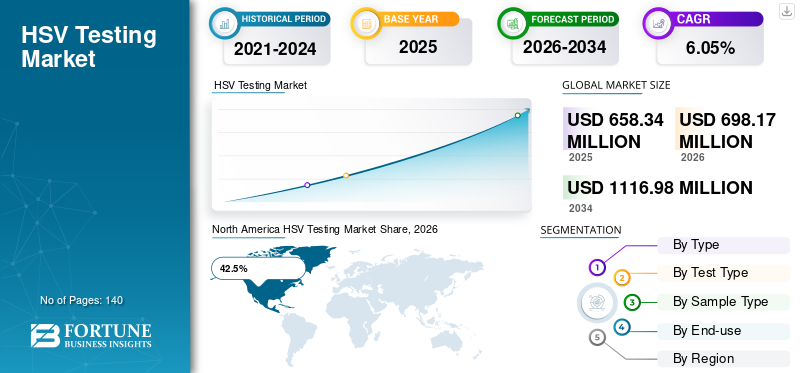
The HSV testing market size was valued at USD 658.34 Million in 2025. The market is projected to grow from USD 698.17 Million in 2026 to USD 1116.98 Million by 2034, exhibiting a CAGR of 6.05% during the forecast period.

The HSV testing market is expanding steadily due to the growing burden of herpes simplex virus infections and increasing demand for accurate diagnostic solutions across hospitals, specialty clinics, diagnostic laboratories, and public health screening programs. The market includes molecular diagnostics, serological testing, viral culture methods, and rapid point-of-care platforms designed to identify HSV-1 and HSV-2 infections. Healthcare providers are prioritizing early diagnosis to reduce transmission risks and improve patient management. The HSV testing market Report indicates that technological innovation, automation in laboratory workflows, and wider STI awareness programs are supporting market penetration. The increasing integration of multiplex testing platforms is also strengthening the HSV Testing Industry Analysis by improving diagnostic efficiency and turnaround times.
The United States remains the largest contributor to the HSV testing market due to extensive screening infrastructure, strong laboratory networks, and high awareness regarding sexually transmitted infections. Clinical laboratories increasingly utilize advanced PCR-based diagnostic platforms to improve sensitivity and specificity. Healthcare organizations are promoting preventive testing strategies among high-risk populations, pregnant women, and immunocompromised patients. The USA HSV testing market Analysis highlights strong adoption of automated diagnostic systems, favorable reimbursement environments, and continuous product launches by major diagnostic manufacturers. Growing utilization of telehealth-linked testing services and at-home specimen collection solutions is further transforming the domestic testing landscape.
Download Free sample to learn more about this report.
HSV Testing Market Key Takeaways
 Global Market Size & Forecast
- 2025 Market Size: USD 658.34 Million
- 2026 Market Size: USD 698.17 Million
- 2034 Forecast Market Size: USD 1,116.98 Million
- CAGR: 6.05% from 2026-2034
 Market Share
- The market in North America dominated with a revenue share of 42.5% in 2025.
- The HSV-1/HSV-2 combined testing segment accounted for approximately 49% of the market share.
- The serological tests segment accounted for approximately 50% of the market share.
 Key Regional Highlights
North America
North America held the largest regional share at 42.5% in 2025.
Europe
Europe accounted for 28% of the global market, supported by established diagnostic infrastructure.
Asia-Pacific
Asia-Pacific represented 22% of the global market, driven by expanding healthcare access and diagnostic adoption.
U.S
The U.S. is a major market supported by advanced diagnostic infrastructure and growing demand for STI testing.
Japan
Japan accounted for 18% of the Asia-Pacific market, supported by established healthcare services and diagnostic capabilities.Japan accounted for 18% of the Asia-Pacific market, supported by established healthcare services and diagnostic capabilities.
Read More

HSV Testing Market Latest Trends
One of the most significant HSV testing market Trends is the growing transition from conventional viral culture methods toward molecular diagnostics. PCR-based assays are increasingly preferred because they deliver rapid results and superior diagnostic accuracy. Healthcare institutions are adopting automated molecular platforms that reduce manual intervention and improve laboratory productivity. Multiplex testing solutions capable of detecting multiple sexually transmitted infections within a single test are also gaining widespread acceptance.
Download Free sample to learn more about this report.
Another important trend within the HSV testing market Outlook is the expansion of point-of-care diagnostics. Portable testing systems are enabling healthcare providers to deliver faster results in outpatient settings and community healthcare centers. Digital connectivity features integrated into diagnostic instruments allow healthcare professionals to monitor testing data efficiently. The HSV testing market Research Report further highlights increasing investments in AI-supported diagnostic interpretation, home-based specimen collection services, and decentralized laboratory networks. Growing emphasis on preventive healthcare and routine STI screening continues to create favorable conditions for sustained market expansion across developed and emerging healthcare systems.
HSV Testing Market Dynamics
DRIVER
Rising Prevalence of Herpes Simplex Virus Infections Worldwide
The primary growth driver for the HSV testing market is the increasing prevalence of HSV infections across both developed and developing economies. Healthcare authorities continue to emphasize early diagnosis and routine screening because herpes infections often remain asymptomatic for extended periods. Rising awareness regarding sexually transmitted infections has encouraged more individuals to undergo diagnostic testing. Hospitals, laboratories, and reproductive health clinics are expanding HSV screening programs to improve disease management and reduce transmission risks.
The HSV testing market Growth is further supported by advancements in molecular diagnostics that offer higher accuracy compared to traditional methods. PCR technologies have become increasingly accessible, allowing healthcare facilities to perform rapid and reliable testing. The growing use of prenatal screening, coupled with expanding public health initiatives, continues to increase testing volumes globally. These factors collectively strengthen the long-term HSV testing market Forecast and contribute to broader adoption of diagnostic solutions.
RESTRAINT
Limited Awareness and Social Stigma Associated With Sti Testing
Despite growing awareness, stigma surrounding sexually transmitted infections remains a significant restraint within the HSV Testing Market. Many individuals avoid testing because of privacy concerns, social perceptions, and fear of discrimination. Delayed diagnosis often results in underreporting of infections and lower testing rates, particularly in developing regions.
Healthcare access disparities also affect market expansion. Rural populations frequently encounter limited diagnostic infrastructure and reduced availability of advanced molecular testing platforms. Budget constraints within healthcare systems may further restrict adoption of high-cost automated diagnostic equipment. The HSV Testing Industry Report indicates that reimbursement inconsistencies and variations in healthcare policies across countries can influence purchasing decisions among healthcare providers. These barriers continue to challenge market penetration despite ongoing technological improvements.
OPPORTUNITY
Expansion of Point-Of-Care And Decentralized Diagnostic Solutions
The growing adoption of decentralized healthcare delivery models presents substantial opportunities for the HSV Testing Market. Point-of-care testing systems enable faster diagnosis and treatment decisions while reducing dependence on centralized laboratories. Healthcare providers increasingly seek portable diagnostic devices capable of delivering reliable results in outpatient settings and remote locations.
The HSV testing market Opportunities are expanding through digital healthcare integration, telemedicine support, and home-based sample collection services. Emerging economies are investing in diagnostic infrastructure modernization, creating favorable conditions for manufacturers. Companies introducing affordable, user-friendly testing platforms are expected to strengthen their competitive positions. Rising demand for preventive screening programs, combined with growing patient preference for convenience and confidentiality, is likely to accelerate market expansion over the coming years.
CHALLENGE
Maintaining Diagnostic Accuracy across Diverse Testing Environments
A major challenge within the HSV testing market is ensuring consistent diagnostic performance across various healthcare settings. Laboratories require rigorous quality control procedures to maintain testing accuracy and regulatory compliance. Variations in sample quality, testing protocols, and operator expertise can influence clinical outcomes.
The increasing complexity of diagnostic technologies also creates training requirements for healthcare professionals. Smaller laboratories may struggle to implement advanced molecular platforms because of technical limitations and workforce shortages. The HSV testing market Insights indicate that manufacturers must continuously invest in product validation, quality assurance, and regulatory approvals to remain competitive. Balancing affordability with high diagnostic performance remains a critical challenge for market participants operating across diverse regional healthcare systems.
HSV Testing Market Segmentation
By Type
HSV-1/HSV-2 combined testing accounts for approximately 49% of the global HSV testing market Share. This segment dominates because healthcare providers increasingly prefer comprehensive diagnostic solutions capable of simultaneously detecting both viral strains. Combined assays improve clinical efficiency by reducing the need for multiple tests and accelerating treatment decisions.
The HSV testing market Analysis indicates strong demand for combined testing in hospitals, diagnostic laboratories, and reproductive health clinics. Molecular diagnostic platforms frequently include integrated HSV-1 and HSV-2 detection capabilities, supporting broader adoption. Healthcare organizations favor combined testing because it provides more complete patient assessments and enhances screening program effectiveness. As routine STI screening expands globally, this segment is expected to maintain leadership within the HSV Testing Industry Report.
HSV-1 testing represents nearly 28% of the HSV testing market Size. The segment benefits from widespread prevalence of oral herpes infections and increasing awareness regarding asymptomatic transmission. Healthcare providers often recommend HSV-1 testing for patients presenting oral lesions, neurological symptoms, or suspected viral infections.
Demand for HSV-1 diagnostics is growing in pediatric and adult healthcare settings. Molecular assays are increasingly replacing traditional culture-based methods because they offer faster and more accurate results. The HSV testing market Research Report highlights increasing utilization of HSV-1 testing within preventive healthcare programs and specialty clinics. Growing public awareness campaigns and improved access to diagnostic services continue to support segment development.
HSV-2 testing holds approximately 23% of the global HSV testing market Share. This segment remains highly important because HSV-2 is closely associated with genital herpes infections and ongoing transmission concerns. Healthcare providers frequently incorporate HSV-2 screening into comprehensive STI testing programs.
The HSV testing market Outlook for HSV-2 diagnostics remains favorable due to increasing demand for reproductive health screening and prenatal testing. Diagnostic laboratories are expanding their test menus to address growing clinical demand. Rising adoption of molecular diagnostics and improved patient education initiatives continue to support market growth. Healthcare systems are prioritizing early detection strategies, further strengthening demand for HSV-2 testing solutions.
To know how our report can help streamline your business, Speak to Analyst
By Test Type
Serological tests account for approximately 50% of the HSV testing market Share. These tests remain widely utilized because they are cost-effective, scalable, and suitable for large population screening programs. Serological assays detect antibodies associated with HSV infections, making them valuable for identifying previous exposure and supporting epidemiological surveillance.
The HSV testing market Report highlights continued adoption of serological testing within hospitals, blood testing laboratories, and public health initiatives. Technological improvements have enhanced assay sensitivity and specificity, increasing clinical confidence. Healthcare providers continue to rely on serological testing for routine screening applications, particularly when molecular testing is not readily available.
Point-of-care tests represent approximately 32% of the HSV testing market Share and continue to expand rapidly. Healthcare providers increasingly value these solutions because they deliver faster diagnostic results and improve patient management. Point-of-care platforms are particularly useful in community clinics, outpatient centers, and remote healthcare settings.
The HSV testing market Trends indicate strong investment in portable diagnostic technologies that support decentralized healthcare delivery. Manufacturers are developing compact systems with enhanced accuracy and digital connectivity features. Growing demand for immediate clinical decision-making is expected to strengthen this segment significantly throughout the forecast period.
By Sample Type
Blood-based testing contributes roughly 46% of the HSV testing market Size. Blood samples are commonly used for serological analysis because they provide reliable antibody detection and support large-scale screening programs. Hospitals and diagnostic laboratories continue to rely heavily on blood-based testing procedures.
The HSV Testing Industry Analysis highlights increasing use of automated laboratory systems that streamline blood sample processing. Growing emphasis on preventive healthcare and routine STI screening further supports segment expansion. Blood testing remains a preferred approach for epidemiological studies and comprehensive patient evaluations.
Swab-based testing accounts for approximately 38% of the HSV testing market Share. Swab specimens collected directly from lesions are particularly useful for molecular diagnostic applications. Healthcare providers often prefer swab testing when active symptoms are present because it allows direct detection of viral material.
The HSV testing market Insights indicate increasing adoption of PCR-based swab testing due to superior diagnostic accuracy. Clinical laboratories are investing in advanced molecular platforms that optimize specimen analysis. As molecular diagnostics continue to expand, swab-based testing is expected to remain a critical component of clinical HSV diagnosis.
Cerebrospinal fluid testing represents nearly 16% of the HSV testing market Share. Although smaller in volume, this segment plays a crucial role in diagnosing neurological complications such as HSV encephalitis. Rapid and accurate diagnosis is essential because delayed treatment can lead to severe clinical consequences.
Advanced molecular testing methods have improved detection capabilities within cerebrospinal fluid samples. Healthcare providers increasingly utilize PCR assays to support neurological evaluations. The HSV testing market Forecast suggests continued demand for specialized testing applications associated with severe HSV-related complications.
By End-use
Diagnostic laboratories hold approximately 44% of the HSV testing market Share, followed by hospitals, specialty clinics, and research institutions. Laboratories dominate because they possess advanced infrastructure and high-throughput testing capabilities required for large-scale diagnostic operations.
Hospitals continue expanding their in-house diagnostic capabilities to improve turnaround times and patient management. Specialty clinics focusing on sexual health and reproductive medicine are also increasing testing volumes. The HSV testing market Opportunities remain strong across all end-use segments as healthcare systems prioritize early diagnosis and preventive screening strategies.
HSV Testing Market Regional Outlook
North America HSV Testing Market Share, 2025 (%)
To get more information on the regional analysis of this market, Download Free sample
North America
North America accounts for approximately 42.5% of the global HSV testing market Share. The region benefits from advanced healthcare infrastructure, widespread availability of molecular diagnostics, and strong awareness regarding sexually transmitted infections. Healthcare providers actively promote routine screening programs, supporting sustained testing demand across hospitals and diagnostic laboratories.
The HSV testing market Growth in North America is further supported by ongoing investments in laboratory automation and innovative diagnostic technologies. Major manufacturers maintain strong regional presence through product development initiatives and strategic partnerships. The increasing adoption of PCR-based testing platforms continues to enhance diagnostic efficiency and strengthen regional market leadership.
Europe
Europe represents approximately 28% of the global HSV testing market Share. The region demonstrates strong demand for diagnostic testing due to established healthcare systems and growing emphasis on preventive medicine. Government-supported public health initiatives continue encouraging STI awareness and routine screening.
The HSV testing market Research Report indicates rising adoption of advanced molecular diagnostics across European healthcare institutions. Laboratories are investing in automation technologies that improve testing accuracy and operational efficiency. Continued innovation and regulatory support are expected to reinforce market expansion throughout the region.
Germany HSV Testing Market
Germany contributes nearly 24% of the European HSV Testing Market. The country benefits from sophisticated healthcare infrastructure, strong laboratory networks, and widespread access to advanced diagnostic technologies. Healthcare providers emphasize early detection and preventive healthcare strategies, creating favorable conditions for market expansion.
The Germany HSV testing market Analysis highlights growing demand for molecular diagnostic solutions within hospitals and specialized laboratories. Research institutions actively participate in diagnostic innovation, supporting the development of next-generation testing platforms. Increasing awareness regarding sexually transmitted infections continues to strengthen testing volumes across the country.
United Kingdom HSV Testing Market
The United Kingdom accounts for approximately 19% of the European HSV Testing Market. Public healthcare initiatives promoting STI awareness and routine screening contribute significantly to diagnostic demand. Healthcare providers increasingly utilize advanced molecular assays to improve diagnostic accuracy and patient outcomes.
The UK HSV testing market Outlook remains positive due to ongoing healthcare modernization efforts and expanding laboratory capabilities. Digital health integration, telemedicine services, and decentralized testing solutions are influencing market development. Rising emphasis on preventive healthcare supports continued adoption of HSV diagnostic technologies.
Asia-Pacific
Asia-Pacific holds approximately 22% of the global HSV testing market Share. The region is experiencing rapid growth due to expanding healthcare infrastructure, rising awareness of sexually transmitted infections, and increasing healthcare expenditures. Governments are investing in diagnostic capacity development to improve disease surveillance and patient outcomes.
The HSV testing market Opportunities within Asia-Pacific are substantial because of large patient populations and growing demand for affordable diagnostic solutions. Increasing adoption of molecular testing technologies and strengthening laboratory networks continue to accelerate market development across the region.
Japan HSV Testing Market
Japan contributes approximately 18% of the Asia-Pacific HSV Testing Market. The country possesses advanced healthcare infrastructure and strong diagnostic capabilities. Healthcare providers increasingly utilize automated laboratory systems and molecular testing technologies to enhance diagnostic precision.
The Japan HSV testing market Insights indicate growing demand for rapid diagnostic solutions that support efficient patient management. Aging demographics and increasing healthcare awareness contribute to sustained testing demand. Diagnostic manufacturers continue introducing innovative platforms tailored to evolving clinical requirements.
China HSV Testing Market
China accounts for approximately 34% of the Asia-Pacific HSV Testing Market. The country’s expanding healthcare infrastructure and large patient population create significant opportunities for diagnostic manufacturers. Public health initiatives focused on infectious disease management continue driving demand for HSV testing services.
The China HSV testing market Report highlights increasing adoption of molecular diagnostics within hospitals and independent laboratories. Investments in healthcare modernization and laboratory expansion are supporting market growth. Domestic and international manufacturers are strengthening their presence through product innovation and strategic collaborations.
Rest of World
The Rest of World region represents approximately 7.5% of the global HSV testing market Share. Growth is supported by improving healthcare access, expanding diagnostic infrastructure, and increasing awareness regarding sexually transmitted infections. Several countries are strengthening laboratory capabilities through public and private sector investments.
The HSV Testing Industry Report identifies significant opportunities across Latin America, the Middle East, and Africa. Healthcare organizations are expanding screening programs to improve disease detection rates. Adoption of cost-effective diagnostic technologies continues to enhance accessibility and support regional market development.
List of Top HSV Testing Companies
- F. Hoffmann-La Roche Ltd.
- Abbott
- Thermo Fisher Scientific Inc.
- BD
- Bio-Rad Laboratories, Inc.
- bioMérieux SA
- DiaSorin S.p.A.
- Hologic, Inc.
- Cepheid
- QuidelOrtho Corporation
Top Two Companies by Market Share
- F. Hoffmann-La Roche Ltd. – 17%
- Abbott – 14%
Investment Analysis and Opportunities
Investment activity within the HSV testing market continues to increase as diagnostic manufacturers focus on molecular testing technologies, automation platforms, and decentralized healthcare solutions. Venture capital firms and healthcare investors are supporting companies developing rapid diagnostic assays, digital healthcare integration tools, and AI-enabled laboratory systems.
The HSV testing market Opportunities are particularly strong in emerging economies where healthcare infrastructure modernization remains a priority. Investments in manufacturing expansion, laboratory automation, and point-of-care diagnostics are creating new growth avenues. Strategic partnerships between healthcare providers and diagnostic companies are accelerating commercialization efforts. Increasing government support for infectious disease surveillance programs further enhances long-term investment attractiveness across the global market.
New Product Development
Product innovation remains a central competitive strategy within the HSV Testing Market. Manufacturers are introducing advanced PCR assays capable of delivering highly accurate results with shorter turnaround times. Multiplex diagnostic platforms that detect HSV alongside other sexually transmitted infections are becoming increasingly popular among healthcare providers.
The HSV testing market Trends also include development of portable diagnostic systems designed for decentralized healthcare settings. Companies are integrating digital reporting capabilities, cloud connectivity, and automated result interpretation into diagnostic platforms. Improved reagent formulations, user-friendly interfaces, and enhanced analytical performance continue shaping product development strategies. These innovations are helping healthcare institutions improve diagnostic efficiency while expanding access to testing services.
Five Recent Developments (2023-2025)
- Roche expanded molecular diagnostic capabilities through enhancements to infectious disease testing platforms.
- Abbott introduced upgraded laboratory workflow solutions supporting faster STI diagnostic processing.
- Thermo Fisher Scientific expanded its molecular diagnostics portfolio with advanced PCR assay offerings.
- BD strengthened automated diagnostic platform integration for infectious disease testing laboratories.
- Cepheid advanced rapid molecular testing solutions designed for decentralized and near-patient healthcare environments.
Report Coverage of HSV Testing Market
The HSV testing market Report provides comprehensive analysis of industry performance across major regions, product categories, testing methodologies, sample types, and end-use sectors. The report evaluates competitive positioning, technological developments, market trends, investment activity, and regulatory influences shaping industry expansion.
Request for Customization to gain extensive market insights.
The HSV testing market Research Report also examines regional demand patterns, healthcare infrastructure developments, and innovation strategies adopted by leading companies. Detailed segmentation analysis supports strategic decision-making for manufacturers, investors, distributors, and healthcare organizations. Coverage includes market dynamics, growth drivers, restraints, opportunities, challenges, competitive benchmarking, and emerging diagnostic technologies influencing the future HSV Testing Industry Outlook.
Frequently Asked Questions
Fortune Business Insights says that the global market value stood at USD 658.34 million in 2025 and is projected to reach USD 1,116.98 million by 2034.
The market is expected to exhibit a CAGR of 6.05% during the forecast period of 2025-2034.
HSV-1/HSV-2 combined testing was the leading type segment, accounting for approximately 49% of the market, as it enables simultaneous detection of both viral strains and improves diagnostic efficiency.
Key players include F. Hoffmann-La Roche Ltd., Abbott, BD, Hologic, Inc., Thermo Fisher Scientific Inc., and bioMérieux, Inc.
Major trends include the shift from viral culture to PCR-based molecular diagnostics and growing adoption of multiplex and point-of-care testing. North America leads regionally with approximately 42.5% market share.



- 2021-2034
- 2025
- 2021-2024
- 140
-

(Offer valid till 15th Oct 2026)
Get 30-60 hrs Free Customization
Expand Regional and Country Coverage, Segments Analysis, Company Profiles, Competitive Benchmarking, and End-user Insights.













.webp)






-
US +1 833 909 2966 ( Toll Free )
-
Get In Touch With Us