Hybrid HVAC Market Size, Share & Industry Analysis, By Product Type (Heating Equipment (Boilers, Heat Pumps, Furnaces, and Unit Heaters), Cooling Equipment (Unitary Air Conditioners, VRF Systems, Chillers, Room Air Conditioner, and Coolers and Cooling Towers), Ventilation Equipment (Air-Handling Units, Air Filters, Air Purifiers, Ventilation Fans & Others), By Energy Source (Dual Fuel, Electricity + Renewable - Driven Systems, Electricity + Thermal-Driven Systems, & Others), By Capacity (Residential, Commercial, and Industrial), By Application, and Regional Forecast, 2026-2034
 Download Free Sample
KEY MARKET INSIGHTS
 Listen to Audio Version
The global hybrid HVAC market size was valued at USD 17.28 billion in 2025 and is projected to grow from USD 18.21 billion in 2026 to USD 28.69 billion by 2034, exhibiting a CAGR of 5.9% during the forecast period. Asia Pacific dominated the hybrid HVAC market with a market share of 49.8% in 2025.
A hybrid HVAC system, also known as dual-fuel system, pairs together a heat pump and a gas furnace to heat and cool a house. It automatically switches between the two to operate most efficiently. The heat pump is used for heating in milder weather conditions and the gas furnace is used as a backup heat source when the temperature is extremely cold.
The market has been undergoing growth owing to increased utility prices, a demand for energy efficiency, a heightened inclination toward government incentives, product innovation, including incorporation of renewable energy sources, and the rising use of smart technology and online sales channels.
The top firms in the industry are Daikin Industries Ltd., Carrier Global Corporation, Trane Technologies, Johnson Controls, Mitsubishi Group, and Lennox International.
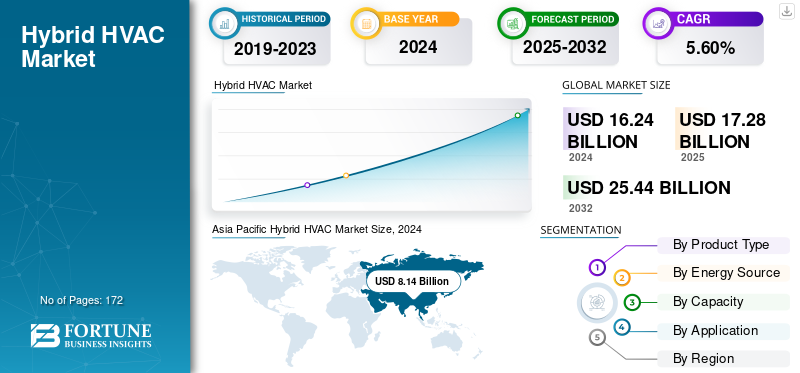
Download Free sample to learn more about this report.
HYBRID HVAC MARKET KEY TAKEAWAYS
 Global Market Size & Forecast
- 2025 Market Size: USD 17.28 billion
- 2026 Market Size: USD 18.21 billion
- 2034 Forecast Market Size: USD 28.69 billion
- CAGR: 5.9% from 2026–2034
 Market Share
- Asia Pacific dominated the hybrid HVAC market with a 49.80% share in 2025.
- The cooling equipment segment is projected to account for 55.12% of the market in 2026.
- The dual fuel segment is expected to hold 53.74% of the global market in 2026.
 Key Regional Highlights
Asia Pacific
The market reached USD 8.61 billion in 2025 and is projected to grow to USD 9.11 billion in 2026.
North America
The market was valued at USD 5.11 billion in 2025 and is expected to reach USD 5.38 billion in 2026.
Europe
The market reached USD 2.40 billion in 2025 and is projected to grow to USD 2.51 billion in 2026.
U.S.
The market is projected to reach USD 4.40 billion in 2026.
Japan
The market is expected to grow steadily, supported by rising demand for energy-efficient and smart climate control solutions.
Read More

MARKET DYNAMICS
Market Drivers
Sustainability Goals and Smart Technologies Fuel Hybrid HVAC Adoption
Energy-efficient and environmentally friendly solutions are in growing demand, leading to the rapid development of the hybrid HVAC market. With the governments upholding strict measures to minimize carbon emissions, the use of hybrid HVACs is on the rise. Through such systems, renewable energy sources such as solar panels are combined with traditional HVAC systems, and this results in significant conservation of energy and a substantial alleviation in the operational costs. Also, the integration of intelligent control systems, artificial intelligence (AI), and the Internet of Things (IoT), is also relevant because it allows monitoring and optimization of energy consumption in real-time and increases the efficiency of the overall system, as well as contributing to the global agenda in sustainability.
Market Restraints
High Costs and Technical Complexity Restrain Market Expansion
Although the potential for growth is significant, the high start-up costs of the hybrid HVAC present a challenge to the industry, as they may discourage potential adopters. It entails technical sophistication in the implementation of renewable energy systems alongside traditional counterparts of HVAC systems, which are demanded by highly trained professionals who are not readily available at the moment. This skills shortage slows down the deployment and maintenance efficiency. Additionally, the levels of awareness and poor knowledge among end-users regarding the benefits and functionality of hybrid HVAC systems lead to slower adoption. All these, together with the uncertainty in the supply chain and the increased expenditures in the initial setup, limit the development of market.
Market Opportunities
Government Incentives and Emerging Markets Unlock Future Growth
The trend of increased attention to sustainability and energy efficiency worldwide is driving the demand toward hybrid HVACs systems. Governments in the regions are also initiating favorable programs such as tax incentives, energy-efficient rebates, and financial schemes to achieve the targets of carbon-neutrality and net-zero emissions. The initiatives of these policies are accelerating product uptake among the households, businesses, and industries. Furthermore, developing economies are investing into intelligent infrastructure and green building construction, which would provide enormous possibilities for the mass implementation of hybrid systems. Innovation and implementation are also a hotbed in the emerging markets because of current advancements in digital control, automation, and localized models of energy.
HYBRID HVAC MARKET TRENDS
Shift Toward Smart, Efficient, and Eco-Friendly Hybrid HVAC Solutions is a Major Trend
The trend in the hybrid HVAC sector is a clear shift toward energy-efficient and smarted innovations. System performance and sustainability are changing due to the implementation of hybrid heat pumps, variable refrigerant flow (VRF) units, and low global warming potential (GWP) refrigerants. IoT-based smart controls are enhancing user comfort and reducing operational expenses by integrating new technology, predictive maintenance, and climate management aspects of smart controls. Additionally, retrofit-friendly constructions allow for the renovation of a building without requiring significant modifications. These innovations are in accordance with the goals of certifying green buildings, as well as a new set of more stringent emission standards. Business and consumers are encouraged to seek the next generation of hybrid solutions that would strike the right balance of efficiency, comfort, and environmental consciousness.
Download Free sample to learn more about this report.
SEGMENTATION ANALYSIS
By Product Type
Cooling Equipment Segment Leads Market Owing to Its Demand in Residential and Commercial Buildings
Based on the product type, the market is segmented into heating equipment, cooling equipment, and ventilation equipment. Heating equipment is further sub-segmented into boilers, heat pumps, furnaces, and unit heaters, cooling equipment into unitary air conditioners, VRF Systems, chillers, room air conditioner, and coolers and cooling towers, and ventilation equipment into air-handling units, air filters, air purifiers, ventilation fans, and others.
The cooling equipment segment dominates with a market share of USD 8.95 billion. Expansion in residential and commercial buildings especially in hot regions boosts demand for AC units, making cooling equipment a more scalable business in many geographies. The cooling equipment segment will account for 55.12% market share in 2026.
The cooling equipment also holds the highest CAGR of 6.2% in the global market. Many hybrid systems are built around electric cooling plus a backup or supplementary heater. Because cooling is already electric in many climates, it is easier to hybridize heating around a cooling base. This makes cooling equipment the prominent leader in hybrid HVAC setups.
By Energy Source
Dual Fuel Segment Dominates Market Owing to Its Ability to Provide Cost and Energy Flexibility
Based on energy source, the market is divided into dual fuel, electricity + renewable- driven systems, electricity + thermal-driven systems, and others (tri-energy, etc.).
The dual fuel segment dominates with a market share of USD 8.88 billion. The dual fuel segment is expected to account for 53.74% of the market in 2026.The segment continues to generate the major revenue due to its ability to provide cost and energy flexibility switching between electricity and gas based on tariff or load demand. This is especially attractive for large commercial, hospitality, and mixed-use projects.
Electricity + renewable driven systems holds the highest CAGR of 6.4% in the global market. The segment's growth is attributable to the sharp decline in solar PV, wind technology, and battery storage costs over the past decade, making integrated renewable + HVAC systems more economically viable.
By Capacity
2–5 Tons Capacity Segment Leads Market Owing to Its Suitability for Medium-Sized Homes
Based on the capacity, the market is divided into residential (up to 2 tons and 2 to 5 tons), commercial (up to 10 tons, 10 to 25 tons, and above 25 tons), and industrial (25 to 50 tons, 50 to 120 tons, and above 120 tons).
Within the residential category, 2 to 5 tons capacity systems has the maximum share of 58.4%. The segment’s growth is attributable to their suitability for medium-sized homes and growing installation in urban housing projects.
In the commercial segment, 10 to 25 tons units dominate the market, accounting for the largest revenue share of 67.9%. The segment’s growth is attributable to their wide use in offices, retail outlets, and educational institutions.
Among industrial users, systems above 120 tons hold the highest revenue share of 62.4%. The segment’s growth is attributable to adoption in large manufacturing facilities and heavy-duty industrial processes.
Within the residential category, systems up to 2 tons are expected to witness the highest growth rate of 6.1%. The segment’s growth is attributable to rising demand from small apartments and energy-efficient housing units.
Under commercial segment, 10 to 25 tons capacity is projected to record the fastest growth rate of 6.5%. The segment’s growth is attributable to increasing commercial construction and retrofitting activities.
Among industrial users, 50–120 tons systems are expected to witness the highest growth rate of 4.8%. The segment’s growth is attributable to increasing demand from medium-scale industries emphasizing energy optimization and hybrid efficiency.
By Application
To know how our report can help streamline your business, Speak to Analyst
Consumer Demand for Comfort and Smart Climate Control Systems Augments Residential Segment Growth
Based on the application, the market is divided into commercial, residential, and industrial.
The residential sector captured the largest hybrid HVAC market share at a value of USD 8.40 billion in 2024. The segment’s growth is attributable to rising urbanization, higher disposable incomes, and consumer preferences for comfort and smart climate control systems to generate a strong baseline sales volumes. The residential segment will account for 50.95% market share in 2026.
Commercial accounts for the largest CAGR at 6.1% in the global market. The segment’s growth is attributable to increasing investment in sustainable buildings, green certifications such as LEED and BREEAM, and strict energy-efficiency regulations. The office, retail, and hospitality sectors are increasingly looking to implement hybrid HVAC systems to improve energy performance of buildings while reducing their operational costs and carbon footprint.
HYBRID HVAC MARKET REGIONAL OUTLOOK
Geographically the market is segmented into North America, Europe, Asia Pacific, South America and Middle East & Africa.
North America
Asia Pacific Hybrid HVAC Market Size, 2025 (USD Billion) To get more information on the regional analysis of this market, Download Free sample
The North America market generated USD 5.11 Billion in 2025, representing 29.60% of the global market landscape, and is expected to reach USD 5.38 Billion in 2026. The region’s growth is attributable to strict energy-efficiency regulations, incentives for electrification, and strong adoption of renewable and smart HVAC technologies. Other components fueling this growth include growing awareness of sustainability and replacement of conventional HVAC systems with hybrid heat pumps.
The U.S. is at the forefront of the North American market, with expected revenue of USD 4.4 billion in 2026. The growth is attributable to construction, urbanization, and rising temperatures.
Europe
Europe contributed 13.90% to the global market in 2025, with a valuation of USD 2.4 Billion, and is projected to reach USD 2.51 Billion in 2026. The region’s growth is attributable to a strong push for energy efficiency, decarbonization goals, and favorable government incentives.
The U.K., Germany and Italy are some of the leading contributors to the growth in the market, with the required revenue stake of USD 0.22 billion, USD 0.71 billion and USD 0.35 billion respectively by 2026.
Asia Pacific
Asia Pacific is currently at the forefront of the global market. Asia Pacific accounted for USD 8.61 Billion in 2025, representing 49.80% of the global market share, and is projected to reach USD 9.11 Billion in 2026. The region’s growth is attributable to rapid urbanization, large-scale construction activity, and high demand for residential and commercial air-conditioning systems.
India and China are major contributors to the hybrid HVAC market growth with an expected revenue share of USD 1.54 billion, and USD 3.52 billion respectively by 2026.
Middle East & Africa
In 2025, Middle East & Africa held 4.42% of the global market, reaching a valuation of USD .76 Billion, and is projected to grow to USD .79 Billion in 2026. The growth of these regions is attributable to the need for energy efficiency, strict government regulations, and large-scale construction projects.
GCC countries are predicted to have a market share of USD 0.22 billion by 2025.
Latin America
Latin America contributed approximately USD 0.4 Billion to the global market in 2025, accounting for 2.30% share, and is expected to reach USD 0.41 Billion in 2026.
COMPETITIVE LANDSCAPE
Key Industry Players
Top Firms Expand Product Portfolios to Lead the Industry
Some of the top firms working in the industry include Daikin Industries Ltd., Carrier Global Corporation, Trane Technologies, Johnson Controls, Mitsubishi Group, and Lennox International. The firms are focusing on energy efficiency, smart technology integration, and renewable energy to appeal to eco-conscious consumers. Other strategies include expanding product portfolios and manufacturing capabilities to meet rising demand, as demonstrated by Carrier and Daikin. They also focus on providing advanced controls, predictive maintenance, and data analytics to optimize performance and reduce operational costs.
LIST OF KEY HYBRID HVAC COMPANIES PROFILED
- Daikin Industries Ltd. (Japan)
- Carrier Global Corporation (U.S.)
- Trane Technologies (U.S.)
- Johnson Controls (Ireland)
- Mitsubishi Group (Japan)
- Lennox International (U.S.)
- Midea Group (China)
- Gree Electric Appliances (China)
- Robert Bosch (Germany)
- Rheem (U.S.)
- Samsung Electronics Co., Ltd. (South Korea)
- LG Electronics Inc. (South Korea)
KEY INDUSTRY DEVELOPMENTS
- September 2025- GE Aerospace and BETA Technologies Inc. announced a new strategic partnership and equity investment agreement, subject to regulatory approval, to accelerate the development of hybrid electric aviation by combining BETA's rapid innovation approach with GE Aerospace's global scale and experience.
- September 2025- Sol-Ark®, a U.S.-based leader in hybrid inverter and energy storage solutions, announced the launch of the Sol-Ark® Premium 18K-2P residential hybrid inverter, the most powerful residential inverter on the market. The 18K-2P is designed to deliver the most backup power and flexible solar capacity.
- July 2024- The Bosch Group plans to take over the global HVAC solutions business for residential and light commercial buildings from Johnson Controls. As part of this transaction, Bosch also intends to acquire 100 percent of the Johnson Controls-Hitachi Air Conditioning (JCH) joint venture, including Hitachi’s 40 percent stake.
- June 2025-S. heating specialist GE Appliances, a unit of China-based Haier Smart Home Company, which is itself part of Chinese multinational home appliances and consumer electronics company Haier Group, launched a hybrid heat pump water heater for residential applications. The new product will initially be available for sale in the U.S. and Canada.
- May 2025- U.K.-based heating specialist Alpha, a unit of Italian group Immergas, launched a new residential heating solution combining a heat pump and a boiler. The Alpha Custom Hybrid is a fully tailored solution suitable for all types of homes, including those with high hot water demands. It combines a range of heat pump outputs with both combi and system boilers, all managed by a built-in smart control.
- July 2020- Electronics Corporation, a premier supplier of advanced semiconductor solutions, introduced the ZSSC4132, an automotive pressure sensor solution featuring an integrated certified LIN v2.2a interface. The single-package sensor signal conditioner (SSC) delivers best-in-class performance, increased design flexibility, and cost efficiency in a compact form factor for HVAC applications used in plug-in hybrid electric vehicle (PHEV), Battery Electric Vehicle (BEV), and Fuel-cell Electric Vehicle (FCEV) climate control systems.
REPORT COVERAGE
The global report provides a detailed analysis of the market and focuses on key aspects such as prominent companies, deployment modes, types, and end users of the product. Besides this, it offers insights into the hybrid HVAC market trends and highlights key industry developments and market share analysis for key companies. In addition to the aforementioned factors, the report encompasses several factors that have contributed to the growth of the market over recent years.
Request for Customization to gain extensive market insights.
Report Scope & Segmentation
| ATTRIBUTE | DETAILS |
| Study Period | 2021-2034 |
| Base Year | 2025 |
| Estimated Year | 2026 |
| Forecast Period | 2026-2034 |
| Growth Rate | CAGR of 5.9% from 2026-2034 |
| Historical Period | 2021-2024 |
| Unit | Value (USD Billion) |
| Segmentation |
By Product Type Heating Equipment
Cooling Equipment
Ventilation Equipment
By Energy Source
By Capacity Residential
Commercial
Industrial
By Application
By Region North America (By and Country/Sub-region)
Europe (By and Country/Sub-region)
South America (By and Country/Sub-region)
Middle East & Africa (By and Country/Sub-region)
|
Frequently Asked Questions
Fortune Business Insights says that the global market stood at USD 18.21 billion in 2026 and is projected to reach USD 28.69 billion by 2034.
The market is expected to exhibit steady growth at a CAGR of 5.9% during the forecast period.
Sustainability goals and smart technologies is speeding up the market growth.
Daikin Industries Ltd., Carrier Global Corporation, Trane Technologies, Johnson Controls, Mitsubishi Group, and Lennox International are some of the top players in the market.
The Asia Pacific region held the largest market share.
Asia Pacific was valued at USD 8.61 billion in 2025.



- 2021-2034
- 2025
- 2021-2024
- 172
Get 30-60 hrs Free Customization
Expand Regional and Country Coverage, Segments Analysis, Company Profiles, Competitive Benchmarking, and End-user Insights.















-
US +1 833 909 2966 ( Toll Free )
-
Get In Touch With Us