 Download Free Sample



Get a Quote
Receive a tailored pricing based on your needs.
- Choose license type
- Multiple user options
- Custom scope & coverage
- Fast turnaround
"Designing Growth Strategies is in our DNA"

(Offer valid till 31st Oct 2026)
 Listen to Audio Version
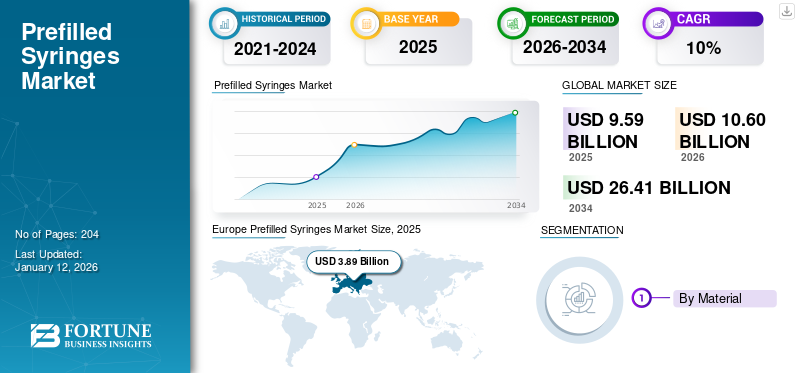
The global prefilled syringes market size was USD 9.59 billion in 2025. The market is projected to grow from USD 10.57 billion in 2026 to USD 23.24 billion by 2034, exhibiting a CAGR of 10.3% during the forecast period.
A prefilled syringe is a container for drug delivery designed for the parenteral administration of drugs. There are several advantages associated with these syringes. Key advantages include reducing the risk of contamination, minimizing drug wastage, improving dosing accuracy, and enabling rapid and convenient administration. Due to the advantages mentioned above, pharmaceutical companies consider it one of the most effective means of providing a wide range of injectable drugs, including biological and non-biological drugs.
The burden of chronic conditions such as cancer and diabetes has been growing significantly. According to the International Agency for Research on Cancer (IARC), by 2040, the global burden of cancer is expected to grow to 27.5 million new cases. According to the American Autoimmune Related Diseases Association Inc. (AARDA), about 50 million Americans suffer from autoimmune disorders currently. The growing burden of chronic conditions has been fueling the demand for effective drugs with advanced administration devices for regular and convenient administration.
BD, Stevanato Group, Gerresheimer AG, and SCHOTT Pharma are among the major market players focusing on partnership and collaboration to enhance their product offerings.
Download Free sample to learn more about this report.
Shift from Glass to Polymeric Materials
The prefillable syringes market is experiencing a shift from glass to polymeric materials such as Cyclo Olefin Polymer (COP) due to the various advantages offered by COP, such as a high degree of break resistance, glass-like transparency, and very low oxygen permeation compared to other plastics. Moreover, these polymers offer advantages such as high chemical stability and design flexibility. The market has witnessed increased investment in the development of more stable resins.
Surge in the Demand for Homecare Treatment Options
Increased focus on self-injection and home-based treatment is significantly expanding the use of these syringes for chronic disease management.
Increasing Demand for Dual-chamber Syringes
Dual-chamber syringes are gaining popularity for lyophilized and combination drugs, particularly in North America and Europe.
Increasing Adoption of Advanced Technology for New Product Development
Advancements such as glass-plastic hybrid barrels, smart safety caps, and temperature-resistant materials drive product innovation.
Europe Prefilled Syringes Market Size, 2021-2034 (USD Billion)
Download Free sample to learn more about this report.
Increasing Demand for Biologics, Biosimilars, and Vaccines to Boost Market Growth
The growing preference for prefilled syringes for administering biologics and biosimilar products has been observed among healthcare providers and product development scientists owing to their advantages, such as improved convenience, dose accuracy, and self-administration. Prefilled syringes can also reduce costs associated with overfilling. Moreover, growing research and development activities and an increasing number of approvals of biologic products in prefilled-syringe presentations are driving market expansion.
This is expected to fuel the prefilled syringes market growth during the forecast period.
Market Drivers - Impact & CAGR Contribution (2026–2034)
| Rank | Market Drivers | Expected Impact on Market Growth | Estimated Gross Market Growth Contribution (USD Billion) | Impact: 2026-2028 | Impact: 2029-2031 | Impact: 2032-2034 |
|---|---|---|---|---|---|---|
| 1 | Increasing demand for biologics, biosimilars, and vaccines | High | 4.14 | High | High | High |
| 2 | Growing shift toward self-administration, home care, and autoinjector-based drug delivery | High | 3.30 | High | High | High |
| 3 | Increasing preference for prefilled formats due to dosing accuracy, convenience, reduced contamination risk, and lower drug wastage | Medium-High | 2.69 | Medium | High | High |
| 4 | Growing use of injectable therapies across vaccines, anticoagulants, chronic diseases, emergency care, and other therapeutic areas | Medium-High | 2.36 | Medium | Medium | High |
| 5 | Technological advancements in polymer, silicone-free, large-volume, and biologic-compatible prefilled syringes | Medium | 2.03 | Medium | Medium | Medium |
| 6 | Others (pharmaceutical lifecycle management, emerging-market penetration, healthcare infrastructure expansion, safety-device integration, aging population) | Low | 1.60 | Low | Low | Medium |
| Total Gross Growth Contribution | 16.12 | |||||
Source: Fortune Business Insights
Download Free sample For In-Depth Market Restraints & Risk Analysis
Strict Regulatory Requirements with Increasing Recalls of Prefilled Syringe Products Hinder Market Growth
Several regulatory authorities, such as the U.S. Food and Drug Administration (FDA), have stringent regulatory requirements for the approval of parenteral dosage forms. For the majority of the key players, the process of moving an injectable therapeutic to a prefilled syringe can be complex due to stability and sterility issues. Therefore, the key players must establish a strategy that carefully evaluates proposed changes in manufacturing, packaging, and shipping processes, and that ensures the validation of these changes on the therapeutic molecule to facilitate the smooth path to regulatory approval. The stringent regulatory requirements for prefilled syringes to maintain their stability, sterility, patient compliance, and smooth regulatory approval are projected to hamper the market growth of prefilled syringes during the forecast period.
Moreover, recalls of prefilled syringes due to the presence of particulate matter or stability issues, labelling issues, and more are also anticipated to negatively impact the demand for prefilled syringes during the forecast period. For instance, in August 2026, Fresenius Kabi issued a voluntary recall for one lot of Morphine Sulfate Injection, USP in a Simplist prefilled syringe due to a labeling mix-up.
Market Restraints - Impact & Negative CAGR Contribution (2026–2034)
| Rank | Market Restraints | Expected Impact on Market Growth | Estimated Reduction in Market Size (USD Billion) | Impact: 2026-2028 | Impact: 2029-2031 | Impact: 2032-2034 |
|---|---|---|---|---|---|---|
| 1 | Strict Regulatory Requirements with Increasing Recalls of Prefilled Syringe Products | High | 1.25 | High | High | Medium-High |
| 2 | Stringent regulatory, quality-control, validation, and combination-product requirements | High | 0.95 | High | Medium | Medium |
| 3 | High manufacturing, sterilization, fill-finish, and capacity-expansion costs | Medium | 0.75 | Medium | Medium | Medium |
| 4 | Others (supply-chain disruptions, breakage risks, pricing pressure, alternative delivery formats, product recalls, and technical failures) | Low | 0.50 | Low | Low | Low |
| Total Market Reduction | 3.45 | |||||
Source: Fortune Business Insights
Download Free sample For In-Depth Market Restraints & Risk Analysis
Increasing Focus of Market Players on Development of Technologically Advanced Products Creates Significant Market Growth Opportunities
Prefilled syringes are introduced into the market as an advanced delivery system for injectable drugs. Since their introduction, continuous improvement in syringe designs and component quality has been witnessed due to manufacturers' strong focus on developing user-friendly, advanced products.
Market players have been focusing on investing in the research and development of prefilled syringes to launch high-quality syringes with improved performance. This factor is expected to create significant market growth opportunities over the forecast period.
Drug-Syringe Compatibility Issues and Higher Manufacturing Costs May Limit Market Growth
Prefilled syringes improve dosing accuracy, convenience, and administration efficiency. However, maintaining drug stability throughout shelf life remains a major challenge, particularly for sensitive biologics. Syringe components such as the barrel, plunger stopper, needle, adhesives, lubricants, and residual manufacturing materials remain in prolonged contact with the formulation and may affect product quality. Silicone oil, commonly used to enable smooth plunger movement, can migrate into the drug and contribute to subvisible particles or protein aggregation. Tungsten and adhesive residues may also create compatibility concerns for certain formulations.
Consequently, pharmaceutical companies must conduct extensive stability, extractables and leachables, container-closure integrity, and compatibility studies, increasing development timelines and costs.
For instance, in September 2024, Gerresheimer highlighted silicone-oil-free syringe systems as a way to reduce particle load for sensitive ophthalmic drugs and biologics. Moreover, ready-to-fill syringe manufacturing requires specialized molding, sterilization, surface treatment, inspection, and quality-control infrastructure, resulting in substantial capital investment requirements.
Glass Segment Dominated Market Due to Its Several Advantages
Based on material, the market is segmented into glass and plastic.
The glass segment held the largest prefilled syringes market share in 2025. Glass has remained the preferred choice of many pharmaceutical drug manufacturers for biological products, as the properties of glass material prevent the interaction between drug compounds and water vapor & oxygen. Such advantages associated with glass syringes are responsible for the segment's growth.
The plastic segment is anticipated to grow with a CAGR of 11.2% during the forecast period.
Increasing Adoption of Staked-Needle Systems to Boost Segment Dominance
By the closing system, the market is segmented into the staked needle system, luer lock form system, and luer cone system.
The staked needle system is likely to capture 42.2% of market share in 2026. The growing adoption of staked needle systems by healthcare providers during medical emergencies, due to various benefits such as simplified steps for the user and fewer chances of error during drug administration, is responsible for the segment's dominance.
The luer lock form system segment is expected to grow at a CAGR of 11.1% during the forecast period.
Rising Demand for Self-Injectable Delivery Systems among Patients Boosted Complete Syringe Set Segment Growth
Based on product, the market is segmented into complete syringe set and components & accessories.
The complete syringe set segment captured the largest share of the market in 2025, owing to the growing demand for these products for effective drug delivery and rising demand for self-injectable delivery systems among patients.
The components & accessories segment is expected to witness a CAGR of 8.3% in the coming years.
To know how our report can help streamline your business, Speak to Analyst
Rheumatoid Arthritis Segment Led Due to Growing Prevalence of the Disease
Based on application, the market is segmented into cancer, rheumatoid arthritis, diabetes, and others.
The rheumatoid arthritis segment is likely to hold 48.3% of market share in 2026. The segment's dominance is attributed to the disease's growing prevalence and the increasing focus of pharmaceutical companies on launching drugs indicated for rheumatoid arthritis treatment in prefilled syringes.
The cancer segment is expected to grow at the fastest CAGR of 11.5% during the forecast period.
Single-Chamber Segment to Lead Due to Increasing Commercialization and Advantages
Based on design, the market is segmented into single-chamber, double-chamber, and multiple-chamber.
The single-chamber segment is projected to capture a significant share of 82.1% of the market in 2026. The segment’s dominance is attributed to the advantages offered by single-chamber design for prefilled syringes to pharmaceutical & biotech companies. This design requires less overfill, resulting in less product waste, and aids in the ease of administration of the drug with its simple design model. Moreover, expanding commercial availability, technological innovations implemented in the filling procedures for single-chamber prefilled syringes, and the rise in the adoption of safety devices assembled in single-chamber prefilled syringes to reduce needlestick injuries among patients & healthcare providers are likely to boost the demand for the single-chamber segment during the forecast period.
The double-chamber segment is expected to grow at the fastest CAGR of 12.2% during the forecast period.
Growing Interest in Injectables to Boost Pharmaceutical & Biotechnology Companies Segment Expansion
Based on End User, the market is categorized into pharmaceutical & biotechnology companies, contract research & manufacturing organizations, and others.
The pharmaceutical & biotechnology companies segment is likely to capture a major share of 55.4% in 2026. The expanding pharmaceutical and biotechnology industries/companies across the globe are mainly engaged in biologics, vaccines, and biosimilars. These companies have increased their demand for new drug delivery systems, such as prefilled syringes containing a unit dose of medication for better patient compliance.
Moreover, the rising number of early-stage biotech players, along with government-funded biotech players, are focusing on drug discovery and development, which is likely to boost the demand for syringes for the effective delivery of drugs. The rise in demand for innovative injectable drug delivery systems is expected to boost the pharmaceutical & biotechnology companies' segment growth during the forecast period.
The contract research & manufacturing organizations segment is likely to expand at a CAGR of 11.2% during the forecast period due to innovative technologies offering filling services.
Geographically, the market is segmented into North America, Europe, Asia Pacific, Latin America, and the Middle East & Africa.
Europe Prefilled Syringes Market Size, 2025 (USD Billion)
To get more information on the regional analysis of this market, Download Free sample
Europe dominated the global market with USD 3.89 billion in 2025. The increasing number of patients using biologics as treatment options for chronic diseases and the strong adoption of advanced delivery methods for self-injection of drugs are the major factors likely to boost the demand in Europe. In addition, the presence of key players engaged in developing prefillable syringes in Europe is likely to boost market growth.
The U.K. market is projected to reach USD 0.45 billion in 2026, representing approximately 4.2% of global sales.
Germany's market is expected to reach USD 1.21 billion in 2026, accounting for approximately 11.5% of global revenues.
North America is projected to record a CAGR of 10.1% during the forecast period, the second-highest globally. The market is expected to reach USD 4.08 billion in 2026. This is attributable to the rising prevalence of chronic diseases such as diabetes and rheumatoid arthritis, which is likely to enhance the demand for prolonged drug administration at an accurate dosage, and the growing adoption of prefilled syringes by healthcare providers.
In 2026, the U.S. is anticipated to reach USD 3.85 billion, accounting for approximately 36.4% of global sales.
The Asia Pacific market is likely to be the third-largest market with a value of USD 1.62 billion in 2026 and witness fast-paced growth during the forecast period, mainly owing to the increasing prevalence of chronic and lifestyle diseases, rising usage of these syringes, and a rapidly growing patient population. Moreover, the rising awareness regarding innovations in these syringes and significant growth in contract manufacturing companies outsourcing packaging & filling services are likely to play a pivotal role in boosting the market growth in the region.
Japan is projected to reach approximately USD 0.55 billion in revenue in 2026, representing nearly 5.2% of global sales.
In 2026, China is anticipated to reach USD 0.50 billion, accounting for approximately 4.7% of global sales.
In 2026, India is anticipated to reach USD 0.15 billion, accounting for approximately 1.4% of global sales.
Latin America is likely to be the fourth-largest market with a value of USD 0.34 billion in 2026, and the Middle East & Africa region is likely to experience slow growth in this market due to lower awareness of innovative products and slow market penetration.
The GCC market is expected to hit USD 0.16 billion in 2026, accounting for 1.5% of global sales.
Strong Product Offerings by Key Players to Propel Market Growth
BD, Stevanato Group, Gerresheimer AG, SCHOTT Pharma, and West Pharmaceutical Services, Inc. were among the leading players in the global prefilled syringes market in 2025. Leading companies are strengthening their market positions through product innovation, capacity expansion, strategic collaborations, and the development of advanced syringe platforms.
Other prominent players in the market, such as West Pharmaceutical Services, Inc., Aptargroup, Inc., and Ypsomed AG, have been focusing on the development and launch of prefilled syringes to enhance their offerings in the market.
The global prefilled syringes market report provides detailed information and insights into the market. Some of these include growth drivers, restraints, competitive landscape, regional analysis, and challenges. It further offers an analytical depiction of the market trends and estimations to illustrate the forthcoming investment opportunities.
Request for Customization to gain extensive market insights.
| ATTRIBUTE | DETAILS |
| Study Period | 2021-2034 |
| Base Year | 2025 |
| Forecast Period | 2026-2034 |
| Historical Period | 2021-2024 |
| Growth Rate | CAGR of 10.3% from 2026 to 2034 |
| Unit | Value (USD billion) |
| Segmentation | Material, Closing System, Product, Application, Design, End User, and Region |
| By Material |
|
|
By Closing System
|
|
| By Product |
|
| By Application |
|
| By Design |
|
| By End User |
|
| By Region |
|
Fortune Business Insights says that the global market is projected to grow from USD 9.59 billion in 2025 to USD 23.24 billion by 2034.
In 2025, the European market stood at USD 3.89 billion.
Growing at a CAGR of 10.3%, the market will exhibit steady growth during the forecast period.
By material, the glass segment led the market.
Increasing demand for biologics, biosimilars, and vaccines is boosting market growth.
BD, Stevanato Group, Gerresheimer AG, SCHOTT Pharma, and West Pharmaceutical Services, Inc. are the top players in the market.
Europe dominated the market share in 2025.

(Offer valid till 31st Oct 2026)
Get 30-60 hrs Free Customization
Expand Regional and Country Coverage, Segments Analysis, Company Profiles, Competitive Benchmarking, and End-user Insights.













.webp)






Related Reports
Get In Touch With Us
US +1 833 909 2966 ( Toll Free )
Receive a tailored pricing based on your needs.
Discuss your questions with our industry experts.
Have questions? Get quick answers before you purchase.

