Veterinary Diagnostics Market Size, Share & Industry Analysis, By Product Type (Instruments and Reagents & Consumables), By Technique (Hematology, Immunodiagnostics, Molecular Diagnostics, Diagnostic Imaging, Clinical Biochemistry, and Others), By Animal Type (Livestock {Bovine, Porcine, and Others}, and Companion {Feline, Canine, and Others}), By End User (Veterinary Hospitals & Clinics, Veterinary Reference Laboratories, and Others), and Regional Forecast, 2026-2034
 Download Free Sample
 Veterinary Diagnostics Market Size and Future Outlook
 Listen to Audio Version
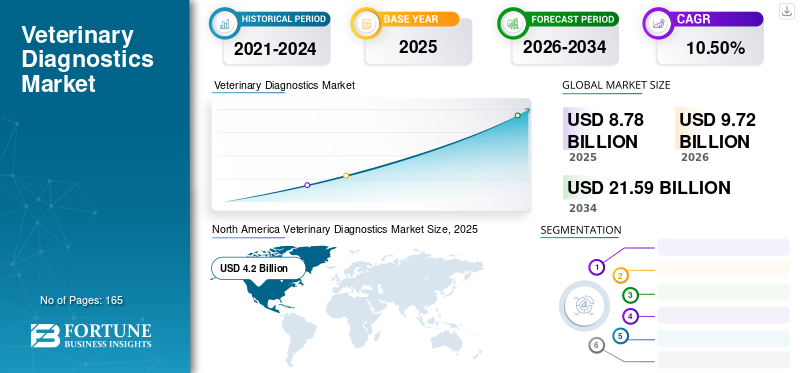
The global veterinary diagnostics market size was valued at USD 8.78 billion in 2025. The market is projected to grow from USD 9.72 billion in 2026 to USD 22.10 billion by 2034, exhibiting a CAGR of 10.82% during the forecast period.
The global market includes instruments, reagents, and consumables used for disease detection, health screening, and treatment monitoring in livestock and companion animals. The market growth is supported by rising pet ownership, increasing livestock disease surveillance, growing zoonotic disease concerns, and wider adoption of point-of-care and molecular testing.
Key players in the global market include IDEXX, Zoetis Services LLC, Antech Diagnostics, Inc. and Virbac. Robust portfolios of diagnostic products, extensive geographic reach, and a focus on innovation are several factors underpinning the leadership of these companies in the worldwide market.
Download Free sample to learn more about this report.
VETERINARY DIAGNOSTICS MARKET TRENDS
Shift Toward AI-Enabled Veterinary Diagnostics is a Remarkable Market Trend
Artificial intelligence is increasingly significant in veterinary diagnostics as it automates the analysis of cytology, hematology, pathology, and imaging findings. Platforms powered by AI assist veterinary clinics in achieving quicker results, minimizing manual evaluations, and detecting irregularities that might need specialist analysis. These approaches are especially useful for point-of-care testing, as swift results facilitate clinical decisions during the same appointment. Collaboration with cloud services and remote experts is broadening diagnostic opportunities for smaller veterinary clinics. These factors are supporting the global veterinary diagnostics market growth during the forecast period.
- In June 2025, Zoetis launched AI Masses for its Vetscan Imagyst platform, enabling in-clinic AI screening of common lymph-node and skin or subcutaneous lesions within minutes.
MARKET DYNAMICS
MARKET DRIVERS
Download Free sample to learn more about this report.
Increasing Incidence and Surveillance of Animal Diseases to Propel Market Growth
Recurring outbreaks of African swine fever, avian influenza, and other transboundary diseases are increasing the need for early and large-scale animal testing. Thus, governments and livestock producers are expanding routine surveillance to limit animal losses, trade restrictions, and disease transmission. This drives recurring demand for PCR assays, ELISA kits, rapid tests, sample-preparation products, and confirmatory laboratory services. Moreover, mandatory screening and outbreak-response programs also increase testing volumes across farms, borders, and veterinary reference laboratories.
- In May 2025, WOAH reported that African swine fever had affected over 971,000 pigs across 64 countries and territories since January 2022, causing approximately 2.08 million domestic-pig losses.
|
Rank |
Market Drivers |
Overall Impact Rank |
CAGR Contribution (2026-2034) |
Impact 2026-2028 |
Impact 2029-2031 |
Impact 2032-2034 |
|
1 |
Rising companion-animal ownership and pet healthcare expenditure |
High |
3.20% |
High |
High |
High |
|
2 |
Increasing prevalence and surveillance of zoonotic and transboundary animal diseases |
High |
2.70% |
High |
High |
High |
|
3 |
Growing adoption of point-of-care and in-clinic diagnostic systems |
High |
2.40% |
High |
High |
High |
|
4 |
Technological advancements in molecular, AI-enabled, and digital diagnostics |
Medium–High |
2.10% |
Medium |
High |
High |
|
5 |
Expansion of livestock production, food-safety testing, and One Health programs |
Medium–High |
1.90% |
Medium |
High |
High |
|
6 |
Others |
Low |
1.62% |
Low |
Low |
Low |
|
Total Positive Growth Contribution |
13.92% |
MARKET RESTRAINTS
High Cost of Veterinary Diagnostics to Hamper Market Growth
Advanced imaging, molecular assays, blood panels, and repeat monitoring can substantially increase the cost of veterinary treatment. As most diagnostic expenses are paid directly by pet owners, price sensitivity can lead to delayed testing or selection of only basic procedures.
Lower test uptake directly affects reagent consumption, analyzer utilization, and reference-laboratory volumes. The restraint is more pronounced for uninsured pets, chronic diseases, and emergency cases requiring multiple diagnostic procedures.
- In June 2025, Synchrony reported that 74% of U.S. pet owners had faced unexpected pet-care costs above USD 250, while only 31% could comfortably manage a major pet expense. Such affordability gaps restrict access to recommended veterinary diagnostics and slow market penetration of premium testing solutions.
|
Rank |
Market Restraints |
Overall Impact Rank |
Negative CAGR Contribution (2026-2034) |
Impact 2026-2028 |
Impact 2029-2031 |
Impact 2032-2034 |
|
1 |
High cost of advanced veterinary diagnostics and affordability constraints |
High |
−1.20% |
High |
High |
Medium |
|
2 |
Limited diagnostic infrastructure and shortage of skilled veterinary professionals |
Medium–High |
−9.0% |
High |
Medium |
Medium |
|
3 |
Regulatory fragmentation and species-specific assay-validation requirements |
Medium |
−0.70% |
Medium |
Medium |
Medium |
|
4 |
Others |
Low |
−0.30% |
Low |
Low |
Low |
|
Total Negative Growth Impact |
|
−3.10% |
MARKET OPPORTUNITIES
Expansion of Urban Pet Care in Emerging Veterinary Markets to Offer Growth Opportunities
Asia Pacific, Latin America, the Middle East, and Africa present considerable growth opportunities as livestock health services and urban pet care become more structured. Restricted availability of automated analyzers, molecular testing, and veterinary reference labs results in significant unmet diagnostic needs in areas away from major urban centers. Producers can fill this void by utilizing compact point-of-care devices, cost-effective rapid testing kits, local labs, and service networks led by distributors. Entering these markets can boost instrument placements and produce ongoing revenue from reagents, consumables, and testing services. All these factors would drive the market growth in the coming years.
- In September 2025, BRIC-Rajiv Gandhi Centre for Biotechnology opened its first veterinary medical laboratory services unit in Oyoor, Kerala, offering advanced clinical testing for livestock, poultry, and companion animals, with additional units planned across the state.
MARKET CHALLENGES
Species- and Specimen-Specific Test Validation to Pose as a Prominent Challenge to Market Growth
Veterinary diagnostic tests need to be validated individually for each specific animal species and specimen type, since their performance may differ among blood, serum, tissue, swabs, and various other matrices. Producers need to determine sensitivity, specificity, cut-off values, repeatability, and reproducibility with suitable positive and negative samples. Acquiring adequately large, well-defined sample panels is challenging, especially for rare diseases, wildlife species, and newly emerging pathogens. These demands raise costs for assay development, prolong approval periods, and limit the swift proliferation of tests among various animal groups.
- In July 2025, USDA APHIS reiterated its oversight of veterinary diagnostic kits; its licensing guidance requires validation based on the intended species, sample type, pathogen, analyte, and assay technology.
Segmentation Analysis
By Product Type
Strong Consumption Trends of Reagents & Consumables to Enable Segmental Dominance
In terms of product type, the market is divided into instruments and reagents & consumables.
The reagents & consumables segment dominated, capturing the largest global veterinary diagnostics market share in 2025. The segment led due to the fact that assay kits, cartridges, slides, controls, calibrators, and sample-preparation products are consumed with every veterinary diagnostic test. Unlike instruments, which are purchased periodically, consumables generate continuous replacement demand across hematology, clinical biochemistry, immunodiagnostics, and molecular testing. Expansion of the installed analyzer base further increases recurring test volumes and proprietary consumable purchases. Routine wellness screening, chronic disease monitoring, and infectious-disease testing also support frequent utilization across veterinary clinics and reference laboratories.
- In May 2025, IDEXX reported double-digit organic growth in IDEXX VetLab consumables revenue, supported by 9% growth in its global premium instrument installed base, highlighting the recurring revenue generated from diagnostic consumables.
The instruments segment is anticipated to rise at a CAGR of 10.05% over the forecast period.
To know how our report can help streamline your business, Speak to Analyst
By Technique
Immunodiagnostics Segment Led the Market Due to Broad Test Applicability and Rapid Point-of-Care Results
On the basis of technique, the market is divided into hematology, immunodiagnostics, molecular diagnostics, diagnostic imaging, clinical biochemistry, and others.
The immunodiagnostics segment dominated with the largest global market share in 2025. This is primarily due to the fact that rapid assays are widely used to detect infectious diseases, antibodies, antigens, hormones, and organ-specific biomarkers in companion and livestock animals. These tests offer simple workflows, short turnaround times, and reliable results without requiring complex laboratory infrastructure. Their suitability for routine screening, preventive care, and same-visit clinical decisions supports high testing volumes across veterinary clinics and reference laboratories. Expanding menus of quantitative fluorescent immunoassays also increase recurring demand for test cartridges and kits. Furthermore, the segment is set to hold a share of 25.3% by 2026.
- In June 2025, BIONOTE launched Vcheck SDMA 2.0, an upgraded point-of-care immunodiagnostic kit for early kidney-disease detection, routine screening, and renal-function monitoring in dogs and cats.
The molecular diagnostics segment is projected to grow at a CAGR of 12.11% over the forecast period.
By Animal Type
High Diagnostic Testing and Preventive-Care Utilization Supported the Companion Segment’s Growth
In terms of animal type, the market is segmented into livestock and companion. The livestock segment is further sub-segmented into bovine, porcine, and others. Furthermore, the companion segment is also sub-segmented into canine, feline, and others.
The companion segment dominated the market in 2025. This is due to the fact that dogs and cats receive more frequent veterinary consultations, wellness screening, pre-surgical testing, and chronic-disease monitoring than most livestock animals. Strong pet humanization and owners’ willingness to pursue advanced care support demand for hematology, clinical biochemistry, immunodiagnostics, imaging, and molecular testing. Longer pet lifespans are also increasing testing for renal, endocrine, cardiac, and oncological conditions. The concentration of diagnostic analyzers and reference-laboratory services in companion-animal clinics further supports higher revenue per animal. Furthermore, the segment is set to hold a 52.0% share in 2026.
- In December 2024, Zoetis announced the global launch of Vetscan OptiCell at VMX 2025, introducing an AI-powered, cartridge-based hematology analyzer designed for rapid complete blood count testing in veterinary clinics across major companion-animal markets.
The livestock segment is anticipated to rise with a CAGR of 8.59% over the forecast period.
By End User
Veterinary Reference Laboratories Segment Led the Market Due to Broad Test Menus and Specialized Testing Capabilities
On the basis of end user, the market is segmented into veterinary hospitals & clinics, veterinary reference laboratories, and others.
In 2025, the veterinary reference laboratories segment dominated as they process large sample volumes using centralized automation, advanced molecular assays, pathology, immunodiagnostics, and specialist interpretation. Clinics routinely outsource complex, low-frequency, and confirmatory tests that are difficult to perform economically in-house. Broad test menus, standardized quality controls, sample-logistics networks, and rapid digital reporting further support recurring laboratory utilization. Reference laboratories also benefit from economies of scale, enabling wider access to specialized diagnostics across multiple animal species. Furthermore, the segment is set to hold a 47.4% share in 2026.
- In May 2026, IDEXX expanded its Fecal Dx antigen testing platform with taeniid tapeworm detection for U.S. and Canadian reference-laboratory customers; the platform had already processed more than 50 million tests globally.
The veterinary hospitals & clinics segment is anticipated to grow at a CAGR of 9.94% over the forecast period.
Veterinary Diagnostics Market Regional Outlook
By region, the market is classified into North America, Europe, Asia Pacific, Latin America, and the Middle East & Africa.
North America
North America Veterinary Diagnostics Market Size, 2025 (USD Billion)
To get more information on the regional analysis of this market, Download Free sample
North America accounted for the largest market share and was valued at USD 3.91 billion in 2024. In 2025, the region maintained its dominance, with USD 4.20 billion. The regional market growth is driven by a large companion-animal population and sustained expenditure on preventive and advanced veterinary care, high penetration of in-clinic diagnostic techniques, and strong livestock and poultry surveillance through coordinated laboratory networks.
U.S. Veterinary Diagnostics Market
The U.S. market dominated the North American market and can be analytically approximated at around USD 4.17 billion in 2026, accounting for roughly 43.0% of the global market.
Europe
The Europe market size is anticipated to grow at a CAGR of 11.06% during the forecast period. The region’s growth is supported by a large pet population and growing utilization of wellness screening, senior-pet testing, and chronic-disease monitoring along with strong veterinary infrastructure and access to specialized pathology, molecular testing, and diagnostic imaging.
U.K. Veterinary Diagnostics Market
The U.K. market value is estimated to reach around USD 0.28 billion by 2026, representing roughly 2.9% of global revenues.
Germany Veterinary Diagnostics Market
The Germany market size is projected to reach approximately USD 0.61 billion by 2026, equivalent to around 6.3% of global sales.
Asia Pacific
The Asia Pacific market is expected to reach a valuation of USD 1.84 billion by 2026. Asia Pacific is expected to be the fastest-growing region as large cattle, swine, poultry, and aquaculture populations create substantial demand for infectious-disease screening and herd-health diagnostics. Moreover, rising urban pet ownership and expanding veterinary-clinic networks also support companion-animal testing.
Japan Veterinary Diagnostics Market
The Japan market is estimated to reach a value of around USD 0.43 billion in 2026, accounting for roughly 4.5% of global revenues.
China Veterinary Diagnostics Market
The China market is projected to reach revenues of around USD 0.69 billion by 2026, representing roughly 7.1% of global sales.
India Veterinary Diagnostics Market
The Indian market size is estimated to reach around USD 0.19 billion by 2026, accounting for roughly 2.0% of global revenues.
Latin America and Middle East & Africa
The Middle East & Africa and Latin America regions are likely to witness a slower growth over the forecast period. The market in Latin America is projected to reach a valuation of USD 0.61 billion by 2026. Latin America’s growth is mainly supported by increasing companion-animal healthcare expenditure in major urban markets and large commercial cattle, poultry, and swine industries that require routine testing.
In the Middle East & Africa region, the GCC market is projected to reach approximately USD 0.15 billion by 2026, representing about 1.6% of global revenues. The regional growth is driven by high economic dependence on livestock, and expansion and modernization of veterinary laboratories.
COMPETITIVE LANDSCAPE
Key Industry Players
Diverse Veterinary Diagnostics Portfolio to Strengthen the Market Positions of Key Competitors
The global veterinary diagnostics market is consolidated, with companies such as IDEXX, Zoetis Services LLC, Antech Diagnostics, Inc. and Virbac holding notable market shares. A growing focus on new product development, coupled with strategic initiatives and robust product portfolio innovative solutions, is helping companies strengthen their market presence.
- In November 2025, Zoetis acquired Veterinary Pathology Group, expanding its veterinary diagnostic laboratory presence across the U.K. and Ireland.
Additional key players in the market include Neogen Corporation, Shenzhen Mindray Animal Medical Technology Co., LTD., Randox Laboratories Ltd., and INDICAL BIOSCIENCE GmbH. These companies are focusing on point-of-care workflows, multiplex testing, and integrated laboratory-clinic connectivity to improve competitiveness during the forecast period.
LIST OF KEY VETERINARY DIAGNOSTICS COMPANIES PROFILED
- IDEXX (U.S.)
- Zoetis Services LLC (U.S.)
- Antech Diagnostics, Inc. (U.S.)
- Thermo Fisher Scientific Inc. (U.S.)
- Virbac (France)
- BIOMÉRIEUX (France)
- Neogen Corporation (U.S.)
- Shenzhen Mindray Animal Medical Technology Co., LTD. (China)
- Randox Laboratories Ltd. (U.K.)
- INDICAL BIOSCIENCE GmbH (Germany)
KEY INDUSTRY DEVELOPMENTS
- July 2026: Zoetis entered into an agreement to acquire VitalRADS, building on their August 2025 partnership. The transaction is intended to add cloud-based teleradiology, imaging workflow technology, and around-the-clock access to veterinary specialists to Zoetis’ Virtual Reference Lab offering.
- January 2026: IDEXX launched the ImageVue DR50 Plus Digital Imaging System for veterinary practices. The platform combines AI-supported image optimization, connected imaging workflows, and radiation exposure up to 25% below the earlier DR50 system.
- January 2026: IDEXX announced the addition of canine mast-cell tumor detection to the Cancer Dx Panel and introduced fine-needle aspiration cytology on the inVue Dx analyzer. The advancement expands early cancer screening and in-clinic cellular analysis capabilities.
- May 2025: Antech launched RapidRead Dental, an AI-powered veterinary radiology interpretation service providing tooth-by-tooth dental radiograph assessments in approximately 10 minutes.
- May 2025: Zoetis opened its largest U.S. veterinary diagnostics reference laboratory at the UPS Healthcare Labport in Louisville. The 32,000-square-foot facility uses its logistics partnership with UPS to improve specimen transportation, tracking, testing capacity, and turnaround times.
REPORT COVERAGE
The global veterinary diagnostics market analysis encompasses an extensive examination of the market size and projections for all market segments featured in the report. It provides information on the market dynamics and trends that are anticipated to propel the market during the forecast period. It offers insights into crucial factors, such as innovations in products, the regulatory landscape, pipeline analysis, and the introduction of new products. Furthermore, the global market report outlines collaborations, mergers & acquisitions, along with significant advancements in the industry within the market. The global market forecast report additionally offers a comprehensive competitive landscape with details on market share and profiles of major active participants.
Request for Customization to gain extensive market insights.
Report Scope & Segmentation
| ATTRIBUTE | DETAILS |
| Study Period | 2021-2034 |
| Base Year | 2025 |
| Estimated Year | 2026 |
| Forecast Period | 2026-2034 |
| Historical Period | 2021-2024 |
| Growth Rate | CAGR of 10.82% from 2026-2034 |
| Unit | Value (USD Billion) |
| Segmentation | By Product Type, Technique, Animal Type, End User, and Region |
| By Product Type |
|
| By Technique |
|
| By Animal Type |
|
| By End User |
|
| By Region |
|
Frequently Asked Questions
According to Fortune Business Insights, the global market value stood at USD 8.78 billion in 2025 and is projected to reach USD 22.10 billion by 2034.
In 2025, the market value stood at USD 4.20 billion.
The market is expected to exhibit a CAGR of 10.82% during the forecast period.
By product type, the reagents & consumables segment is expected to lead the market.
Growing companion-animal population and pet healthcare spending along with increasing incidence and surveillance of animal diseases are primarily driving market expansion.
IDEXX, Zoetis Services LLC, Antech Diagnostics, Inc. and Virbac are some of the leading players in the global market.
North America dominated the market in 2025.



- 2021-2034
- 2025
- 2021-2024
- 180
Get 30-60 hrs Free Customization
Expand Regional and Country Coverage, Segments Analysis, Company Profiles, Competitive Benchmarking, and End-user Insights.













.webp)






Related Reports
-
US +1 833 909 2966 ( Toll Free )
-
Get In Touch With Us