Industrial Radiography Market Size, Share & Industry Analysis, By Imaging Technique (Film-based Radiography, Digital Radiography), End User (Petrochemicals & Gas, Power Generation, Manufacturing, Aerospace, and Automotive & Transportation) and Geography, and Regional Forecast, 2026-2034
 Download Free Sample
 Industrial Radiography Market Overview
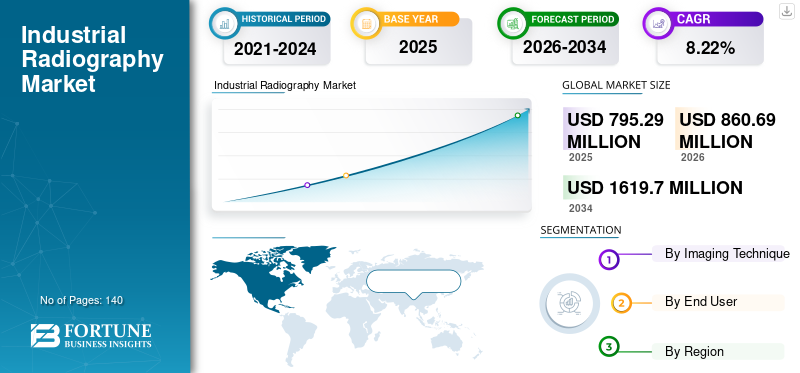
The industrial radiography market size was valued at USD 795.29 million in 2025. The market is projected to grow from USD 860.69 million in 2026 to USD 1619.70 million by 2034, exhibiting a CAGR of 8.22% during the forecast period.

The industrial radiography market is witnessing strong adoption across non-destructive testing environments where defect detection, weld inspection, corrosion monitoring, and structural integrity verification are critical. Industrial radiography systems are increasingly used in sectors including petrochemicals, aerospace, automotive manufacturing, power generation, and heavy engineering. The market is benefiting from the transition toward digital inspection technologies that provide enhanced image quality, faster diagnostics, and improved workflow efficiency. Growing regulatory requirements for safety compliance and asset reliability are encouraging organizations to implement advanced radiographic inspection solutions. industrial radiography market Analysis indicates that digital transformation, automation integration, and demand for predictive maintenance programs are shaping long-term industry development.
The United States remains a major contributor to the industrial radiography market due to extensive deployment of non-destructive testing solutions across aerospace manufacturing, oil and gas infrastructure, defense production, and industrial fabrication facilities. The country has a mature inspection ecosystem supported by strict quality assurance standards and continuous investment in advanced imaging systems. Industrial Radiography Industry Analysis highlights growing adoption of portable digital radiography units for field inspections and pipeline monitoring operations.
The expansion of renewable energy projects, aircraft maintenance activities, and modernization of aging industrial infrastructure continues to support demand for industrial radiography equipment. Manufacturers are increasingly replacing conventional film systems with digital radiography platforms to improve inspection speed and operational productivity. industrial radiography market Research Report findings indicate that artificial intelligence-assisted defect recognition is gaining momentum throughout the U.S. inspection sector.
Download Free sample to learn more about this report.
Key Takeaways
Market Size & Growth
- Global market size 2025: USD 795.29 million
- Global market size 2034: USD 1619.70 million
- CAGR (2026–2034): 8.22%
Market Share – Regional
- North America: 36%
- Europe: 28%
- Asia-Pacific: 25%
- Rest of World: 11%
Country-Level Shares
- Germany: 31% of Europe’s market
- United Kingdom: 22% of Europe’s market
- Japan: 24% of Asia-Pacific market
- China: 38% of Asia-Pacific market
industrial radiography market Latest Trends
One of the most influential industrial radiography market Trends is the rapid migration from film-based inspection systems toward digital radiography solutions. Digital platforms enable real-time imaging, faster reporting, reduced chemical processing requirements, and superior image storage capabilities. Industries requiring high-volume inspections are prioritizing digital systems to improve operational efficiency while maintaining compliance with stringent safety standards.
Download Free sample to learn more about this report.
Another significant trend in the industrial radiography market is the integration of artificial intelligence and machine learning technologies into inspection workflows. Automated defect detection software is helping inspectors identify anomalies with greater accuracy while reducing interpretation time. Advanced image analytics platforms are becoming increasingly valuable in aerospace, manufacturing, and power generation applications.
Portable radiography systems are also experiencing strong demand due to their flexibility in remote industrial environments. Pipeline inspections, offshore energy projects, and infrastructure maintenance operations are increasingly utilizing compact imaging systems. industrial radiography market Outlook assessments further indicate growing investment in computed tomography technologies for complex component analysis, particularly within aerospace and precision manufacturing industries where internal structural evaluation is essential.
industrial radiography market Dynamics
DRIVER
Rising Demand for Non-Destructive Testing Across Critical Industrial Infrastructure
The primary growth driver of the industrial radiography market is the increasing need for reliable non-destructive testing solutions across high-value industrial assets. Industries such as petrochemicals, power generation, aerospace, and automotive manufacturing require precise inspection methods to identify cracks, voids, corrosion, and welding defects without damaging components. Industrial radiography offers a dependable approach for evaluating material integrity while minimizing operational disruptions.
As industrial facilities age, operators are investing heavily in maintenance and asset management programs. Pipeline networks, pressure vessels, storage tanks, and structural components require routine inspection to prevent failures and maintain safety compliance. industrial radiography market Growth is also supported by stricter quality assurance regulations imposed across multiple industries. Organizations increasingly prioritize preventive maintenance strategies, creating sustained demand for advanced radiographic inspection technologies. The growing focus on infrastructure reliability and operational safety continues to strengthen adoption throughout the global Industrial Radiography Industry.
RESTRAINT
High Equipment Acquisition Costs and Radiation Safety Requirements
One of the major restraints affecting the industrial radiography market is the substantial investment required for advanced inspection equipment. Digital radiography systems, detector arrays, imaging software, and specialized radiation sources involve significant procurement and maintenance expenses. Small and medium-sized enterprises often face budget limitations that can delay modernization initiatives and reduce technology adoption rates.
Radiation safety regulations represent another important challenge for market participants. Industrial radiography operations require trained personnel, protective equipment, licensing procedures, and strict compliance protocols. Organizations must invest in workforce certification and continuous safety monitoring to meet regulatory requirements. These obligations increase operational complexity and can discourage adoption among businesses seeking lower-cost inspection alternatives. industrial radiography market Forecast evaluations indicate that while demand remains positive, financial barriers and compliance burdens may limit growth potential in cost-sensitive sectors.
OPPORTUNITY
Expansion of Digital Radiography and Automated Inspection Platforms
The transition toward digital inspection technologies presents significant opportunities for the industrial radiography market. Digital radiography systems deliver improved image quality, faster inspection cycles, enhanced data management, and reduced environmental impact compared with traditional film-based methods. Industries seeking operational efficiency are increasingly investing in digital transformation initiatives that incorporate advanced radiographic solutions.
Automation represents another major growth opportunity. Artificial intelligence-enabled image interpretation, robotic inspection systems, and remote monitoring platforms are reshaping industrial inspection practices. These technologies help reduce human error, improve defect detection consistency, and enhance productivity across large-scale operations. industrial radiography market Opportunities are particularly strong within aerospace manufacturing, renewable energy infrastructure, automotive production, and smart factory environments where automated quality control systems are becoming standard operational requirements. The continued development of high-resolution detectors and cloud-based inspection platforms is expected to create additional market expansion opportunities.
CHALLENGE
Shortage of Skilled Inspection Professionals
The industrial radiography market faces a persistent challenge associated with workforce availability and technical expertise. Radiographic inspection requires specialized training, certification, and extensive experience in image interpretation. Many industrial sectors are experiencing shortages of qualified inspectors capable of operating advanced equipment and evaluating complex inspection results.
The adoption of sophisticated digital systems further increases training requirements. Organizations must continuously update employee skills to accommodate new software platforms, automated imaging tools, and evolving inspection methodologies. industrial radiography market Insights reveal that workforce limitations can delay project timelines, increase labor costs, and reduce operational efficiency. In regions experiencing rapid industrialization, the gap between inspection demand and skilled workforce availability remains particularly significant. Addressing this challenge requires expanded training programs, certification initiatives, and investments in user-friendly inspection technologies.
industrial radiography market Segmentation
By Imaging Technique
Film-based radiography continues to maintain relevance within the industrial radiography market despite the growing shift toward digital solutions. This segment accounts for approximately 39% of the global market share due to its long-established reliability and widespread acceptance in industrial inspection procedures. Industries operating legacy infrastructure frequently continue using film-based systems because of existing workflows and regulatory familiarity. Film-based radiography is commonly employed in petrochemical facilities, pipeline inspections, and heavy manufacturing environments where historical inspection records are maintained using conventional imaging methods. The technology delivers detailed image resolution and remains trusted for critical weld inspections. industrial radiography market Report assessments indicate that replacement cycles for film systems are longer than digital alternatives, allowing this segment to retain a substantial presence despite modernization efforts.
Digital radiography represents the dominant segment of the industrial radiography market with an estimated share of 61%. The segment is benefiting from widespread demand for faster inspections, improved image quality, reduced processing times, and enhanced data storage capabilities. Organizations are increasingly transitioning to digital platforms to improve operational efficiency and reduce long-term inspection costs. Digital radiography systems provide real-time imaging and enable inspectors to perform immediate analysis without chemical film processing. Advanced software integration supports automated defect recognition and remote collaboration. Aerospace manufacturers, automotive producers, and power generation companies are among the leading adopters of digital inspection technologies. industrial radiography market Size evaluations indicate that digital radiography will remain the preferred technology segment as industries pursue automation and predictive maintenance strategies.
By End User
The petrochemicals and gas segment holds approximately 27% of the industrial radiography market share due to extensive inspection requirements across pipelines, refineries, storage facilities, and offshore production assets. Industrial radiography plays a critical role in identifying corrosion, weld defects, and material degradation that could affect operational safety. Energy operators increasingly utilize digital radiography systems to improve inspection efficiency and minimize downtime. Regulatory compliance requirements and aging infrastructure continue to generate consistent demand for advanced inspection technologies. Industrial Radiography Industry Report findings indicate that pipeline integrity management programs remain a major demand driver within this segment.
Power generation accounts for nearly 20% of the industrial radiography market and relies heavily on non-destructive testing solutions to ensure reliability of turbines, boilers, heat exchangers, and structural components. Nuclear, thermal, hydroelectric, and renewable energy facilities require routine inspections to maintain operational efficiency and regulatory compliance. Radiographic inspection technologies help identify internal defects before failures occur, reducing maintenance costs and unplanned outages. industrial radiography market Research Report evaluations suggest growing demand from renewable energy installations where inspection of wind turbine components and energy storage infrastructure is becoming increasingly important.
Manufacturing: The manufacturing segment represents approximately 22% of the industrial radiography market share. Industrial radiography supports quality assurance programs across metal fabrication, machinery production, industrial equipment manufacturing, and precision engineering applications. Manufacturers depend on radiographic testing to validate product integrity and ensure compliance with industry specifications. The expansion of smart manufacturing environments is driving adoption of digital radiography systems integrated with automated production lines. industrial radiography market Trends indicate increasing use of artificial intelligence-assisted inspection tools to accelerate quality control processes and improve defect detection accuracy.
Aerospace contributes nearly 16% of the industrial radiography market due to stringent safety requirements and complex component inspection needs. Aircraft manufacturers and maintenance providers rely on radiographic testing to evaluate engine components, structural assemblies, composite materials, and critical flight systems. Digital radiography and computed tomography technologies are widely utilized to detect hidden defects without damaging expensive aerospace components. industrial radiography market Outlook studies highlight continued demand from commercial aviation, defense programs, and space exploration initiatives requiring high-precision inspection capabilities.
Automotive and transportation applications account for approximately 15% of the industrial radiography market share. Vehicle manufacturers employ radiographic inspection to evaluate weld quality, casting integrity, battery systems, and structural components. The rise of electric vehicle production is creating additional opportunities for advanced imaging technologies. Industrial radiography helps manufacturers maintain quality standards while reducing product recalls and warranty risks. Growing investments in transportation infrastructure and advanced mobility solutions continue to support long-term demand for inspection technologies throughout this segment.
industrial radiography market Regional Outlook
North America
North America accounts for approximately 36% of the industrial radiography market. The region benefits from advanced industrial infrastructure, strict regulatory standards, and strong adoption of digital inspection technologies. Aerospace manufacturing, energy production, defense programs, and industrial automation projects contribute significantly to regional demand. Companies across the United States and Canada continue investing in predictive maintenance strategies that require sophisticated non-destructive testing solutions.
The region also demonstrates strong adoption of artificial intelligence-based inspection platforms and automated imaging systems. industrial radiography market Insights indicate that modernization of aging energy infrastructure and growing investments in renewable energy projects are generating additional opportunities for equipment manufacturers and service providers.
Europe
Europe represents nearly 28% of the industrial radiography market share. The region maintains a strong industrial base across aerospace, automotive, manufacturing, and energy sectors. Stringent product quality standards and workplace safety regulations continue to support widespread use of radiographic inspection technologies.
European industries are actively adopting digital radiography platforms to improve operational efficiency and environmental sustainability. industrial radiography market Analysis shows increasing demand for advanced inspection systems supporting electric vehicle manufacturing, industrial automation projects, and renewable energy infrastructure development.
Germany industrial radiography market
Germany holds approximately 31% of the European industrial radiography market. The country's strong manufacturing ecosystem, automotive production leadership, and engineering excellence create substantial demand for advanced inspection technologies. Industrial radiography is extensively utilized across automotive assembly plants, industrial machinery production facilities, and precision engineering operations.
Digital radiography adoption is accelerating as manufacturers pursue Industry 4.0 objectives and automated quality control systems. The aerospace sector and energy infrastructure projects further contribute to market expansion. industrial radiography market Opportunities in Germany are supported by continued investment in smart factories, industrial automation, and advanced materials manufacturing.
United Kingdom industrial radiography market
The United Kingdom accounts for approximately 22% of the European industrial radiography market. Demand is driven by aerospace manufacturing, defense programs, energy infrastructure maintenance, and transportation projects. Radiographic inspection remains essential for ensuring compliance with stringent quality and safety standards.
The country is witnessing increasing deployment of digital radiography technologies across industrial facilities seeking faster inspection cycles and improved data management. industrial radiography market Growth is also supported by offshore energy operations and infrastructure modernization initiatives requiring comprehensive non-destructive testing services.
Asia-Pacific
Asia-Pacific holds approximately 25% of the industrial radiography market. Rapid industrialization, infrastructure development, and manufacturing expansion are fueling strong demand for inspection technologies throughout the region. Countries including China, Japan, India, and South Korea are investing heavily in industrial quality assurance programs.
Growing adoption of advanced manufacturing technologies and increased emphasis on operational safety are accelerating digital radiography implementation. industrial radiography market Forecast assessments suggest that Asia-Pacific will remain a key growth region due to expanding industrial capacity and infrastructure investments.
Japan industrial radiography market
Japan represents approximately 24% of the Asia-Pacific industrial radiography market. The country's advanced manufacturing capabilities and technological expertise support extensive utilization of industrial radiography solutions. Automotive production, electronics manufacturing, aerospace engineering, and precision equipment industries are major contributors to demand.
Japanese companies continue investing in digital imaging systems, automated inspection technologies, and artificial intelligence-based defect detection platforms. industrial radiography market Research Report evaluations indicate strong focus on innovation and quality assurance across industrial sectors, sustaining long-term market expansion.
China industrial radiography market
China accounts for approximately 38% of the Asia-Pacific industrial radiography market. Massive manufacturing output, infrastructure development programs, and expanding energy projects are driving substantial demand for radiographic inspection technologies. Industrial radiography is widely used across construction, transportation, aerospace, and industrial manufacturing environments.
The country is rapidly adopting digital radiography systems to support modernization objectives and improve production efficiency. industrial radiography market Size studies highlight increasing investment in high-resolution imaging technologies and automated inspection platforms throughout China's industrial ecosystem.
Rest of World
The Rest of World region accounts for approximately 11% of the industrial radiography market. Demand originates from energy projects, mining operations, transportation infrastructure development, and industrial manufacturing activities across Latin America, the Middle East, and Africa. Oil and gas investments remain a primary driver of radiographic inspection requirements.
Governments and industrial operators are increasingly emphasizing safety compliance and asset reliability, encouraging adoption of modern inspection technologies. industrial radiography market Trends indicate growing opportunities for portable digital radiography systems capable of operating effectively in remote and challenging environments.
List of Top Industrial Radiography Companies
- General Electric (U.S.)
- FujiFilm Holdings Corporation (Japan)
- COMET Group (Switzerland)
Top Two Companies by Market Share
- FujiFilm Holdings Corporation – 18%
- General Electric – 15%
Investment Analysis and Opportunities
Investment activity within the industrial radiography market is increasingly focused on digital transformation, automation, and advanced imaging technologies. Manufacturers are allocating resources toward development of high-resolution detectors, artificial intelligence software platforms, and portable inspection systems designed for field applications. Venture investments and strategic partnerships are supporting commercialization of next-generation inspection solutions capable of improving productivity and inspection accuracy.
industrial radiography market Opportunities are particularly attractive within renewable energy, aerospace manufacturing, electric vehicle production, and industrial automation sectors. Investors are targeting technologies that reduce inspection time while enhancing defect detection performance. Cloud-connected radiography platforms and remote inspection capabilities are gaining significant attention due to their ability to support distributed industrial operations. Market participants are also pursuing acquisitions to expand product portfolios and strengthen regional distribution networks.
New Product Development
Product innovation remains a major competitive strategy across the industrial radiography market. Manufacturers are introducing advanced digital detector arrays that provide higher image resolution, improved sensitivity, and faster processing capabilities. These systems enable inspectors to evaluate complex industrial components with greater precision while reducing inspection cycle times.
Another important area of development involves artificial intelligence-enabled imaging software. New platforms can automatically identify defects, classify anomalies, and generate inspection reports with minimal operator intervention. industrial radiography market Insights indicate increasing demand for portable battery-powered systems designed for remote energy infrastructure inspections. Companies are also developing integrated cloud solutions that facilitate real-time image sharing, remote collaboration, and centralized inspection data management across multiple industrial locations.
Five Recent Developments (2023-2025)
- FujiFilm expanded its industrial digital radiography portfolio with enhanced detector technology for high-resolution non-destructive testing applications.
- COMET Group introduced upgraded X-ray inspection solutions focused on precision manufacturing and electronics quality assurance.
- General Electric expanded digital inspection capabilities through advanced software integration supporting automated defect recognition.
- Multiple industrial radiography manufacturers launched portable wireless imaging systems for pipeline and infrastructure inspections.
- Industry participants accelerated investment in artificial intelligence-based image analytics platforms designed to improve inspection productivity and accuracy.
Report Coverage of industrial radiography market
The industrial radiography market Report provides comprehensive evaluation of industry trends, market dynamics, competitive developments, technological innovations, and growth opportunities across major industrial sectors. The report examines adoption patterns for film-based and digital radiography technologies while assessing demand across petrochemicals, power generation, manufacturing, aerospace, and transportation applications.
Request for Customization to gain extensive market insights.
industrial radiography market Research Report coverage includes regional analysis across North America, Europe, Asia-Pacific, and Rest of World markets. It evaluates regulatory influences, technological advancements, investment activity, and strategic initiatives implemented by leading industry participants. The report further analyzes emerging opportunities associated with artificial intelligence integration, automated inspection systems, cloud-based imaging platforms, and digital transformation initiatives shaping the future of the Industrial Radiography Industry.



- 2021-2034
- 2025
- 2021-2024
- 140
Get 30-60 hrs Free Customization
Expand Regional and Country Coverage, Segments Analysis, Company Profiles, Competitive Benchmarking, and End-user Insights.




















-
US +1 833 909 2966 ( Toll Free )
-
Get In Touch With Us