Industrial Service Robots Market Size, Share & Industry Analysis, By Robot Type (Autonomous Mobile Robots (AMRs), Automated Guided Vehicles (AGVs), Collaborative Robots (Cobots), Aerial Robots, and Others), By Application (Material Handling, Inspection & Maintenance, Packaging and Sorting and Others), and Regional Forecast, 2026-2034
 Download Free Sample
INDUSTRIAL SERVICE ROBOTS MARKET SIZE AND FUTURE OUTLOOK
 Listen to Audio Version
The global industrial service robots market size was valued at USD 16.81 billion in 2025 and is projected to grow from USD 19.92 billion in 2026 to USD 88.99 billion by 2034, exhibiting a CAGR of 20.6% during the forecast period.
Industrial service robots are specialized, automated machines equipped for performing various tasks in industrial ecosystem. These tasks could include welding, industrial handling, inspection and assembly, thus improving the precision, efficiency, and safety of operations.
The market is growing rapidly due to increasing demand for operational efficiency and workplace safety, surging robotic automation across manufacturing industry, and rising labor costs. Additionally, advancements in technology including IoT, AI and machine learning accelerates the product adoption.
Key players operating in the market include ABB, FANUC, Geek+, GreyOrange, HAI Robotics, Hikrobot, and KUKA. These companies focus on introducing innovative technologies, such as modular systems, AI based solutions and cobots (collaborative robots) to meet the evolving customer needs.
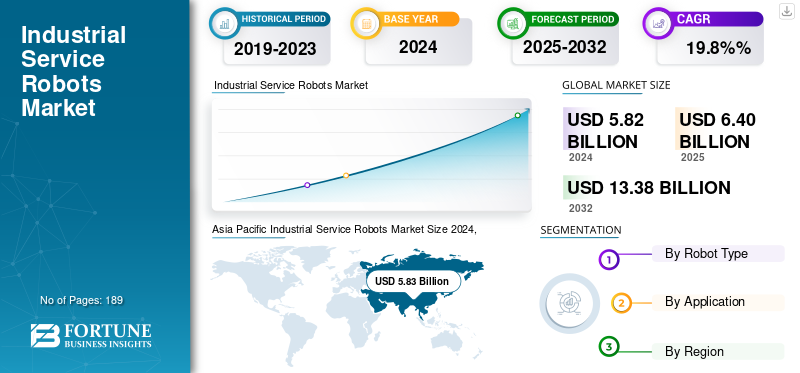
Download Free sample to learn more about this report.
Industrial Service Robots Market Key Takeaways
 Global Market Size & Forecast
- 2025 Market Size: USD 16.81 billion
- 2026 Market Size: USD 19.92 billion
- 2034 Forecast Market Size: USD 88.99 billion
- CAGR: 20.6% from 2026–2034
 Market Share
- Asia Pacific dominated the industrial service robots market with a 41.80% share in 2025.
- The Autonomous Mobile Robots (AMRs) segment held the largest market share and is expected to record a CAGR of 42.31% in 2026.
- The material handling segment dominated the market and is projected to witness a CAGR of 49.27% in 2026.
 Key Regional Highlights
Asia Pacific
Asia Pacific led the global market with revenue of USD 7.02 billion in 2025 and is projected to reach USD 8.49 billion in 2026.
Europe
Europe accounted for USD 4.74 billion in 2025, representing 28.20% of the global market.
North America
North America generated USD 3.80 billion in 2025, accounting for 22.60% of global revenue.
U.S.
The market is expected to generate USD 3.47 billion in revenue by 2026.
Japan
Growth is supported by strong adoption of automation, robotics, and smart manufacturing technologies.
Read More

MARKET DYNAMICS
Market Drivers
Growing Demand for Automation in Manufacturing Drives the Market Development
The surging adoption of automation across manufacturing operations is prominently driving the industrial service robots market growth. Integrating automation in business operations aids in enhancing efficiency, ensuring consistency across the outputs generated and reduces labor costs. Different industries are embedding service robots to maintain high quality outputs, handle hazardous, high-accuracy and repetitive activities. This therefore enhances the overall business productivity.
- For instance, according to the International Federation of Robotics, around 4,281,585 units operating in factories worldwide in 2024 - an increase of 10%. Annual installations exceeded half a million units for the third consecutive year. By region, 70% of all newly deployed robots 2023 were installed in Asia, 17% in Europe and 10% in the Americas.
Moreover, the advancements in machine learning, AI and sensor technologies has also accelerated the market growth. This has enabled a smarter, safer and cost-efficient robotic processes.
Market Restraints
High Implementation Costs and Complex Integration Hampers the Market Growth
One of the major factor deterring the overall market growth is a need for investing substantial capital for adopting industrial service robots. Additionally, the complexity associated with its integration into the current or existing workflow limits companies, particularly small and medium sized from contributing to the market growth. This is majorly due to presence of limited technical and financial resources with such firms.
Market Opportunities
Expansion in Emerging Industrial Sectors Offers Lucrative Growth Opportunities
Industrial service robots are expanding in different sectors such as electric vehicle production, renewable energy and advanced logistics. This offers a significant opportunity for market to grow and generate high revenue for key players. Additionally, the increasing emphasis of giant companies on adopting smart manufacturing and digital transformation has proved to be a lucrative market opportunity. This has created new avenues for industrial service robot applications, globally.
INDUSTRIAL SERVICE ROBOTS MARKET TRENDS
Integration of Artificial Intelligence and Machine Learning Has Emerged as a Prominent Market Trend
A significant trend reshaping the market is growing integration of technology advancements including including artificial intelligence (AI)and machine learning (ML). Such technologies are transforming the operations of robotics by improving their decision-making capabilities, enabling automated performance and high precision across logistics, manufacturing, and maintenance landscape.
Additionally, AI-driven robotics are capable of analyzing complex data, handling dynamic industrial settings and performing difficult tasks with minimal human interventions and errors. This has enabled product enhancement, reduced operational risks and optimized efficient resource utilization.
SEGMENTATION ANALYSIS
By Robot Type
Increased Navigation Accuracy, Flexibility, and Ability to Operate in a Dynamic Landscape Boosts Autonomous Mobile Robots (AMRs) Segment Growth
Based on robot type, the market is segmented into Autonomous Mobile Robots (AMRs), Automated Guided Vehicles (AGVs), Collaborative Robots (Cobots), aerial robots, and others.
In 2024, Autonomous Mobile Robots (AMRs) segment held the largest industrial service robots market share and with a revenue share of USD 5.95 billion. The segment also held the highest CAGR of 42.31% in 2026. This growth is due to their navigation accuracy, flexibility, and ability to operate in a dynamic landscape. This has made it crucial in logistics and manufacturing sectors, allowing companies to optimize their material flow, improve workplace safety, and reduce the downtime. Moreover, surged advancements in artificial intelligence, connectivity, and sensor technology has also augmented the segment growth. This has increased their demand for smart factory automation and efficiency intralogistics across various industries.
By Application
Growing Demand for Automation in Warehousing and Production Lines to Drive the Material Handling Segment Growth
The market is divided into material handling, inspection & maintenance, packaging and sorting and others, based on application.
Among these, the material handling segment dominated the market with a revenue share of USD 6.97 billion in 2024. The segment also held highest CAGR of 49.27% in 2026. This is majorly due to the demand for automation in warehousing and production lines across various industries. Robots are capable of performing extensive tasks including unloading, loading and transporting materials that help in lowering the labor dependency and enhance the operational efficiency. Additionally, growing need for accurate and fast order fulfillment also promotes the segment’s growth. The surge in investments in automated warehouse systems and e-commerce is also propelling the segment’s expansion.
To know how our report can help streamline your business, Speak to Analyst
INDUSTRIAL SERVICE ROBOTS MARKET REGIONAL OUTLOOK
Geographically the market is segmented into North America, Europe, Asia Pacific, South America and Middle East & Africa.
North America
North America contributed 22.60% to the global market in 2025, with a valuation of USD 3.8 Billion, and is projected to reach USD 4.49 Billion in 2026. This growth is driven by the rapid adoption of automation and growing labor costs. Moreover, advancements in technology including AI, IoT, and machine learning in the U.S. also drives the market growth. The U.S. leads the North American market with an expected revenue share of USD 3.47 billion in 2026.
Europe
Europe accounted for USD 4.74 Billion in 2025, representing 28.20% of the global market share, and is projected to reach USD 5.53 Billion in 2026. This growth is attributed to the growing demand for professional service robotics across different industries in the region. Additionally, the presence of different service robot manufacturers in various countries also promote the market growth. U.K., Germany, and Italy are some of the major contributors to the market growth with an expected revenue share of USD 0.84 billion, USD 1.27 billion, and USD 0.47 billion respectively by 2025.
Asia Pacific
The Asia Pacific market was valued at USD 7.02 Billion in 2025, capturing 41.80% of global revenue, and is estimated to reach USD 8.49 Billion in 2026.
This growth is owing to the increased adoption of automation technologies across manufacturing hubs in Japan, China, and South Korea. Government programs also promote smart manufacturing with the presence of different robot manufacturers augment the regional market growth.
Download Free sample to learn more about this report.
Additionally, the rapid technological advancements and growing industrial base also contributes to the market growth. This has led to a surge in investments across robotics based production systems and logistics automation. India and China are the major contributors for the market growth with an expected revenue share of USD 2 0.88 billion and USD 3.67 billion by 2025.
South America and Middle East & Africa
The market in Middle East & Africa reached USD .47 Billion in 2025, representing 2.80% of total market revenue, and is projected to reach USD .51 Billion in 2026. This is driven by the growing demand for and modernized techniques and automation across warehouse systems and manufacturing across Gulf countries. GCC countries are predicted to have a market share of USD 0.26 billion by 2025.
Latin America
In 2025, the Latin America market stood at USD 0.79 Billion, representing 4.70% of global demand, and is projected to grow to USD 0.89 Billion in 2026.
Asia Pacific Industrial Service Robots Market Size 2025, (USD Billion)
To get more information on the regional analysis of this market, Download Free sample
COMPETITIVE LANDSCAPE
Key Industry Players
Growing Focus of Key Players Focus on Collaboration to Strengthen their Market Positions
The industrial service robots industry is highly competitive with different market players operating in the market. These include ABB, FANUC, Geek+, GreyOrange, HAI Robotics, Hikrobot, and KUKA. These companies adopt different initiatives including investment in innovative technologies, collaborations, new launches, and others to sustain the market competition.
LIST OF KEY INDUSTRIAL SERVICE ROBOTS COMPANIES PROFILED
- ABB (Switzerland)
- FANUC (Japan)
- Geek+ (China)
- GreyOrange (U.S.)
- HAI Robotics (China)
- Hikrobot (China)
- KUKA (Germany)
- Locus Robotics (U.S.)
- Mitsubishi Electric Corporation (Japan)
- Omron (Japan)
- Teradyne (U.S.)
- Yaskawa Electric Corporation (Japan)
- Zebra Technologies (U.S.)
KEY INDUSTRY DEVELOPMENTS
- October 2025: Unitree Robotics unveiled a new 1.8-meter-tall humanoid robot named Unitree H2, which moves with remarkable agility and grace, showing major progress in motion flexibility.
- September 2025: zSpace, Inc., a leader in immersive augmented reality (AR) solutions for education, announced the release of three new applications designed to prepare learners and workers for careers in industrial robotics. The new applications — Industrial Robotics Training, Industrial Robotics Maintenance, and Industrial Robotics Operations — provide hands-on, risk-free simulations that can be used in classrooms and workforce development programs built for today’s automation-driven industries.
- July 2025: NEURA Robotics presented several innovations at Automatica 2025 in Munich, Germany. They include the world premiere of the third generation of its 4NE1 humanoid robot, the market launch of the MiPA cognitive household and service robot, and its Neuraverse open robotics ecosystem.
- June 2025: Apptronik, a U.S.-based AI humanoid robotics startup, announced the formation of Elevate Robotics, a new, wholly owned subsidiary focused on advancing industrial automation beyond human capabilities. The company has been created to commercialize non-humanoid robotics solutions, building on Apptronik’s decade-long experience in humanoid systems.
- March 2025: KEENON Robotics, a global leader in autonomous service robotics, officially introduces the XMAN-R1 humanoid robot alongside the latest KLEENBOT models—C40, C55, and C20. This introduction marks a significant milestone in KEENON's development of multi-form service robotics solutions, reinforcing its ability to meet diverse and complex business needs.
REPORT COVERAGE
The global report provides a detailed analysis of the market and focuses on key aspects such as prominent companies, deployment modes, types, and end users of the product. Besides this, it offers insights into the industrial service robots market trends and highlights key industry developments and market share analysis for key companies. In addition to the aforementioned factors, the report encompasses several factors that have contributed to the growth of the market over recent years.
Request for Customization to gain extensive market insights.
Report Scope & Segmentation
| Attributes | Details |
| Study Period | 2021-2034 |
| Base Year | 2025 |
| Forecast Period | 2026-2034 |
| Growth Rate | CAGR of 20.6% from 2026-2034 |
| Historical Period | 2021-2024 |
| Unit | Value (USD billion) |
| Segmentation | By Robot Type, Application, and Region |
| By Robot Type |
|
| By Application |
|
| By Region |
|
Frequently Asked Questions
Fortune Business Insights says that the global market stood at USD 16.81 billion in 2025 and is projected to reach USD 88.99 billion by 2034.
The market is expected to exhibit steady growth at a CAGR of 20.6% during the forecast period
Growing Demand for Automation in Manufacturing drives the market growth.
ABB, FANUC, Geek+, GreyOrange, HAI Robotics, Hikrobot, and KUKA are some of the top players in the market.
The Asia Pacific region held the largest market share.
North America was valued at USD 3.8 billion in 2025.



- 2021-2034
- 2025
- 2021-2024
- 189
Get 30-60 hrs Free Customization
Expand Regional and Country Coverage, Segments Analysis, Company Profiles, Competitive Benchmarking, and End-user Insights.















Related Reports
-
US +1 833 909 2966 ( Toll Free )
-
Get In Touch With Us