Nebulizer Market Size, Share, & Industry Analysis, By Type (Jet Nebulizer, Ultrasonic Nebulizer, and Mesh Nebulizer), By Modality (Tabletop and Portable), By Disease Type (COPD, Asthma, Respiratory infections, Bronchiectasis, Cystic Fibrosis, and Others), By End-user (Hospitals, Clinics, and Homecare Settings), and Regional Forecasts, 2026-2034
 Download Free Sample
(Offer valid till 15th Aug 2026)
Nebulizer Market Size and Future Outlook
 Listen to Audio Version
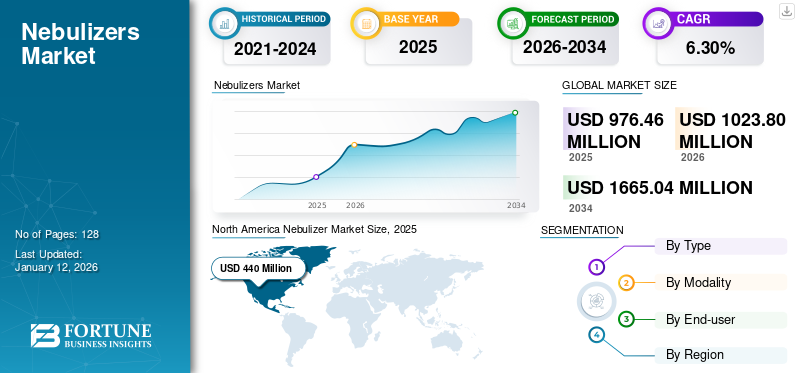
The global nebulizer market size was valued at USD 976.5 million in 2025. The market is projected to grow from USD 1,021.1 million in 2026 to USD 1,559.9 million by 2034, exhibiting a CAGR of 5.4% during the forecast period. North America dominated the nebulizer market with a market share of 45.06% in 2025.
A nebulizer is a drug delivery device that enables medication administration in the form of a mist into the lungs. These devices pump pressurized air through the liquid to form a fine mist, breathed in through a mouthpiece or mask. These machines are designed to treat asthma, cystic fibrosis, COPD, and other respiratory disorders.
There is an increasing prevalence of chronic respiratory conditions, including COPD, asthma, and others. Increasing air pollution, rise in smoking rates among the general population, and other factors have been responsible for an increasing number of patients seeking treatment for respiratory conditions, especially in emerging countries. This is driving the demand for treatment devices, including nebulizers, contributing to the segment’s growth.
OMRON Healthcare, Inc., PARI GmbH, and Koninklijke Philips N.V. held the highest global nebulizer market share in 2025 due to strong brand reputation and a widespread portfolio.
Download Free sample to learn more about this report.
Nebulizer Market Key Takeaways
 Market Size & Forecast
- 2025 Market Size: USD 976.5 million
- 2026 Market Size: USD 1,021.1 million
- 2034 Forecast Market Size: USD 1,559.9 million
- CAGR: 5.4% from 2026–2034
 Market Share
- North America dominated the nebulizer market with a 45.06% share in 2025.
- The portable nebulizer segment is projected to grow at the fastest CAGR of 6.9% during the forecast period.
- The mesh nebulizer segment is anticipated to expand at a CAGR of 6.1% over the study period.
 Key Regional Highlights
North America
North America led the global market in 2025, driven by high prevalence of respiratory diseases, advanced healthcare infrastructure, and strong adoption of portable respiratory care devices.
Europe
Europe secured the second-largest market position, supported by increasing respiratory disease cases and rising demand for advanced nebulization therapies.
Asia Pacific
Asia Pacific ranked as the third-largest market due to improving healthcare infrastructure, expanding medical device presence, and increasing prevalence of chronic respiratory disorders.
U.S.
The U.S. nebulizer market is projected to reach approximately USD 434.0 million by 2026, supported by strong demand for home-based respiratory care solutions.
Japan
Japan is expected to generate around USD 73.7 million in revenue by 2026, driven by rising respiratory healthcare needs and growing adoption of advanced nebulizer technologies.
Read More

NEBULIZER MARKET TRENDS
Shift toward Vibrating Mesh Nebulizers Due to Adoption of Advanced Technology by Market Players in Their Product Offerings
The prevalence of respiratory disorders has been increasing at a significant rate worldwide, which is driving the demand for effective treatment devices. To cater to this growing demand, market players have increased their focus on developing technologically advanced devices that dispense medication with consistent particle size and enhance the overall administration experience.
- For instance, in July 2025, HCmed Innovations Inc., a CDMO specializing in inhalation drug-device combination products, received 510(k) clearance from the U.S. FDA for the adaptive breath-actuated mesh nebulizer, AdheResp, with built-in connectivity.
Moreover, rising awareness among healthcare providers of innovative products and increasing collaborations among players to expand their market reach are also anticipated to accelerate global nebulizer market growth.
MARKET DYNAMICS
MARKET DRIVERS
Download Free sample to learn more about this report.
Increasing Incidence of Respiratory Disorders to Propel Market Growth
The increasing prevalence of respiratory disorders such as asthma, Chronic Obstructive Pulmonary Disorder (COPD), and other respiratory conditions is exerting a substantial economic burden on the healthcare systems of various countries globally.
- For instance, according to 2025 data published by the Asthma and Allergy Foundation of America (AAFA), it was reported that over 28 million people have asthma in the U.S.
There has been a rise in the prevalence of these conditions owing to an increase in the smoking population, poor air quality, and other factors.
- In 2021, according to an article published by Physiopedia, there will be around 65.0 million people suffering from chronic obstructive pulmonary disease (COPD).
According to the Global Strategy for Diagnosis, Management, and Prevention of COPD report, the European Union spends around 6% of its total healthcare budget on managing respiratory disorders (direct costs) each year. Also, according to the report, COPD accounts for roughly 60% of the EU's total expenditure on respiratory diseases each year.
In emerging countries, the prevalence is gradually increasing, resulting in a large number of patients suffering from respiratory disorders. Various government initiatives to promote early diagnosis and treatment are leading to more patients receiving treatment.
Moreover, the increasing focus of market players on new product launches has also been fueling the market growth. For instance, in 2020, Omron Healthcare introduced the ‘OMRON NE C106’, a cost-effective, all-age-group-compatible nebulization device in India.
Growing Demand for Home Healthcare Devices to Drive Market Growth
The rising cost of healthcare services and hospital stays has led to a preferential shift of patient treatment toward homecare settings. The increasing cost of the hospital stays for treating respiratory diseases such as chronic obstructive pulmonary disease (COPD), asthma, and others encourages patients to take treatment in the homecare setting.
- For instance, according to data published by the National Center for Biotechnology Information (NCBI), about 3.3 million patients received home healthcare in the U.S. in 2022.
This factor led to increased adoption of breathable medical devices for home healthcare. Thus, the growing demand for effective inhaled drug delivery devices and the promotion of home-use respiratory care devices by many healthcare organizations are likely to drive market growth.
MARKET RESTRAINTS
Availability of Alternative Drug Delivery Devices, Such as Inhalers, May Hamper Market Growth
The widespread availability and robust clinical acceptance of alternative drug-delivery devices, particularly metered-dose inhalers (MDIs), dry powder inhalers (DPIs), and soft mist inhalers, represent a major constraint on the global market. For routine asthma and COPD management, inhalers are typically favored over traditional nebulizers due to their compact size, quick use, portability, and superior suitability for daily maintenance therapy.
This is expected to reduce the frequency with which nebulizers are prescribed outside specific use cases such as severe exacerbations, pediatric care, elderly patients with poor coordination, and certain hospital-based settings. As inhaler-based therapy continues to dominate outpatient respiratory care, it is expected to limit the addressable market for nebulizer systems, particularly in mild-to-moderate disease management.
MARKET OPPORTUNITIES
Expanding Access to Respiratory Therapy in Emerging Markets to Offer Lucrative Growth Opportunities
Currently, there has been an increasing number of undiagnosed, undertreated, or inadequately managed patients with asthma, COPD, and other chronic respiratory conditions. The growing number of patients, advances in healthcare systems, expansion of insurance coverage, and improved patient access to hospitals, clinics, pharmacies, and home-based treatment are driving the rising demand for respiratory devices.
- For instance, according to 2024 data published by the World Health Organization (WHO), asthma and COPD affect approximately half a billion people worldwide.
Also, a very large patient pool is concentrated in markets where access to diagnosis, medicines, and respiratory support is still developing. As these countries strengthen respiratory care pathways, even modest improvements in access are expected to translate into meaningful growth in nebulizer adoption.
MARKET CHALLENGES
High Cost of Advanced Mesh and Electronic Nebulizers to Challenge Market Growth
Although nebulizers have significant benefits, their high cost is limiting their wider adoption. The added expense makes it difficult to justify for many patients, caregivers, and healthcare providers, especially in price-sensitive markets. This keeps a large share of demand concentrated in lower-cost conventional products rather than premium devices.
The cost issue is more pronounced in markets where patients pay out of pocket for respiratory devices or where reimbursement is limited. In these environments, buyers prioritize affordability over advanced features, so many continue to opt for conventional systems as they are affordable. This, in turn, slows the transition from basic nebulizers to more sophisticated electronic models and limits revenue growth in the premium segment.
- For instance, according to the 2024 Medicare Fee-for-Service Supplemental Improper Payment Data, CMS also reported a 7.1% improper payment rate for nebulizers and related drugs, highlighting the administrative complexity around coverage and claims in this category.
Segmentation Analysis
By Type
Jet Nebulizers Dominate Due to Lower Cost and Higher Adoption Rate
To know how our report can help streamline your business, Speak to Analyst
Based on type, the market is segmented into jet nebulizer, mesh nebulizer, and ultrasonic nebulizer.
The jet nebulizer segment dominated the market in 2025. Nebulization devices based on jet technology for delivering aerosolized medications have been used traditionally. The clinically proven technological advantages of jet devices and their comparatively lower costs have been instrumental in their greater adoption globally. Furthermore, the emergence of domestic manufacturers offering new and low-cost devices in this segment, especially in emerging countries, is fueling segmental growth.
The mesh nebulizer segment is expected to register a 6.1% CAGR during the forecast period.
By Modality
Tabletop Segment Leads Owing to Reimbursement Policies in Developed Markets
Based on modality, the market is segmented into portable and tabletop.
The tabletop segment dominated the market in 2025 and is expected to grow at a substantial CAGR during the forecast period. The segment’s dominance is attributed to the increased use of tabletop nebulizers, driven by reimbursement policies in developed markets and the operational benefits these devices offer. For example, according to the U.S. Centers for Medicare & Medicaid Services (CMS), nebulizers are covered under Medicaid's Durable Medical Equipment (DME) benefit. Also, the presence of a large number of players with a strong tabletop device portfolio is contributing to the segment's higher market share. Moreover, the cost-effectiveness of these devices compared to portable devices has also been fueling demand.
The portable nebulizer segment is anticipated to grow at a CAGR of 6.9% during the forecast period.
By Disease Type
High Prevalence of COPD Places it at Top Spot while also Creating Strong Demand for Nebulizers
Based on disease type, the market is segmented into COPD, asthma, respiratory infections, bronchiectasis, cystic fibrosis, and others.
The COPD segment dominated the market in 2025 and is expected to grow at a substantial CAGR during the forecast period. The segment’s dominance is attributed to the higher prevalence of COPD worldwide, which is driving demand for nebulizers. Furthermore, the segment is projected to hold a 64.4% share in 2026.
- For instance, according to the data from the American Lung Association in September 2025, around 11.1 million adults were living with COPD in the U.S.
The asthma segment is anticipated to grow at a 4.8% CAGR during the forecast period.
By End-user
Hospitals to Dominate Backed by the Large Number of Inpatient Admissions
The market is segmented by end user into hospitals, clinics, and homecare settings.
The hospitals segment dominated the global market in 2025 and will hold a dominant nebulizer market share of 43.8% in 2026. Higher demand for these devices in hospital settings, especially driven by the greater number of inpatient admissions with comorbid conditions, has been pivotal in driving global demand for table-top and portable devices in these settings. For instance, according to the statistics published by the GOV.UK, in June 2022, in England, the emergency admissions of children for bronchiolitis increased to 68.3% in 2021 compared to 60.8% in 2014.
The clinics segment is expected to grow at a 6.0% CAGR during the forecast period.
Nebulizer Market Regional Outlook
On the basis of region, the market is segmented into North America, Europe, Asia Pacific, Latin America, and the Middle East & Africa.
North America
North America Nebulizer Market Size, 2025 (USD Million)
To get more information on the regional analysis of this market, Download Free sample
North America accounted for the largest share of revenues in 2024, valued at USD 423.5 million, and reached USD 440.0 million in 2025. A higher prevalence of asthma, other chronic respiratory conditions, and the rising adoption of advanced portable ones in the region have been instrumental in its higher market share. According to the statistics published by the Asthma and Allergy Foundation of America in 2021, around 25.0 million people in the U.S. were living with asthma. Moreover, adequate reimbursement policies for these devices in the region are likely to boost market growth.
U.S Nebulizer Market
In 2026, the U.S. is anticipated to reach USD 434.0 million, accounting for approximately 44.5% of the global market.
Europe
Europe is projected to record a 5.6% growth rate during the forecast period, the second-highest globally, reaching USD 266.2 million in 2026. The primary driver of the market's growth in Europe is the rising prevalence of respiratory diseases, which is driving increased demand for these devices.
U.K Nebulizer Market
The U.K. is projected to reach USD 39.9 million in 2026, depicting approximately 3.9% of global revenues.
Germany Nebulizer Market
In 2026, Germany is expected to reach USD 55.6 million accounting for approximately 5.4% of global revenue.
Asia Pacific
Asia Pacific is projected to reach approximately USD 220.6 million, making it the third-largest market worldwide. The regional market is driven by the rising prevalence of chronic respiratory diseases, improving healthcare infrastructure, and the growing number of medical device companies expanding into this region. For instance, in March 2025, Aerogen Ltd opened its India headquarters in New Delhi to bring global-standard respiratory care solutions to the country.
Japan Nebulizer Market
Japan is projected to generate approximately USD 73.7 million in revenue in 2026, representing nearly 7.2% of the global market.
China Nebulizer Market
In China, the market is anticipated to gather around USD 48.7 million by 2026, accounting for nearly 4.8% of global revenues.
India Nebulizer Market
India’s market is expected to reach approximately USD 40.9 million by 2026, accounting for around 4.0% of global market revenue.
Latin America and Middle East & Africa
Latin America and the Middle East & Africa are anticipated to witness moderate growth, with Latin America estimated to hit approximately USD 45.8 million by 2026. The growth is attributed to improvements in healthcare infrastructure and the increasing adoption of advanced medical technologies in these regions.
GCC Nebulizer Market
In 2026, the GCC market is estimated to reach approximately USD 12.4 million, representing around 1.2% of global revenues.
COMPETITIVE LANDSCAPE
Key Industry Players
Increasing Focus of Market Players on Innovations and Collaborations to Strengthen Their Market Position
The global market is fragmented, with players such as Omron Healthcare, Inc., Koninklijke Philips N.V., and PARI Respiratory Equipment, Inc. accounting for a significant share in 2025. They focus on developing innovative devices and on strategic partnerships and collaborations to strengthen their market position.
- For instance, in December 2025, PARI GmbH and Savara received a European patent covering the drug-device combination of MOLBREEVI delivered via the eFlow nebulizer system.
Moreover, the market is further characterized by many small manufacturers in emerging nations focusing on developing relatively lower-cost devices. Other key players offering a wide range of devices involve DeVilbiss Healthcare LLC, BRIGGS HEALTHCARE, GF HEALTH PRODUCTS, INC., Trudell Medical International, and Allied Healthcare Products, Inc.
LIST OF KEY NEBULIZER MARKET COMPANIES PROFILED
- OMRON Healthcare, Inc. (Japan)
- Koninklijke Philips N.V. (Netherlands)
- PARI GmbH (Germany)
- GF Health Products, Inc. (U.S.)
- Aerogen Ltd. (Ireland)
- Trudell Medical Limited (Canada)
- Allied Medical LLC (U.S.)
- Drive Devilbiss International (U.S.)
- Feellife Health Inc. (China)
- Yirdoc (China)
- Jiangsu Yuyue Medical Equipment & Supply Co., Ltd. (China)
- Rossmax International Ltd. (Taiwan)
- MEDEL INTERNATIONAL SRL (Italy)
- Flaem Nuova Spa (Italy)
- Microlife Corporation (Switzerland)
- Beurer GmbH (Germany)
KEY INDUSTRY DEVELOPMENTS
- March 2026: Koninklijke Philips N.V. announced the expansion of its digital pathology portfolio with new cloud-enabled capabilities designed to help healthcare organizations scale digital diagnostics, improve productivity, and advance their transformation to fully digital workflows.
- September 2025: Feellife Health Inc. announced that its globalization strategy entered a new, intensive phase, with the home healthcare device company participating simultaneously in major medical exhibitions across Germany, the Netherlands, Austria, Singapore, Thailand, Peru, South Africa, and two other countries.
- August 2025: Allied Medical LLC opened a new, purpose-built facility in St. Louis, Missouri, to strengthen its presence in the global market.
- December 2021: Aerogen collaborated with Nuance Pharma to develop a non-invasive approach to treat Respiratory Distress Syndrome (RDS). This agreement also grants Nuance the right to commercialize AeroFact, an innovative therapy that combines a pulmonary surfactant drug with proprietary vibrating mesh technology.
- July 2021: PARI GmbH collaborated with TWT Digital Health (TWT) and developed the PARI Connect app. This app can be used to plan inhalations, take medications, make doctor’s appointments, and view details of their therapy. It also communicates via Bluetooth with the eTrack controller, a control unit for PARI’s eFlow Technology nebulizer.
REPORT COVERAGE
The global nebulizer market report provides a detailed analysis of the market and focuses on key factors, including technological advancements, the prevalence of asthma, and COPD. Additionally, the report offers insights into market trends and highlights key industry developments, including mergers, partnerships, and acquisitions. In addition to the factors mentioned above, the report encompasses several factors that have contributed to the market's growth in recent years.
Request for Customization to gain extensive market insights.
Report Scope & Segmentation
| ATTRIBUTE | DETAILS |
| Study Period | 2021-2034 |
| Base Year | 2025 |
| Estimated Year | 2026 |
| Forecast Period | 2026-2034 |
| Historical Period | 2021-2024 |
| Growth Rate | CAGR of 5.4% from 2026-2034 |
| Unit | Value (USD Million) |
| Segmentation | By Type, Modality, Disease Type, End-user, and Region |
| By Type |
|
| By Modality |
|
| By Disease Type |
|
| By End-user |
|
| By Geography |
|
Frequently Asked Questions
Fortune Business Insights says that the global market size was USD 976.5 million in 2025 and is projected to reach USD 1,559.9 million by 2034.
In 2025, North America stood at USD 440.0 million.
Registering a CAGR of 5.4%, the market will exhibit steady growth over the forecast period.
The jet nebulizer segment is expected to lead this market during the forecast period.
The rising incidence of chronic respiratory diseases, the increasing adoption of homecare medical devices, and the ongoing advancements in these devices are key factors driving the market.
Omron Healthcare, Inc., Koninklijke Philips N.V., and PARI GmBH. are among the top players in the market.
North America dominated the market in terms of share in 2025.



- 2021-2034
- 2025
- 2021-2024
- 185
-
(Offer valid till 15th Aug 2026)
Get 30-60 hrs Free Customization
Expand Regional and Country Coverage, Segments Analysis, Company Profiles, Competitive Benchmarking, and End-user Insights.













.webp)






Related Reports
-
US +1 833 909 2966 ( Toll Free )
-
Get In Touch With Us