Allergic Rhinitis Treatment Market Size, Share & Industry Analysis, By Drug Class (Corticosteroids, H1 Antihistamines, Leukotriene Receptor Antagonists, Decongestants, Mast Cell Stabilizers, Anticholinergics, and Allergen Immunotherapy Products), By Disease (Seasonal Allergic Rhinitis and Perennial Allergic Rhinitis), By Age Group (Pediatric and Adults), By Type (Prescription and OTC), By Route of Administration (Intranasal, Oral, Sublingual, and Subcutaneous), By Distribution Channel (Hospital Pharmacies, Retail Pharmacies, and Specialty Pharmacies), and Regional Forecast, 2026-2034
 Download Free Sample
Allergic Rhinitis Treatment Market Size and Future Outlook
 Listen to Audio Version
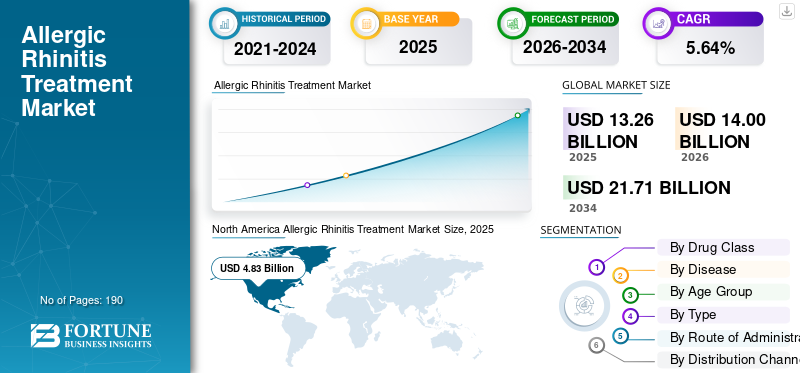
The allergic rhinitis treatment market size was valued at USD 13.26 billion in 2025. The market is projected to grow from USD 14.00 billion in 2026 to USD 21.71 billion by 2034, exhibiting a CAGR of 5.64% during the forecast period. North America dominated the allergic rhinitis treatment market with a market share of 36.43% in 2025.
The market is witnessing significant growth due to the increasing prevalence of allergies associated with pollen, house dust mites, animal dander, and other environmental allergens. The market is also witnessing a gradual shift from short-term symptomatic treatment toward allergen-specific immunotherapies that address the underlying immune response. This shift, along with the development of convenient sublingual formulations and pediatric treatment options, is expanding the treated patient population and supporting market growth.
Key companies operating in the market are focusing on research and development related to their offerings, to introduce new product launches, followed by regulatory approval to commercialize market growth potential.
- For instance, in February 2025, ALK-Abelló A/S received approval from the U.S. FDA for ODACTRA for treating house dust mite-induced allergic rhinitis, with or without conjunctivitis, in children aged five to 11 years. The expanded approval increased access to sublingual allergen immunotherapy among younger patients and demonstrated the growing focus on convenient, disease-modifying allergy treatments.
Furthermore, key players, such as Haleon plc, Kenvue Inc., Opella Healthcare Group SAS, and Bayer AG, are actively participating in new product launches, strategic collaborations, and acquisitions, as well as regulatory approval and investment initiatives to expand market presence.
Download Free sample to learn more about this report.
Allergic Rhinitis Treatment Market Key Takeaways
 Global Market Size & Forecast
- 2025 Market Size: USD 13.26 billion
- 2026 Market Size: USD 14.00 billion
- 2034 Forecast Market Size: USD 21.71 billion
- CAGR: 5.64% from 2026–2034
 Market Share
- North America dominated the allergic rhinitis treatment market with a 36.43% share in 2025.
- Others segment is projected to grow at a 7.65% CAGR during the forecast period.
- Pediatric segment is projected to grow at a 6.11% CAGR during the forecast period.
 Key Regional Highlights
North America
North America led the market with a valuation of USD 4.83 billion in 2025.
Europe
Europe is projected to reach USD 3.76 billion in 2026, growing at a 4.70% CAGR.
Asia Pacific
Asia Pacific held the third-largest share and is estimated to reach USD 3.59 billion in 2026.
U.S.
The market is estimated at USD 4.64 billion in 2026, accounting for approximately 33.14% of the global market.
Japan
The market is estimated at USD 0.85 billion in 2026, accounting for approximately 6.04% of the global market.
Read More

ALLERGIC RHINITIS TREATMENT MARKET TRENDS
Growing Adoption of Allergen-specific Immunotherapy to Support Long-term Disease Management is a Prominent Market Trend
One of the prominent market trends observed is the shift toward allergen-specific immunotherapy. Conventional treatments, including antihistamines, corticosteroids, and decongestants, primarily control symptoms but do not directly address the underlying allergic response. In comparison, allergen immunotherapy gradually modifies the immune system’s response to specific allergens and may reduce patients’ dependence on symptomatic medicines. The increasing availability of convenient sublingual tablets is further improving treatment accessibility, particularly among patients who prefer an alternative to repeated injections. The trend is encouraging pharmaceutical companies to expand immunotherapy indications across allergen types and age groups, thereby strengthening the long-term market growth.
- For instance, in September 2025, Regeneron Pharmaceuticals, Inc. showcased results evaluating its investigational allergen-blocking antibodies in allergen-challenge Phase 3 trials in adults with moderate-to-severe cat or birch allergies. Both trials met their respective primary and key secondary endpoints. Trials of REGN5713 and REGN5715 in patients with birch-induced allergic rhinitis revealed profound benefit with durable reduction of allergic rhinitis and conjunctivitis symptoms up to 3 months following a single subcutaneous administration of the allergen-blocking antibodies.
MARKET DYNAMICS
MARKET DRIVERS
Download Free sample to learn more about this report.
Large Diagnosed and Self-Treating Population to Drive Consistent Treatment Demand
The large population affected by allergic rhinitis is a major factor supporting the allergic rhinitis treatment market growth. Diagnosed patients with persistent or severe symptoms commonly require prescription corticosteroids, antihistamines, combination nasal sprays, and allergen immunotherapy. Additionally, many patients with mild or seasonal symptoms recognize recurring allergy patterns and purchase OTC medicines without visiting a physician. The recurrent nature of seasonal and perennial allergic rhinitis results in repeated medicine purchases and long-term treatment use. This combination of medically managed patients and self-treating consumers expands the addressable population across hospital, retail, and online pharmacy channels, thereby strengthening market development.
- For instance, in December 2025, the U.K. Medicines and Healthcare Products Regulatory Agency (MHRA) approved the reclassification of Haleon’s Pirinase Allergy 0.05% nasal spray, allowing it to be supplied without a prescription to adolescents aged 12 years and above from February 2026. The decision expanded pharmacy-based access to an intranasal corticosteroid and enabled a broader population to manage allergic rhinitis symptoms without requiring a physician appointment.
|
Rank |
Market Driver |
Expected Impact on Market Growth |
Estimated Gross Market Growth Contribution (USD Billion) |
Impact: 2026-2028 |
Impact: 2029-2031 |
Impact: 2032-2034 |
|
1 |
A large diagnosed and self-treating population |
High |
3.05 |
High |
High |
High |
|
2 |
Longer and less predictable pollen exposure. |
High |
2.25 |
Medium |
High |
High |
|
3 |
Broad OTC access and consumer self-care |
High |
1.75 |
High |
High |
Medium |
|
4 |
Expansion of differentiated intranasal combinations |
Medium-High |
1.45 |
Medium |
High |
High |
|
5 |
Growing clinical and payer recognition of allergen immunotherapy |
Medium |
1.15 |
Medium |
Medium |
High |
|
6 |
Others |
Low |
0.70 |
Low |
Low |
Low |
|
Total Gross Growth Contribution |
10.35 |
MARKET RESTRAINTS
Intensifying Generic Competition and Price Erosion to Restrain Market Revenue Growth
The market includes several mature drug categories, for which multiple prescription and over the counter alternatives are available. The entry of additional generic manufacturers increases price-based competition and encourages pharmacies, healthcare providers, and consumers to select lower-cost equivalent products. This reduces the pricing power of branded manufacturers and lowers the average selling price of commonly used allergy medicines. Continued discounting can also compress manufacturers’ profit margins and limit investment in differentiated formulations. Therefore, treatment volumes may continue to increase, but strong generic penetration and declining manufacturer prices can restrict the overall value growth of the market.
- For instance, in April 2026, The European Journal of Allergy and Clinical Immunology published an article titled ‘Availability and Costs of Allergic Rhinitis Treatments Across the World: A Survey of ARIA Experts’ that reported beclomethasone was the medication most frequently identified as the cheapest, while cetirizine and loratadine were the OAH most frequently reported as the least expensive.
|
Rank |
Market Restraint |
Expected Impact on Market Growth |
Estimated Reduction in Market Size (USD Billion) |
Impact: 2026-2028 |
Impact: 2029-2031 |
Impact: 2032-2034 |
|
1 |
Genericization and manufacturer-price compression |
High |
1.05 |
High |
High |
Medium |
|
2 |
Incomplete adherence and incorrect nasal-spray technique |
Medium-High |
0.70 |
High |
Medium |
Medium |
|
3 |
Safety, labeling, and age restrictions |
Medium |
0.55 |
Medium |
Medium |
Low |
|
4 |
Others |
Low |
0.34 |
Low |
Low |
Low |
|
Total Market Reduction |
2.64 |
MARKET OPPORTUNITIES
Expansion of Pediatric Indications and Age-appropriate Formulations to Create Growth Opportunities
The expansion of treatment labels to younger age groups presents a significant opportunity for the market growth. Children represent a substantial patient population, but the use of several therapies remains limited by age-specific safety data, dosing requirements, and difficulties in administering conventional formulations. Conducting dedicated pediatric trials can enable manufacturers to extend existing product indications and reach previously untreated or inadequately treated patients. Furthermore, child-friendly products can improve treatment acceptance and adherence. Therefore, pediatric label expansions and convenient formulations can widen the eligible patient pool, strengthen product differentiation, and generate additional long-term revenue for manufacturers.
- For instance, in March 2025, Health Canada approved ALK’s ACARIZAX sublingual tablet for children aged five to 11 years with house dust mite-induced allergic rhinitis, with or without conjunctivitis. The approval expanded the product’s Canadian indication to patients aged five to 65 years and was supported by a Phase III pediatric trial involving 1,460 children. As the tablet rapidly dissolves under the tongue and subsequent doses can be administered at home after supervised initiation, the expansion demonstrates how pediatric clinical evidence and age-appropriate delivery formats can broaden market uptake.
MARKET CHALLENGES
Safety and Age-specific Dosing Concerns to Complicate Treatment Selection
The treatment of allergic rhinitis in pediatric and elderly patients remains a significant challenge for the market due to differences in drug metabolism, tolerability, comorbidities, and appropriate dosing requirements. Children often require age- or weight-based doses and suitable formulations, while incorrect administration of liquid medicines or nasal sprays can reduce effectiveness or increase the risk of adverse effects. Elderly patients, on the other hand, may be more sensitive to sedation, dizziness, cognitive impairment, and urinary retention. Polypharmacy in this population also increases the possibility of drug interactions. These concerns require greater clinical supervision and restrict the broad use of certain commonly available treatments, thereby complicating treatment selection and limiting market uptake among vulnerable age groups.
- For instance, in 2025, the World Allergy Organization Journal published an article recommending that diphenhydramine use to be reconsidered due to its unfavorable adverse-effect profile, particularly among children and older adults. The article also highlighted risks associated with sedation, anticholinergic effects, dosing errors, and accidental exposure, while noting that safer second-generation antihistamines are available. Such safety concerns can reduce the use of established allergy medicines and increase the need for age-specific clinical guidance.
Segmentation Analysis
By Drug Class
Rapid Symptom Relief and Broad Product Availability Supported Dominance of H1 Antihistamines
Based on the drug class, the market is categorized into corticosteroids, H1 antihistamines, leukotriene receptor antagonists, decongestants, mast cell stabilizers, anticholinergics, allergen immunotherapy products, combination drugs, and others.
H1 antihistamines segment dominated the market. These medicines are widely used to relieve common allergic rhinitis symptoms, including sneezing, nasal itching, runny nose, and watery eyes. Second-generation antihistamines offer convenient once-daily dosing and generally cause less sedation than older products, supporting their use among working adults and students. Moreover, the presence of numerous products improves affordability and accessibility. These factors result in high treatment volumes and repeated seasonal purchases, thereby supporting the segment’s leading market share.
- For instance, in 2024, Kenvue launched Zyrtec 24 Hour Allergy Relief Dissolve Tablets containing cetirizine hydrochloride. These tablets dissolve in the mouth without water and were developed to provide a convenient treatment option for consumers who have difficulty swallowing conventional pills, thereby expanding the usability of H1 antihistamine products.
The others segment is expected to grow at a CAGR of 7.65% over the forecast period.
To know how our report can help streamline your business, Speak to Analyst
By Disease
Large Pollen-exposed Population and Recurrent Allergy Seasons Drove Seasonal Allergic Rhinitis Segment Leadership
Based on disease, the market is segmented into seasonal allergic rhinitis, perennial allergic rhinitis, and others.
In 2025, the seasonal allergic rhinitis segment captured the largest allergic rhinitis treatment market share. This is due to the widespread exposure of populations to tree, grass, and weed pollens during different months of the year. Patients frequently experience recurring symptoms during spring, summer, and autumn, resulting in predictable annual demand for combination treatments for allergies. The ability of patients to recognize recurring seasonal symptoms also encourages early treatment initiation and self-medication before or during peak pollen periods.
- For instance, in March 2024, Allegra launched Allegra Airways, a nationwide digital navigation tool designed to provide outdoor routes with lower pollen and air-pollution exposure. The initiative reflected the significant effect of seasonal pollen on consumers and demonstrated the increasing focus of allergy-treatment brands on supporting patients during high-exposure periods.
The others segment is predicted to grow at a 7.66% CAGR during the forecast period.
By Age Group
Higher Diagnosed Prevalence and Greater Self-treatment Supported Adult Segment Dominance
Based on age group, the market is segmented into pediatric and adult.
In 2025, the adults segment dominated the market. This dominance was attributed to its large patient base, higher diagnosed seasonal allergy prevalence, and greater ability to purchase treatments independently. Adults are frequently exposed to pollen, dust, pollution, and occupational allergens while commuting, working, and participating in outdoor activities, which increases the need for regular symptom management. They also commonly use over-the-counter antihistamines and nasal sprays without initially consulting a physician, resulting in high treatment penetration. Furthermore, most prescription and non-prescription allergic rhinitis products are approved for adults, while age, dosage, safety requirements, and formulation suitability may restrict pediatric use. The combination of broad product eligibility, purchasing power, and repeated self-treatment consequently supported the segment’s leading share.
- For instance, in August 2024, ARS Pharmaceuticals, Inc. received approval from the U.S. FDA for neffy (epinephrine nasal spray) 2 mg for the treatment of Type I Allergic Reactions, including anaphylaxis, in adults.
The pediatric segment is projected to rise at a 6.11% CAGR during the forecast period.
By Type
Convenient Access and Strong Self-medication Practices Positioned OTC Products as Leading Segment
Based on the type, the market is segmented into prescription and OTC.
Over-The-Counter (OTC) segment dominated the market as mild-to-moderate allergic rhinitis symptoms are commonly recognized and managed directly by patients. Many widely used antihistamines, decongestants, and intranasal corticosteroids can be purchased without a prescription from pharmacies, supermarkets, and online retailers. As allergic rhinitis is generally recurrent rather than an acute one-time condition, convenient OTC access results in substantial treatment volumes and strengthens the segment’s dominance.
- For instance, in 2024, Dr. Reddy’s Laboratories entered the U.K. consumer health market with the launch of Histallay, an OTC fexofenadine product for hay fever and allergy relief. The medicine had been classified as prescription-only but became available without a prescription through pharmacies and supermarkets, widening direct consumer access to allergic rhinitis treatment.
The prescription segment is likely to expand at a CAGR of 5.96% over the forecast period.
By Route of Administration
Direct Nasal Delivery and Effective Multi-Symptom Control Supported Intranasal Segment Dominance
Based on the route of administration, the market is segmented into intranasal, oral, sublingual, subcutaneous, and others.
Among these, intranasal segment held the dominant position in the market. Nasal congestion, sneezing, itching, and rhinorrhea are the principal symptoms experienced by allergic rhinitis patients, supporting segment dominance. Additionally, nasal sprays deliver treatment directly to the affected nasal tissues, allowing a strong local therapeutic effect while limiting unnecessary systemic exposure. Continued improvements in spray pumps, dose consistency, and formulation comfort are also increasing patient acceptance, thereby supporting the route’s leading market position.
- For instance, in November 2025, Glenmark Pharmaceuticals received approval from China’s NMPA for RYALTRIS compound nasal spray for allergic rhinitis. The approval covered moderate-to-severe seasonal allergic rhinitis in adults and children aged six years and above, as well as perennial allergic rhinitis in patients aged 12 years and above, expanding access to a combination intranasal therapy.
The sublingual segment is projected to grow at a CAGR of 8.33% during the forecast period.
By Distribution Channel
Immediate Availability and Pharmacist Guidance Led to Drug Store Retail Pharmacies Segment Dominance
Based on the distribution channel, the market is segmented into hospital pharmacies, specialty pharmacies, drug class stores & retail pharmacies, and online pharmacies.
In 2025, drug stores and retail pharmacies dominated the market due to high proportion of allergic rhinitis treatments sold over-the-counter. Their widespread physical presence is particularly important during sudden seasonal allergy peaks, when patients seek rapid symptom relief rather than waiting for a medical appointment or online delivery. Pharmacists can also provide guidance regarding appropriate formulations, dosing, adverse effects, and referral to a physician when symptoms remain uncontrolled. Furthermore, retail pharmacies dispense prescription products alongside OTC medicines, allowing the channel to serve both self-treating and medically managed patients.
- For instance, in June 2026, CVS Pharmacy announced the nationwide introduction of new packaging for selected store-brand OTC allergy products. The initial rollout included value-sized retail equivalents of widely used brands such as Zyrtec, Claritin, Allegra, and Benadryl, demonstrating the broad allergy-treatment assortment and strong private-label presence available through retail pharmacies.
The online pharmacies segment is expected to rise at a CAGR of 7.32% over the forecast period.
Allergic Rhinitis Treatment Market Regional Outlook
By geography, the market is categorized into Europe, North America, Asia Pacific, Latin America, and the Middle East & Africa.
North America
North America Allergic Rhinitis Treatment Market Size, 2025 (USD Billion)
To get more information on the regional analysis of this market, Download Free sample
North America was valued at USD 4.61 billion in 2024 and maintained its growth momentum with a leading position in 2025 at USD 4.83 billion. The North American market growth is supported by the high prevalence of seasonal allergies, strong diagnosis rates, and widespread use of OTC antihistamines and nasal sprays. The presence of major pharmaceutical companies, robust healthcare infrastructure and frequent product launches further strengthens treatment availability.
U.S. Allergic Rhinitis Treatment Market
Given North America's substantial contribution and the U.S. dominance in the region, the U.S. market is estimated at around USD 4.64 billion in 2026, accounting for roughly 33.14% of the global market.
Europe
Europe is projected to grow at 4.70% CAGR over the forecast period, the second-highest among all regions, and reach a valuation of USD 3.76 billion by 2026. The European region is witnessing growth, with rising pollen exposure, well-established healthcare systems, and growing adoption of allergen immunotherapy driving market growth.
U.K. Allergic Rhinitis Treatment Market
The U.K. market is estimated at USD 0.73 billion in 2026, accounting for roughly 5.24% of the global market.
Germany Allergic Rhinitis Treatment Market
Germany's market is projected to reach approximately USD 0.83 billion in 2026, equivalent to around 5.92% of the global market.
Asia Pacific
Asia Pacific accounted for the third largest share in the market in 2025 and is estimated to reach USD 3.59 billion in 2026. The market is expanding due to increasing urbanization, air pollution, and awareness of allergic rhinitis across densely populated countries. Improving healthcare access and the availability of affordable generic medicines are enlarging the treated patient population, supporting regional growth.
Japan Allergic Rhinitis Treatment Market
The Japanese market in 2026 is estimated at around USD 0.85 billion, accounting for approximately 6.04% of the global market.
China Allergic Rhinitis Treatment Market
China's market is projected to be among the largest worldwide, with 2026 revenues estimated at around USD 1.10 billion, accounting for approximately 7.88% of global sales.
India Allergic Rhinitis Treatment Market
The Indian market is estimated at around USD 0.48 billion in 2026, accounting for roughly 3.42% of global revenue.
Latin America and Middle East & Africa
The Latin America region is expected to witness significant growth in this market during the forecast period and estimated to reach a valuation of USD 0.89 billion in 2026. This growth is supported by increasing recognition of respiratory allergies and wider access to pharmacies and self-medication products. Expanding pharmaceutical distribution networks are also improving the availability of antihistamines and intranasal therapies. In the Middle East & Africa, the GCC is set to reach USD 0.28 billion in 2026.
South Africa Allergic Rhinitis Treatment Market
The South African market is projected to reach approximately USD 0.16 billion by 2026, accounting for roughly 1.12% of global revenue.
COMPETITIVE LANDSCAPE
Key Industry Players
Product Approvals and Strategic Partnerships among Key Companies to Intensify Market Competition
The strong presence of diversified consumer healthcare companies, generic drug manufacturers, and specialized allergy immunotherapy providers characterizes the market. Key companies are focusing on strengthening their portfolios through OTC antihistamines, combination nasal sprays, child-friendly formulations, allergen-specific immunotherapy tablets, geographic product expansion, and commercial partnerships. Competition is increasing as patients and healthcare providers demand treatments that provide rapid relief, convenient administration, reduced sedation, and longer-term control of the underlying allergic response. Large consumer healthcare companies benefit from established brands, strong retail visibility, and broad distribution networks. In contrast, specialty companies compete through clinically validated immunotherapy products, regulatory approvals, and allergen-specific treatment expertise.
- For instance, in October 2023, Haleon Inc. launched Otrivin Nasal Mist to bring greater comfort and ease of use to people suffering from nasal congestion due to colds, allergic rhinitis, and sinusitis. The development demonstrates how companies are competing through differentiated delivery formats, rapid geographic expansion, and greater penetration of the intranasal treatment category.
Major players such as Haleon plc, Kenvue Inc., Opella Healthcare Group SAS, Bayer AG, ALK-Abelló A/S, Viatris Inc., GSK plc, Perrigo Company plc, compete through product innovation, pediatric label expansion, generic launches, strategic partnerships, consumer-brand investment, and geographic reach. Companies with established OTC antihistamine and nasal-spray brands are expected to maintain strong positions in self-treatment channels. At the same time, ALK-Abelló and Stallergenes Greer are differentiated by their allergen immunotherapy portfolios. Glenmark and Viatris also strengthen competition through combination intranasal therapies, whereas generic manufacturers compete primarily through affordability and broad pharmacy availability.
LIST OF KEY ALLERGIC RHINITIS TREATMENT COMPANIES PROFILED
- Haleon plc (U.K.)
- Kenvue (U.S.)
- Opella Healthcare Group SAS (France)
- Bayer AG (Germany)
- ALK-Abello A/S (Denmark)
- Viatris Inc. (U.S.)
- GSK plc (U.K.)
- Perrigo Company plc (Ireland)
- Stallergenes Greer (Switzerland)
- Teva Pharmaceutical Industries Ltd. (Israel)
- Organon & Co. (U.S.)
KEY INDUSTRY DEVELOPMENTS
- July 2026: Glenmark Specialty S.A. received approval from the U.S. FDA for the expanded use of RYALTRIS (olopatadine hydrochloride and mometasone furoate) Nasal Spray, 665 mcg/25 mcg per spray, for the treatment of symptoms of Seasonal Allergic Rhinitis (SAR) in pediatric patients aged 6 to less than 12 years.
- March 2026: SK Chemicals Co., Ltd. strengthened its pharmacy sales capabilities in the over-the-counter (OTC) business sector through collaboration with Kyongnam Pharmaceutical for the allergic rhinitis treatment 'Nose-Al Soft Capsules'.
- October 2025: Cadila Pharmaceuticals launched Dlorfast-M-Tablets, a new fixed-dose combination therapy containing Desloratadine (5 mg) and Montelukast (10 mg) in India. The product is designed for the management of allergic rhinitis and urticaria.
- March 2022: Perrigo Company plc received final approval from the U.S. FDA for the over-the-counter use of Nasonex 24HR Allergy (mometasone furoate monohydrate 50mcg). The approval marked the first branded Rx-to-OTC switch for the company and paved the way for Nasonex to enter the OTC marketplace.
- January 2022: Glenmark Pharmaceuticals Ltd. collaborated with Lotus Pharmaceutical Co., Ltd. (Lotus) for commercializing its innovative nasal spray Ryaltris in Singapore, Hong Kong, and Vietnam. The collaboration enabled the company to manufacture and supply Ryaltris, whereas Lotus will be responsible for the commercialization of Ryaltris in these markets.
REPORT COVERAGE
The report provides a comprehensive allergic rhinitis treatment market analysis across major drug classes, disease, age group, type route of administration, distribution channel, and geographic regions. The report further assesses key market drivers, restraints, opportunities, challenges, and emerging trends influencing market growth. It includes regional and country-level analysis across North America, Europe, Asia Pacific, Latin America, and the Middle East & Africa. The competitive landscape covers the product portfolios, geographic presence, strategic partnerships, regulatory approvals, product launches, acquisitions, and expansion initiatives of leading companies. The report also provides market size estimates, growth forecasts, segment-level shares, and detailed profiles of major participants operating in the market.
Request for Customization to gain extensive market insights.
Report Scope & Segmentation
| ATTRIBUTE | DETAILS |
| Study Period | 2021-2034 |
| Base Year | 2025 |
| Estimated Year | 2026 |
| Forecast Period | 2026-2034 |
| Historical Period | 2021-2024 |
| Growth Rate | CAGR of 5.64% from 2026 to 2034 |
| Unit | Value (USD Billion) |
| Segmentation | By Drug Class, Disease, Age Group, Type, Route of Administration, Distribution Channel, and Region |
| By Drug Class |
|
| By Disease |
|
| By Age Group |
|
| By Type |
|
| By Route of Administration |
|
| By Distribution Channel |
|
| By Region |
|
Research Methodology
1. Bottom Up Approaches
Approach 1: Revenues and Market Share of Major Allergic Rhinitis Treatment Players
- Collection of allergic rhinitis-related revenues from annual reports, SEC filings, investor presentations, earnings transcripts, company websites, product portfolios, and regulatory filings of key companies such as Haleon, Kenvue, Opella, Bayer, ALK-Abelló, Viatris, GSK, Perrigo, Stallergenes Greer, Organon, Glenmark, Teva, Torii Pharmaceutical, Allergy Therapeutics, and Jubilant HollisterStier.
- Estimation of company revenue attributable to corticosteroids, H1 antihistamines, leukotriene receptor antagonists, decongestants, mast cell stabilizers, anticholinergics, combination drugs, and allergen immunotherapy products.
- Adjustment of multi-indication product revenues to exclude sales attributable to asthma, urticaria, common cold, allergic conjunctivitis, and other non-allergic-rhinitis conditions.
- Assessment of prescription and OTC presence, branded versus generic mix, regional product availability, pharmacy penetration, distribution strength, and allergen immunotherapy exposure.
- Triangulation of company-level revenues with prescription volumes, OTC utilization, product pricing, and regional treatment adoption to estimate the global market.
Approach 2: Product-Level Sales Analysis
- Identification of major branded, generic, private-label, and allergen immunotherapy products, including Flonase, Zyrtec, Allegra/Telfast, Claritin/Clarityn, Nasacort, Nasonex, Dymista, Ryaltris, Avamys, Astepro, Grastek/Grazax, Ragwitek/Ragwizax, Odactra/Acarizax, Oralair, Staloral, and other regional products.
- Collection of product-level prescription volumes, pharmacy dispensing data, public procurement information, company disclosures, product availability, and import-export indicators.
- Estimation of annual units sold in the form of nasal-spray packs, tablets, capsules, oral liquids, sublingual tablets or solutions, and subcutaneous allergen extract packs.
- Calculation of product revenue by multiplying annual product volumes by manufacturer-level average selling prices.
- Aggregation of product-level revenues by product class, disease, age group, route of administration, prescription status, distribution channel, country, and region.
Approach 3: Epidemiology Model
- Assessment of allergic rhinitis prevalence across seasonal, perennial, and other allergic rhinitis conditions in all countries included in the study.
- Estimation of diagnosed, undiagnosed, medically treated, self-medicated, and untreated patient populations.
- Segregation of eligible patients into pediatric and adult populations and allocation by prescription medicines, OTC products, and allergen immunotherapy.
- Application of treatment-seeking rates, medical consultation rates, product adoption, adherence, treatment duration, repeat purchasing, and average treated months per year.
- Estimation of annual product consumption per patient for oral medicines, nasal sprays, sublingual immunotherapy, and subcutaneous immunotherapy.
- Multiplication of treated-patient numbers by annual product utilization and manufacturer-level treatment cost to estimate country-level market revenues.
- Aggregation of country estimates to regional and global levels, followed by comparison with company-revenue and product-sales approaches.
2. Top Up Approaches
Approach 1: Analysis of Parent Market
- Analysis of parent markets, including the global pharmaceutical market, respiratory and allergy therapeutics market, consumer healthcare allergy category, nasal drug-delivery market, and allergen immunotherapy market.
- Estimation of the proportion attributable to allergic rhinitis based on disease prevalence, treated-patient share, prescription volumes, OTC allergy-product sales, and allergen immunotherapy utilization.
- Allocation of the addressable market across seasonal allergic rhinitis, perennial allergic rhinitis, and other allergic rhinitis conditions.
- Adjustment for revenues attributable to asthma, urticaria, common cold, sinusitis, allergic conjunctivitis, and non-allergic rhinitis.
- Estimation of regional shares using population, allergic rhinitis prevalence, healthcare access, prescription and OTC utilization, manufacturer pricing, reimbursement, and immunotherapy adoption.
- Summation of allergic-rhinitis-attributable revenues across pharmaceutical and allergen immunotherapy categories to estimate the global market.
- List of Key Sources
- S. FDA, EMA, MHRA, PMDA, NMPA, CDSCO, TGA, Health Canada, and national regulatory authorities
- WHO, OECD, World Bank, Eurostat, national statistical agencies, and public healthcare databases
- American Academy of Allergy, Asthma & Immunology
- American College of Allergy, Asthma & Immunology
- European Academy of Allergy and Clinical Immunology
- World Allergy Organization and ARIA guidelines
- PubMed, NCBI, ClinicalTrials.gov, peer-reviewed epidemiological studies, and clinical guidelines
- Annual reports, SEC filings, investor presentations, earnings transcripts, and company product portfolios
- Regulatory approvals, product labels, prescription-to-OTC switches, product launches, recalls, and discontinuations
- Public procurement databases, prescription and pharmacy dispensing records, reimbursement formularies, and pharmaceutical trade data
3. Primary Interviews
- Supply Side Interviews: 60%
- Key Respondents: Discussions with pharmaceutical manufacturers, consumer healthcare companies, generic drug manufacturers, allergen immunotherapy companies, distributors, wholesalers, and pharmacy-channel participants.
- Interviews focused on product revenues, manufacturer pricing, prescription and OTC sales mix, distribution margins, market penetration, regional product availability, competitive positioning, and expected market growth.
- Key respondents included sales executives, product managers, marketing managers, business-development executives, regional heads, distributors, and supply-chain professionals.
- Demand Side Interviews: 40%
- Key Respondents: Discussions with allergists, immunologists, ENT specialists, primary-care physicians, pediatricians, pharmacists, hospital procurement professionals, payers, and reimbursement stakeholders.
- Interviews assessed diagnosed and treated populations, prescription patterns, OTC self-medication, preferred drug classes, treatment duration, patient adherence, immunotherapy adoption, and product-switching behavior.
- Inputs were used to validate differences in treatment practices, affordability, reimbursement, and access across countries and regions.
Frequently Asked Questions
According to Fortune Business Insights, the global market value stood at USD 13.26 billion in 2025 and is projected to reach USD 21.71 billion by 2034.
In 2025, North America market value stood at USD 4.83 billion.
The market is expected to grow at a CAGR of 5.64% over the forecast period of 2026-2034.
The H1 antihistamine drug class segment is expected to lead the market.
Large diagnosed and self-treating population is driving market growth.
Haleon plc, Kenvue Inc., Opella Healthcare Group SAS, and Bayer AG are among the major players in the global market.
North America accounted for the largest market share in 2025.



- 2021-2034
- 2025
- 2021-2024
- 190
Get 30-60 hrs Free Customization
Expand Regional and Country Coverage, Segments Analysis, Company Profiles, Competitive Benchmarking, and End-user Insights.













.webp)






Related Reports
-
US +1 833 909 2966 ( Toll Free )
-
Get In Touch With Us