Breast Imaging Market Size, Share & Industry Analysis, By Imaging Modality (2D Mammography, Digital Breast Tomosynthesis, Breast Ultrasound, Breast MRI, Nuclear Breast Imaging, Galactography/Ductography, and Others), By Technology (Ionizing Breast Imaging and Non-ionizing Breast Imaging), By End-user (Hospitals, Specialty clinics, Diagnostic Imaging Centers, and Others), and Regional Forecast, 2026-2034
 Download Free Sample
Breast Imaging Market Size and Future Outlook
 Listen to Audio Version
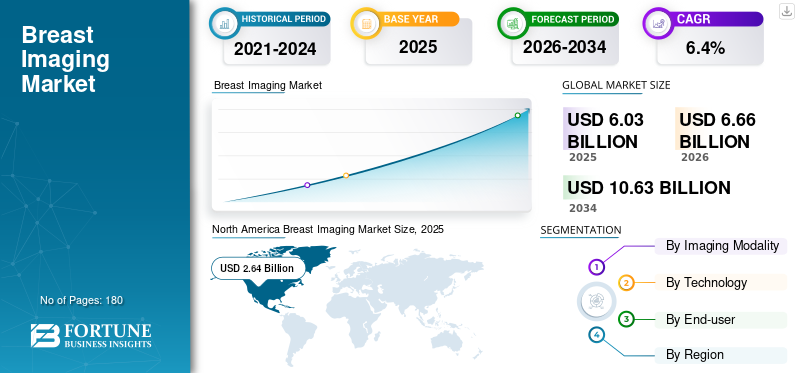
The global breast imaging market size was valued at USD 6.03 billion in 2025 and is projected to grow from USD 6.66 billion in 2026 to USD 10.63 billion by 2034, exhibiting a CAGR of 6.4% during the forecast period. North America dominated the breast imaging market with a market share of 43.78% in 2025.
Breast imaging is a diagnostic and screening technology used to detect, characterize, and monitor breast abnormalities, such as breast cancer. It includes 2D and 3D mammography/digital breast tomosynthesis, breast MRI, breast ultrasound, molecular breast imaging, and AI-enabled interpretation tools.
Furthermore, Hologic, Inc., GE HealthCare, and Siemens Healthineers AG held the majority of the market share due to their broad portfolios and strong brand reputations.
Download Free sample to learn more about this report.
BREAST IMAGING MARKET KEY TAKEAWAYS
 Global Market Size & Forecast
- 2025 Market Size: USD 6.03 billion
- 2026 Market Size: USD 6.66 billion
- 2034 Forecast Market Size: USD 10.63 billion
- CAGR: 6.4% from 2026–2034
 Market Share
- North America dominated the market with a 43.78% share in 2025.
- The Ionizing Breast Imaging segment is estimated to hold a 60.0% market share in 2026.
- The Hospitals segment is projected to hold a 53.0% market share in 2026.
 Key Regional Highlights
North America
Dominated the market with USD 2.47 billion in 2024 and is projected to reach USD 2.64 billion in 2025, driven by high screening awareness, favorable reimbursement, and widespread adoption of 3D mammography systems.
Europe
Projected to reach USD 1.49 billion in 2026, supported by advanced healthcare infrastructure and increasing availability of breast imaging technologies.
Asia Pacific
Expected to reach USD 1.32 billion in 2026, driven by the rising breast cancer patient population and growing adoption of advanced imaging platforms.
U.S.
The market is projected to reach USD 2.65 billion in 2026, supported by strong screening programs and advanced diagnostic infrastructure.
Japan
The market is projected to reach USD 0.24 billion in 2026, driven by increasing adoption of early breast cancer screening and advanced imaging technologies.
Read More

BREAST IMAGING MARKET TRENDS
Shift From 2D-only Mammography to 3D, Contrast-Enhanced, and AI-supported Imaging to Emerge as a Key Trend
Currently, there has been a significant shift from conventional 2D mammography toward 3D tomosynthesis, contrast-enhanced mammography, and AI-supported interpretation. Healthcare providers are increasingly adopting these technologies to reduce tissue-overlap limitations and improve diagnostic confidence. As a result, key players are presenting novel products at various conferences and congresses to improve the landscape of breast cancer screening.
- For instance, in September 2023, Siemens Healthineers AG presented the MAMMOMAT B.brilliant mammography system at the European Society of Breast Imaging congress, featuring wide-angle tomosynthesis for high-quality 3D images in just five seconds.
MARKET DYNAMICS
MARKET DRIVERS
Download Free sample to learn more about this report.
Rising Incidence of Breast Cancer to Fuel Market Growth
Over the past few years, there has been a significant increase in new cases of breast cancer globally, which is driving demand for early breast cancer detection through routine screening, which improves treatment options and surgical outcomes. This is driving demand for breast imaging platforms, including mammography systems, digital breast tomosynthesis, breast MRI, breast ultrasound, and more. This is anticipated to drive the global breast imaging market growth during the forecast period.
- For instance, in January 2026, the American Cancer Society estimated that around 382,640 total new cases would be diagnosed in the U.S.
MARKET RESTRAINTS
High Equipment Costs and Radiation Concerns to Restrict Market Growth
Despite a significant volume of breast cancer screening, the cost of advanced breast imaging systems, especially 3D tomosynthesis, breast MRI, contrast-enhanced mammography, and AI-enabled platforms, is significantly high. Moreover, their maintenance also adds high costs, increasing total costs. This is expected to limit their adoption among smaller hospitals and low-resource settings. Additionally, mammography is an ionizing radiation modality, so patient concerns about radiation exposure, discomfort, and compression are anticipated to reduce participation in screening programs, hindering market growth.
- For instance, according to the Block Imaging Inc. 2026 Mammography Price Guide, the average cost of a premium mammography system can range from USD 205,000 to USD 265,000.
MARKET OPPORTUNITIES
Integration of AI and Workflow Automation to Offer Lucrative Growth Opportunities
Recently, the growth in radiology departments, the limited availability of professionals, and the rising volume of breast screening have created demand for AI tools that triage exams, assess breast density, flag suspicious lesions, support risk evaluation, and improve reading efficiency. This is expected to offer significant opportunities for key players to enter into partnerships to integrate AI and workflow automation to support clinical outcomes.
- For instance, in April 2025, iCAD, Inc. collaborated with Microsoft to bring AI-powered mammography solutions into Microsoft’s Precision Imaging Network.
MARKET CHALLENGES
Workforce Shortages to Challenge Market Expansion
Advanced mammography systems require trained technologists and breast radiologists to operate with precision and accuracy. At the same time, many countries face the challenge of limited availability of trained professionals. This is expected to delay the screening and diagnosis exams, which may directly lead to limited use and adoption of breast imaging products. Such a scenario may pose a significant challenge to product penetration, slowing market growth over the forecast period.
For instance, in May 2025, the Indian Practitioner reported that India faces a persistent shortage of radiologists, with only about 10,000-15,000 serving a population of 1.4 billion.
Segmentation Analysis
By Imaging Modality
2D Mammography Segment Led Market Due to Its Widespread Installed Base and Affordability
Based on imaging modality, the market is segmented into 2D mammography, digital breast tomosynthesis, breast ultrasound, breast MRI, nuclear breast imaging, galactography/ductography, and others.
The 2D mammography segment accounted for the largest global breast imaging market share in 2025. 2D mammography is the most established breast screening modality, widely installed across hospitals, mobile screening units, diagnostic centers, and population screening programs, as it is affordable and has long-standing reimbursement.
The digital breast tomosynthesis segment is projected to grow at a 8.6% CAGR during the forecast period.
To know how our report can help streamline your business, Speak to Analyst
By Technology
High Usage of Ionizing Breast Imaging Fueled Segment Growth
By technology, the market is segmented into ionizing breast imaging and non-ionizing breast imaging.
The ionizing breast imaging segment accounted for the largest market share in 2025. In recent years, ionizing breast imaging such as digital breast tomosynthesis has become the backbone of breast cancer screening globally. These technologies are used at scale for asymptomatic screening, diagnostic workups, and image-guided biopsy planning, which is anticipated to fuel the segment’s growth. Moreover, the segment is estimated to hold a 60.0% share in 2026.
The non-ionizing breast imaging segment is anticipated to grow at a 7.0% CAGR over the forecast period.
By End-user
Hospitals Led Market Due to Higher Patient Volume
On the basis of end-user, the market is segmented into hospitals, specialty clinics, diagnostic imaging centers, and others.
In 2025, hospitals dominated the market. Hospitals have a greater capacity to invest in premium mammography systems due to higher patient volume. Moreover, the increasing number of hospitals globally is expected to drive this demand further, thereby augmenting the segment’s growth. Furthermore, the segment is set to hold a 53.0% share in 2026.
- For instance, according to the American Hospital Association (AHA) 2026 statistics, there are approximately 6,100 hospitals in the U.S.
In addition, the diagnostic imaging centers segment is projected to grow at an 7.1% CAGR over the forecast period.
Breast Imaging Market Regional Outlook
Based on geography, the market is classified into North America, Europe, Asia Pacific, Latin America, and the Middle East & Africa.
North America
North America Breast Imaging Market Size, 2025 (USD Billion)
To get more information on the regional analysis of this market, Download Free sample
North America accounted for the largest share of revenues in 2024, valued at USD 2.47 billion, and is projected to grow to USD 2.64 billion by 2025. The growth is attributed to high screening awareness, strong reimbursement coverage, and a large installed base of 3D mammography systems in the region.
U.S. Breast Imaging Market
In 2026, the U.S. is projected to reach USD 2.65 billion, accounting for approximately 41.1% of global revenues.
Europe
Europe is projected to record a 5.1% growth rate during the projection period, the second-highest globally, reaching USD 1.49 billion in 2026. The growth is attributed to a well-established healthcare infrastructure and a significant number of radiologists in countries such as Germany, France, the U.K., Italy, and Spain, which are attracting key players to increase product availability in the region.
U.K. Breast Imaging Market
The U.K. market is expected to reach USD 0.23 billion in 2026, accounting for roughly 3.6% of global revenues.
Germany Breast Imaging Market
Germany's market is projected to reach USD 0.36 billion in 2026, accounting for approximately 5.5% of global revenues.
Asia Pacific
In 2026, the Asia Pacific market is expected to reach USD 1.32 billion, ranking third globally. The growth is attributed to the large patient pool of breast cancer and increasing awareness of screening and early detection, which is increasing demand for imaging platforms.
Japan Breast Imaging Market
Japan is projected to generate USD 0.24 billion in revenue in 2026, accounting for approximately 3.7% of global revenues.
China Breast Imaging Market
China’s market is expected to reach nearly USD 0.63 billion in 2026, accounting for 9.8% of global revenues.
India Breast Imaging Market
India’s market is projected to reach USD 0.12 billion in 2026, accounting for around 1.9% of global revenues.
Latin America and Middle East & Africa
Both Latin America and the Middle East & Africa are expected to grow moderately in the coming years. The Latin America market is predicted to reach USD 0.50 billion in 2026. The growth of these regions is expected to be driven by the gradual expansion of screening programs, the growth of private diagnostic centers, and investments in digital mammography systems.
GCC Breast Imaging Market
In 2026, the GCC market is expected to reach USD 0.14 billion, accounting for 2.1% of total revenues.
COMPETITIVE LANDSCAPE
Key Industry Players
Increasing Innovation and Widespread Portfolios to Enhance Market Shares of Key Players
In 2025, Hologic, Inc., GE HealthCare, and Siemens Healthineers AG held the majority of the global market share. This share is attributed to their strong portfolio of advanced products and their worldwide brand reputation. Moreover, other prominent players are focusing on key strategies, including new product launches, collaborations, partnerships, and acquisitions. Also, they are expanding their geographic presence through strengthening their distribution network and opening new facilities, which is anticipated to enhance their market share.
LIST OF KEY BREAST IMAGING COMPANIES PROFILED
- Hologic, Inc. (U.S.)
- GE HealthCare (U.S.)
- Siemens Healthineers AG (Germany)
- FUJIFILM Holdings Corporation (Japan)
- Koninklijke Philips N.V. (Netherlands)
- Canon Inc. (Japan)
- Shanghai United Imaging Healthcare Co., LTD (China)
- Planmed Oy (Finland)
- IMS Giotto S.p.A (Italy)
- Metaltronica S.p.A. (Italy)
KEY INDUSTRY DEVELOPMENTS
- November 2025: GE HealthCare received FDA Premarket Authorization for Pristina Recon DL, an AI-powered 3D mammography reconstruction application.
- October 2025: Cleveland Clinic London introduced the H1 ceramic hip resurfacing implant, one of the first worldwide, for patients with smaller bone structures previously limited by metal-on-metal options.
- September 2025: ScreenPoint Medical’s Transpara breast imaging AI was selected for the USD 16.0 million PRISM randomized controlled trial in the U.S.
- April 2025: SimonMed partnered with Lunit and Volpara to deploy AI-powered breast cancer detection across its U.S. imaging network.
- November 2024: iCAD announced FDA-cleared next-generation AI solutions for breast cancer detection at RSNA 2024, showcasing ProFound Detection advancements that boost accuracy in challenging cases.
- September 2024: Siemens Healthineers AG received FDA PMA for the 3D/tomosynthesis portion of MAMMOMAT B.brilliant.
- November 2023: GE HealthCare released MyBreastAI Suite, an AI platform optimized for mammography and integrated with iCAD applications.
REPORT COVERAGE
The breast imaging market report provides a detailed assessment of all market segments, highlighting key drivers, trends, opportunities, restraints, and challenges shaping industry growth. It also covers technological advancements, disease incidence trends, major industry developments, market share analysis, and comprehensive profiles of leading companies.
Request for Customization to gain extensive market insights.
Report Scope & Segmentation
| ATTRIBUTE | DETAILS |
| Study Period | 2021-2034 |
| Base Year | 2025 |
| Estimated Year | 2026 |
| Forecast Period | 2026-2034 |
| Historical Period | 2021-2024 |
| Growth Rate | CAGR of 6.4% from 2026 to 2034 |
| Unit | Value (USD Billion) |
| Segmentation | By Imaging Modality, Technology, End-user, and Region |
| By Imaging Modality |
|
| By Technology |
|
| By End-user |
|
| By Region |
|
Frequently Asked Questions
Fortune Business Insights says that the global market value stood at USD 6.03 billion in 2025 and is projected to reach USD 10.63 billion by 2034.
In 2025, the market value in North America stood at USD 2.64 billion.
The market is expected to grow at a CAGR of 6.4% over the forecast period of 2026-2034.
The 2D mammography segment led the market by imaging modality.
The key driver of the market is the rising incidence of breast cancer.
Hologic, Inc., GE HealthCare, and Siemens Healthineers AG are among the prominent players in the market.
North America dominated the market in 2025.



- 2021-2034
- 2025
- 2021-2024
- 180
Get 30-60 hrs Free Customization
Expand Regional and Country Coverage, Segments Analysis, Company Profiles, Competitive Benchmarking, and End-user Insights.













.webp)






-
US +1 833 909 2966 ( Toll Free )
-
Get In Touch With Us