Baking Enzymes Market Size, Share & Industry Analysis, By Type (Carbohydrases, Proteases, Lipases, Oxidases, and Others), By Form (Powder and Liquid), By Source (Microbial, Plant-based, and Animal-based), By Functionality (Dough Conditioning, Shelf-Life Extension, Volume Improvement, Texture Enhancement, and Others), By Application (Bread, Cakes & Pastries, Biscuits & Cookies, Rolls & Buns, and Others), By End-Use (Industrial Bakeries, Artisan Bakeries, and Foodservice), and Regional Forecast, 2026-2034
 Download Free Sample
(Offer valid till 15th Oct 2026)

Bakery Enzymes Market Size & Future Outlook
 Listen to Audio Version
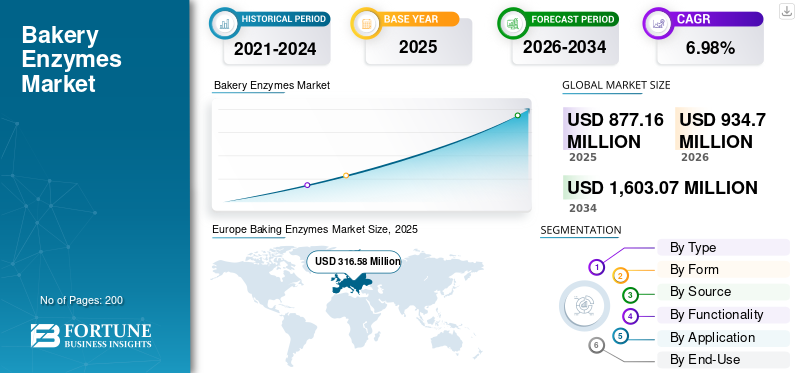
The global baking enzymes market size was valued at USD 877.16 million in 2025. The market is projected to grow from USD 934.75 million in 2026 to USD 1,603.07 million by 2034, exhibiting a CAGR of 6.98% during the forecast period. Europe dominated the baking enzymes market with a market share of 36.09% in 2025.
Baking enzymes are functional bio-catalysts used to enhance dough handling, improve texture, extend shelf life, and optimize baking performance. These enzymes, including carbohydrases, proteases, and lipases, play a critical role in replacing chemical additives, thereby aligning with clean-label and natural ingredient trends.
The market growth is primarily driven by increasing demand for processed and convenience bakery products, rising adoption of clean-label formulations, and growing industrial bakery production globally. Additionally, advancements in enzyme engineering and microbial fermentation technologies are enabling manufacturers to develop more efficient and cost-effective enzyme solutions.
The global market demand is led by key companies, including Novozymes A/S, DSM-Firmenich, AB Enzymes GmbH, DuPont (IFF), and Kerry Group plc. These players compete through innovation in enzyme formulations, partnerships with industrial bakeries, and expansion of specialty enzyme portfolios.
Download Free sample to learn more about this report.
BAKING ENZYMES MARKET KEY TAKEAWAYS
 Market Size & Forecast
- 2025 Market Size: USD 877.16 Million
- 2026 Market Size: USD 934.75 Million
- 2034 Forecast Market Size: USD 1,603.07 Million
- CAGR: 6.98% from 2026–2034
 Market Share
- Europe dominated the baking enzymes market with a 36.09% share in 2025.
- Carbohydrases led the market, generating USD 465.75 million in revenue in 2025.
- Bread remained the leading application segment, reaching USD 405.46 million in 2025.
 Key Regional Highlights
Europe
Europe led the market with USD 316.58 million in 2025.
Asia Pacific
Asia Pacific was valued at USD 192.42 million in 2025 and is projected to grow at the fastest CAGR of 7.95%.
North America
North America reached USD 230.69 million in 2025
U.S.
The market was valued at approximately USD 173.80 million in 2025.
Japan
Growing demand for premium bakery products, convenience foods, and enzyme-based clean-label formulations is expected to support steady market expansion during the forecast period.
Read More

Baking Enzymes Market Trends
Growing Demand for Clean-Label and Natural Baking Ingredients to Shape Industry Trends
The growing demand for clean-label and natural baking ingredients is becoming a major trend shaping the global market, as consumers increasingly prefer bakery products made with simple, recognizable, and minimally processed ingredients. Modern consumers are paying closer attention to product labels and are actively avoiding artificial additives, chemical emulsifiers, and synthetic preservatives, which has encouraged bakery manufacturers to adopt enzyme-based solutions as a more natural alternative. Baking enzymes such as amylases, xylanases, lipases, and proteases help improve dough handling, stability, texture, softness, loaf volume, and shelf life while allowing manufacturers to reduce or replace conventional chemical additives.
- For instance, in March 2020, DuPont (now part of IFF) launched the POWERBake 6000 and 7000 enzyme series as a “clean‑label” emulsification system for bakery, specifically tailored to European white‑bread and bun recipes. The platform is positioned as a replacement for synthetic emulsifiers such as mono‑ and diglycerides, SSL, and DATEM while keeping the same‑or‑better eating quality.
MARKET DYNAMICS
Market Drivers
Download Free sample to learn more about this report.
Rising Global Consumption of Processed Bakery Products to Support Market Growth
The rising global consumption of processed bakery products is a key factor supporting the baking enzymes market growth, driven by changing lifestyles, urbanization, and increasing demand for convenient food options. Busy schedules and the growing working population have significantly boosted the demand for ready-to-eat and packaged bakery items such as bread, cakes, biscuits, and pastries, which offer convenience, longer shelf life, and consistent quality. This surge in consumption has compelled manufacturers to enhance production efficiency while maintaining product quality, thereby increasing the adoption of baking enzymes. These advanced enzymes play a critical role in improving dough handling, enhancing texture, increasing volume, and extending shelf life, making them essential in large-scale industrial baking processes.
- According to a report from the American Bakers Association (ABA), the retail share of total baked goods volume grew to 71.9% in 2024, reflecting a long-term shift towards at-home consumption.
Market Restraints
Stringent Regulatory Framework and Approval Processes to Limit Market Expansion
Baking enzymes, although widely accepted as processing aids, are subject to stringent regulatory approvals across major markets such as the U.S., Europe, and Japan. Regulatory bodies such as the FDA (U.S.), EFSA (Europe), and FAO/WHO Joint Expert Committee on Food Additives (JECFA) impose strict guidelines on enzyme safety, labeling, and permissible usage levels. These regulatory requirements often lead to longer product development cycles and increased compliance costs for manufacturers. Additionally, variations in regulatory standards across regions create complexities for global players, particularly when launching new enzyme formulations in multiple markets.
- For instance, EFSA requires extensive toxicological and allergenicity assessments before approving new enzyme strains, which can delay commercialization timelines by 1–3 years.
Market Opportunities
Rising Demand for Gluten-Free and Specialty Bakery Products to Create New Growth Avenues
The growing prevalence of gluten intolerance and celiac disease, along with increasing consumer preference for specialty diets, is driving demand for gluten-free and alternative grain-based bakery products. Baking enzymes play a critical role in improving texture, volume, and shelf life in gluten-free formulations, where traditional gluten lacks.
Manufacturers are increasingly developing customized enzyme blends specifically designed for gluten-free applications, enabling better dough elasticity and product consistency. This creates significant growth opportunities, particularly in North America and Europe, where gluten-free product penetration is high.
- According to FAO and global health estimates, around 1% of the global population is affected by celiac disease, while a larger portion experiences gluten sensitivity, supporting demand for enzyme-assisted formulations.
SEGMENTATION ANALYSIS
By Type
Carbohydrase Segment Dominated the Market Due to Its Critical Role in Improving Dough Fermermentation and Bread Quality
Based on type, the market is segmented into carbohydrases, proteases, lipases, oxidases, and others.
The carbohydrase segment dominated the market, valued at USD 465.75 million in 2025, as these enzymes are extensively used to break down starch into fermentable sugars, improving dough fermentation, volume, and crumb softness. Their widespread application in bread and staple bakery products makes them the most utilized enzyme category globally.
The lipases segment is projected to grow at the fastest CAGR of 9.28% from 2026 to 2034), driven by increasing replacement of chemical emulsifiers and rising demand for clean-label bakery products.
To know how our report can help streamline your business, Speak to Analyst
By Form
Powder Segment Led the Market Due to Longer Shelf Life and Ease of Handling
Based on form, the market is divided into powder and liquid.
The powder segment held the dominant global baking enzymes market share, reaching USD 542.39 million in 2025, supported by its stability, ease of transportation, compatibility with dry premixes, and wide usage in industrial baking. Powder enzymes are less sensitive to environmental conditions and offer longer shelf life, making them preferable for large-scale operations.
The liquid segment is expected to grow at the fastest CAGR of 8.30% during the forecast period, driven by increasing automation and modernization of bakery processing lines.
By Source
Scalability and Cost-Effective Production of Microbial Enzymes Places Them on Top Position
Based on the source, the market is categorized into microbial, plant-based, and animal-based.
The microbial segment dominated the market, valued at USD 765.44 million in 2025, owing to its high enzymes production efficiency, scalability, and consistent enzyme quality achieved through fermentation technologies. Microbial enzymes are widely preferred due to their reliability, ease of customization, and regulatory acceptance in food processing.
The microbial segment is also projected to grow steadily at a CAGR of 7.22% over the forecast period, maintaining its dominance throughout the global bakery enzymes market forecast period.
By Functionality
Dough Conditioning’s Essential Role in Dough Handling and Processing Efficiency Bolstered Its Dominance
Based on functionality, the market is segmented into dough conditioning, shelf-life extension, volume improvement, texture enhancement, and others.
The dough conditioning segment dominated the market, valued at USD 248.01 million in 2025, as enzymes significantly improve dough elasticity, machinability, and tolerance during processing. This is particularly critical in industrial baking environments where consistency and efficiency are key.
The texture enhancement segment is projected to grow at the fastest CAGR of 8.32% over the forecast period, driven by increasing consumer preference for high-quality and premium baked goods.
By Application
Bread Segment Dominated the Market Due to High Global Consumption and Daily Dietary Dependence
Based on application, the market is segmented into bread, cakes & pastries, biscuits & cookies, rolls & buns, and others.
The bread segment dominated the market, reaching USD 405.46 million in 2025, as bread remains a staple food across both developed and developing regions. The large-scale production of packaged bread significantly drives enzyme consumption for improving shelf life, texture, and production efficiency.
The rolls & buns segment is expected to grow at the fastest CAGR of 8.61% during the forecast period, driven by the expansion of fast-food culture and increasing demand for convenience bakery products.
By End-Use
Industrial Bakeries Governs the End-Use Segment Due to Large-Scale Production and High Enzyme Utilization
Based on end-use, the market is segmented into industrial bakeries, artisan bakeries, and foodservice.
The industrial bakeries segment dominated the market, valued at USD 576.69 million in 2025, due to high-volume production, standardized processing, and extensive use of enzymes to ensure product consistency, efficiency, and cost optimization.
The artisan bakeries segment is projected to grow at the fastest CAGR of 8.04% from 2026 to 2034, supported by rising demand for premium and specialty bakery offerings.
Baking Enzymes Market Regional Outlook
Regionally, the market is studied across North America, Europe, Asia Pacific, South America, and the Middle East & Africa.
North America
Europe Baking Enzymes Market Size, 2025 (USD Million)
To get more information on the regional analysis of this market, Download Free sample
North America was valued at USD 230.69 million in 2025 and is projected to reach USD 438.07 million by 2034, growing at a CAGR of 7.43% from 2026 to 2034. The region’s growth is driven by strong demand for clean-label bakery products, high consumption of packaged baked goods, and advanced food processing infrastructure. Additionally, the presence of major enzyme manufacturers and large-scale industrial bakeries supports steady market expansion.
U.S. Baking Enzymes Market
The U.S. dominates the North American market, valued at approximately USD 173.80 million in 2025, and is expected to grow at a CAGR of around 7.60%. Growth is supported by high consumption of bread, cakes, and frozen bakery products, along with increasing adoption of enzyme-based clean-label solutions in industrial baking.
Europe
Europe accounted for a leading market share, valued at USD 316.58 million in 2025, and is projected to reach USD 547.04 million by 2034, registering a CAGR of 6.31% from 2026 to 2034. The region benefits from well-established bakery consumption patterns, particularly high per capita bread consumption, and strong regulatory support for enzyme-based clean-label solutions.
Germany Baking Enzymes Market
Germany is valued at approximately USD 76.31 million in 2025, and is expected to grow at a CAGR of 6.32% from 2026 to 2034. The country’s strong industrial bakery sector and high bread consumption drive enzyme demand.
U.K. Baking Enzymes Market
The U.K. market was valued at approximately USD 90.81 million in 2025, with a CAGR of 6.78% from 2026 to 2034, driven by rising demand for packaged and convenience bakery products along with clean-label reformulations.
Asia Pacific
Asia Pacific was valued at USD 192.42 million in 2025 and is projected to reach USD 381.68 million by 2034, growing at the fastest CAGR of 7.95% during the forecast period. Growth is driven by rapid urbanization, increasing disposable incomes, and expanding consumption of bakery products across emerging economies.
China Baking Enzymes Market
China dominates the regional market, valued at approximately USD 66.84 million in 2025, and is expected to grow at a CAGR of around 8.69% during the forecast period. Growth is supported by the rapid expansion of industrial bakeries, increasing demand for packaged food, and a rising middle-class population.
South America and the Middle East & Africa
South America was valued at USD 89.31 million in 2025 and is projected to reach USD 160.91 million by 2034, registering a CAGR of 6.81% from 2026 to 2034. Growth is driven by improving food processing infrastructure, increasing bakery consumption, and rising demand for cost-effective production solutions.
The Middle East & Africa market was valued at USD 48.17 million in 2025 and is projected to reach USD 75.37 million by 2034, expanding at a CAGR of 5.13% from 2026 to 2034. Growth is driven by urbanization, increasing demand for digestive health products, and rising dependence on packaged dairy.
Brazil Baking Enzymes Market
Brazil dominates the South American market, valued at approximately USD 58.89 million in 2025, and is expected to grow at a CAGR of around 7.01%. The country’s strong bread consumption and expanding industrial bakery sector support the country’s market growth.
COMPETITIVE LANDSCAPE
Key Industry Players
Key Players Focus on Enzyme Innovation, Clean-Label Solutions, and Partnerships, Driving Their Market Shares
The global baking enzymes market is moderately consolidated, with leading biotechnology and food ingredient companies focusing on innovation, sustainability, and expansion of enzyme portfolios. Key players are investing in microbial fermentation technologies and customized enzyme blends to enhance bakery efficiency and product quality. Strategic collaborations with industrial bakeries and expansion into emerging markets remain central to competitive positioning.
Key Players in the Market
|
Rank |
Company Name |
|
1 |
Novozymes A/S |
|
2 |
DSM-Firmenich |
|
3 |
AB Enzymes GmbH |
|
4 |
IFF (International Flavors & Fragrances) |
|
5 |
Kerry Group plc |
List of Key Baking Enzymes Companies Profiled
- Novozymes A/S (Denmark)
- DSM-Firmenich (Netherlands)
- AB Enzymes GmbH (Germany)
- International Flavors & Fragrances Inc. (U.S.)
- Kerry Group plc (Ireland)
- BASF SE (Germany)
- Hansen Holding A/S (Denmark)
- Amano Enzyme Inc. (Japan)
- Associated British Foods plc (U.K.)
- Enzyme Development Corporation (U.S.)
KEY INDUSTRY DEVELOPMENTS
- August 2025: IFF launched POWERFRESH ACE 2000 as a next-generation enzyme solution for U.S. industrial bakeries. It enhances bread softness, resilience, and cohesiveness for up to 34 days, addressing consumer demand for "fresher for longer" products while cutting waste and boosting efficiency.
- May 2025: BRAIN Biotech AG announced the buyout of remaining minority shares in its Dutch subsidiary Breatec B.V., achieving full ownership. The company also signed a lease for a larger production site near Eindhoven, Netherlands, to serve as a continental European hub for production, warehousing, and an expanded Baking Application Center.
- March 2025: Kerry launched Biobake Fresh Rich, a clean-label starch-acting enzyme system designed for sweet baked goods with over 20% sugar content. Introduced around late 2023, it extends shelf life by maintaining softness, freshness, and moistness in products like muffins, pancakes, and pound cakes.
- March 2021: IFF launched Enovera 3001 as an enzyme-only dough strengthener for North American industrial bakeries seeking clean-label formulations. This Danisco-derived solution replaces chemical emulsifiers such as DATEM, SSL, or monoglycerides, maintaining dough strength, texture, volume, and crumb structure without production trade-offs.
- December 2020: DuPont Nutrition & Biosciences launched POWERFresh Special and POWERSoft Cake 8010 enzymes in Japan. These Danisco enzymes target sweet baked goods such as cakes, sweet rolls, and buns, providing anti-staling effects for extended softness and moistness.
REPORT COVERAGE
The global baking enzymes market industry report analyzes the market in depth and highlights crucial aspects such as global market trends, market dynamics, supply chains, prominent companies, investment in research and development, and end-use. Besides this, the report also provides insights into the global market analysis and highlights significant industry developments.
Request for Customization to gain extensive market insights.
Report Scope & Segmentation
| ATTRIBUTE | DETAILS |
| Study Period | 2021-2034 |
| Base Year | 2025 |
| Estimated Year | 2026 |
| Forecast Period | 2026-2034 |
| Historical Period | 2021-2024 |
| Growth Rate | CAGR of 6.98% from 2026 to 2034 |
| Unit | Value (USD Million) |
|
Segmentation |
By Type
|
|
By Form
|
|
|
By Source
|
|
|
By Functionality
|
|
|
By Application
|
|
|
By End-Use
|
|
|
By Region
|
Frequently Asked Questions
Fortune Business Insights says that the global market was valued at USD 877.16 million in 2025 and is anticipated to reach USD 1,603.07 million by 2034.
At a CAGR of 6.98%, the global market will exhibit steady growth over the forecast period.
By form, the powder segment led the market.
Europe held the largest market share in 2025.
Rising global consumption of processed bakery products to support market growth.
Novozymes A/S, DSM-Firmenich, AB Enzymes GmbH, DuPont (IFF), and Kerry Group plc. are the leading players in the market.
Growing demand for clean-label and natural baking ingredients to shape industry trends.



- 2021-2034
- 2025
- 2021-2024
- 200
-
(Offer valid till 15th Oct 2026)
Get 30-60 hrs Free Customization
Expand Regional and Country Coverage, Segments Analysis, Company Profiles, Competitive Benchmarking, and End-user Insights.



















Related Reports
-
US +1 833 909 2966 ( Toll Free )
-
Get In Touch With Us