Food Enzymes Market Size, Share & Industry Analysis, By Source (Microbes, Plants, and Animals), By Type (Carbohydrases, Proteases, Lipases, and Others), By Application (Bakery {Bread, Cakes and Pastries, Biscuits and Cookies, and Others, Dairy {Milk, Cheese, Yogurt, Ice Cream, and Others}, Beverages {Fermented Beverages, Fruit Juices, Wines & Alcoholic Drinks and Others}, Nutraceuticals, and Other Processed Foods), and Regional Forecast, 2026-2034
 Download Free Sample
(Offer valid till 30th Sep 2026)

Food Enzymes Market Size and Future Outlook
 Listen to Audio Version
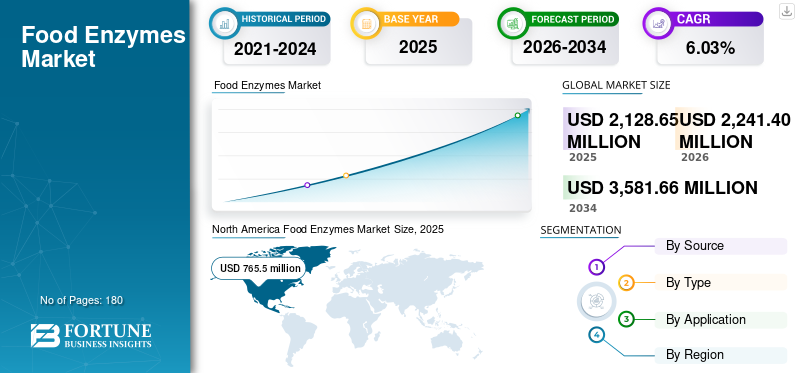
The global food enzymes market size was valued at USD 2,128.65 million in 2025 and is projected to grow from USD 2,241.40 million in 2026 to USD 3,581.66 million by 2034, exhibiting a CAGR of 6.03% during the forecast period. North America dominated the global food enzymes market with a market share of 35.94% in 2025.
Food enzymes includes products such as carbohydrases, proteases, lipases, and others and each has specialized function such as improving food quality, texture, flavor, shelf life, and aid digestion. The market for food enzymes is witnessing a robust growth owing to its extensive application in various processed food and beverages. The emerging trend of consuming clean-labeled products, rising demand for natural ingredients, and ongoing biotechnological advancements are the factors driving the growth of the global market.
Companies such as Novozymes, DuPont, DSM, Roche, and AB Enzymes are some of the key players operating in this market. New product launch is the key strategy which is adopted by the manufacturers.
Download Free sample to learn more about this report.
FOOD ENZYMES MARKET KEY TAKEAWAYS
 Market Size & Forecast
- 2025 Market Size: USD 2,128.65 Million
- 2026 Market Size: USD 2,241.40 Million
- 2034 Forecast Market Size: USD 3,581.66 Million
- CAGR: 6.03% from 2026–2034
 Market Share
- North America dominated the food enzymes market with a 35.94% share in 2025.
- Nutraceuticals was the fastest-growing application segment, registering a CAGR of 6.72% during the forecast period.
- Proteases remained a key product segment and are projected to grow at a CAGR of 5.91% through 2034.
 Key Regional Highlights
North America
North America is expected to reach USD 803 million in 2026, supported by rising consumer preference for natural and safe food additives.
Europe
Europe is projected to attain USD 660.99 million in 2026, maintaining its position as the second-largest regional market.
Asia Pacific
Asia Pacific is forecast to reach USD 553.79 million in 2026 and remain among the fastest-growing regions due to expanding food processing activities.
U.S.
The country continues to lead regional demand, driven by strong consumption of processed foods and increasing adoption of clean-label ingredients.
Japan
The market is experiencing steady growth, supported by demand for functional foods, advanced food manufacturing technologies, and enzyme-based product innovations.
Read More

MARKET DYNAMICS
MARKET DRIVERS:
Rising Demand for Bio-Based Additives in Processed Food and Beverages to Drive the Market Growth
The growing demand for all-natural, chemical-free products has led to the increased incorporation of bio-based additives in processed foods. Enzymes are produced by various microorganisms, plants, animals, and have a range of benefits over synthetic chemicals in product processing as well as for human consumption. The constant adoption of enzymes results in many advantages that cannot be obtained through a traditional chemical treatment. These often include higher product quality, lower manufacturing cost, less wastage, and reduced energy consumption. Traditional synthetic chemical treatments are generally non-specific, hard to control, and may create uneven conditions. Food processors are choosing enzymes as a cost-effective and safe alternative to synthetic chemicals. Another driver for the growth of the market is the improvement of product quality through these enzymes. Food enzymes are used as additives to modify organoleptic, rheological, and nutritional properties like digestibility, texture, and shelf-life, among others. Enzymes incorporated in processed foods are generally destroyed during subsequent processing steps and they are not present in the final food products. The growing awareness regarding the undesirable side effects of excessive consumption of synthetic chemicals is fueling the demand for enzymes across various segments of the food industry
MARKET RESTRAINTS:
Regulatory Uncertainties to Impede Growth of the Market
The rise of food enzymes as processing ingredients in the food industry has led to the continuous evolution and upgradation of safety regulation framework. In terms of food legislation, enzymes are categorized into food additives and food processing aids. The categorization of food enzymes is vital because the pre-market approval, including safety evaluation, is mandatory only for additives in some countries. Furthermore, the definitions for additives and processing aids vary across countries and regions, which create regulatory uncertainties that negatively impact the food enzymes market growth.
MARKET OPPORTUNITY:
Growing Usage of Specialty Enzymes Creates Opportunity For Market Growth
Specialty food enzymes which are targeted towards consumer suffering from specialty food related issues is growing in popularity globally. Manufacturer have the opportunity to launch product portfolio which are specifically targeted towards vegan consumer or lactose intolerance consumers. Products that help to enhance the digestive health of the consumers are also growing in popularity. Another major segment is the high value segment which include medical or sports nutrition where manufacturers have the opportunity to expand their product line.
FOOD ENZYMES MARKET TRENDS:
Proactive Ingredients and Additives Transformation towards Clean-Labeled Claims based on Consumer Preferences
The rising trend of consuming clean-labelled, free-from foods is fueling the demand for enzymes in the food industry. Increasing awareness among consumers regarding the health impacts of the food consumed has shifted their focus towards naturally processed foods that are perceived to be safe by the health conscious consumers. There is a significant shift in consumer preferences from chemical ingredients to natural, minimally processed food products. The shift is attributable to the growing awareness of adverse health effects owing to the consumption of synthetic raw materials and additives. This emerging food enzymes market trend has led to the increasing adoption of natural ingredients and additives in processed food system by the manufacturers.
Download Free sample to learn more about this report.
Segmentation Analysis
By Source
Microbial Enzymes to Hold the Largest Market Share Owing to their Cost-effectiveness & Stability
As per source, the market is divided by source into microbes, plants, and animals.
Microbial enzymes are expected to hold the largest market food enzymes market share as they are cost-effective and more stable than plant and animal enzymes. Microbial enzymes can be produced effectively by using various fermentation techniques including solid-state and submerged fermentations. The large scale production for microbial enzymes is comparatively easier than plants and animals.
The plant segment is expected to grow at a Compound Annual Growth Rate (CAGR) of 6.56% over the forecast period. As regulatory bodies are pushing food manufacturers to reduce reliance on chemical additives, usage of plant based enzymes is expected to increase in the future.
By Type
Increasing Utilization of Carbohydrases in Food Industry Drives the Segment’s Dominance
The market is segmented by form into carbohydrases, proteases, lipases, and others, by type
Carbohydrases hold the largest share as they are extensively used in various segments of the food industry. They catalyze the breakdown of carbohydrates into simple sugar. The vast application of carbohydrases in the food industry is driving the growth of the segment. Amylases - a type of carbohydrases, are widely used in the brewing and baking as flavor enhancer and anti-staling agents to improve bread quality.
Proteases is another major segment that is expected to grow at a growth rate of 5.91% during the forecast period. Proteases help in improving the texture of the food and beverages as they are widely used for meat tenderization, improving quality of lower-value cuts, and improve the texture of baked good products.
To know how our report can help streamline your business, Speak to Analyst
By Application
Booming Bakery Segment & Emerging Application in Nutraceuticals Contribute to the Segment’s Growth
The market is segmented by application into bakery, dairy, beverages, nutraceuticals, and other processed foods. Bakery is further segmented into bread, cakes and pastries, biscuits and cookies, and others. Dairy is further segmented into milk, cheese, yogurt, ice cream, and others. Beverages are segmented into fermented beverages, fruit juices, wines & alcoholic drinks, and others.
Bakery segment is accounted for the largest market share. One of the major factors contributing to the growth of the market is the robust growth of the bakery segment across the globe. Enzymes are usually added to modify dough rheology, gas retention, and crumb softness in bread, pastry, and biscuit manufacturing. The growing demand for clean-label, organic, and high quality bakery products in developed countries is driving the sales performance of the food enzymes. The evolving consumer lifestyles in developing regions has led to the increasing demand for premium bakery products. Bakery products properties especially taste, texture, flavour, and shelf life play vital role and it is achieved through the use of baking enzymes.
Nutraceuticals is the fastest-growing application category in the market expected to grow at a CAGR of 6.72% during the forecast period. The most promising application of enzymes in nutraceuticals is the introduction of encapsulated digestive enzymes in the body for the breakdown of hard-to-digest compounds. The increasing awareness of digestive health among health-conscious consumers is driving the demand for various enzymes in nutraceuticals.
Food Enzyme Market Regional Outlook
By geography, the market is categorized into Europe, North America, Asia Pacific, South America, and the Middle East & Africa.
North America
North America Food Enzymes Market Size, 2025 (USD Million)
To get more information on the regional analysis of this market, Download Free sample
The market in North America is estimated to reach USD 803 million in 2026. The growing perception among consumers that natural additives are healthy & safe is fueling the demand for food enzymes in the region. The increasing demand for processed foods without chemical additives has led to the increased utilization of enzymes in the plethora of food systems. In 2026, the U.S. market is estimated to reach USD 606.31 million. The U.S. consumers are some of the major consumers of processed food products in the world. As processed food such as bread, snacks, ready meals, dairy, and beverages are popular in the country which use enzymes. Such usage of such enzymes will continue to increase in the future as well.
Europe
The market in Europe is estimated to reach USD 660.99 million in 2026 and secure the position of the second-largest region in the market. The region is one of the leading manufacturer of industrially produced baked goods due to which the demand for enzymes in the region is high. With the growing demand for functional food the usage of specialty enzymes which fortify and enhance the taste and texture of food products is growing rapidly. Plant-based enzymes is also growing in popularity in the region due to the increased adoption of vegan diet among the consumers. During the forecast period, the European region is projected to record a growth rate of 5.66%. Backed by these factors, Germany is expected to record valuation of USD 161.85 million, France record USD 118.49 million, and U.K. to reach USD 190.83 million in 2026.
Asia Pacific
The Asia Pacific Food Enzyme market is valued at USD 553.79 million in 2026, and is also one of the fastest-growing markets global. The adoption of Western diets that are associated with the growing demand for bakery products, dairy products, and beverages continue to increase in the region. These products are expected to utilize food enzymes in place of synthetic additives amid growing concerns for sustainability and food safety. In this region, China and Japan are estimated to reach USD 179.17 million and USD 129.64 million, each, in 2026.
South America and Middle East & Africa
Over the forecast period, South America is expected to experience significant growth in this market. The South America market in 2026 is set to record USD 165.95 million. Traditionally baked goods have been popular in the region and enzyme usage in the bakery industry continues to grow. With the growing popularity of their processed convenience food items the usage of such products is expected to continue to increase in the future. In the Middle East & Africa, the South Africa market forecast is set to grow at a CAGR of 6.96% during the forecast period. Middle eastern countries are actively working on expanding food processing industry in the region and reduce reliance on imported food products. Hence with the opening of such new food processing pants the usage of food enzymes in the region is expected to increase in the future.
COMPETITIVE LANDSCAPE
Key Industry Players:
Highly Consolidated Industry Structure is Defining the Market Competition
The market structure is highly consolidated owing to the strong dominance of a few key players. The manufacturers are working towards further consolidation by developing innovative products and acquiring small players in the food enzymes industry. The dominant players present in the market are Novozymes, Roche, DuPont, AB Enzymes, and DSM. These players are expected to hold the major share in the market.
The market is highly competitive and technology-intensive. The key players are investing more in research and development to deliver high-quality products that meet the modern consumer demand for clean-label products. Product portfolio expansion, with innovative enzymes especially for the bakery and dairy industry, is one of the key strategies adopted by major players to strengthen their positions in the market.
LIST OF KEY FOOD ENZYMES COMPANIES PROFILED:
- Novozymes (Denmark)
- DuPont (U.S.)
- Hoffmann-La Roche Ltd. (Switzerland)
- AB Enzymes (Germany)
- Koninklijke DSM N.V. (Netherlands)
- Hansen Holding A/S (Denmark)
- BASF SE (Germany)
- Nutritech Enzymes (Finland)
- Amano Enzymes, Inc. (China)
- Biocatalysts (U.K.)
KEY INDUSTRY DEVELOPMENTS:
- August 2025: IFF, one of the leading manufacturers of flavors fragrances and food ingredients launched POWERFRESH ACE 2000 in the U.S. market. The product is suitable or baking business as it improves softness and cohesiveness during its shelf life.
- May 2025: BRAIN Biotech, one of the leading manufacturers of integrated solution of food ingredients completed the acquisition of Dutch subsidiary Breatec B.V. This acquisition helped he company to expand its flour and bake enzyme business.
- March 2025: DSM Firmenich is one of the leading manufacturer of health and beauty products launched Maxiren EVO, a coagulant enzyme which is used for manufacturing cheese products.
- November 2024 – Biocatayst Ltd, a leading manufacturer of food enzyme, launched plant based enzyme named Plant PRO which is suitable for dairy, plant based meat and cheese alternatives manufacturing.
- November 2024 – IFF launched enzymatic texturizing solution named TEXSTAR in the market which is suitable for dairy and plant based fermented products manufacture. It makes the products creamy, velvety and enhance the flavor of the products.
REPORT COVERAGE
The global food enzymes market research provides an in-depth study of market size & forecast by all the market segments included in the report. The market analysis includes details on the market dynamics, regulatory frameworks and market trends expected to drive the market during the forecast period. It offers information on the supply chain, technological advancements, new product launches, key industry developments, and details on partnerships, mergers & acquisitions. The market demand also encompasses detailed competitive landscape with information on the market segmentation, food enzyme industry, food enzymes market forecast and profiles of key operating players.
Request for Customization to gain extensive market insights.
Report Scope & Segmentation
|
ATTRIBUTE |
DETAILS |
|
Study Period |
2021-2034 |
|
Base Year |
2025 |
|
Forecast Period |
2026-2034 |
|
Historical Period |
2021-2024 |
|
Growth Rate |
CAGR of 6.03% from 2026-2034 |
|
Unit |
Value (USD Million) |
|
Segmentation |
By Type, Source, Application and Region |
|
By Type |
|
|
By Source |
|
|
By Application |
|
|
By Region |
North America (By Type, Source, Application and Country)
Europe (By Type, Source, Application and Country)
Asia Pacific (By Type, Source, Application and Country)
South America (By Type, Source, Application and Country)
Middle East & Africa (By Type, Source, Application and Country)
|
Frequently Asked Questions
Fortune Business Insights says that the global market value stood at USD 2,128.65 million in 2025 and is projected to reach USD 3,581.66 million by 2034.
In 2026, the market value stood at USD 803 million.
The market is expected to exhibit a CAGR of 6.03% during the forecast period.
By type, carbohydrases segment led the global market in 2025.
Rising demand for bio-based additives in processed food and beverages supports the market growth.
Novozymes, DuPont, DSM, Roche and AB Enzymes, are a few of the players in the market.
North America to holds the market share in 2026.
Proactive ingredients and additives transformation towards clean-labeled claims based on consumer preferences are the market trends.



- 2021-2034
- 2025
- 2021-2024
- 180
-
(Offer valid till 30th Sep 2026)
Get 30-60 hrs Free Customization
Expand Regional and Country Coverage, Segments Analysis, Company Profiles, Competitive Benchmarking, and End-user Insights.



















-
US +1 833 909 2966 ( Toll Free )
-
Get In Touch With Us