Foodservice Coffee Market Size, Share & Industry Analysis, By Type (Take Away/Delivery and Dine-In Coffee), By End-User (Coffee House & Beverage Shops, Bakery Shops & Restaurants, and Others), and Regional Forecast, 2026-2034
 Download Free Sample
(Offer valid till 15th Aug 2026)
Foodservice Coffee Market Size and Future Outlook
 Listen to Audio Version
The global foodservice coffee market size was valued at USD 625.52 billion in 2025. The market is projected to grow from USD 666.24 billion in 2026 to USD 1,185.66 billion by 2034, exhibiting a compound annual growth rate CAGR of 7.47% during the forecast period. Europe dominated the foodservice coffee market with a market share of 34.36% in 2025.
Foodservice coffee, encompassing beverages served through cafés, restaurants, quick-service restaurants (QSRs), and take away formats, has evolved into a core component of the global foodservice ecosystem. The market continues to benefit from increasing out-of-home consumption, rapid urbanization, and the proliferation of branded coffee chains across both developed and emerging economies. Coffee has transitioned from a commodity beverage to an experiential product, driven by premiumization, customization, and specialty offerings.
Growth is further supported by the expansion of café culture, rising disposable incomes, and evolving consumer lifestyles that prioritize convenience and social experiences. The integration of digital ordering platforms, delivery services, and drive-thru formats has also significantly enhanced accessibility and consumption frequency.
The global market demand is led by key players such as Starbucks Corporation, Costa Coffee, Nestlé S.A., Restaurant Brands International Inc., and JAB Holding Company, with competition centered around store expansion, menu innovation, and strengthening of omnichannel capabilities.
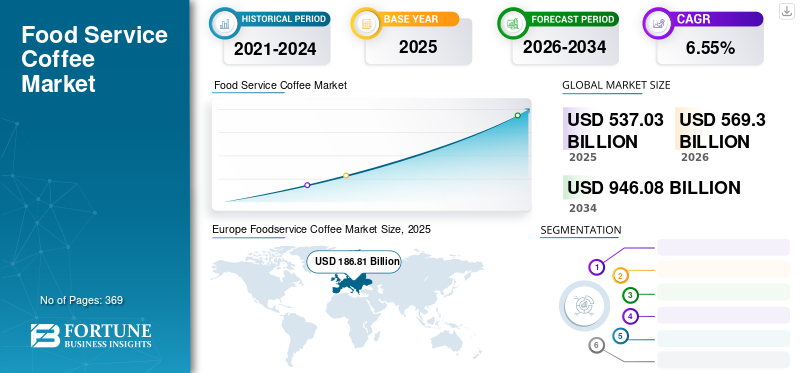
Download Free sample to learn more about this report.
Foodservice Coffee Market Key Takeaways
 Global Market Size & Forecast
- 2025 Market Size: USD 625.52 billion
- 2026 Market Size: USD 666.24 billion
- 2034 Forecast Market Size: USD 1,185.66 billion
- CAGR: 7.47% from 2026–2034
 Market Share
- Europe dominated the market with a 34.36% share in 2025.
- The take away/delivery segment captured the dominant global foodservice coffee market share, reached USD 338.83 billion in 2025.
- The coffee houses and beverage shops segment dominated the market, accounted for USD 293.63 billion in 2025.
 Key Regional Highlights
North America
The market reached USD 174.70 billion in 2025 and is projected to reach USD 318.97 billion by 2034.
Asia Pacific
The market reached USD 124.88 billion in 2025 and is projected to reach USD 270.73 billion by 2034.
Europe
The market reached USD 214.90 billion in 2025 and is projected to reach USD 374.76 billion by 2034.
U.S.
The market reached USD 133.25 billion in 2025, driven by strong café culture and digital ordering.
Japan
The market is expected to grow steadily, supported by rising café culture and premium coffee consumption.
Read More

Foodservice Coffee Market Trends
Premiumization and Specialty Coffee Offerings to Fuel Market Expansion
The market is witnessing a notable shift toward premium and specialty coffee offerings, including single-origin beans, cold brew, nitro coffee, and functional beverages infused with health-oriented ingredients. Consumers are increasingly seeking high-quality, ethically sourced coffee with unique flavor profiles, leading to a surge in artisanal and specialty café formats globally.
Simultaneously, digital transformation is playing a critical role in redefining consumption patterns. Mobile ordering, loyalty programs, and app-based customization are enhancing customer experience and operational efficiency. The rise of takeaway and delivery-focused formats, including cloud cafés further accelerating foodservice coffee market growth.
- For instance, in October 2025, Wawa introduced coffee innovation that offers consumers more customization options for handcrafted beverages. Customers can select milk type (whole, 2%, almond, oat, or cream) and adjust the amount of milk in their drink. Moreover, toppings such as drizzle, graham crackers, chocolate chips, and Crème Brulée‑style sprinkles can be added and customized per order. This kind of coffee customization innovation helps consumers mainly by giving them more control, a better fit to personal preferences, and greater perceived value.
Download Free sample to learn more about this report.
MARKET DYNAMICS
Market Drivers
Increasing Number of Coffee Shops to Drive Market Growth
There has been a significant increase in coffee shops globally in recent years. The rise in coffee stores can be attributed to the rising demand for different coffee types and increasing competition among coffee operators to expand their presence globally. The growing number of shopping malls and suburban retail stores supports the expansion of coffee outlets in developing countries, thereby fueling the away-from-home consumption of coffee.
- For instance, in February 2023, Third Wave Coffee (TWC) announced the opening of its 91st store in Oberoi Mall in Mumbai, India. The profitability of coffee shops and cafes is mainly driven by consumer taste, income level, and shop location. Moreover, coffee shops are becoming more popular and eminent among urban inhabitants, encouraging vendors to develop their operations to serve industrialized countries' populations.
Market Restraints
Fluctuations in Coffee Prices to Restrain Market Growth
In recent years, the rising population across the globe, high food prices, and increasing unemployment have contributed to the rising concern over food security and price volatility related to food ingredients, including coffee beans. Several other factors, such as transportation costs, storage costs, human resources costs, political environments, and various other features, have also led to a rise in the price of final products.
Coffee prices constantly change, and coffee is often procured by professionals and vendors interested seeking to benefit from purchasing and selling shares in the commodity market. Such speculations are expected to drastically affect demand and supply dynamics.
- According to the International Coffee Organization (ICO), recent coffee price trends show that the market has remained elevated and volatile. In April 2024, the ICO Composite Indicator Price (I-CIP) averaged 216.89 US cents/lb, up 16.4% from March 2024. During the same month, Colombian Milds prices increased by 15.0% to 241.80 US cents/lb, while Robusta prices rose 16.8% to 193.65 US cents/lb, marking the highest Robusta price level in about 45 years.
Market Opportunities
Expansion of Coffee Consumption Through Non-Traditional Foodservice Channels
The growing penetration of coffee offerings across non-traditional foodservice channels such as convenience stores, petrol stations, quick-service restaurants (QSRs), and workplace cafeterias presents a significant global foodservice coffee market growth opportunity. These channels are increasingly incorporating high-quality coffee solutions, including self-serve machines and premium ready-to-consume formats to capture on-the-go consumption demand.
Convenience-driven formats are gaining traction, particularly among urban consumers seeking quick and affordable coffee options without visiting traditional cafés. This trend is supported by extended operating hours, strategic store locations, and integration of coffee into daily routines such as commuting and workplace consumption.
SEGMENTATION ANALYSIS
By Type
Take Away/Delivery Dominated the Market Due to a Strong Rise in App-Based Ordering
Based on type, the global market is segmented into take away/delivery and dine-in coffee.
The take away/delivery segment captured the dominant global foodservice coffee market share, reaching USD 338.83 billion in 2025, as consumers increasingly prefer convenient and time-saving coffee consumption formats that fit fast-paced urban lifestyles. The strong rise in app-based ordering, third-party delivery services, grab-and-go formats, and drive-thru models has significantly supported this segment’s expansion across both developed and emerging markets.
Dine-in coffee remains important for café experience, social interaction, and premium beverage consumption, but the market has increasingly shifted toward convenience-oriented formats. As a result, the segment is expected to register the fastest CAGR of 7.81% during the forecast period.
To know how our report can help streamline your business, Speak to Analyst
By End-User
Coffee Houses and Beverage Shops Dominated the Market Due to Rising Consumer Preference for Premium Coffee Handcrafted Beverages
Based on end user, the market is segmented into coffee houses and beverage shops, bakery shops & restaurants, and others.
The coffee houses and beverage shops segment dominated the market, accounting for USD 293.63 billion in 2025, driven by the strong international presence of branded café chains, the expansion of specialty coffee outlets, and rising consumer preference for premium handcrafted beverages. These establishments serve as the primary destination for coffee consumption in many countries, offering extensive menu variety, product customization, and a café environment that supports both social and functional consumption occasions. Their dominance is also reinforced by high transaction frequency, strong brand loyalty, and continuous innovation in hot, iced, and functional coffee beverages.
The bakery shops & restaurants segment is projected to grow at a CAGR of 8.14% from 2026 to 2034.
Foodservice Coffee Market Regional Outlook
Regionally, the market is studied across North America, Europe, Asia Pacific, South America, and the Middle East & Africa.
North America
Europe Foodservice Coffee Market Size, 2025 (USD Billion)
To get more information on the regional analysis of this market, Download Free sample
North America was valued at USD 174.70 billion in 2025 and is projected to reach USD 318.97 billion by 2034, growing at a CAGR of 7.02%. Growth is driven by high per capita coffee consumption, strong presence of global chains, and increasing demand for premium and specialty beverages.
U.S. Foodservice Coffee Market
The U.S. dominates the North American market, valued at approximately USD 133.25 billion in 2025, supported by a well-established café culture, high consumer spending, and strong digital integration in foodservice. The market benefits from widespread adoption of mobile ordering, drive-thru formats, and continuous product innovation.
Europe
Europe dominated the global market, which was valued at USD 214.90 billion in 2025 and is projected to reach USD 374.76 billion by 2034, registering a CAGR of 6.48%. Growth is supported by strong coffee traditions, increasing café density, and rising demand for premium and sustainable coffee products.
Germany Foodservice Coffee Market
Germany’s market was valued at approximately USD 55.16 billion in 2025, driven by high consumption levels, strong café culture, and growing demand for specialty coffee offerings.
U.K. Foodservice Coffee Market
The U.K. market was valued at approximately USD 22.14 billion in 2025, driven by the rapid expansion of coffee chains, increasing takeaway culture, and strong consumer preference for convenience-led formats.
Asia Pacific
Asia Pacific was valued at USD 124.88 billion in 2025 and is projected to reach USD 270.73 billion by 2034, growing at a CAGR of 9.07%, the fastest among all regions. Growth is driven by rapid urbanization, rising disposable incomes, and increasing Western influence on consumption habits.
China Foodservice Coffee Market
China dominated the regional market, with a valuation of approximately USD 31.70 billion in 2025, supported by the aggressive expansion of coffee chains, increasing youth consumption, and the rapid adoption of digital ordering platforms.
India Foodservice Coffee Market
India was valued at USD 18.89 billion in 2025, driven by rapid urbanization, changing consumer lifestyles, and the increasing influence of café culture across metropolitan and tier-1 and tier-2 cities.
South America and the Middle East & Africa
South America was valued at USD 92.04 billion in 2025 and is projected to reach USD 181.52 billion by 2034, growing at a CAGR of 7.94%. Growth is supported by strong coffee production and increasing domestic consumption.
The Middle East and Africa market was valued at USD 18.99 billion in 2025 and is projected to reach USD 39.68 billion by 2034, expanding at a CAGR of 8.63%. Growth is driven by urbanization, tourism, and the increasing penetration of international coffee chains.
Brazil Foodservice Coffee Market
Brazil dominated the South American market, with the valuation of approximately USD 37.11 billion in 2025, supported by its position as the largest coffee producer and increasing café culture domestically.
COMPETITIVE LANDSCAPE
Key Industry Players
Key Players Focus on Premiumization to Reinforce Their Market Position
The global foodservice coffee market is highly competitive, with leading players focusing on expanding store networks, enhancing digital capabilities, and introducing innovative beverage offerings. Companies are investing in premiumization, sustainability initiatives, and localized menu strategies to strengthen their market position.
Key Players in the Foodservice Coffee Market
|
Rank |
Company Name |
|
1 |
Starbucks Corporation |
|
2 |
Costa Coffee |
|
3 |
Nestlé S.A. |
|
4 |
Restaurant Brands International Inc. |
|
5 |
JAB Holding Company |
List of Key Foodservice Coffee Companies Profiled
- Coffee Beanery (U.S.)
- Coffee Republic (U.K.)
- Dunkin’ (Inspire Brands) (U.S.)
- illycaffè S.p.A. (Italy)
- JAB Holding Company (Caribou) (Luxembourg)
- Luigi Lavazza S.p.A. (Italy)
- Massimo Zanetti Beverage Group (Segafredo Zanetti) (Italy)
- McDonald’s Corporation (U.S.)
- Nestlé S.A. (Switzerland)
- Pacific Foods (U.S.)
- Restaurant Brands International Inc. (Canada)
- Royal Cup Coffee, Inc. (U.S.)
- Seven & I Holdings (7-Eleven) (Japan)
- SSP Group (U.K.)
- Starbucks Corporation (U.S.)
- Strauss Group Ltd. (Israel)
- Tchibo GmbH (Germany)
- The Coca-Cola Company (Costa Limited) (U.S.)
- The J.M. Smucker Company (U.S.)
- Wawa (U.S.)
KEY INDUSTRY DEVELOPMENTS
- February 2026: McDonald’s rolled out a new McCafé‑branded beverage line across its U.S. restaurants this year, following a multi‑store test whose sales and customer response “exceeded expectations.” The expanded menu focuses on high-growth categories within the non-alcoholic beverage sector, aiming to modernize the chain’s drink portfolio.
- February 2026: SSP Group, one of the leading travel foodservice operators, renewed and expanded its food and beverage contracts at three key Egyptian airports: Sharm El-Sheikh International, Aswan International, and Abu Simbel Airport. The portfolio mixes offerings from global chains such as KFC, Burger King, and Costa Coffee with local favorites and SSP's proprietary brands such as Ritazza and Panopolis, targeting business travelers, families, and tourists.
- September 2025: Nestlé Professional launched NESCAFÉ BARISTA, a whole‑bean coffee range specifically designed for the foodservice and B2B sector, targeting independent cafés and quick‑service restaurants (QSRs).
- October 2024: JAB Holding Co. bought Mondelez International’s entire stake in JDE Peet’s for about USD 2.34 billion, gaining nearly full control of the coffee and tea company. This deal strengthens JAB’s position in the global market by giving it tighter control over JDE Peet’s’ portfolio of B2B coffee brands, channels, and footprint, especially in Europe and quick‑service/ on‑the‑go outlets.
- January 2023: Tchibo, one of Europe's leading coffeehouse brands from Germany, announced its U.S. market expansion, moving from the Midwest to the Southeast. Tchibo entered the U.S. in 2020 via distributor Rainmaker Food Solutions, starting with eight Midwestern states: Illinois, Indiana, Iowa, Michigan, Minnesota, Missouri, Ohio, and Wisconsin. It reached nearly 2,700 retail points such as Meijer, Jewel-Osco, and Spartan Nash stores.
REPORT COVERAGE
The global foodservice coffee market industry report analyzes the market in depth and highlights crucial aspects such as global market trends, market dynamics, supply chains, prominent companies, investment in research and development, and end-use. Besides this, the report also provides insights into the global market analysis and highlights significant industry developments.
Request for Customization to gain extensive market insights.
Report Scope & Segmentation
| ATTRIBUTE | DETAILS |
| Study Period | 2021-2034 |
| Base Year | 2025 |
| Estimated Year | 2026 |
| Forecast Period | 2026-2034 |
| Historical Period | 2021-2024 |
| Growth Rate | CAGR of 7.47% from 2026 to 2034 |
| Unit | Value (USD Billion) |
|
Segmentation |
By Type
|
|
By End-User
|
|
|
By Region
|
Frequently Asked Questions
Fortune Business Insights says that the global market was valued at USD 625.52 billion in 2025 and is anticipated to reach USD 1,185.66 billion by 2034.
At a CAGR of 7.47%, the global market will exhibit steady growth over the forecast period.
By type, the take away/delivery segment led the market.
Europe held the largest market share in 2025.
Increasing number of coffee shops is a key factor driving market growth.
Starbucks Corporation, Costa Coffee, Nestlé S.A., Restaurant Brands International Inc., and JAB Holding Company are the leading players in the market.
Premiumization and specialty coffee offerings is a key market trend.



- 2021-2034
- 2025
- 2021-2024
- 200
-
(Offer valid till 15th Aug 2026)
Get 30-60 hrs Free Customization
Expand Regional and Country Coverage, Segments Analysis, Company Profiles, Competitive Benchmarking, and End-user Insights.




















Related Reports
-
US +1 833 909 2966 ( Toll Free )
-
Get In Touch With Us